Can You Negotiate Rent? Expert Strategies to Save Money In

A rent increase notice hits differently in California. You open the email, scan the new number, and immediately start doing mental math on groceries, gas, car insurance, utilities, and everything else that already feels expensive.
That's usually the moment people ask, can you negotiate rent, or is the price fixed?
In practice, rent negotiation is often less about arguing and more about presenting a business case. If you handle it early, show local market support, and make a clear ask, many landlords will at least consider it. Even when they won't lower the base rent, they may adjust terms in ways that still help your budget.
That matters because every dollar you keep in a California budget has a job. Savings from housing costs can help cover essentials that shouldn't be left to chance, especially renters insurance, auto insurance, car insurance, and for some households, life insurance.
Yes You Can Negotiate Rent in California
If your lease renewal is coming up and the new rate feels too high, negotiation is a reasonable next step. A landlord isn't doing you a favor by hearing you out. They're making a business decision about occupancy, turnover, and risk.
A lot of renters assume asking will annoy the property manager or make them look difficult. That fear keeps people silent. But the better frame is this: you're discussing terms in one of your largest monthly expenses.
What makes negotiation realistic
The strongest approach isn't emotional. It's specific and time-sensitive. According to major-market rent negotiation guidance, rent is negotiable in many major markets, and the highest-probability method is to gather comparable listings from the same neighborhood with similar square footage and amenities, then make one specific counteroffer. That same guidance recommends negotiating 60 to 90 days before lease expiration, and notes that listings active for 30+ days can be a useful negotiating point because they may signal softer demand.
That timing matters in California. If you wait until the last minute, the landlord has less room to plan. If you start while there's still time to avoid vacancy, your proposal is more practical.
Practical rule: Ask early enough that the landlord can choose retention over turnover.
Why this matters beyond rent
Housing costs don't live in isolation. When rent rises, something else usually gets squeezed. For some renters, that's savings. For others, it's protection.
I've seen budgets where the first thing people cut is the policy they hope they never need. That can mean dropping a better California renters insurance policy, carrying thinner auto insurance limits, or putting off life insurance altogether. Negotiating rent can create breathing room so those protections stay intact.
A successful negotiation doesn't have to be dramatic to be useful. If you lower the monthly burden or improve the lease terms, you free up cash flow. In California, that extra room often goes straight toward the basics people need: reliable transportation coverage, protection for personal property, and a stronger financial cushion.
Build Your Case with Market Research
Most rent negotiations fail before the conversation starts. The renter asks vaguely, doesn't bring evidence, and hopes the landlord will volunteer a better deal. That approach usually goes nowhere.
Research changes the tone. It turns the discussion from “I want lower rent” into “Here's why this request makes sense.”
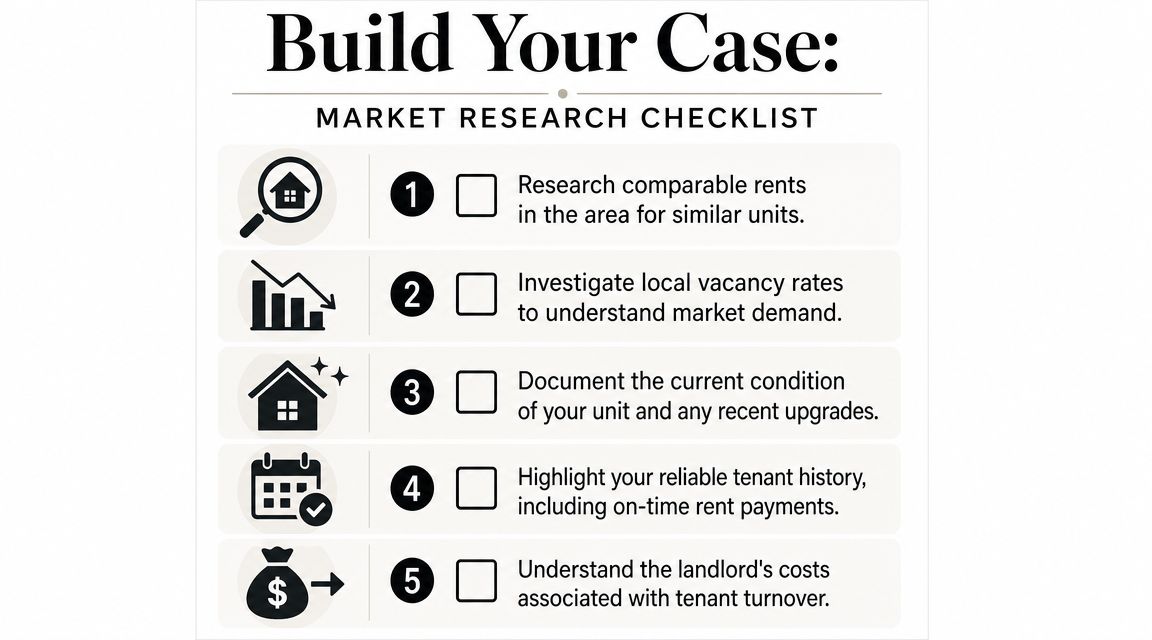
Start with comparable listings
Your best evidence is a small set of comparable rentals. Use listing platforms people recognize, such as Apartments.com, Zillow, Rent.com, and local brokerage listings. Focus on units in the same neighborhood with similar square footage, layout, parking situation, age, and amenities.
An Apartments.com lease negotiation survey found that 47% of renters said they do not negotiate their lease at all, while among those who do negotiate, 32% reported success versus 21% who were unsuccessful. The same survey notes that renters strengthen their position by bringing market evidence such as comparable listings, rental-price histories, and local availability, rather than making a vague request.
Don't gather random screenshots. Build a simple file with:
- Matching unit types so you aren't comparing your older one-bedroom to a luxury high-rise studio.
- Listing dates because stale listings can support your case differently than brand-new ones.
- Amenities notes such as parking, laundry, air conditioning, pet policy, and any utilities included.
- A short summary that states what you found and what rent level seems reasonable.
Document your value as a tenant
Landlords don't just compare rents. They compare risk.
If you've paid on time, renewed reliably, kept the place in good condition, and communicated well, that has value. A low-maintenance tenant saves time and reduces uncertainty. Gather your proof before you ask.
A practical tenant packet can include:
- Payment history showing consistent on-time rent.
- Lease history that reflects stability.
- Credit strength if you're comfortable sharing updated information.
- Proof of care such as photos showing the unit is clean and well-maintained.
- Insurance readiness if you carry renters insurance.
That last point is underrated. An active renters policy signals responsibility. It also shows you take your own property risk seriously. For a landlord, that tends to support the broader picture of a tenant who plans ahead.
Bring facts, not frustration. Landlords respond better to evidence than to pressure.
Know what the landlord is weighing
A landlord isn't only deciding whether to accept less rent. They're weighing vacancy, marketing time, cleaning, repairs, re-listing, and uncertainty about the next tenant. Your goal is to show that keeping you is the lower-friction option.
If you want more help organizing that prep work, these California insurance and budgeting guides can help you think through the household side of the equation, especially if a rent change affects your coverage decisions.
A good negotiation file is short, clean, and easy to scan. One page of strong evidence beats a long emotional email every time.
How to Ask Your Landlord to Lower Rent
The ask itself needs discipline. Most renters weaken their position by sounding unsure, apologetic, or too open-ended. “Is there any way you can do something?” puts all the work on the landlord. A better move is to make a reasonable proposal and support it.
Use the right timing and one clear number
Timing and clarity work together. A practical rent-negotiation guide notes that many successful negotiations yield about 5% to 10% reductions in rent or equivalent perks, especially when the tenant uses market comparables and timing to strengthen the request. The same guidance recommends starting the conversation four weeks before lease expiration or roughly 60 days before renewal in major markets, as explained in this rent negotiation timing guide.
That doesn't mean you should demand a percentage. It means you should decide on one concrete offer before you write or call.
Instead of this:
- “Can you lower it a bit?”
- “Is there any flexibility?”
- “I was hoping for something cheaper.”
Use this approach:
- “I'd like to renew at $X based on comparable nearby listings and my payment history.”
A simple email works best
Keep the tone professional and calm. You're not challenging the landlord's authority. You're presenting a retention case.
| Section | Content to Include |
|---|---|
| Opening | State that you'd like to renew and appreciate living in the unit |
| Market support | Mention comparable listings with similar size, location, and amenities |
| Tenant value | Note your on-time payment record and reliability |
| Specific request | Ask for one exact rent figure or one exact concession |
| Close | Invite a conversation and express willingness to finalize promptly |
Sample renewal email
Subject lines matter less than clarity. “Lease renewal request” is fine.
Hello [Landlord or Manager Name],
I'd like to renew my lease and stay in the unit. I've enjoyed living here and have consistently paid rent on time.
Before I sign the renewal, I wanted to ask whether you'd consider a monthly rent of [your number]. I'm making that request based on comparable listings in the area with similar size and amenities, along with my history as a reliable tenant.
If adjusting the base rent isn't possible, I'd also be open to discussing lease terms or other concessions that could help make the renewal work.
Thank you for considering it. I'm happy to discuss this by phone or in person.
When to talk instead of email
Email is good for documentation. A live conversation is better for flexibility.
Use a call or in-person meeting if:
- You already have a solid relationship with the manager.
- The market is mixed and you want to test where they have room.
- You expect a counteroffer on terms instead of price.
- You want faster feedback before signing.
If you speak first, follow up in writing and summarize the agreement. That protects both sides.
Adjust your strategy by situation
A renewal negotiation is different from a new lease. An existing tenant can lean on reliability. A new applicant has less history and may need to lead with readiness, clean documentation, and responsiveness.
In a softer market, your bargaining power comes from nearby alternatives and slower leasing activity. In a tighter market, your bargaining power is mostly your stability and ease of renewal.
For more practical consumer guidance on California insurance and everyday household decisions, the articles in this California coverage blog are a useful companion resource.
The biggest mistake is leaving the discussion fuzzy. Ask for one thing. Then stop talking and let the landlord respond.
Negotiate Perks When Rent Wont Budge
A landlord may say no to lowering the sticker price and still be open to improving the deal. That's where experienced renters pivot instead of walking away too soon.
In California, this matters a lot. The listed rent might be firm because of internal pricing rules, ownership preferences, or property management policies. But the full lease package often has more room than the headline number suggests.
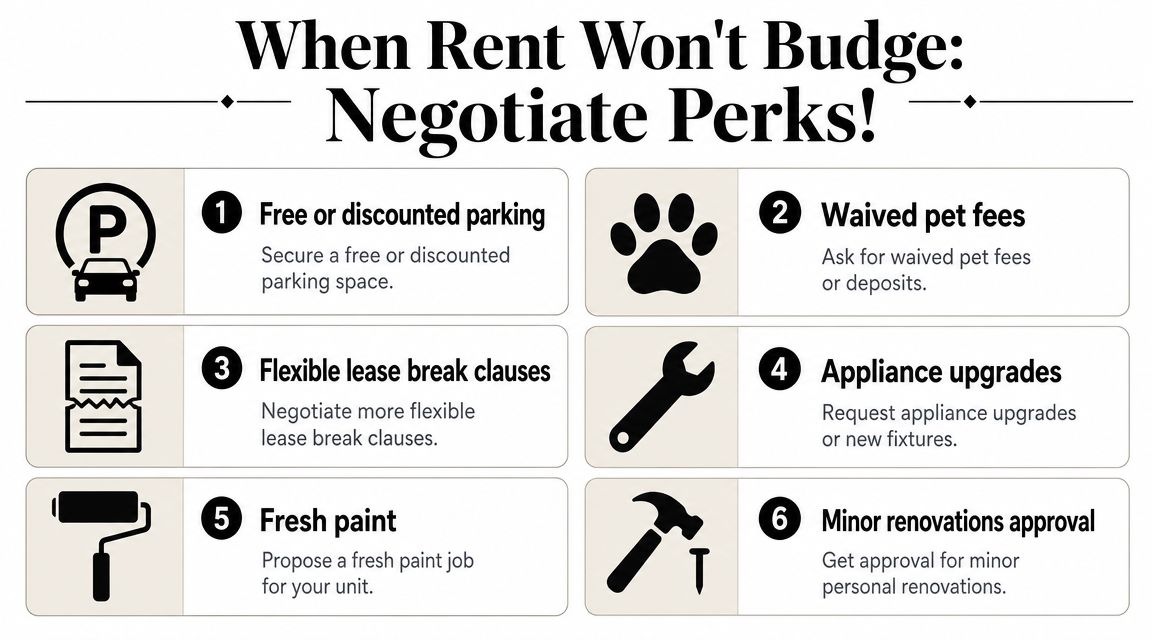
What to ask for instead
A tenant-focused lease guide explains that the best tactic may be to negotiate perks instead of headline rent, such as free parking, a reduced deposit, a shorter lease, or minor repairs, especially in California metro areas where affordability pressure is high but landlords still want to avoid turnover. That guidance is outlined in this smart tenant lease negotiation resource.
Good fallback requests include:
- Parking relief if the property charges separately for a space.
- Reduced deposit pressure if upfront move-in cash is the bigger strain.
- Minor repairs that improve livability and save you out-of-pocket costs later.
- Flexible lease length if your work or school timeline doesn't fit a rigid term.
- Pet fee adjustments when a landlord is open to keeping a solid tenant.
How to choose the right concession
Not every perk is equally valuable. Ask for the one that changes your budget or day-to-day life the most.
If your car is essential, a parking concession can matter as much as a rent cut because transportation costs in California are hard to ignore. If cash flow is tight at move-in, deposit flexibility may help more than a small monthly discount. If the apartment needs work, repairs or upgrades can keep you from paying for convenience elsewhere.
If the landlord won't change the rent line, look at the rest of the lease. That's often where the flexibility is hiding.
Keep the conversation framed as a win-win
The best perk requests are easy to understand and cheap for the landlord relative to turnover. A fresh coat of paint, appliance replacement, or approved minor repair may cost less than vacancy, cleaning, and re-listing.
Try language like this:
- For parking: “If the rent needs to stay as quoted, would you consider including the parking space?”
- For deposit relief: “If the monthly rate is fixed, could we discuss a reduced deposit?”
- For repairs: “If pricing is firm, could we include these maintenance items before renewal?”
This is still negotiation. You're still improving the economics of the lease. And if the result lowers your monthly strain or upfront costs, that savings can support the rest of your California budget, including car insurance, renters insurance, or other core protections that are easier to keep when housing costs are under control.
Know Your Rights Under California Rent Control
Negotiation works better when you know the legal boundaries around the lease. In California, that means looking at state law, local ordinances, and the property itself.
State rules can affect how much a landlord may raise rent in covered units, and local rent control rules can be stricter. But even when an increase is legally allowed, that doesn't stop you from asking for a smaller increase or no increase at all.
What to verify before you negotiate
Start with the basics:
- Whether your unit is covered by state or local rent rules.
- Whether the notice was proper under the lease and applicable law.
- Whether local rules are stricter than the statewide baseline.
- Whether your building has special governance issues such as condominium association restrictions.
That last point gets overlooked. If you're renting in a condo building, lease terms can intersect with community restrictions, approval rules, and owner obligations. This overview of HOA rules for condo rentals is useful context if your unit is part of an association-managed property.
What the law does and doesn't do
California rent control rules may limit what a landlord can do in certain properties. They don't eliminate negotiation. In fact, legal limits can sharpen your strategy because they define the range inside which the landlord is operating.
A practical approach is to separate two questions:
| Question | Why it matters |
|---|---|
| Is the increase legal? | This tells you the landlord's maximum room under the rules |
| Is the increase negotiable? | This tells you whether the final number can still be improved |
If your landlord is within the law, that doesn't mean the proposed increase is the only possible outcome. If your unit has stronger local protections, you may have more bargaining power than you think.
Use legal knowledge as support, not as a threat
Going in aggressive usually backfires. You don't need to lead with accusations or legal jargon. Instead, confirm what applies to your property, understand your rights, and then negotiate from an informed position.
For readers trying to sort out common California coverage questions while also reviewing household expenses, this California insurance FAQ page is a practical place to compare related decisions.
A calm, informed tenant is harder to dismiss. That's the advantage of knowing the rules before you start the conversation.
Secure Your Rent and Your Financial Future
A strong rent negotiation comes down to a few moves. Research the local market. Ask early. Make one specific proposal. If the landlord won't lower rent, shift to concessions that still improve the deal.
The bigger point is what you do with the savings.
In California, lower housing costs shouldn't just disappear into random spending. If you free up room in your monthly budget, use it to strengthen the parts of your financial life that carry real risk. That often means keeping or upgrading renters insurance, reviewing auto insurance or car insurance limits, and for families or anyone supporting others, considering whether life insurance deserves a place in the plan.
Put the savings to work
A modest rent win can help cover practical protections that are easy to postpone when cash is tight:
- Renters insurance protects your belongings and can help after covered losses.
- Auto insurance deserves attention in a state where repair and liability costs can get expensive fast.
- Home insurance matters if you're transitioning from renting to ownership or helping family think ahead.
- Life insurance can support long-term security, not just immediate bill-paying.
If you're trying to decide how much of your income should go toward housing before you even start negotiating, these personalized rent budgeting insights can help you pressure-test the number against the rest of your obligations.
Don't waste the win
The smartest renters I know treat rent negotiation like cash-flow planning. They don't just celebrate the lower number. They assign the savings immediately.
If renters coverage has been on the back burner, this is a good time to review California renters insurance options. Housing savings are most valuable when they improve stability, not just convenience.
Rent is one of the largest recurring bills most Californians pay. If you can negotiate it thoughtfully, you're not just reducing an expense. You're creating room to protect your car, your home setup, your belongings, and your family.
If you want help turning monthly savings into stronger protection, Mai & Associates can help you compare California renters, auto, home, and life insurance options so your budget works harder without leaving coverage gaps.