Can you change car insurance at any time? A Simple Guide to Switching
The short answer is a resounding yes. You can absolutely change your car insurance at any time. It doesn’t matter if you’re one month into a six-month policy or halfway through a year-long term; you are never locked in.
This flexibility is one of the biggest advantages you have as a driver, especially in a competitive market like California where rates for auto insurance are always in flux.
Why You Have the Power to Switch Your Policy
Think of your car insurance policy less like a rigid, iron-clad contract and more like a subscription service. You're paying for coverage, and just like with your Netflix or gym membership, you have every right to cancel and take your business elsewhere if you find a better deal, better service, or a policy that just fits your life better.
This consumer power is what keeps the California insurance market competitive. It forces companies to earn your loyalty, not just assume it.
So, the real question isn't if you can change your car insurance, but how to do it smartly. A well-planned switch can easily save you hundreds of dollars a year. On the other hand, a rushed or poorly handled change could leave you with surprise fees or, even worse, a dangerous gap in your coverage. Knowing the ropes is key to making a move that truly benefits your wallet.
More Californians Are Making the Switch
It’s not just you—rising insurance costs are pushing a lot of people to shop around. In fact, the number of long-time customers who started shopping for and switching their car insurance jumped by a whopping 35% in just one year.
That statistic tells a powerful story: millions of drivers are tired of watching their premiums climb and are taking action. They're using their right to switch, and you can, too. You can get more details on this trend from The General's industry analysis.
This guide will walk you through everything you need to know to make a clean break and start fresh with a new provider. We'll cover:
- The simple steps for finding a new policy and getting it started.
- How to make sure you get your refund and avoid sneaky fees.
- The critical importance of never, ever letting your coverage lapse.
- Special rules for California drivers who have a car loan, a lease, or an SR-22 filing.
Getting a handle on these points will give you the confidence to take control of your auto insurance. And if you're also juggling home insurance, renters insurance, or even life insurance, nailing down the best car policy is a fantastic first step toward getting your entire financial picture in order.
How the Insurance Switching Process Actually Works
Thinking about switching your car insurance can feel like a huge headache, but in reality, it's a lot less complicated than you'd imagine. The process is surprisingly straightforward and leaves you in the driver's seat.
It helps to think of it like changing your internet provider. You shop around for a better deal, line up the new service, and only pull the plug on the old one once your new Wi-Fi is up and running. This simple overlap prevents you from ever going a moment offline.
The same logic applies perfectly to car insurance. You can hunt for better rates without ever risking a dangerous gap in your coverage. The whole trick is just being methodical: get your quotes, pick your new policy, set its start date, and then officially cancel your old one. It's a simple sequence designed to make the transition totally seamless.
The insurance market is more competitive than ever. A recent LexisNexis US Auto Insurance Trends Report found that drivers are shopping around and switching carriers at record rates, proving you really can change car insurance at any time. The system is built for it. Most states require pro-rated refunds, and many companies don't even charge a fee for canceling early—as long as your new policy is ready to go.
The Three Core Steps to a Smooth Switch
When you boil it all down, the entire process comes down to just three main actions. If you nail these steps, you can move from your old insurer to a new one with total confidence.
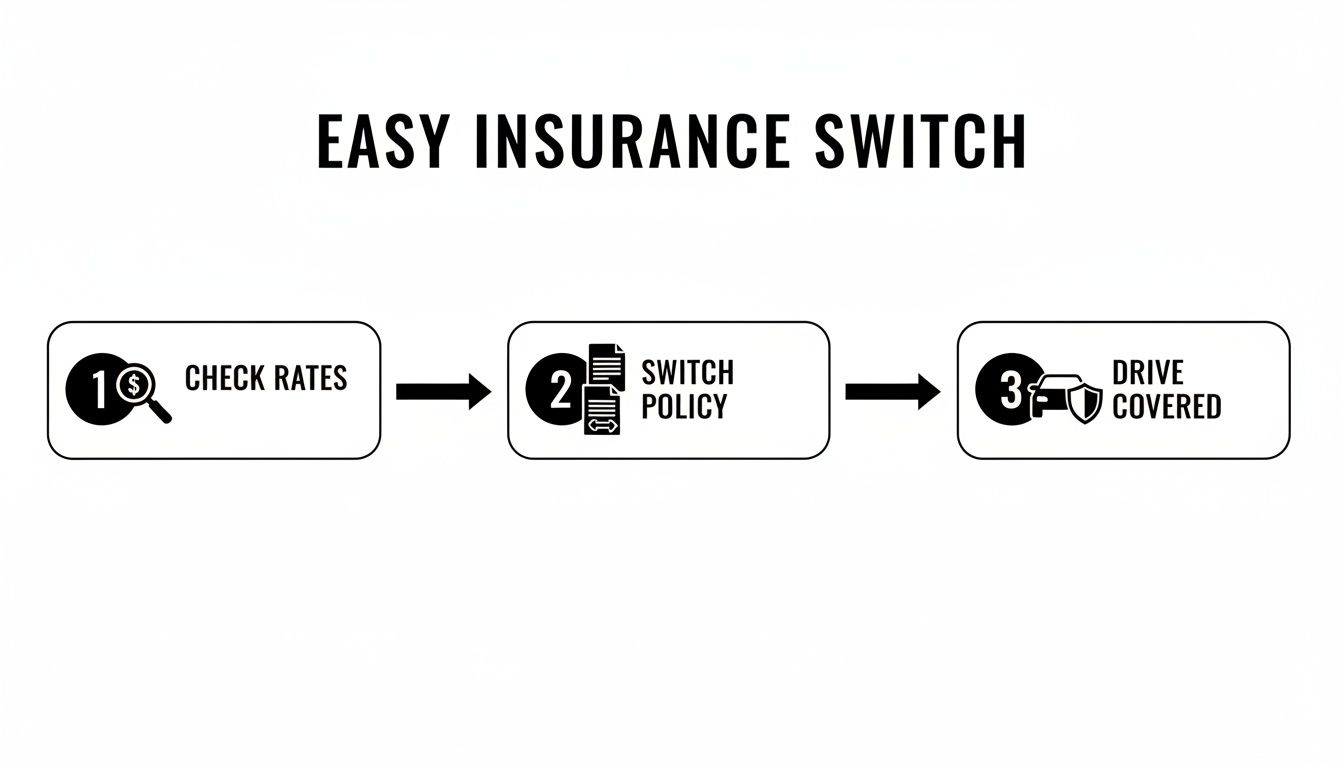
As the diagram shows, the journey starts with a little homework, leads to a clear decision, and ends with the peace of mind of knowing you're fully covered.
Here’s what that looks like in the real world:
Shop Around and Get Quotes: First things first, gather quotes from a handful of different insurance companies. Don’t just look at the price tag; compare the coverage limits, deductibles, and what other drivers are saying in customer reviews. This is your chance to find the absolute best value for your situation here in California.
Purchase Your New Policy: Found a winner? Great. Go ahead and buy the new policy and set its effective start date. This part is critical: make sure the new policy starts on or before the day you cancel your old one. You should get your new ID cards and policy documents almost immediately.
Cancel Your Old Policy: Once your new coverage is officially active, it’s time to call your old insurer to cancel. Whatever you do, don't just stop paying the bill. You need to formally request the cancellation—ideally in writing—to create a paper trail. This ensures the policy is truly terminated and that you get back any refund you're owed for the premium you paid but didn't use.
This same structured approach works just as well when you're juggling other policies, like your home insurance or renters insurance. For more on managing all your coverage, take a look at our other California insurance guides.
Understanding the Financial Side of Switching Insurers
Let's be honest: when you're thinking about switching car insurance, money is almost always the main reason. But making a smart move means looking beyond just the new, lower premium. You need to get the full picture of any costs and refunds involved to avoid any nasty surprises.
The biggest question on everyone's mind is, "Will I get my money back for the months I already paid for but won't use?" The answer is usually yes, but how much you get back depends on your insurer's cancellation policy.
Pro-Rated vs. Short-Rate Cancellations
Knowing how your refund will be calculated is crucial. Insurance companies typically handle mid-term cancellations in one of two ways.
Pro-Rated Refund: This is the good one—the most common and fair method, especially here in California. A pro-rated refund means you get back every penny of the unused premium. Pay for a six-month policy but find a better deal and cancel after four? You’ll get a full refund for those remaining two months. Simple as that.
Short-Rate Cancellation: This one is less common, but you need to be aware of it. With a short-rate cancellation, the insurance company will charge you a penalty for leaving early. They'll subtract a small administrative fee, usually around 10%, from your unused premium before sending it back to you.
The good news is that most major carriers in California stick to the pro-rated system. This makes it much easier to jump on a better deal without losing money in the process. To be absolutely sure, pull out your policy documents or just give your current agent a quick call and ask about their cancellation terms.
Budgeting for Your New Insurance Policy
Switching isn't just about getting money back; you also have to be ready to pay for the new policy. You can't just start a new policy without putting some money down first.
A seamless switch means being financially prepared for both the end of one policy and the beginning of another. Your goal is to secure a better rate without getting hit with unexpected costs that offset your savings.
Your new insurer will almost always require an initial payment to activate your coverage. This could be a down payment or just the first month's premium. It's a critical step—your new protection doesn't begin until they've received your payment.
Make sure you factor this cost into your budget. Planning for it ensures you can pay on time, avoid any gap in your coverage, and make the entire switch feel smooth and stress-free. The easiest way to see what your new costs and savings will look like is to get an instant insurance quote in California and compare your options side-by-side.
Avoiding the Critical Mistake of a Coverage Lapse
While it's true you can change your car insurance anytime, there's one massive pitfall you absolutely have to sidestep: the coverage lapse. A gap in your insurance, even for a single day, is a huge misstep with some pretty serious consequences, especially here in California.
Think of your insurance coverage like a bridge. As long as it's continuous, you can cross from one side to the other safely. But if there's a gap, no matter how small, you're left completely exposed to some immense financial and legal risks. Driving uninsured can get you hit with hefty fines, a suspended license, and maybe even having your car impounded.
And the pain doesn't stop there. A coverage lapse sends a major red flag to every insurance company out there. It essentially labels you as a high-risk driver. What does that mean for you? When you go to buy that new policy, expect your premiums to be dramatically higher, and that rate hike could follow you for years.
The Golden Rule of Switching Insurers
So, how do you avoid this costly mistake? The strategy is simple, and honestly, it’s non-negotiable.
The golden rule of switching is this: Never cancel your old policy until your new one is officially active and you have proof of coverage in hand.
This means the start date for your new policy has to be on or before the cancellation date of your old one. It's perfectly fine—and actually a smart move—to have them overlap by a day. This tiny overlap is your safety net, guaranteeing you're never without protection.
A Real-World Scenario
Let's play this out. Say you decide to cancel your current policy on a Friday, thinking you'll save a few bucks by starting your new one on Monday. But on Saturday, you get into a minor fender-bender. Because you had no active insurance at that moment, you are now personally on the hook for everything.
- You'd be facing fines for driving without insurance.
- The DMV could suspend your driver's license.
- You'd have to pay for thousands of dollars in repair costs out of your own pocket.
This whole nightmare is easily avoided just by making sure your new policy kicks in the very moment the old one ends.
The good news is that with insurance rate increases slowing down, making an advantageous mid-year switch is easier than ever. In 95% of cases, you won't face any penalties if you just align the dates for a seamless transition. This flexibility has even prompted 35% more long-term customers to switch insurers recently. You can dive deeper into these 2025 auto insurance trends to see what's happening in the market.
Navigating Special Circumstances for California Drivers
For most people, changing car insurance is pretty simple. But a few common situations can throw a wrench in the works if you're not careful. If you have a car loan, an SR-22 filing, or have your policies bundled together, you can still switch—you just need to be more deliberate about it.
Think of it like moving. If you’re just carrying a few boxes yourself, it’s a breeze. But if you have a grand piano (your car loan), a fragile art collection that needs special movers (an SR-22), or a shared storage unit with your neighbor (bundled policies), you need a much better plan. Let's break down these common scenarios for California drivers.
Switching with a Leased or Financed Vehicle
When you have a car loan or a lease, the car isn't technically 100% yours yet. Your lender or leasing company has a financial interest in it, and they need to protect their asset. That’s why your loan agreement requires you to carry both comprehensive and collision coverage.
Before you even think about switching, make sure the new policy you're eyeing meets these specific requirements. Once you’ve bought the new plan, your first call should be to your lender. You need to give them your new proof of insurance and make sure they are listed correctly as the lienholder or loss payee.
Don't skip this step! If your lender thinks for even a moment that their car is uninsured, they can buy their own policy to cover it. This is called "force-placed" insurance, and it's incredibly expensive—and they'll add the cost right onto your loan payment.
Managing an SR-22 Filing in California
If you're a driver who needs an SR-22, you have zero room for error when switching insurers. An SR-22 isn't insurance itself; it's a certificate your insurance company files with the California DMV to prove you have the legally required liability coverage.
Any gap in coverage—even for a single day—is a huge problem. Your old insurer is required by law to report the cancellation to the DMV immediately, which will trigger an automatic suspension of your driver's license. To avoid this, your new insurance company must file a new SR-22 before your old policy is canceled. You'll need to coordinate the timing with both companies to ensure a perfect handoff.
The Math of Unbundling Your Insurance Policies
Lots of Californians get a great deal by bundling their auto insurance with their home insurance, renters insurance, or even a life insurance policy. That multi-policy discount can be pretty significant. So, if you're planning to move just your car insurance, you've got to run the numbers first.
It's a simple cost-benefit analysis:
- Get a New Auto Quote: See exactly how much you stand to save on your car insurance by switching.
- Calculate Your Lost Discount: Call your current provider and ask them point-blank: "How much will my home/renters premium go up if I move my auto policy?"
- Compare the Numbers: Is the amount you're saving on car insurance greater than the amount your other policy will increase? If you still come out ahead, switching is a no-brainer.
Often, the savings on a new car policy are so good that they easily make up for losing the bundling discount. For more on finding the best coverage for your needs, check out our complete guide to auto insurance in California.
Special requirements like these demand a bit more planning, but they are manageable. The key is to communicate clearly with all parties—your old insurer, your new one, and your lender—to ensure there are no surprises.
Here's a quick look at how to handle these situations:
How to Switch Insurance with Special Requirements
| Situation | Action Required | Potential Consequence of Error |
|---|---|---|
| Financed or Leased Car | Ensure the new policy meets lender coverage minimums. Immediately notify the lender and list them as the lienholder. | The lender could add expensive "force-placed" insurance to your loan. |
| SR-22 Filing | Have your new insurer file an SR-22 with the DMV before the old policy cancels. Coordinate timing perfectly. | An immediate license suspension from the DMV due to a reported coverage lapse. |
| Bundled Policies | Calculate your savings on the new auto policy versus the lost multi-policy discount on your remaining policies. | You could end up paying more overall if the lost discount is larger than your auto savings. |
In short, a little bit of homework goes a long way. By understanding these specific rules, you can switch providers confidently and avoid any costly mistakes or headaches down the road.
When Is the Best Time to Change Your Car Insurance?
While you can technically change your car insurance at any time, the real question is, when should you? Think of certain moments in your life as natural checkpoints for your policy. These events often change how insurance companies see you from a risk perspective, which directly impacts the price you pay.
Your current rate is just a snapshot of your life from the last time you got a quote. If that picture has changed, there's a good chance your premium should, too.
Life Events That Should Trigger a Rate Review
Many of life’s biggest milestones are a clear signal that it's time to shop for new quotes. When these things happen, your old rate is almost certainly obsolete, and you could be leaving a lot of money on the table by not checking. Don't just wait for your renewal notice to land in your inbox—get ahead of it.
Here are some key moments when you should definitely re-shop your California auto insurance:
- Moving to a new ZIP code: Where you live is a massive factor in how rates are calculated. Moving, even just across town, can cause your premium to swing up or down dramatically.
- Buying a different car: A new ride with modern safety features or a lower theft risk is often cheaper to insure.
- Getting married: Insurance companies see married drivers as more stable and less risky, which usually translates into a welcome discount.
- Improving your credit score: A healthier credit history can unlock much better insurance rates, as many carriers use it as a factor in their pricing.
A common mistake is assuming your current insurer will automatically give you the best new rate after a life change. The only way to make sure you're getting the best deal is to actively compare fresh quotes from several different companies.
Market Changes You Can’t Afford to Ignore
It’s not just about what’s happening in your life; shifts in the insurance market itself can be a powerful reason to look for a new policy. The most obvious sign? Getting that renewal notice and seeing a big, unexplained price jump. That's your cue to see what else is out there.
Viewing it this way turns switching carriers from a hassle into a smart financial strategy. By timing your insurance shopping with these key moments, you can ensure your policy for car insurance, home insurance, or renters insurance is always aligned with your current situation and priced as competitively as possible.
Common Questions About Switching Car Insurance
To wrap things up, let's tackle a few of the questions that come up all the time when California drivers decide to make a change. Getting straight answers can make the whole process feel a lot less intimidating.
Will Switching Car Insurance Hurt My Credit Score?
Nope, changing your car insurance company won't directly hurt your credit score. When you're shopping around for quotes, insurers run a "soft inquiry" on your credit. Think of it as a quick peek that isn't visible to lenders and has zero effect on your credit rating.
The real danger comes from unpaid bills. If you cancel your old policy but forget to pay a final premium or a cancellation fee, that debt could get sent to collections. That would absolutely ding your credit.
Can My Old Insurer Refuse to Cancel My Policy?
In California, you have the absolute right to cancel your auto insurance policy whenever you want. Your insurance company can't just say no.
They can, however, require you to follow their specific steps for cancellation. This might mean signing a form or sending a formal letter. As long as you give them proper notice, they have to process the cancellation and send you any refund you’re owed. For more on this, our California insurance FAQ page has you covered.
The bottom line is that you're in the driver's seat. An insurer must honor your request to cancel, as long as you follow their reasonable, established procedures.
At Mai & Associates, we make it easy to compare quotes for auto, home, renters, and life insurance from top California carriers. Get the coverage you need at a price you can afford. Find your perfect policy today by visiting https://cahomeauto.com.