Can A Landlord Require Renters Insurance in 2026?
Yes, landlords in California can legally require renters insurance, and no federal or state law requires it for tenants. It’s also common: about 50% of U.S. landlords include renters insurance requirements in their leases, even though nearly 50% don’t verify coverage at all.
If you’re staring at a lease for a new California apartment and you’ve hit a clause about renters insurance, don’t treat it like a red flag. Treat it like a standard risk-management rule. A good renters policy protects your belongings, gives you liability protection, and helps keep a routine lease issue from turning into a move-in delay.
For landlords, this requirement makes sense when it’s handled correctly. For tenants, it’s usually cheaper and more useful than people think. The main question isn’t whether a landlord can require renters insurance. In California, the answer is yes. The pertinent issue is how to set it up properly, what the lease can say, and what both sides should watch for in wildfire and earthquake country.
Your Lease Requires Renters Insurance What Now
You found the unit. The rent works. The neighborhood works. Then the lease says you need renters insurance before move-in.
That’s normal in California. It’s not a punishment, and it’s not a scammy add-on by default. It’s a practical lease condition that protects both sides when someone’s property is damaged, someone gets hurt, or a claim starts bouncing between the tenant and the landlord.
What you should do first
Don’t overcomplicate it. Read the clause and check for these items:
- Coverage requirement: Does the lease require liability coverage only, or a full renters policy?
- Proof of insurance: Does the landlord want a declarations page or certificate before move-in?
- Interested party request: Does the lease ask to list the landlord or management company as an additional interested party for notices?
- Timing: Is proof due before keys are released, at renewal, or both?
If you’re a landlord updating paperwork, the lease language has to be clear and signed. Sloppy wording creates avoidable arguments. If you need a clean starting point for documents, Securely create and sign leases with Papersign and make sure the insurance clause is part of the lease package, not buried in an email thread.
Practical rule: If the insurance requirement matters, put it in the lease itself, not in a side note after the tenant has already committed.
Why this clause is usually a smart move
Tenants often assume the building’s insurance covers everything inside the unit. It doesn’t. Landlord coverage and renters coverage serve different jobs.
A renters policy is usually the cheapest way to solve a big problem before it starts. If your laptop is stolen, if a kitchen fire damages your things, or if a guest claims you caused an injury, you want your own policy in place. You don’t want to learn the coverage gap after the loss.
The Legal Standing of Renters Insurance in California
California landlords can require renters insurance, but the authority doesn’t come from a law that says all tenants must carry it. It comes from the lease contract. That distinction matters.
No federal law requires renters insurance. No state law requires it either. But landlords in most states can lawfully make it a lease condition, and that includes California. That’s the legal foundation. Contract first, statute second.

What the numbers say
This isn’t a fringe practice. According to Apartments.com’s overview of renters insurance lease requirements, approximately 50% of U.S. landlords include renters insurance requirements in their leases. The same source says nearly 50% of landlords do not verify tenants’ renters insurance coverage at all, and smaller landlords managing 1 to 4 units are 60% more likely to enforce these requirements compared to larger operators.
That last point tracks with what happens in real life. Smaller landlords often know every unit, every tenant, and every renewal date. Large operators often want the rule but struggle with follow-through unless they build a system around it.
Why landlords push for it
Landlords require renters insurance because ownership insurance doesn’t solve tenant-side risk. A building policy protects the structure and the owner’s property interests. It doesn’t turn the landlord into the insurer for a tenant’s furniture, clothing, electronics, or personal liability.
In California, that matters even more because claims can get messy fast. Fire losses, water losses, and guest injuries can trigger finger-pointing. A renters policy creates another layer of protection and a cleaner claims path.
Landlords don’t require renters insurance because they think tenants are reckless. They require it because one accident can involve property damage, personal property loss, and liability questions at the same time.
Where landlords need to be careful
Just because a landlord can require renters insurance doesn’t mean every approach is enforceable. The lease has to say it plainly. The requirement also has to be handled consistently.
A weak lease clause invites conflict. So does selective enforcement. If one tenant is forced to comply and another isn’t, the landlord creates unnecessary legal risk and operational confusion.
Here’s the clean framework:
| Issue | Practical California answer |
|---|---|
| Is renters insurance required by law? | No |
| Can a landlord require it? | Yes, through the lease |
| Does the lease need to say it clearly? | Yes |
| Should the landlord verify compliance? | Yes, if they want the rule to mean anything |
The legal answer is simple. The operational answer is where carelessness frequently surfaces.
A Tenant's Guide to Renters Insurance Requirements
Tenants shouldn’t fight a reasonable renters insurance clause just because it’s unfamiliar. In California, a fair insurance requirement is usually manageable, predictable, and worth having anyway.
The key is knowing what your landlord can ask for and what should make you pause.
What a fair clause usually looks like
According to Cost-U-Less Direct’s summary of California landlord renters insurance requirements, landlords in California can require renters insurance through an explicit lease clause, and the requirement can’t be applied retroactively to an existing tenancy. It has to come in at lease inception or renewal. That same source notes that strong clauses often require minimum liability limits of $100,000 to $300,000 and ask that the landlord be listed as an additional interested party for lapse notices.
That’s a sensible framework. It tells you what’s expected and gives the landlord a way to know if the policy gets canceled.
What to look for before you sign
Read the insurance clause line by line. Specifically check for:
- Minimum liability limit: If the lease sets a required range, make sure your quote matches it.
- Interested party language: This is usually an administrative request, not ownership of your policy.
- Proof deadline: Some landlords want proof before move-in. Others ask again at renewal.
- Uniform application: The same rule should apply consistently across comparable tenants.
If you also own property elsewhere or you’re comparing household protection options, it helps to understand how renters and homeowners coverage differ. This guide to California home insurance options is useful for seeing where landlord protection ends and personal coverage begins.
If the landlord wants proof of insurance, give proof of insurance. Don’t send screenshots with missing pages and expect that to settle it.
What tenants should push back on
You should question a clause if it’s vague, contradictory, or impossible to satisfy. A lease shouldn’t demand insurance without explaining what kind of proof is acceptable or when it’s due.
You should also be careful if management tries to add the requirement in the middle of an active lease without a renewal. In California, that’s where contract disputes start. The cleaner practice is simple: add it at the beginning or at renewal, not halfway through an existing deal.
The smart tenant response isn’t resistance. It’s verification. Confirm the limit, buy the right policy, submit the documents, and keep a copy for yourself.
A Landlord's Playbook for Mandating Insurance
If you’re a landlord, don’t just write “tenant must carry renters insurance” and call it done. That’s lazy drafting. If you want the clause to work, define the requirement, define the proof, and define what happens if the tenant doesn’t comply.
A vague clause is worse than no clause because it creates false confidence.
What your lease language should accomplish
Your clause should answer four questions:
- What policy is required
- What proof the tenant must provide
- When proof is due
- What happens if coverage lapses
A practical clause can say that the tenant must maintain an active renters insurance policy during the lease term, provide proof before occupancy, and keep the landlord listed as an additional interested party for notice purposes if requested in the lease.
Here’s sample language you can adapt with legal review:
Tenant agrees to maintain an active renters insurance policy for the duration of the tenancy in the minimum amount stated in this lease, and to provide proof of coverage before move-in and upon renewal or request as permitted by the lease. Tenant will notify Landlord of any cancellation, nonrenewal, or material change in coverage and will list Landlord as an additional interested party if required by this agreement.
That’s clear. It’s readable. It doesn’t try to get cute.
Don’t get clever with force-placed tenant coverage
Some landlords try to solve noncompliance by buying a policy for the tenant and adding the cost to rent. That approach exists, but it creates legal and practical issues.
As Rocket Lawyer’s discussion of landlord-required renters insurance notes, when landlords purchase policies for non-compliant tenants and fold the cost into rent, questions come up about tenant consent, coverage adequacy, and what happens if a claim is denied, especially under California’s tenant-protection rules.
That’s why my advice is simple: avoid landlord-placed renters insurance unless you’ve had competent legal review and a very clear written system.
The safer enforcement approach
Use a compliance process, not a workaround.
- Require proof before move-in: No proof, no keys.
- Track renewals: Ask for updated proof when the lease renews if your lease requires ongoing coverage.
- Apply the rule evenly: Inconsistent enforcement creates problems you don’t need.
- Document communication: Keep requests and responses in writing.
Here’s a quick comparison:
| Approach | Risk level | Why |
|---|---|---|
| Clear lease clause and proof requirement | Lower | Expectations are defined up front |
| Informal verbal requirement | Higher | Hard to enforce and easy to dispute |
| Landlord buys policy for tenant and bills it back | Higher | Consent and coverage disputes can follow |
Landlords don’t need aggressive tactics here. They need clean paperwork and consistent administration.
What Your California Renters Policy Actually Covers
Most renters don’t object to renters insurance because they hate insurance. They object because they don’t know what they’re buying.
That’s fair. If all you hear is “bring proof before move-in,” it sounds like paperwork. In reality, a renters policy fills the gap between your landlord’s insurance and your own financial exposure.
What it usually handles
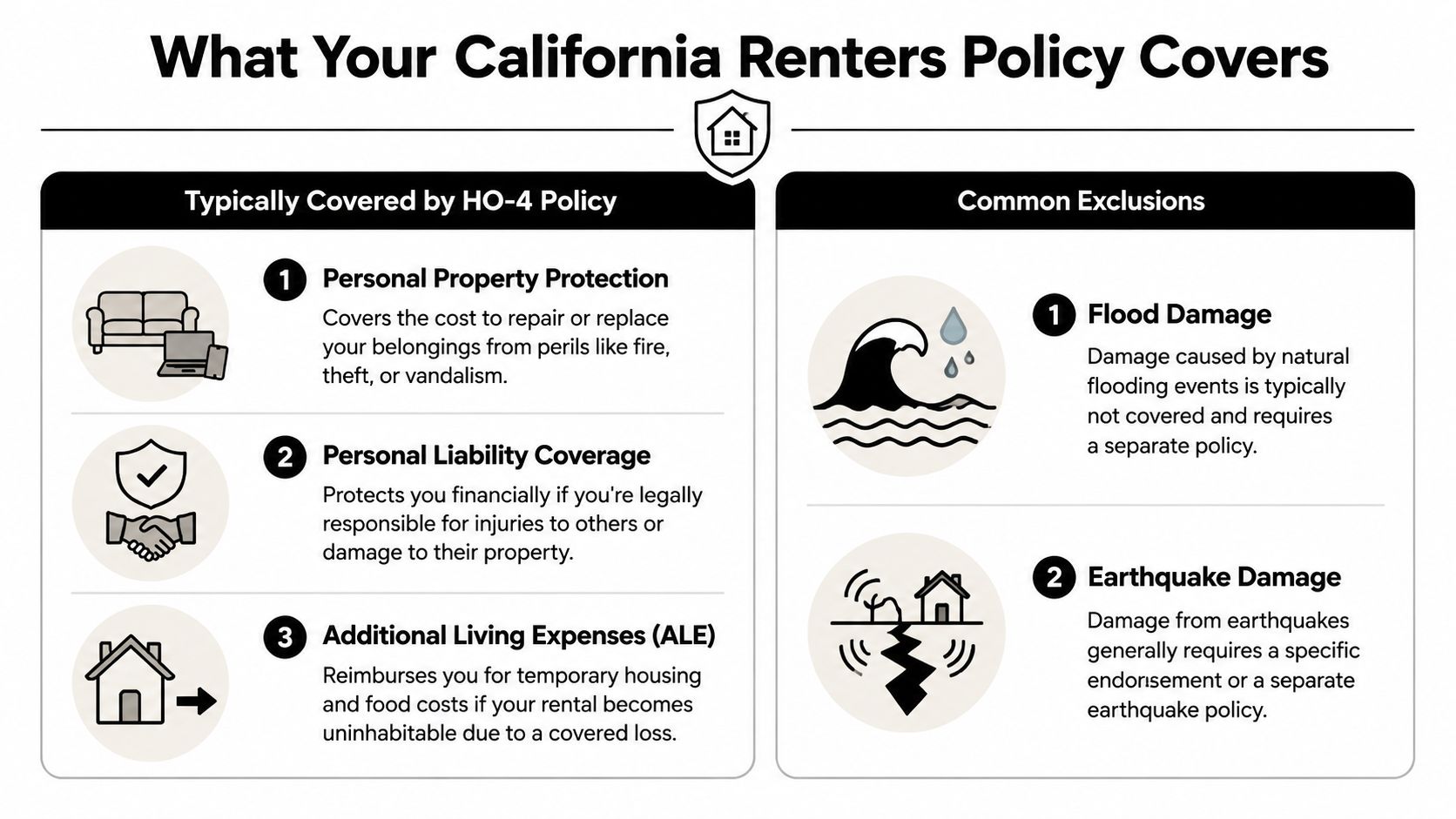
According to Progressive’s explanation of whether landlords can require renters insurance, a landlord’s insurance policy covers the building structure and the landlord’s appliances, but it does not cover the tenant’s personal property or liability. That’s the core reason renters insurance matters. The same source says average national premiums are around $12 per month.
Here’s the plain-English breakdown of what tenants are usually buying:
- Your stuff: Clothing, furniture, electronics, and other personal property.
- Your liability: Claims if you’re legally responsible for injury or damage.
- Living elsewhere after a covered loss: Temporary housing and related costs if the unit can’t be lived in after a covered event.
If you’re shopping for a policy that satisfies a lease and protects you, compare real options for California renters insurance coverage.
What it usually doesn’t handle
California renters need to pay attention to exclusions. Standard renters coverage is not the same thing as broad protection against every disaster in the state.
Use this comparison as your gut check:
| Typically covered by a standard renters policy | Common problem areas |
|---|---|
| Personal belongings after covered loss | Flood damage |
| Personal liability claims | Earthquake damage |
| Temporary living costs after a covered loss | Some wildfire-related issues depending on cause, policy wording, and market conditions |
That last line matters in California. Wildfire and smoke exposures can create coverage questions, and earthquake risk is its own category. If you live in a high-risk area, don’t assume “I have renters insurance” means “I’m covered for everything that happens here.”
A basic renters policy is good. A basic renters policy that ignores local hazards is incomplete.
Why this matters for both tenants and landlords
Tenants need coverage because replacing everything out of pocket is expensive and liability claims can get ugly. Landlords benefit because tenants have their own path for covered personal losses and certain liability situations.
That doesn’t make renters insurance a substitute for landlord insurance. It makes it the missing half of the picture.
How to Get Compliant California Renters Insurance Today
Getting compliant isn’t hard. Most delays happen because tenants wait until the day before move-in, then realize the landlord wants specific proof, specific limits, or a specific name listed on the policy notices.
Handle it in order and it goes quickly.
Step 1 through Step 3
First, pull the lease and highlight the insurance requirement. You need the exact liability limit, the name and address of the property, and any request to list the landlord or management company as an additional interested party.
Second, estimate what you need to protect. Don’t obsess over perfect math. Make a practical inventory of your electronics, furniture, clothing, kitchen items, and anything expensive or hard to replace. If you want a rough starting point before speaking with an agent, VerticalRent's insurance calculator can help you think through personal property value and coverage needs.
Third, compare quotes from real carriers. Don’t just buy the cheapest option if it fails the lease requirement or ignores local risk issues.
Step 4 through Step 6
Fourth, ask for proof in the format your landlord expects. Usually that means a declarations page or similar proof document. Send it before the deadline and keep a copy.
Fifth, look at bundling. If you already carry auto insurance, or you’re shopping for car insurance, home insurance, or life insurance, bundling can simplify your overall protection and sometimes improve value. Start with a California insurance quote request so you can compare combinations instead of shopping every policy in isolation.
Sixth, ask one California-specific question before you bind coverage: “What are the important exclusions for my location?” If you’re in a wildfire-prone area or concerned about earthquake exposure, that question matters more than any marketing language on the quote screen.
What to submit to your landlord
Keep it simple and complete:
- Declarations page: Shows the policy basics and limits.
- Property address: Make sure it matches the rental unit.
- Interested party details: Include them if the lease requires it.
- Effective dates: Make sure coverage starts before move-in if that’s required.
The best move is same-day compliance. Buy the right policy, send the proof, and move on with your life.
Frequently Asked Questions About Renters Insurance
Does renters insurance cover my roommate
Usually, don’t assume it does. Roommate coverage depends on the policy setup and who is named. If two adults share a unit, they should confirm whether one policy covers both people or whether each person needs separate coverage.
Can a landlord tell me which insurance company to use
A landlord can require coverage through the lease. The better practice is to require the coverage standard, not force a specific carrier. If a landlord wants proof, limits, and notice provisions, that’s one thing. Telling every tenant to buy from one insurer raises unnecessary concerns.
What if my dog bites someone
That can become a liability claim. Whether the policy responds depends on the policy terms and any animal-related restrictions. If you own a dog, don’t guess. Ask before you buy and get the answer in writing from the insurer or agent.
Can my landlord add this requirement after I already moved in
In California, a renters insurance requirement should be added at lease inception or renewal, not dropped into the middle of an existing tenancy as if it were already part of the contract.
Do I need renters insurance if I don’t own much
Yes, often for liability alone. People fixate on furniture and forget that liability protection may be the most important part of the policy.
Where can I get more general insurance answers
If you want broader guidance on coverage questions beyond renters insurance, review this California insurance FAQ page.
If you need help comparing renters, auto, home, or life insurance in California, Mai & Associates can help you review options, spot coverage gaps, and get a no-obligation quote with guidance suited to your budget and location.