California Renters Insurance Earthquake Coverage: 2026

Standard California renters insurance does not cover earthquake damage. If you want protection for your belongings and temporary living costs after a quake, you usually need separate coverage, and some California renters policies can start as low as $35 per year.
That surprises a lot of renters. You buy renters insurance, you assume “my stuff is covered,” and you move on. Then a tremor hits, cabinet doors swing open, a TV tips, glass breaks, and the main question shows up fast: who pays for this?
In California, that answer often depends on whether you added earthquake coverage on purpose. This isn't like the everyday protection built into many renters policies. It's a separate decision, and it comes with a tradeoff that confuses people more than the premium itself. The coverage can be relatively inexpensive, but the deductible can be large enough that small claims may not make sense.
That's why california renters insurance earthquake coverage is less about fear and more about math. You're trying to decide whether a low premium is worth carrying a policy that's mainly built for bigger losses, not minor cracks, a broken lamp, or a few dishes.
A practical insurance plan works the same way across categories. Your car insurance protects against driving risk. Your home insurance or renters policy handles common property losses. Your life insurance protects the people who depend on you. Earthquake coverage fills a very specific gap for California renters. If you understand what it does, what it doesn't do, and how the deductible works, you can make a clear decision instead of guessing.
The Shaky Truth About Your Renters Policy
You come home after a small quake, open the door, and see books on the floor, a cracked TV screen, and broken dishes in the kitchen. Your first thought is simple: I have renters insurance, so this should be covered.
For many California renters, that assumption is where the confusion starts.
A standard renters policy usually helps with losses like theft, fire, and certain kinds of water damage. Earthquake damage is usually treated as a separate problem, not part of the base policy. So the key question is not whether you have renters insurance. It is whether you added earthquake protection to go with it.
That distinction matters because renters often picture insurance as one box labeled “my stuff.” In reality, it works more like a set of smaller boxes. One box covers common property losses. Another may cover liability. Earthquake coverage, if you want it, is often its own box.
What renters usually expect
A new renter often assumes three things:
- My belongings are covered: Often true for covered events listed in your renters policy.
- The apartment itself is my insurance company's problem: Usually no. The building is generally the landlord's responsibility.
- If the damage came from shaking, it still counts as property damage: Usually no, unless you bought separate earthquake coverage.
That last point is the one that catches people off guard.
A good starting point is to review your California renters insurance options and see whether earthquake coverage appears anywhere as a separate endorsement or companion policy. If you do not see it, there is a good chance you do not have it.
Why the decision is not as simple as “yes” or “no”
Earthquake coverage for renters often costs less than people expect. The harder part is understanding what you are buying for that price.
This coverage is often built for bigger losses, not smaller annoyances. A deductible works like the part of the repair bill you agree to handle yourself before insurance starts paying. If your deductible is high and your loss is modest, filing a claim may not help much. If a quake destroys much more of what you own or leaves you with a serious loss, the same policy can matter a lot.
That is why the practical question is not “Do earthquakes happen?” California renters already know they do. The better question is “If I lost enough belongings at once, would this policy help me replace them after the deductible?”
If you are also sorting out where a landlord's responsibility ends and a renter's responsibility begins, these Edinhart property insurance insights can help clarify the difference between building coverage and coverage for the person living inside it.
The goal is a clear-eyed decision. Low premium on one side. High deductible on the other. Once you see that tradeoff clearly, earthquake coverage becomes much easier to judge based on your own budget and the value of the belongings you would be trying to replace.
How California Earthquake Insurance Works For Renters
You sign your lease, buy renters insurance, and assume you checked the boxes that matter. Then a quake hits, a bookshelf crashes into your TV, dishes shatter, and your apartment is unsafe for a few days. That is often the moment renters learn their standard policy and earthquake coverage are usually two different products.
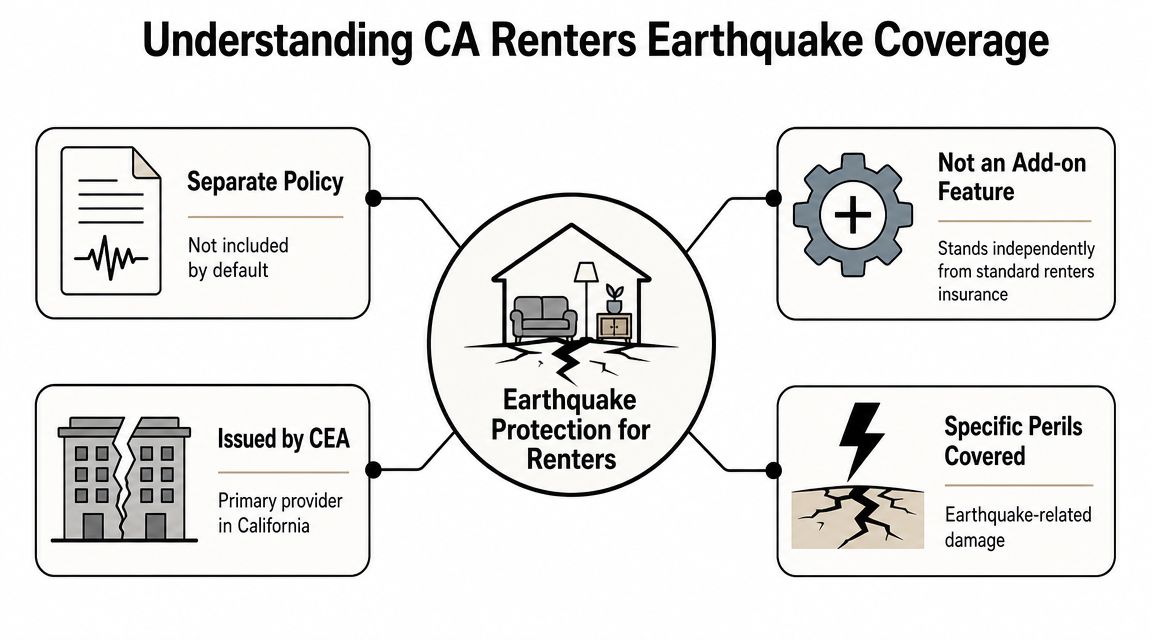
Earthquake coverage works like a sidecar policy attached to your main renters setup. Your renters policy handles the covered problems listed in that contract. Earthquake damage is usually carved out, so you add separate protection if you want help with quake-related losses.
The basic setup
For many California renters, the path is fairly simple. You start with a renters policy. Then, if your insurer offers earthquake coverage through the California Earthquake Authority, you can choose a separate renters earthquake policy that sits next to your base coverage.
That packaging matters because it changes how you evaluate the purchase. You are not asking whether earthquakes are possible. You are asking whether this separate policy would pay enough, after the deductible, to justify the premium for the belongings you own.
If you want a clearer picture of what the base policy covers before adding anything else, this guide to California renters insurance options gives you that foundation.
What the CEA means for a renter
The California Earthquake Authority, or CEA, is the main source of earthquake insurance for many renters in the state. You typically do not go out and buy it as a built-in feature you forgot to notice. You usually get access through an insurer that participates in the CEA program.
A lot of confusion starts here. Renters hear "I have insurance" and assume that includes earthquake loss. In practice, it often does not. The earthquake policy is its own agreement, with its own limits, its own deductible, and its own terms.
That separation can be helpful. It forces you to look at earthquake protection as a specific tool for a specific kind of loss, instead of assuming your regular renters policy will stretch further than it does.
Why the setup changes the decision
A separate earthquake policy is best viewed like emergency gear you hope stays in the closet. The yearly cost may feel manageable. The harder question is whether the policy would be useful for your version of a bad day.
For example, a renter with older furniture, a basic wardrobe, and little savings may decide even limited coverage is worth carrying because replacing everything at once would be tough. Another renter may own only a few lower-value items and prefer to self-fund that risk. The right answer depends less on fear of earthquakes and more on the math of your belongings, your cash reserve, and your deductible.
Before you buy, read the policy exclusions language carefully. That step helps you see where earthquake coverage stops, so you can judge the policy on what it does instead of what you hope it will do.
A good shopping checklist is short:
- Confirm your insurer offers renters earthquake coverage
- Ask whether the policy is issued through the CEA
- Compare the available personal property limits with the value of what you own
- Check the deductible and ask yourself whether a claim would still help after that amount is subtracted
That last step is where good decisions happen. Low premium sounds attractive, but the deductible determines when the policy becomes useful in real life.
What Your Earthquake Coverage Actually Protects
A useful way to judge this coverage is to ask one plain question: after a serious quake, which bills would land on you first?
For most renters, the answer is not the building. It is the contents of daily life inside the unit, plus the cost of living somewhere else if the place becomes unsafe.
Personal property coverage
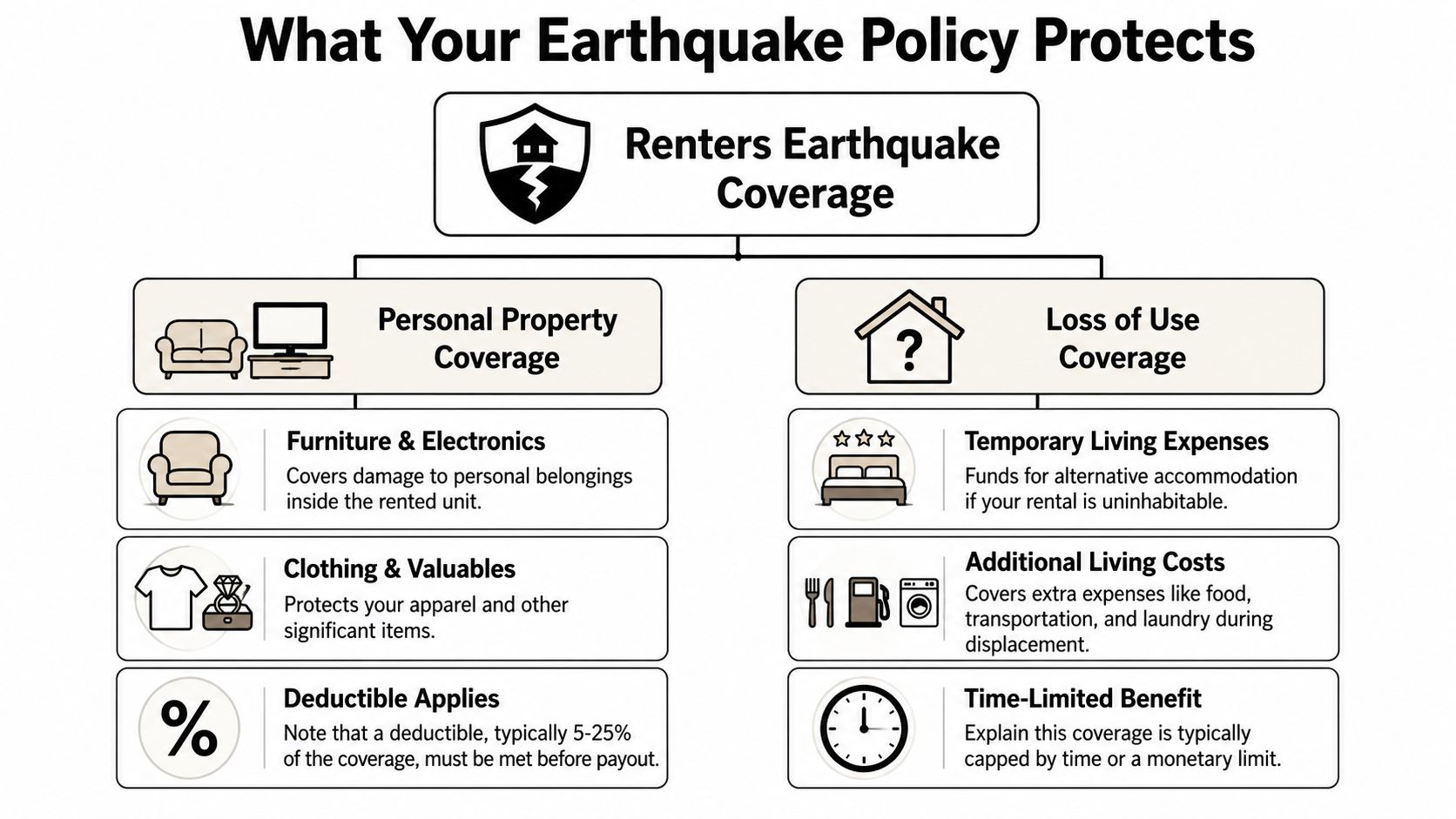
Personal property coverage applies to the things you own. A quake does not need to flatten a building to create a costly loss. A bookshelf can fall. A TV can crack. Dishes, laptops, lamps, and small appliances can all be damaged in one event.
That matters because renters often underestimate the value of ordinary items. One couch is manageable. A couch, bed, clothes, cookware, work computer, and phone charger collection adds up fast.
Examples usually include:
- Furniture and electronics: sofas, desks, TVs, monitors, laptops
- Clothing and household goods: shoes, jackets, linens, cookware
- Everyday personal items: the practical things you rely on each week
The key decision is not whether your belongings matter. It is whether the amount you could collect after a deductible would still make a claim worthwhile. If the answer is yes, the coverage has a real job to do.
Loss of use coverage
Loss of use covers the disruption that follows a damaging quake. If your rental cannot be lived in, this part of the policy can help pay the extra cost of staying elsewhere for a period of time.
Renters sometimes focus so much on damaged property that they miss this second risk. Temporary housing can become the bigger problem, especially in California, where short-term lodging is expensive and repairs may take time.
Covered expenses can include:
- Temporary lodging: a hotel or short-term rental
- Added living costs: expenses above your normal baseline while you are displaced
- Day-to-day disruption costs: practical costs that come from being out of your home
This part of coverage often feels abstract until you picture paying for your normal rent and a temporary place at the same time.
What stays outside the policy
A renters earthquake policy usually does not pay to repair the building itself. The landlord's insurance handles the walls, roof, framing, and foundation. Your policy is centered on your belongings and your temporary living costs. The Humboldt Renters' Complete Toolkit insurance overview explains that division clearly.
Here is the cleanest way to sort it out:
| If the quake damages... | Usually falls to... |
|---|---|
| Your sofa, TV, clothes | Your renters earthquake coverage, if purchased |
| Your hotel stay after displacement | Your loss-of-use coverage, if selected |
| The walls, roof, foundation, framing | The landlord's property insurance |
Read the fine print with care. Common policy exclusions often define the precise boundary of coverage more clearly than the policy summary does.
If you want a side-by-side frame of reference, this guide to California home insurance basics helps show why building protection belongs under a homeowner or landlord policy, while a renter's earthquake policy is built around belongings and displacement costs.
Understanding Earthquake Insurance Deductibles
A renter sees a quote for earthquake coverage and thinks, “That's cheaper than I expected.” Then they notice the deductible and pause. That reaction makes sense, because earthquake deductibles do not work like the flat dollar deductibles people often see on auto or standard renters policies.
For renters earthquake coverage, the deductible is often a percentage of your personal property limit. In plain terms, the more coverage you buy for your belongings, the larger the deductible can be in dollars.
That sounds technical, but the math is simple.
If your policy covers $25,000 of personal property and your deductible is 5%, your share of the loss is $1,250 before insurance starts paying for damaged belongings. If a quake destroys $20,000 worth of your property, a claim would pay $18,750 on that portion.
A real-world way to read that number
A deductible is your part of the repair bill or replacement bill. It works like a gate the claim has to cross before money comes back to you.
Here's the same example in a quick table:
Earthquake Deductible Calculation Example
| Item | Amount |
|---|---|
| Personal property coverage limit | $25,000 |
| Deductible percentage | 5% |
| Deductible amount | $1,250 |
| Covered loss to belongings | $20,000 |
| Claim payment | $18,750 |
This is the part renters should slow down and study. A low monthly premium can still come with a deductible large enough that the policy only helps in a serious loss.
What the deductible means for your decision
Earthquake coverage is usually not built for a few cracked dishes, one damaged lamp, or a smaller belongings loss. If your damage stays below the deductible, you would not get a payout for personal property. If the loss is much larger, the policy can do a lot more work for you.
That is why the key question is not just, “Is the premium affordable?” The better question is, “Would I be able to replace a big share of what I own out of pocket?”
A simple decision frame:
- Small loss: you may end up paying for most or all of it yourself
- Large loss: the policy may cover a meaningful part of replacement costs after the deductible
- Tight savings: even a higher deductible may be worth accepting if replacing furniture, clothes, electronics, and basics would be hard on your budget
One point that trips up renters
People sometimes hear “high deductible” and assume the coverage is a bad deal. That is not the right takeaway. A high deductible usually means the policy is designed for harder hits, not minor damage.
That distinction matters in California. Earthquake insurance for renters is often a catastrophe tool. You keep it for the event that would be financially difficult to absorb on your own.
The practical test I give renters
Start with an inventory of your life, not a guess.
Walk through your apartment, even if only in your head. Add up the bed, couch, laptop, phone, kitchen items, work clothes, shoes, and the small things you would have to rebuy fast. Then compare that total to your emergency savings.
Ask yourself:
- Could I replace a large share of my belongings without going into debt?
- Would I still want this policy if it only pays after a bigger loss?
- Does the premium make sense for the level of risk I am choosing to keep?
If you want a plain-English refresher before reviewing a quote, this insurance FAQ for common policy terms can help make the wording easier to follow.
The best choice is the one that matches your real financial cushion. For many renters, the deductible is the deciding factor that shows whether earthquake coverage is a smart backup plan or an expense they would rather handle another way.
Estimating The Cost Of Renters Earthquake Coverage
A lot of renters get to this point and focus on one number. The monthly premium.
That makes sense. If a quote looks low, earthquake coverage can feel like an easy yes. But price by itself does not tell you whether the policy is a good fit for your situation.
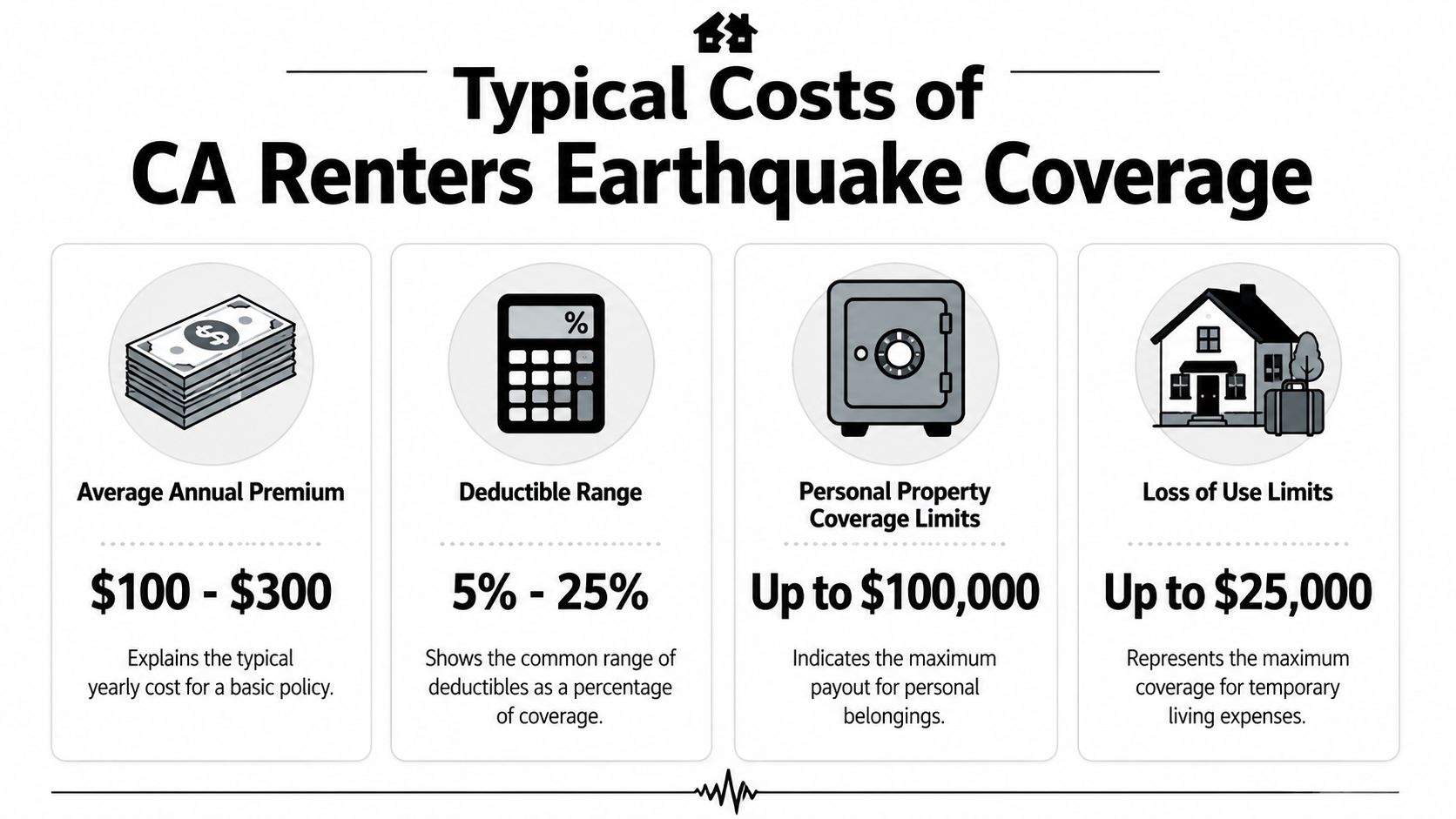
In California, renters earthquake coverage is often fairly inexpensive compared with many other insurance add-ons. The reason is simple. These policies usually come with deductibles that leave the renter responsible for a meaningful share of the loss before coverage starts paying. A low premium and a high deductible often travel together.
A good way to look at it is like buying a safety net with a wider gap at the bottom. The policy may cost only a little each month, but it is built for a harder fall, not every crack, topple, or small break.
Why your quote may look different from someone else's
Two renters in the same city can still get different quotes. Insurers usually look at a few practical details:
- Your location: some areas carry more earthquake risk than others
- Your personal property limit: more coverage for belongings usually means a higher premium
- Your deductible choice: the amount you agree to absorb affects what you pay
Those choices shape the actual value of the policy. If you choose a very high deductible to keep the monthly cost low, the coverage may still be useful, but mainly for a serious loss that wipes out a large share of what you own.
How to tell if the price is actually reasonable
I tell renters to do one quick comparison before they judge a quote.
Set the premium on one side. Set your likely out-of-pocket cost on the other. Then ask whether the policy would still feel worthwhile after a major quake, when you would need to file a claim and pay the deductible before insurance helps.
That is the heart of the decision.
Ask yourself:
- If my apartment contents were badly damaged, would this coverage pay enough after the deductible to matter?
- Could I handle the deductible from savings without putting replacement costs on a credit card?
- Am I buying this for true catastrophe protection, or am I expecting it to cover smaller losses too?
Here is the practical takeaway. A cheap premium is good news only if the policy still solves a real financial problem for you.
For a renter with modest belongings and solid savings, skipping earthquake coverage may be a reasonable choice. For a renter whose laptop, bed, clothes, and basic furniture would be expensive to replace all at once, even a low-cost policy with a high deductible can still make sense. The right answer depends on what you own, what you could replace on your own, and how much risk you are comfortable keeping.
How To Add Earthquake Coverage To Your Plan
A lot of renters get stuck at this stage because the quote looks simple, but the decision is not. Adding earthquake coverage is usually easy. Choosing an option that would help you after a major quake takes a little more thought.
Start with a rough home inventory
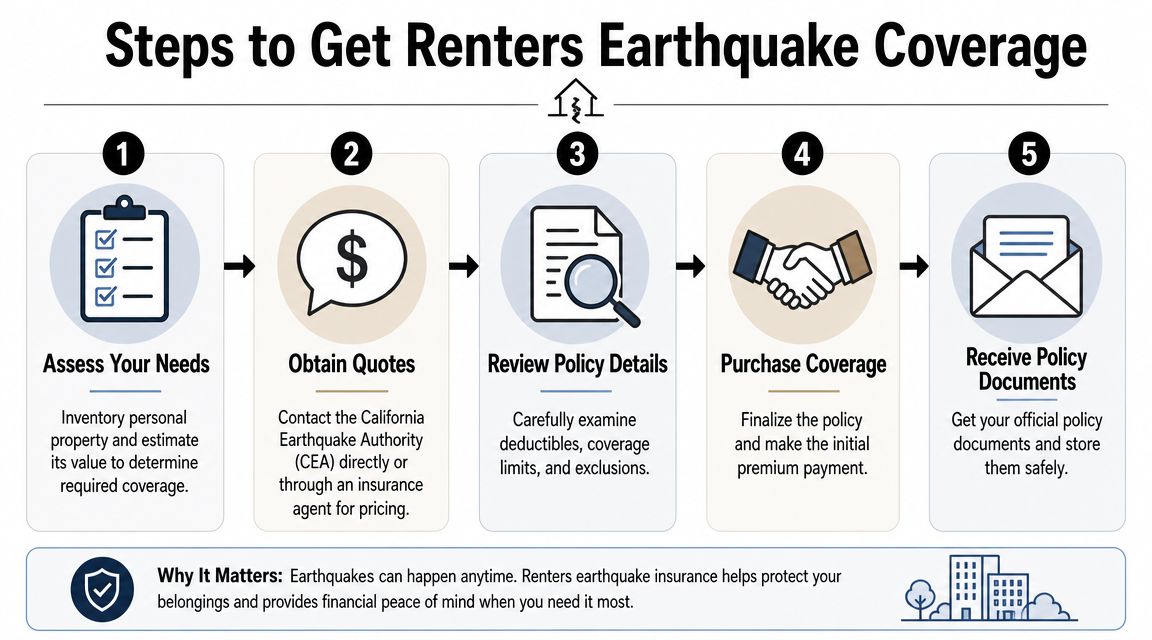
Before you request anything, get a ballpark estimate of what you own. You are not trying to build a perfect spreadsheet for tax season. You are trying to answer one practical question. If a quake wrecked your apartment contents, how much would it cost to replace the basics?
Start with the items that would hurt to buy again all at once:
- Electronics: laptop, TV, tablet, gaming gear
- Furniture: bed, sofa, desk, dining set
- Clothing and household basics: shoes, jackets, cookware, linens
This step matters because the coverage decision should come from your replacement cost, not from a premium that happens to sound cheap.
Ask your current insurer what can be added
Your current renters insurer is usually the first place to check. If the company offers earthquake protection for renters, or places it through the California Earthquake Authority, they can tell you what options are available and how the coverage would be issued.
Ask for the quote in writing. Then ask these questions in plain language:
- What personal property limits can I choose?
- What deductible options are available?
- How much loss-of-use coverage comes with each option?
- Are any extra features included for urgent repairs after a quake?
That last question is easy to overlook. Some policies include limited help for immediate damage control after a quake. The details vary, so ask the agent to show you where that feature appears in the quote or policy summary.
Review the quote like a real-world test
This is the part many renters rush through.
A quote is not just a price tag. It is a stress test. You are checking whether the policy would solve a real financial problem, or whether it only looks good because the monthly cost is low.
A simple way to look at it is this. Coverage limit is the size of the bucket. The deductible is the hole at the bottom. A big bucket still helps, but if the hole is large, small and mid-sized losses may never reach the point where insurance pays much.
Use the quote to answer these questions:
| Question to ask | Why it matters |
|---|---|
| Is the personal property limit close to what I actually own? | A low limit can leave you short even after a valid claim |
| Could I realistically pay this deductible from savings? | If not, the policy may be harder to use when you need it most |
| Would the loss-of-use amount help me afford a temporary move? | Housing costs after a quake can become a separate financial problem |
If you want help comparing those tradeoffs, you can request a personalized California earthquake and renters insurance quote.
Final step: add it and save the paperwork
Once you choose the option that fits your budget and your risk tolerance, ask the insurer to bind the coverage and confirm the effective date. Then save the declarations page and policy documents somewhere easy to reach, such as cloud storage or an email folder you can access from your phone.
That way, if a quake happens, you are not trying to remember what you bought or who to call.
Secure Your Peace Of Mind With The Right Coverage
For California renters, the core lesson is simple. Your standard renters policy usually won't pay for earthquake damage to your belongings. If you want that protection, you have to choose it separately.
That doesn't mean every renter should automatically buy it. It means every renter should evaluate it carefully. If your savings could comfortably replace your belongings and handle a temporary move, you may decide to self-insure that risk. If a major quake would put real pressure on your finances, earthquake coverage may be a sensible addition even with a percentage-based deductible.
The best decision usually comes down to three things:
- What your belongings are worth
- How much displacement would cost you
- How much of a loss you could absorb on your own
If you want help comparing renters, earthquake, auto, home, or life insurance options in one place, it's worth getting a personalized review and a no-obligation California insurance quote. A good agent should help you think clearly about tradeoffs, not push you into coverage you don't need.
Peace of mind comes from knowing what's covered, what isn't, and what a policy would do for you on a bad day. That's the standard to use.
If you want a second opinion on california renters insurance earthquake coverage, Mai & Associates can help you compare renters, home, auto, car, and life insurance options across California with clear guidance and no-pressure quotes. Their licensed team can walk you through coverage gaps, deductible choices, and whether earthquake protection fits your budget and risk level.