California Insurance Requirements Your 2026 Guide
California drivers now need at least $30,000 per person, $60,000 per accident, and $15,000 for property damage in auto liability coverage to drive legally. That 30/60/15 rule changed the baseline for California insurance overnight and it matters far beyond your glove box.
A lot of people hear “California insurance requirements” and think only about car insurance. That's where the legal minimums are clearest, but it's not the whole picture. Home insurance, renters insurance, and life insurance work differently in California. Some are driven by state law. Others are driven by lenders, landlords, and the realities of living in a state where wildfire and earthquake risk can reshape what a standard policy really covers.
The big mistake is assuming “having insurance” and “having the right insurance” are the same thing. They're not. A legal minimum auto policy can keep you compliant while still leaving major gaps. A renter may not face a state mandate, yet still need coverage to satisfy a lease. A homeowner in a higher-risk area may discover that basic property coverage isn't enough without separate endorsements or a California FAIR Plan strategy.
This guide connects those dots in plain language. If the rules have felt scattered, this will make them easier to follow.
Understanding California Insurance in 2026
California insurance rules affect millions of drivers, homeowners, renters, and families, but they do not all work from one master checklist. The better way to understand them is to sort them into three buckets: coverage the state requires, coverage a contract can require, and coverage you choose because California's risks are unusually expensive.
Auto insurance sits in the first bucket. If you own a vehicle, the state sets financial responsibility rules and expects you to keep proof of coverage in place. If you want a plain-language overview of the basics before getting into the legal details, this California auto insurance guide is a useful starting point.
Home and renters insurance usually fall into the second and third buckets. California generally does not tell a renter how much personal property coverage to buy, and it does not set one statewide minimum policy for homeowners. But a landlord can require renters insurance in the lease, and a mortgage lender can require home coverage to protect the property securing the loan. In wildfire country, another layer often appears because standard home insurance may not solve every high-risk problem on its own. Earthquake protection is another separate decision, much like adding a second lock to a front door after you realize the first lock only covers part of the risk.
Life insurance is different again. The state regulates how policies are sold, serviced, and disclosed, but it does not assign every household a required dollar amount. That leaves many California families with the same question: what is legally required, and what is smart planning? That question matters more here because one insurance decision often affects another. A driver carrying only the minimum auto limits may also be underestimating umbrella needs. A homeowner in a fire-prone ZIP code may need to review dwelling coverage, loss-of-use protection, and backup options all at once.
The recent auto liability increase matters for that reason. It was not just a technical update to old numbers. It was a reminder that California's insurance rules try to keep pace, even if slowly, with the actual cost of accidents and property loss. The minimum is the floor, like the first rung on a ladder. It helps you get off the ground, but it does not get you safely to the roof.
A quick way to avoid confusion is to separate these three ideas:
- Legal requirement: coverage California directly requires, such as auto liability.
- Contract requirement: coverage a lender, landlord, or other agreement can require.
- Risk requirement: coverage you may need because wildfire, earthquake, theft, lawsuits, or income loss can create costs far above the minimum rules.
That framework also helps when you shop. Vehicle details can affect pricing and underwriting, and VekTracer on vehicle history and insurance explains one example of how insurers look beyond the simple fact that a car is registered and insured.
If you keep those three buckets in mind, California insurance starts to feel less like a pile of unrelated rules and more like a map. The numbers matter, but the reason behind them matters just as much.
California's New Auto Insurance Mandates Explained
California drivers now need to remember three numbers: 30/60/15. Those numbers became the new minimum auto liability requirement on January 1, 2025, replacing the older 15/30/5 limits that had stayed in place for decades.
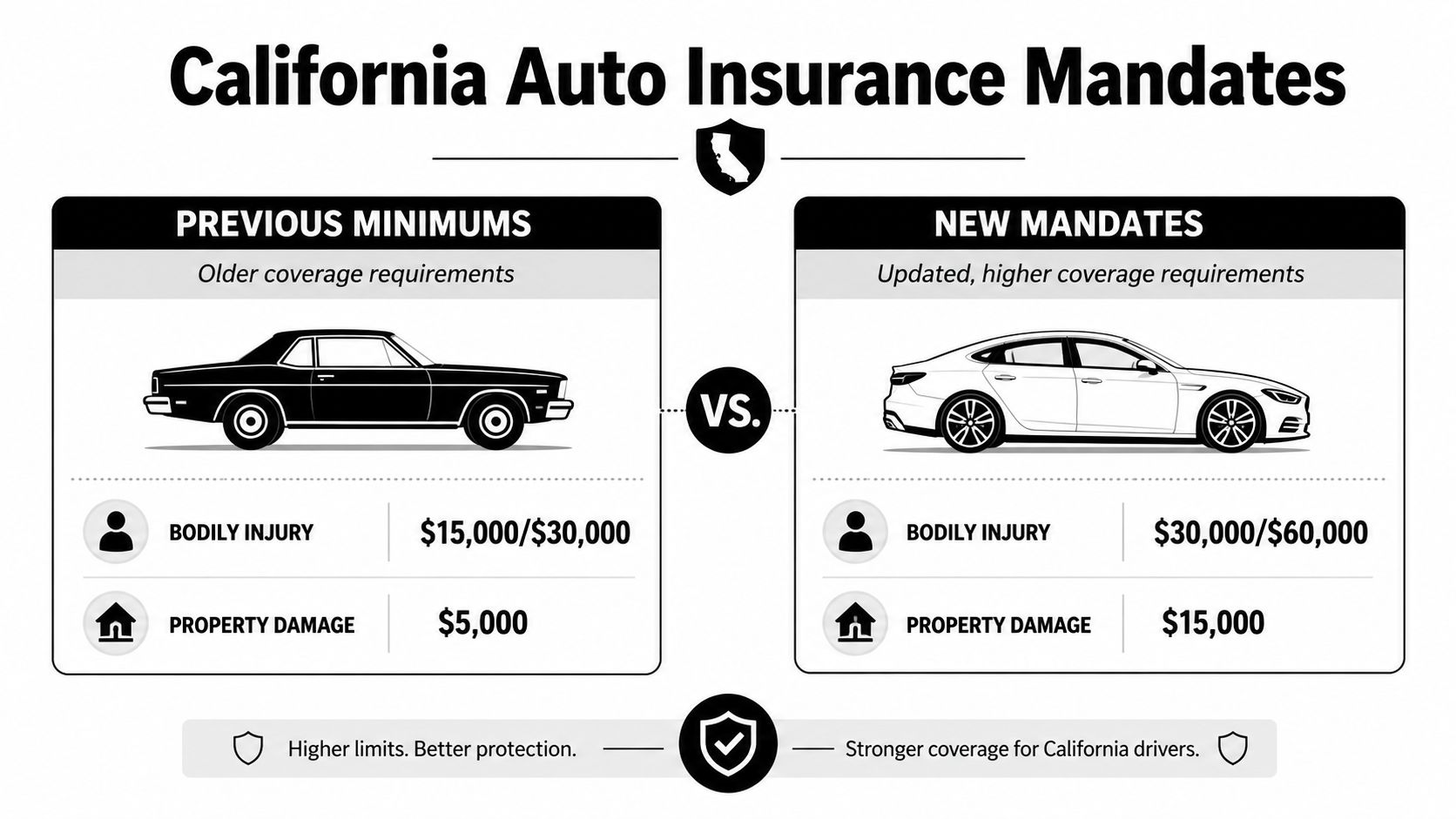
The easiest way to read 30/60/15 is to treat it like three separate buckets of money your policy makes available if you cause a crash. One bucket is for injuries to one person. One is for all injuries in the same accident. The third is for damage to cars, fences, buildings, or other property.
What 30 60 15 actually means
Liability insurance works like a financial shield for harm you cause other people.
- $30,000 per person for bodily injury or death to one person
- $60,000 per accident for total bodily injury or death when more than one person is hurt
- $15,000 for property damage in that accident
A quick example helps. If you cause a crash that injures one driver and damages that person's car, the injury claim draws from the $30,000 per-person bucket. The car repair claim draws from the separate $15,000 property-damage bucket. If two or three people are injured, the policy still has a total bodily injury ceiling of $60,000 for everyone together.
That distinction matters because drivers often assume the larger number applies to each injured person. It does not.
Old limits versus current limits
| Coverage | Previous Limit (Until Dec 31, 2024) | Current Limit (From Jan 1, 2025) |
|---|---|---|
| Bodily Injury per person | $15,000 | $30,000 |
| Bodily Injury per accident | $30,000 | $60,000 |
| Property Damage per accident | $5,000 | $15,000 |
The property-damage increase is easy to overlook, but it may be the most practical change for many drivers. A newer vehicle, a commercial truck, or even a damaged storefront can push repair costs past the old $5,000 limit very quickly. California raised the floor because accident costs rose far beyond what the older minimums could reasonably cover.
That helps explain the "why" behind the law. The state was not merely updating paperwork. It was acknowledging that hospital care, body work, parts, and labor cost far more than they did when the old limits were set. The same pattern shows up across California insurance. Auto losses cost more. Rebuilding homes after wildfire costs more. Replacing personal property after a disaster costs more. The legal minimum changed in auto insurance first, but the larger message applies across your whole protection plan.
What drivers need to check right now
If your policy renewed recently, do not assume everything adjusted the way you expected. Some drivers only confirm that they still have "insurance" without checking whether the liability limits meet the current rule.
Review these details:
- your bodily injury limits
- your property damage limit
- the vehicles listed on the policy
- the names of all household drivers
- whether your insurance card and DMV records match your current policy
Proof matters too. California requires drivers to carry evidence of financial responsibility, and insurance status can affect registration issues after a lapse. If you are comparing options, a practical guide to California auto insurance coverage choices can help you sort legal minimums from better protection choices.
Your car itself can also affect what you pay and how an insurer views the risk. VekTracer on vehicle history and insurance explains how accident records, title problems, and other vehicle history details can change pricing.
Why minimum compliance is only step one
Meeting 30/60/15 keeps you legal. It does not guarantee that one serious accident will stay within those limits.
That is the part many California drivers miss. The law sets the entry point. Your actual exposure depends on what you drive, how much you own, how often you drive in heavy traffic, and whether one claim could spill into your savings or future income. In a state where households also have to think about wildfire zones, earthquake risk, and rising replacement costs, auto insurance should be viewed as one part of a connected plan rather than a stand-alone checkbox.
Beyond Basic Liability Advanced Auto Insurance Rules
Minimum liability gets your foot in the door. It doesn't solve every problem that can follow a crash.
The next layer of California auto insurance is built around a practical question: what happens when the other driver can't fully pay? That's where uninsured and underinsured motorist coverage becomes important.
UM UIM is offered by law
California requires insurers to offer Uninsured/Underinsured Motorist coverage, often shortened to UM/UIM, with every auto policy at limits matching the policyholder's liability coverage under Insurance Code §11580.2, and drivers can reject it in writing, as described in this overview of California uninsured and underinsured motorist rules.
That detail trips people up. UM/UIM isn't the same thing as mandatory liability insurance. Liability protects other people when you cause a crash. UM/UIM protects you when someone else causes the crash and doesn't have enough coverage.
Why this rule fits California's larger approach
California's system is built on financial responsibility. The state requires liability coverage so drivers can answer for the harm they cause. UM/UIM extends that same logic in the opposite direction. It helps when the at-fault driver doesn't carry enough protection to cover the damage.
A simple comparison helps:
- Liability coverage: pays others when you're at fault.
- UM/UIM coverage: can help pay when the other driver is at fault but uninsured or underinsured.
That's why the written rejection matters. California wants the coverage offered clearly, not buried in paperwork.
If you decline UM/UIM, make that decision deliberately. It's one of the easiest protections to underestimate until after a collision.
A brief word on SR 22 filings
People often call an SR-22 “insurance,” but it's better understood as a filing tied to financial responsibility for certain higher-risk situations. The key idea is that it's not a separate insurance policy by itself. It's a certificate connected to your auto coverage and DMV requirements.
Because drivers often mix up insurance rules with lawsuit timelines after a crash, it also helps to review understanding California's car accident statute of limitations if you're trying to sort out what must be filed with the DMV, what must be carried on your policy, and what deadlines can affect a legal claim.
The practical decision most drivers face
The question isn't whether the state forces every optional coverage choice. The question is whether the policy you carry matches the problems you'd face after an accident.
For many drivers, the smart review looks like this:
- Confirm the legal minimums first: make sure your liability limits satisfy current California law.
- Check whether UM/UIM was accepted or rejected: don't assume.
- Review your risk tolerance: if a claim would strain your finances, minimum compliance may not be enough.
That's the difference between being merely legal and being prepared.
Navigating Home and Renters Insurance Requirements
A large share of Californians face property risk that standard policies do not handle well, especially wildfire and earthquake exposure. That is why home and renters insurance in California can feel harder to figure out than auto insurance. Auto coverage starts with state minimums. Property coverage usually starts with your contract, your address, and the gaps in a standard policy.
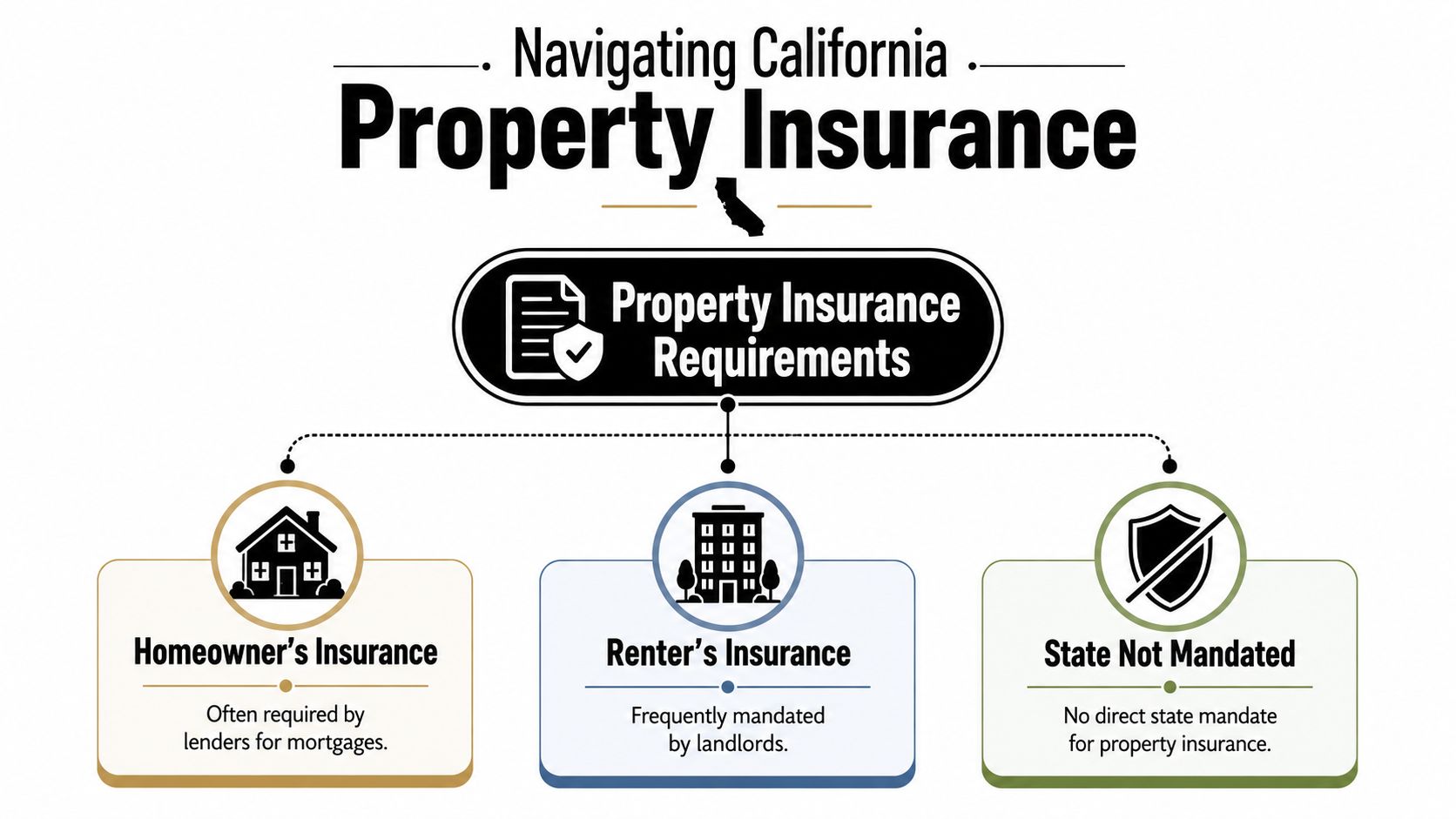
Homeowners and renters often ask the same question: “What does California require me to carry?” The clearer question is, “Who is requiring coverage, and for what risk?” For a house, the answer is often a mortgage lender. For an apartment, it is often a landlord and the lease. The state may not name a single minimum dollar amount for your dwelling or your belongings, but real-world requirements still show up before closing day or move-in day.
A homeowner in a wildfire-prone area
A mortgage lender usually requires proof that the home is insured before it will fund the loan. The reason is simple. The house is collateral for the loan, so the lender wants protection if a fire or other covered loss damages it.
In higher-risk parts of California, that protection may come in pieces rather than one neat package. A homeowner may need coverage through the California FAIR Plan for basic fire protection, then add a separate policy or endorsement for other losses. Earthquake coverage is another common point of confusion because it is usually not included in a standard homeowners policy. California's property insurance rules make more sense once you see the pattern. The state focuses on consumer rules, while lenders and insurers shape the practical coverage setup.
Liability coverage also shows up often in real life, but it is better described as a common lender or lease expectation than a statewide rule with one fixed number. If your policy has to satisfy a mortgage company, homeowners association, or landlord, read the insurance clause line by line instead of assuming the policy format is standard.
One more local issue matters here. Water damage claims are often covered or excluded based on the cause, not just the fact that water showed up. For a useful example of how property systems and insurance questions connect in mountain communities, see Understanding plumbing insurance in Big Bear.
A renter in a city apartment
Renters face a different version of the same problem. California generally does not require every renter to buy a policy, but many landlords require renters insurance in the lease. That makes the policy functionally required for that household, even without a statewide purchase mandate.
The lease usually focuses on liability first. If a kitchen fire starts in your unit, if water overflows into the apartment below, or if a guest is injured and claims you were negligent, liability coverage can matter far more than the value of your couch or television. Personal property coverage still matters because the landlord's policy usually protects the building, not your clothes, electronics, furniture, or kitchen items.
If you want a plain-English breakdown of how lease requirements and policy choices fit together, this guide to California renters insurance options is a good place to start.
The California risks that change the answer
Wildfire and earthquake exposure are the two big reasons property insurance here cannot be treated like a simple checkbox.
- Wildfire exposure: In higher-risk areas, a standard homeowners policy may be harder to get, more expensive, or structured through multiple policies.
- Earthquake coverage: This is usually separate from standard homeowners insurance, and deductibles can be much higher than people expect.
- Lease and loan terms: A landlord or lender can make coverage effectively required, even when the state does not set a universal minimum.
A good way to picture it is a three-lock system. One lock is state law. Another is your contract, such as a lease or mortgage. The third is local risk, especially wildfire and earthquake exposure. You need all three keys to know what coverage makes sense.
| Question | Why it matters |
|---|---|
| Does the state directly require this coverage? | For home and renters insurance, California usually does not set a single statewide minimum for the building or your belongings. |
| Does my lease or mortgage require it? | This often decides what you must carry in practice. |
| Does my property face wildfire, earthquake, or water-damage gaps? | Local risk can change the policy structure, the deductible, and whether you need separate coverage. |
That is the main difference between property insurance and auto insurance in California. Auto law starts with a state number. Home and renters coverage starts with the risk itself, then works backward to the policy you need.
Understanding California Life Insurance Rules
Life insurance is the one major coverage type in this guide that California usually does not require you to buy at all. That surprises many families, especially after seeing hard state minimums for auto insurance and practical coverage pressures in home insurance.
The better way to read California's life insurance rules is this. Auto insurance law asks, “What must you carry to protect other people on the road?” Life insurance rules ask, “How do we protect the buyer while they decide what their family needs?” The state's focus is less about forcing a coverage amount and more about setting guardrails around the sale.
That distinction matters because life insurance is often purchased during high-pressure moments. A marriage, a new child, a mortgage, or a business obligation can make the monthly premium feel like the only number that matters. In reality, the policy terms matter just as much.
The two protections every buyer should know
California gives life insurance buyers a 30-day free look period on individual life policies. During that period, you can review the contract after delivery and cancel for a refund, as described in the California Insurance Code section on life policy return rights.
California law also requires nonforfeiture protections for covered cash value life insurance policies. In plain English, that means a qualifying policy cannot erase built-up value the moment premiums stop. The policy must provide a legally defined way to preserve some value, as outlined in the California Insurance Code rules on standard nonforfeiture law for life insurance.
Those protections work like a review window and a safety net.
- Free look period: You get time to read the actual contract, compare it to what you expected, and back out if the policy is not the right fit.
- Nonforfeiture provision: If the policy builds cash value, the law may preserve part of that value instead of letting it disappear immediately after a lapse.
Why these rules matter in real life
A life insurance illustration can look simple at first glance. The legal contract holds the true answer. Beneficiaries, exclusions, riders, conversion rights, premium schedules, and cash value terms all affect whether the policy does the job you bought it to do.
That is the “why” behind these rules. California does not hand adults a single life insurance number the way it does with auto liability. It gives consumers time and legal protections so they can choose coverage based on income replacement, debt payoff, childcare needs, and mortgage stability.
If you want a plain-language starting point before comparing policy details, this guide to life insurance options in California can help.
Where homeownership and life insurance overlap
Home and life insurance solve different problems, but families often shop for both at the same time. One protects the house from covered physical loss. The other helps protect the people who rely on the income that keeps that house affordable.
That overlap becomes more important in California because household risk here is rarely one-dimensional. A family may be reviewing mortgage obligations, wildfire exposure, earthquake gaps, and income protection all at once. One policy does not replace the other. They work like different parts of the same financial plan.
Property claims also teach a useful lesson for life insurance buyers. Coverage depends on the contract language, not the label on the policy. This article on Understanding plumbing insurance in Big Bear shows how narrow coverage details can shape the result after a loss. Life insurance deserves the same careful reading before you sign.
The High Cost of Non-Compliance
A short insurance lapse can create a much bigger problem than a single ticket. In California, one gap in coverage can affect your ability to drive legally, keep your registration active, and get through ordinary weekly routines.
For auto insurance, the state expects more than buying a policy once. You have to keep the required minimum liability limits in force and make sure proof of coverage matches what the state has on record. As noted earlier, California can suspend a vehicle registration when required proof is missing. That means the immediate penalty often starts before a courtroom fine ever enters the picture.
Why the penalty hurts more than the fine
The fine is only the first bill.
Registration trouble can leave a legally owned car parked in the driveway. An impound can add towing and storage costs. A license issue can spill into work schedules, school drop-offs, medical appointments, and basic errands. Insurance rules work a bit like the electrical panel in a house. If one breaker trips, several rooms can go dark at once.
That chain reaction matters even more in California because insurance problems rarely stay in one box. A driver dealing with a lapse may also be trying to keep a home insured in a wildfire-prone area, satisfy a lender, or protect family income with life insurance. One compliance problem can strain the whole plan.
The common compliance failures
Drivers usually do not set out to break California insurance rules. More often, they get caught by one of these common mistakes:
- Missed renewal: The policy ends before the driver notices.
- New car confusion: The driver assumes the replacement vehicle is covered automatically, but the insurer needs notice or a policy update.
- Proof mismatch: Coverage exists, but the state records do not reflect it yet.
- Outdated limits: The policy carried an older legal minimum and was never updated to current requirements.
Why acting early saves money
Legal minimum coverage works like the entry ticket for staying on the road. It does not solve every risk, especially in a state where severe accidents, wildfires, and earthquakes can expose gaps fast, but it keeps the legal foundation in place.
If you already know your coverage may be outdated, fix it before a stop, renewal problem, or DMV notice forces the issue. A quick review and a fresh California insurance quote for compliant coverage can be far less expensive than dealing with fines, reinstatement headaches, and days without a usable car.
Your Path to Compliant Coverage in California
Once you understand the rules, the next step is simpler than anticipated. Start with the policy type, then match it to the rule that applies.
For auto insurance, confirm that your liability limits satisfy California's current minimum. For home insurance and renters insurance, read the mortgage or lease requirements before you shop. For life insurance, focus less on state minimums and more on whether the policy protects the people who rely on you.
A quote process is easier when you gather the basics first.
A clean checklist that works
- Check your current documents: Look at declarations pages, not just ID cards.
- Match the policy to the requirement: Legal minimum for auto. Contract requirement for home or renters. Personal need for life insurance.
- Identify special California risks: Wildfire exposure, earthquake questions, or higher-risk driving issues can change what “enough” coverage looks like.
- Compare more than one insurer: Price matters, but exclusions, deductibles, and add-on options matter too.
- Request a fresh quote when life changes: A move, marriage, new car, new child, or home purchase can all change what fits.
If you're ready to price options, an online tool for getting a California insurance quote can help you compare policies more efficiently.
What good shopping looks like
Good insurance shopping doesn't start with “What's cheapest?” It starts with “What am I legally required to carry, what does my lender or landlord require, and where are my biggest gaps?”
That small shift changes the outcome. You're no longer buying a random policy. You're building compliant coverage that fits California's rules and your actual risks.
The right policy should be easy to explain in one sentence: what it covers, what it doesn't, and why you chose it.
If you want help sorting through California auto insurance, home insurance, renters insurance, or life insurance, Mai & Associates offers no-obligation guidance, multilingual support, and side-by-side quote comparisons to help you find coverage that's compliant and budget-conscious.