California FAIR Plan Reviews: Navigating Home, Auto, and Life Insurance in a Tough Market
For a growing number of California homeowners, especially those living in areas prone to wildfires, the California FAIR Plan has become a household name—and not always for the right reasons. If you're sifting through California FAIR Plan reviews, you'll quickly notice a theme: it's a safety net, but a flawed one.
It’s the policy you get when private insurers have packed their bags and left your neighborhood. But here’s the most important thing to grasp right away: the FAIR Plan is not a substitute for a standard homeowners policy. It’s a basic fire insurance plan with significant blind spots, which can impact your entire financial picture, from your home insurance to your auto insurance portfolio.
Is The California FAIR Plan Your Best Insurance Option?
Let's be blunt: if you've been turned down for coverage by every traditional insurance carrier you've called, the FAIR Plan is often your only lifeline for California insurance. It isn't a government entity. Instead, think of it as a shared risk pool that all licensed insurers in the state are required to fund. Its entire purpose is to be the "insurer of last resort."
That "last resort" label is key. A FAIR Plan policy operates on a completely different framework than the comprehensive home insurance you’re probably used to. It’s designed to cover a very narrow set of perils, which means you’re left holding the bag for many common household risks.
What The FAIR Plan Covers And What It Excludes
At its core, a FAIR Plan policy protects your home from direct physical damage caused by fire, lightning, and internal explosions. That's it. What’s truly defined by what it doesn't cover. Getting a handle on these exclusions is the first step toward building a protection plan that actually works. You can dive deeper into various policy types in our other insurance guides.
Here’s a quick breakdown of what you're getting—and what you're not.
| Feature | California FAIR Plan | Standard Home Insurance |
|---|---|---|
| Primary Peril | Fire, Lightning, Internal Explosion | All Perils (unless specifically excluded) |
| Liability Coverage | Not Included | Included (covers things like guest injuries) |
| Theft/Burglary | Not Included | Typically Included |
| Water Damage | Not Included | Included (for issues like burst pipes) |
Why Is The FAIR Plan Growing So Rapidly?
The FAIR Plan’s recent explosion in popularity is a direct symptom of California’s deepening insurance crisis. It was created back in 1968 in response to riots and brush fires, but its policy count has absolutely surged as private companies flee high-risk zip codes. This crisis impacts all lines of California insurance, not just homes.
The numbers are staggering. Between September 2020 and September 2024, the number of FAIR Plan dwelling policies shot up by 123%. This isn't random—it's the direct fallout of major carriers non-renewing tens of thousands of policies because of wildfire risk. You can read the full research on this dramatic shift in California's insurance market.
This massive influx of homeowners means the FAIR Plan, which was once a small, niche program, now has to operate like one of the state's largest insurers. For you, the homeowner, this reality check is crucial: you’re getting a bare-bones policy that, while essential, absolutely requires you to buy supplemental coverage to fill in the gaps.
Decoding California FAIR Plan Coverage and Exclusions
To really get a handle on the California FAIR Plan, you have to think about what it doesn't cover, not just what it does. It's like buying the basic frame of a car—you get the essential structure, but the engine, seats, and windows are all missing. This is a crucial point, and it’s why so many California FAIR Plan reviews are filled with shock and frustration from homeowners who only discovered these gaps after a disaster.
At its core, the policy is intentionally limited. It covers direct physical loss to your house and belongings from just three specific events: fire, lightning, and internal explosion. That's it. Full stop. If a wildfire sweeps through your area, you’re covered. If a lightning strike toasts your home theater system, you can file a claim. But that’s where the safety net ends, leaving you dangerously exposed to common, everyday risks.
Let's walk through a real-world example. Say a big winter storm rolls in. A heavy tree branch snaps and smashes through your roof, and the torrential rain causes a pipe to burst in your attic. A standard home insurance policy would step in to cover the roof repair, the water damage, and your ruined personal property.
With only a FAIR Plan policy? You'd get zero financial help for any of that. The plan simply doesn't cover wind, water damage from burst pipes, or falling objects.
What the FAIR Plan Doesn't Cover
The list of what's excluded is long, and it includes some of the most frequent reasons people file insurance claims. Without another policy to fill the gaps, you're footing the entire bill for losses from:
- Theft and Burglary: If someone breaks into your home, the FAIR Plan won't cover your stolen possessions or the damage they caused getting in. This is a standard feature in most home insurance and renters insurance policies.
- Water Damage: This is a big one. It covers everything from a ruptured water heater flooding your basement to a leaky dishwasher ruining your kitchen floor.
- Personal Liability: If a visitor trips on your steps, falls, and sues you, you have no coverage. This is a massive financial risk and a non-starter for most mortgage lenders.
- Falling Objects: That tree branch we talked about? Not covered. Debris from a neighbor's roof in a windstorm? Also not covered.
"The most dangerous assumption a homeowner can make is that the FAIR Plan is 'good enough.' It's a foundational policy designed to be built upon, not to stand alone. The lack of liability and water damage coverage alone leaves families financially vulnerable to everyday accidents."
Available Endorsements Still Fall Short
The FAIR Plan does offer a few optional add-ons, called endorsements, to try and patch some of these holes. They help, but they still don't come close to what you’d get from a traditional homeowners policy.
The most common endorsements you can add are:
- Extended Coverage: This brings in protection for windstorms, hail, riots, and damage from vehicles or aircraft.
- Vandalism or Malicious Mischief: This covers intentional damage to your property.
But even if you buy these, you're still missing theft, liability, and most forms of water damage coverage. That’s why a FAIR Plan, even with endorsements, is never a complete solution. You're still left without protection from some of the most common and expensive household mishaps. To get more familiar with terms like these, our comprehensive insurance glossary can help clear things up.
Ultimately, you have to remember what the FAIR Plan was designed for: to be the last resort for basic fire coverage when no one else in the private market will offer it.
FAIR Plan vs. Private Home Insurance: A Detailed Comparison
If you've been forced to turn to the California FAIR Plan, your first question is probably, "How does this stack up against the private home insurance I used to have?" The difference is night and day. Comparing the FAIR Plan to a standard policy, like an HO-3, isn't just about a few different features; it’s a clash of two entirely different philosophies of coverage.
Think of it this way: a private HO-3 policy is designed to be a comprehensive shield. It's built to protect your home, your belongings, and your financial well-being from a whole host of common risks. The FAIR Plan, on the other hand, is a very specific, targeted tool. It was created for one primary purpose: to provide basic fire coverage when no one else will. Grasping this core difference is absolutely crucial to protecting your assets in California's tough insurance market.
This diagram shows just how limited the FAIR Plan is on its own.
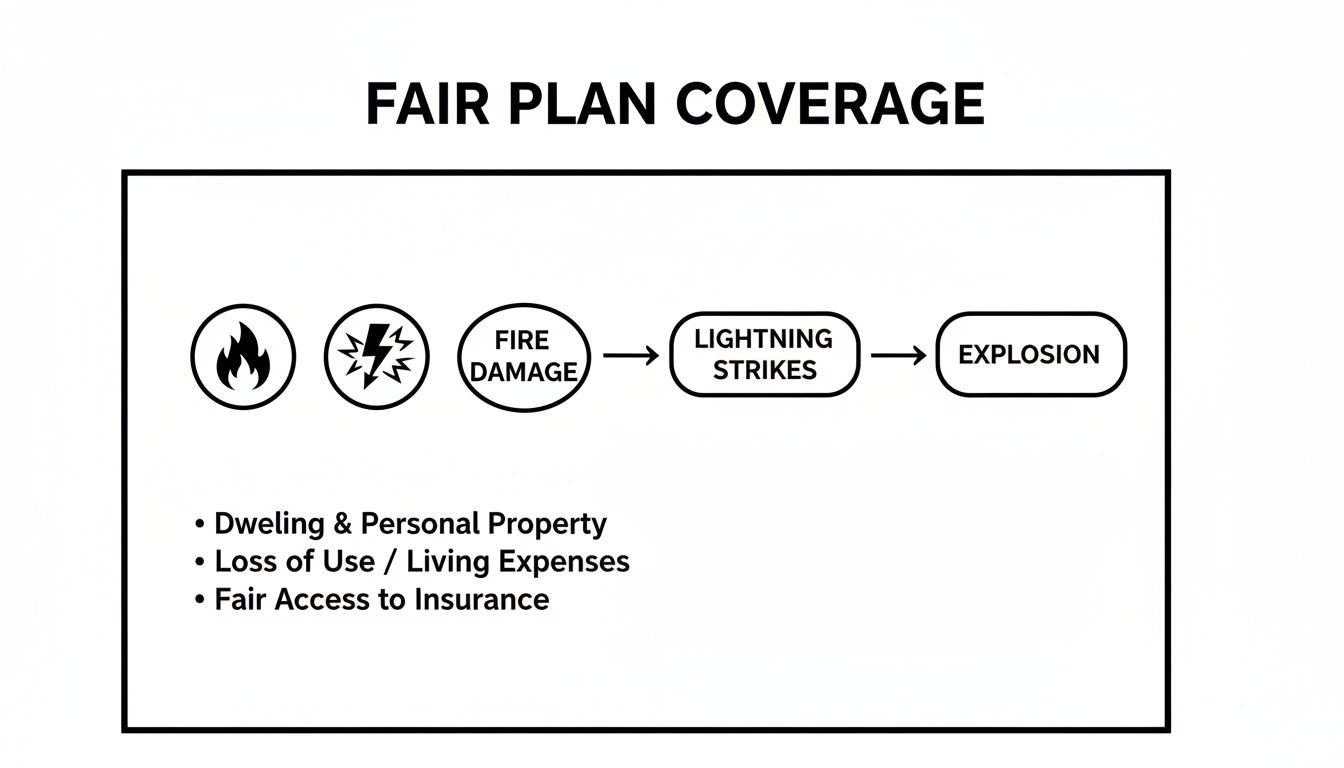
As you can see, a standalone policy only covers fire, lightning, and internal explosions. This leaves massive, and frankly, dangerous gaps in your protection.
Covered Perils and Exclusions
The most dramatic difference between the two is what each policy actually covers. A standard HO-3 policy uses an "open perils" approach for your home's structure. In plain English, this means it covers damage from all causes except those specifically listed as exclusions in the policy. This gives you incredibly broad protection against things like wind, hail, falling objects, and the weight of ice.
The FAIR Plan is the complete opposite. It operates on a "named perils" basis, meaning it only covers the specific risks listed in the policy. Initially, that's just fire, lightning, and internal explosion. You can add endorsements for wind and vandalism, but the list of what's not covered remains long and scary. Common events like water damage from a burst pipe or a simple theft? Not covered.
Liability Protection: The Critical Missing Piece
Here’s the single most dangerous gap in the FAIR Plan: it has absolutely no personal liability coverage. None. If a guest slips and falls, a delivery person trips on a broken step, or your dog bites a neighbor, a standard home insurance policy is there to cover legal fees and medical expenses.
The FAIR Plan offers zero liability protection. This isn't just a financial risk; it’s a complete dealbreaker for virtually all mortgage lenders. They require homeowners to carry liability coverage to protect their investment, making a standalone FAIR Plan a non-starter.
The absence of liability coverage is the single greatest shortcoming of the FAIR Plan. It forces homeowners into a two-policy solution, as no lender will approve a mortgage on a property without it.
Personal Property and Living Expenses
Both policies offer coverage for your personal belongings and Additional Living Expenses (ALE), which pays for you to live somewhere else if a covered disaster makes your home uninhabitable. The key, however, is the trigger for that coverage.
With an HO-3 policy, if a covered event like a windstorm destroys your roof, your ALE coverage kicks in. With the FAIR Plan, that same windstorm wouldn't be a covered event unless you had bought the specific endorsement. Without it, you would get nothing for repairs or temporary housing.
The claims experience also varies widely, a frequent topic in California FAIR Plan reviews. Private insurers often have streamlined digital processes and dedicated adjusters to help you. The FAIR Plan, on the other hand, is often dealing with high-volume, catastrophic events. This can lead to a slower, more document-heavy process. Many reviews point to disputes over the scope of damage, especially with smoke and ash, where the Plan has faced criticism for its very strict definition of "direct physical loss."
California FAIR Plan vs. Standard Homeowners Insurance (HO-3)
To really see the differences in black and white, this side-by-side comparison lays it all out.
| Feature | California FAIR Plan | Standard Private Insurance (HO-3) | Key Takeaway |
|---|---|---|---|
| Covered Perils | Named perils: fire, lightning, explosion (wind/vandalism optional). | Open perils: all perils are covered unless specifically excluded. | The FAIR Plan is extremely limited, leaving you exposed to common risks. |
| Liability Coverage | None. You are fully exposed to lawsuits from injuries on your property. | Included. Covers medical bills and legal defense for accidents. | This is non-negotiable for lenders and a massive financial risk. |
| Personal Property | Covered only for named perils (e.g., fire). | Covered for a broad range of perils, including theft. | Your belongings are unprotected from common events like burglary. |
| Water Damage | Not covered. No protection for burst pipes or appliance leaks. | Typically covered for sudden and accidental discharge. | A common and expensive claim that the FAIR Plan excludes entirely. |
| Typical Cost | Often 60-85% higher than previous private policies due to high risk. | Varies by location, but generally more affordable for lower-risk areas. | Expect to pay a significant premium for this last-resort coverage. |
At the end of the day, the FAIR Plan should never be mistaken for a replacement for traditional home insurance in California. It’s a foundational piece, a starting point that absolutely requires a second, supplementary policy to create a functional safety net for your family and your home.
The Real Cost: Breaking Down FAIR Plan Premiums and Financial Risks
Let's talk about the sticker shock. When homeowners get pushed onto the California FAIR Plan, the first thing they notice is the price. We see it all the time in California FAIR Plan reviews—premiums are often dramatically higher than what they were used to paying a private insurer. This isn't price gouging; it’s a direct reflection of the raw risk the Plan is forced to cover by law.
The state mandates that FAIR Plan rates must be "actuarially sound." In plain English, that means the premiums have to be high enough to cover catastrophic losses without a dime of state subsidy. While this ensures the Plan can actually pay claims after a disaster, it also means homeowners in high-risk zones shoulder the full financial burden of that risk. It's not uncommon to see premiums jump by 60% to 85%, sometimes even more.
For a lot of families, this is a tough pill to swallow. Imagine being a homeowner in Berkeley and watching your annual premium leap from a predictable figure to over $5,200. That kind of economic pressure is a huge part of the real cost of living in a beautiful but high-risk area.
The Hidden Risk That Affects All Californians
Beyond your personal premium, there's a much bigger, systemic risk baked into the FAIR Plan's structure—and it affects nearly every property insurance holder in the state, not just those on the Plan. The Plan pays claims in a specific order: first, it uses its own money from premiums and capital, then it draws on its reinsurance policies.
But what happens if a truly massive disaster blows through both of those layers? This is where it gets serious. The Plan has the legal authority to impose a surcharge on almost every property insurance policy across California. That includes standard homeowners, renters insurance, and commercial policies from private companies. In a nightmare scenario, this could mean surprise surcharges of $1,000 to $3,700 for all California homeowners, no matter how low their personal risk is.
This statewide surcharge is the FAIR Plan's hidden financial trigger. It effectively socializes the cost of a mega-disaster, meaning a wildfire in Southern California could send a bill to a policyholder hundreds of miles away in the Bay Area.
Explosive Growth Is Straining the System
As private insurers have pulled back, the FAIR Plan's financial exposure has ballooned at a frankly alarming rate. It’s doing its job as the state's backstop, but the fiscal pressure is immense. The numbers tell a pretty stark story.
By September 2025, the FAIR Plan’s total exposure hit a staggering $696 billion. That’s a 317% surge in just four years, since September 2021. This explosive growth shows just how much wildfire risk it has absorbed from private carriers who no longer want it. With nearly 646,000 policies now in force, its financial cushion is stretched incredibly thin. You can dig into these figures yourself on the official FAIR Plan data page.
This rapid expansion puts the Plan in a very tight spot. As of early 2025, it had only $377 million in cash reserves to back up that massive exposure. While it does have billions in reinsurance, that coverage doesn’t even kick in until the Plan first pays out $900 million from its own pocket. One truly bad wildfire season could wipe out its reserves and force it to pull that statewide surcharge trigger, impacting every California policyholder.
This situation really highlights the fragile tightrope the FAIR Plan is walking. Understanding its financial health isn't just an academic exercise—it's essential for anyone who depends on it for protection.
How To Create A Comprehensive Insurance Safety Net

Relying solely on the California FAIR Plan is like building a house with only the frame. You’ve got the basic structure, but you’re completely exposed. To turn that bare-bones fire policy into a real shield for your home and assets, you absolutely have to layer on additional coverage. This isn't just a good idea—it’s a necessity to protect your finances and keep your mortgage lender happy.
The answer is a supplemental policy that fills the gaping holes left by the FAIR Plan. This secondary policy is built to work hand-in-glove with your fire coverage, piecing together a safety net that looks and feels like a traditional home insurance policy. Without it, you’re taking a huge gamble every single day.
The Role Of The Difference In Conditions Policy
The most common solution here is a Difference in Conditions (DIC) policy. You'll often hear it called a "wraparound" policy because that’s exactly what it does—it wraps around your FAIR Plan policy to cover all the major risks it ignores. Think of it as the missing piece that completes the puzzle.
A solid DIC policy adds several critical layers of protection, including:
- Personal Liability: This is the big one. It covers you if someone gets hurt on your property and sues. It’s arguably the most important coverage missing from a standalone FAIR Plan.
- Theft and Vandalism: DIC policies bring back coverage for burglaries and malicious mischief, protecting your belongings from more than just fire.
- Water Damage: You'll get protection against sudden and accidental water damage from things like burst pipes or a faulty washing machine hose.
- Additional Living Expenses (ALE): If a covered event (like theft or a major water leak) makes your home unlivable, the DIC policy helps pay for your hotel or rental costs.
By pairing a FAIR Plan policy for fire with a DIC policy for everything else, you effectively rebuild the comprehensive protection of a standard HO-3 homeowner's policy. This two-policy strategy is now the go-to solution for homeowners in high-risk fire zones.
Top Carriers Offering DIC And Wraparound Policies
While many big-name insurers have pulled back from writing new home insurance in high-risk areas, a few reputable companies still offer DIC policies to supplement the FAIR Plan. Finding the right partner is key, as the quality of coverage and the claims experience can differ dramatically from one to the next.
Some of the main carriers still in the game for DIC or wraparound coverage in California include:
- Stillwater Insurance Group: Well-known for offering DIC policies that pair relatively smoothly with a FAIR Plan policy.
- Pacific Specialty Insurance Company: A long-time player in the California market that provides solid wraparound options.
- Farmers Insurance: Although they’ve restricted new HO-3 policies in many areas, they may still offer DIC coverage, particularly to existing customers.
Your best bet is to work with an independent insurance agent who can shop the market for you. They have relationships with these carriers and can compare quotes to find the best fit and value. This is where professional California FAIR Plan reviews from an expert can save you from dangerous coverage gaps.
Key Considerations When Choosing Your DIC Policy
Not all DIC policies are created equal. As you build this insurance safety net, you have to sweat the details to make sure you're truly protected. Before you sign on the dotted line, run through this checklist.
Checklist for Your DIC Policy
- Liability Limits: Make sure the liability coverage meets your mortgage lender's minimums, which are usually between $300,000 and $500,000.
- Water Damage Exclusions: Read the fine print. Look for any unusual exclusions related to water damage, like slow leaks or mold, which can sometimes be carved out.
- Personal Property Coverage: Confirm your belongings are covered on a "replacement cost" basis, not "actual cash value." This ensures you can buy new items to replace old ones.
- Deductible Alignment: Understand how your deductibles work together. You'll have one for the FAIR Plan (for fire) and a separate one for the DIC policy (for everything else).
This two-policy solution is the new normal for many Californians. It might seem a bit complicated at first, but it's a proven strategy for securing complete protection for your home, family, and other assets like your auto insurance and life insurance.
Get a Professional California Insurance Review with Mai & Associates
Figuring out the California FAIR Plan and then finding the right policy to wrap around it can be a genuinely frustrating experience. If you go it alone, it's incredibly easy to miss something and end up with dangerous gaps in your coverage, putting your home and your savings on the line. This is exactly why getting a professional California insurance review is no longer a luxury—it's essential.
At Mai & Associates, our licensed agents live and breathe the challenges of the California insurance market. We specialize in providing detailed California FAIR Plan reviews to make sure that foundational fire policy is set up correctly from the start. From there, we’ll help you find the best Difference in Conditions (DIC) policy to fill in those critical gaps for things like liability, theft, and water damage.
Why a Professional Review Matters
A real insurance review is so much more than just shopping for a policy. It's a strategic look at your specific situation to build a complete safety net for your family. The benefits are clear and immediate.
- Uncover Hidden Gaps: We're trained to spot vulnerabilities you might easily overlook, making sure you’re actually protected against common household risks.
- Satisfy Lender Requirements: We know what mortgage lenders look for. Our team will ensure your combined FAIR Plan and DIC policies meet their strict requirements for liability and other perils.
- Optimize All Your Coverage: We’ll look at your whole insurance picture—including auto insurance, renters insurance, and even life insurance—to ensure all your policies are working together correctly.
A piecemeal approach to insurance is a recipe for disaster. A professional review connects the dots between your FAIR Plan, DIC policy, and other coverage like car insurance, creating a unified shield against financial loss.
Our goal isn't just to sell you a policy. We want to give you a reliable, long-term strategy that actually fits your life. We do the legwork for you, comparing options from multiple carriers to find the right combination for your needs and budget.
Don't leave your family's protection to chance. Let our experts provide the clarity and confidence you deserve. To start building a truly secure insurance plan, you can easily get an insurance quote from Mai & Associates today.
Unpacking the FAIR Plan: Your Questions Answered
If you're looking into California's FAIR Plan, you probably have a lot of questions. It's a different beast than standard homeowners insurance, and understanding the nuances around eligibility, lender approval, and the claims process is crucial. Let's tackle some of the most common concerns we hear from homeowners every day.
Can The California FAIR Plan Actually Deny You?
Yes, they can. It's a common misconception that the FAIR Plan has to accept everyone. While it's designed as the "insurer of last resort" for properties private companies won't cover due to wildfire risk, it's not a guaranteed safety net.
Approval hinges on your property being reasonably well-maintained. If a FAIR Plan inspector comes out and finds significant, unaddressed hazards—things completely unrelated to wildfire risk—you could be denied. We're talking about major issues like a collapsing roof, dangerous wiring, or serious structural problems. The plan is there to cover a specific risk, not to take on properties that are uninsurable for other reasons.
Will My Mortgage Lender Accept a FAIR Plan Policy?
On its own? Almost certainly not. A standalone FAIR Plan policy is just a starting point and won't meet the requirements of any mortgage lender I've ever encountered. Lenders demand comprehensive protection, and that means covering two huge risks the FAIR Plan completely ignores: personal liability and common perils like theft or a burst pipe.
Think of it from the lender's perspective. Their investment—your home—is at risk from far more than just fire. A FAIR Plan policy alone leaves them exposed to lawsuits and a dozen other ways a home can be damaged, which is why a supplemental policy is mandatory.
This is exactly why so many california fair plan reviews talk about needing two separate policies. You get the FAIR Plan for fire, and then you must purchase a second policy, called a Difference in Conditions (DIC) policy, to add the liability and other coverage needed to satisfy your loan and properly protect yourself.
How Long Does a FAIR Plan Claim Take?
Be prepared for a slower, more deliberate process than what you might be used to with a private insurance carrier. Based on what we see with clients and in public reviews, FAIR Plan claims can take a while, especially after a major wildfire event that floods their system with thousands of claims at once.
The FAIR Plan operates as a pooled-risk association, not a competitive private insurer. This means it often lacks the agile digital platforms and massive adjuster teams that major carriers deploy after a catastrophe. Their process is thorough and protocol-driven. If you ever have to file a claim, meticulous documentation on your part isn't just helpful—it's absolutely essential to moving things forward.
Navigating the FAIR Plan and finding the right supplemental coverage to build a complete insurance package takes expertise. The team at Mai & Associates specializes in this exact challenge, creating comprehensive solutions for California homeowners. We make sure you have solid protection that satisfies your lender and, more importantly, gives you real peace of mind. Let us help you get it right at cahomeauto.com.