California Fair Plan Review: A Guide to Home, Auto & Life Insurance in CA

If you're a California homeowner in a high-wildfire-risk area, chances are you've heard of the California FAIR Plan. It's often the last resort for home insurance when traditional insurers pull back, but understanding what it actually covers is critical. A thorough review of your FAIR Plan policy isn't just a good idea—it's your first line of defense in making sure you can rebuild your life after a disaster.
This guide is designed to walk you through exactly what to look for, so you can spot the gaps before you need to file a claim. We'll also explore how this fits into your broader California insurance needs, including auto, renters, and life insurance.
A First Look At The California FAIR Plan
Let's start with the basics. The FAIR Plan was created to be a safety net, not a comprehensive replacement for a standard homeowner's policy. It provides essential home insurance coverage for specific perils like fire, lightning, and smoke, which is a lifeline for many.
However, it's notorious for its limitations. The standard policy comes with caps on crucial coverages like your dwelling, personal belongings, liability, and the funds for temporary housing, known as Additional Living Expenses (ALE).
Here are the key things to know right off the bat:
- It primarily covers fire and smoke damage, along with a few other basic perils.
- Liability and ALE are included but often at levels far below what a typical homeowner needs.
- You can purchase optional add-ons (endorsements) for things like wildfire or earthquake damage, but they aren't standard.
The image below gives a quick visual of what a basic policy structure might look like, highlighting the different tiers and their associated limits.

As you can see, a standard policy might cap your dwelling coverage at $500,000 and liability at just $100,000. For many California homes, that's simply not enough.
Overview Of FAIR Plan Key Features
To give you a clearer picture, this table breaks down the core components of a standard FAIR Plan policy at a glance. Think of this as your cheat sheet before we dive deeper into each category.
| Coverage Type | Coverage Details | Standard Limits |
|---|---|---|
| Dwelling | Protects the physical structure of your home from fire, smoke, and lightning. | $500,000 |
| Personal Property | Covers your belongings, like furniture, electronics, and clothing. | $150,000 |
| Liability | Helps with legal costs if someone is injured on your property. | $100,000 |
| Additional Living Expenses | Pays for temporary housing and related costs if your home is uninhabitable. | 20% of dwelling limit |
This table really highlights where the potential shortfalls are. Now, we'll get into the nitty-gritty of how to analyze each part of your policy to ensure you're truly protected when wildfire season hits.
Why Is This Review So Important?
Honestly, it’s all about catching problems before they become catastrophes. A regular policy check-up is the only way to find out if you're missing a critical endorsement for wildfire or if your coverage limits have fallen behind the soaring costs of construction. It's about being proactive.
At Mai & Associates, we specialize in all forms of California insurance. We can run same-day comparisons between your FAIR Plan policy and what private carriers might offer, often finding better coverage for your home, auto, or life insurance through what's known as a "difference in conditions" (DIC) policy.
This guide will give you the confidence to start that review. Let's get your home—and your peace of mind—properly protected.
Understanding Your Policy's Coverages And Limits
The first thing to get your head around is that the California FAIR Plan isn't your typical homeowner's insurance. Think of it as a foundational safety net, not a comprehensive package. It’s designed to cover very specific things—what we call "named perils"—which are primarily fire, lightning, and smoke. Once you grasp that fundamental difference, you're on the right path to building the protection you actually need.
The FAIR Plan used to be a last resort for just a few homeowners. Not anymore. As private insurance companies have pulled back from high-risk areas, the FAIR Plan's role has ballooned. What was once a small program is now projected to cover a staggering $696 billion in property by September 2025. This explosion shows just how many Californians are relying on it, which makes taking a hard look at your own policy more critical than ever.
Breaking Down The Core Protections
A standard FAIR Plan policy is built on four main pillars of coverage. Your job is to look at the dollar limits for each one, because they're often much lower than what you'd find in a private policy.
- Dwelling Protection: This is what covers the actual structure of your home—the roof, walls, and foundation. The FAIR Plan’s maximum limit here is often not enough to completely rebuild in many parts of California, especially with how much construction costs have soared.
- Personal Property Coverage: This is for your stuff: furniture, clothes, electronics, you name it. This limit is almost always a percentage of your dwelling coverage. So, if your dwelling limit is too low, this one will be too. It’s a double whammy. This is a key part of both home insurance and renters insurance.
- Liability Thresholds: This is a big one. The FAIR Plan provides only the most basic liability protection, which is supposed to cover legal costs if someone gets hurt on your property. This is probably the single biggest gap most homeowners find when they review their policy.
- Additional Living Expense (ALE): If a fire forces you out of your home, ALE is supposed to cover temporary housing costs like a hotel or rental. We saw this firsthand with a client from Sonoma during the wildfires; their standard 20% ALE limit ran out long before they could even think about rebuilding or returning home.
Here's a crucial detail that can make or break your recovery: Replacement Cost Value (RCV) vs. Actual Cash Value (ACV). RCV pays to rebuild your home with new materials at today's prices. ACV only pays you what your property was worth after factoring in depreciation. The difference at claim time is enormous.
The Role Of Endorsements
The out-of-the-box FAIR Plan policy is intentionally bare-bones. To get anything close to the coverage you're used to, you have to bolt on "endorsements," which are just optional add-ons that cost extra.
For most Californians, endorsements for things like wildfire and earthquake damage are non-negotiable.
When you're looking at your declarations page, check exactly which endorsements you have and what they cover. An earthquake endorsement, for instance, will have its own separate—and often very high—deductible. Skipping the right endorsements can leave you completely unprotected from the very disasters you thought you were insured against. If you want to see what a more complete policy looks like, you can explore a broader range of home insurance in California in our detailed guide.
Identifying Common Coverage Gaps
So, you have a California FAIR Plan policy. That’s a great first step, but it's crucial to understand that it’s not a finish line. Think of it as a foundation—a solid one, but one that often has some serious gaps that could leave you financially exposed if disaster strikes.
The biggest mistake I see homeowners make is treating the FAIR Plan like a typical, all-encompassing homeowners policy. It’s not. It's what we in the industry call a "named peril" policy. This means it only covers the specific risks listed in the fine print, like fire and smoke. If it's not on that list—think theft, a burst pipe, or someone slipping and falling—you're not covered. This highlights the need for comprehensive California insurance planning.

Underestimating Your Dwelling Replacement Cost
Here's one of the most dangerous gaps I encounter: an undervalued dwelling limit. The FAIR Plan has its maximums, and in a state with construction costs as high as California's, those limits might not even come close to what it would actually cost to rebuild your home from the ground up today.
I’ve seen this happen firsthand. A client in a high-risk area of Butte County had a policy, but when we ran the numbers, we found their dwelling limit was a staggering $100,000 less than what local contractors were quoting for a full rebuild. That's a huge shortfall you'd be expected to cover out of your own pocket. You absolutely have to calculate your true replacement cost every year, not just assume the initial number is still accurate.
Overlooking High-Value Personal Items
Your stuff isn't always as covered as you think, either. The FAIR Plan often puts tight sub-limits on specific categories of personal belongings, and the caps can be surprisingly low. This is true for both home insurance and renters insurance policies.
- Electronics: Your home office setup, entertainment system, and other gadgets often have a low combined cap, maybe just a few thousand dollars.
- Fine Art and Jewelry: That engagement ring or special piece of art? They are almost certainly not fully covered without a specific add-on, called an endorsement, or a completely separate policy.
- Business Property: If you work from home, any business equipment or inventory you keep there has next to no coverage under a standard plan.
It’s easy to imagine the shock of losing a $10,000 jewelry collection in a fire, only to find out your policy will only pay out $1,500. This happens far too often.
A critical part of any California FAIR Plan review is creating a detailed home inventory. Document everything you own, including receipts and appraisals for valuable items. This list is invaluable for identifying gaps and substantiating a claim later.
Ignoring Insufficient Liability And ALE Limits
Two of the most frequently overlooked—and most critical—coverages are liability and Additional Living Expenses (ALE). The FAIR Plan’s liability limits are generally quite low. They might not be nearly enough to handle the legal fees and settlement if someone is seriously injured on your property.
ALE is your lifeline, covering temporary housing costs if a fire or other disaster makes your home unlivable. But a capped payout can evaporate fast, especially when a major rebuild can easily take more than a year. The last thing you want is to be paying for rent or a long-term hotel stay out-of-pocket. This is why a supplemental "wrap-around" policy is almost always a smart move to boost these essential coverages.
Calculating Your Home's True Replacement Cost
Getting the replacement cost right is probably the single most important part of your insurance review. This is the magic number that dictates how much your insurer will pay to rebuild your home from the ground up after a catastrophe. Get it wrong, and you could be facing a devastating financial shortfall, especially with a basic policy like the California FAIR Plan.
First things first: your home's market value and its replacement cost are not the same thing. Not even close. Market value is what a buyer would pay for your house and the land it sits on. Replacement cost is the actual price tag for labor and materials to build your home again from scratch. They are two completely different calculations.

Start With Local Building Costs
A good place to begin is by figuring out the average cost per square foot for new construction right in your neighborhood. These numbers can swing wildly across California—building in San Francisco is a world apart from building in Bakersfield.
Once you find a reliable local benchmark, multiply it by your home's total square footage. This gives you a rough baseline, but it's just the starting line.
Factor in Your Home's Unique Features
Now, think about what makes your house your house. Standard calculators don't know about the custom cabinetry you installed, that beautiful hardwood flooring, or the gourmet kitchen you poured your heart and savings into last year. These upgrades significantly increase what it would cost to rebuild.
Here’s a real-world example we recently encountered with a client:
- The Home: A classic bungalow in a quiet Los Angeles suburb.
- The Upgrade: A $50,000 kitchen remodel, complete with high-end appliances and custom finishes.
- The Problem: The homeowner never told their insurance company. When we reviewed their FAIR Plan policy, their dwelling coverage was still based on the home's value before the renovation, leaving a massive gap.
It's an easy mistake to make, but a costly one. You have to be meticulous. List every significant improvement and its cost since you last updated your policy.
Your insurance policy needs to protect the home you have today, not the one you bought five years ago. Forgetting to update your coverage after a major renovation is like leaving a five-figure hole in your financial safety net.
Bring in the Pros for an Accurate Estimate
Online calculators can give you a ballpark figure, but for a number you can truly rely on, nothing beats a professional assessment. Your best bet is to get detailed bids from a couple of local, licensed contractors. They're on the ground and know the current costs for materials and labor in your specific market.
When you ask for a rebuild estimate, make sure it includes a breakdown of often-overlooked expenses:
- Demolition and Debris Removal: This is a surprisingly big-ticket item that many homeowners forget.
- Architectural and Engineering Fees: You'll need brand new plans drawn up to meet today's building codes.
- Permitting Costs: Depending on your city, these fees can easily add thousands to the final bill.
A comprehensive contractor's estimate is the gold standard for setting an accurate dwelling coverage limit. Don't leave this crucial number to an online guess. For more insights on what drives California insurance needs, check out our other guides for California residents. Taking the time to get this right ensures your policy can actually do its job when you need it most.
Comparing Quotes And Endorsement Options
Now that you’ve nailed down your home’s true rebuild cost, it’s time to gather quotes and see how carriers stack up. Having the right documents at your fingertips not only speeds up the process, it ensures each quote is based on the same solid foundation.
- Current FAIR Plan Declarations Page: Your summary of coverage limits, active endorsements, and current premium.
- Replacement Cost Worksheet: The detailed numbers you just completed, reflecting your home’s unique needs.
- Property Loss History Report (CLUE): A record of past claims that underwriters use to gauge risk.
Keep these handy before you start shopping around—otherwise you’ll find yourself stuck, hunting down details instead of comparing real offers.
Stacking Up The FAIR Plan Against Private Insurers
When you compare quotes, don’t fixate on the lowest sticker price. Think about total value.
Look at the annual cost of your FAIR Plan plus a Difference‐in‐Conditions (DIC) policy—then compare it to a private carrier’s bundled package. Often, bundling your home insurance with auto insurance or even life insurance can provide discounts that close the gap or even make a private plan the smarter financial play.
That snapshot underlines why FAIR Plan exposure keeps climbing—and why rates shift in response.
Exposure And Premium Comparison
Before you dive deeper, here’s a quick look at how FAIR Plan exposure and premiums compare to a typical private insurer:
| Insurer | Total Exposure | Annual Premiums |
|---|---|---|
| California FAIR Plan | $696 billion | $3,500 |
| Private Insurer Example | $200 billion | $4,800 |
Taking this in tells a clear story: FAIR Plan carries a much heavier risk load while often charging lower premiums.
Evaluating The Cost And Impact Of Endorsements
Add-ons let you fine-tune protection—but they add to your bill. Wildfire and earthquake endorsements are non-negotiable for many California homeowners.
Whenever you receive a quote, ask for a line-by-line cost breakdown of each endorsement. That transparency helps you see which add-ons deliver the most coverage for your dollar.
One Napa Valley homeowner we worked with added wildfire protection for $120 a year. That modest sum more than doubled their debris removal and code-upgrade limits—two massive line items after a fire.
Analyze the total exposure you’re covering against the full cost. A slightly higher premium now could save you tens of thousands later.
Remember, FAIR Plan’s total exposure has skyrocketed from $219 billion to $696 billion in just four years. That imbalance—far outpacing premium growth—raises concerns about claim payouts after a major catastrophe. For the full story on how California’s insurance risk leapfrogs Florida, check out this analysis.
Here’s one more table to visualize the bottom line:
| Coverage Aspect | California FAIR Plan + DIC | Private Insurer (HO-3) |
|---|---|---|
| Dwelling Limit | Matches Your Calculation | Matches Your Calculation |
| Liability Coverage | $100,000 (Standard) | $300,000–$500,000 |
| Included Perils | Fire, Smoke, Wind (Named) | All Perils (Except Exclusions) |
| Annual Premium | $3,500 (FAIR) + $1,200 (DIC) | $4,800 (Bundled) |
| Total Annual Cost | $4,700 | $4,800 |
In this example, the private plan costs only $100 more annually while offering higher liability limits and broader peril coverage. That slight difference can make all the difference when you’re protecting your home and peace of mind.
Taking the Final Step with Mai & Associates
You’ve done the hard work of reviewing your FAIR Plan policy and comparing your options. Now it's time to lock in the right protection for your home and family. The key is to act quickly to close any coverage gaps you've found before you actually need to file a claim.
Here at Mai & Associates, we make this last step easy. We specialize in providing same-day quotes for comprehensive home insurance, auto insurance, life insurance, and renters insurance, so you can see exactly where you stand right away.
Our straightforward process helps you move from uncertainty to security in just a few simple stages.
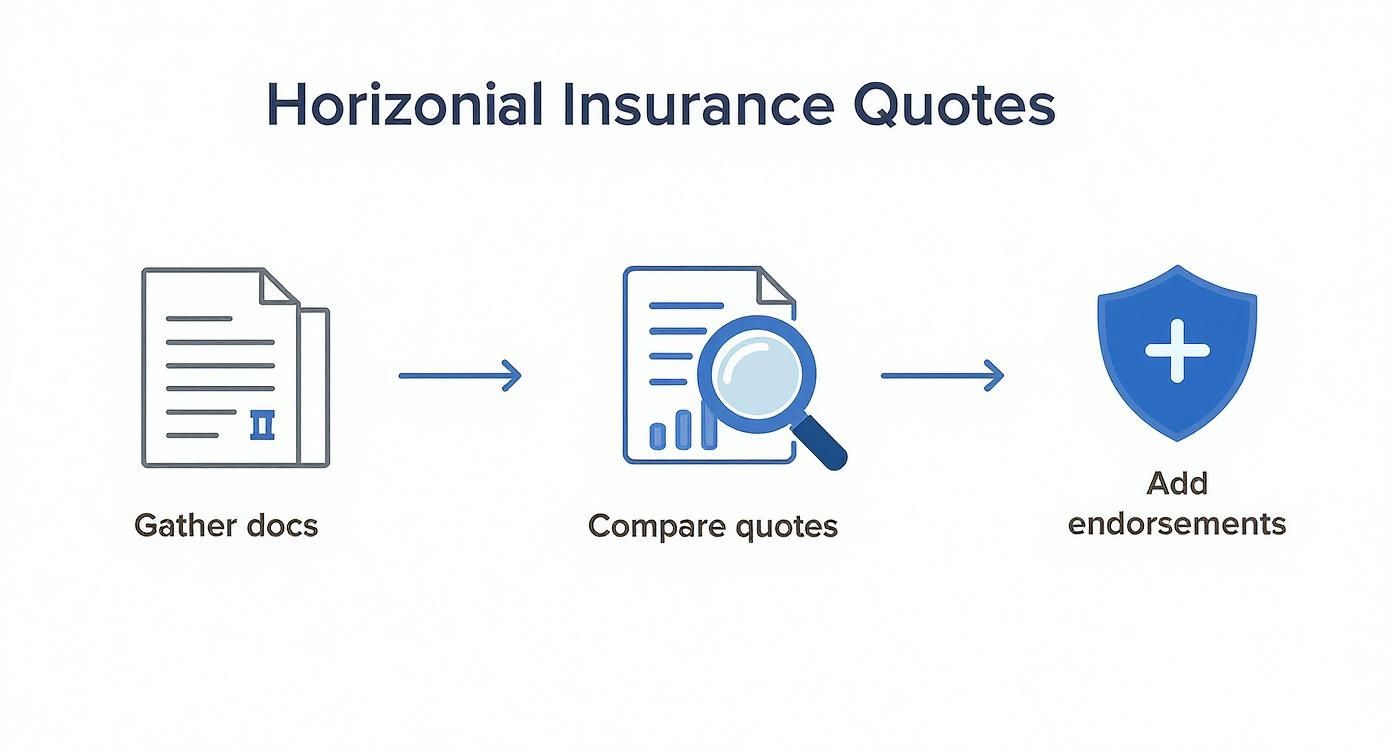
As you can see, getting the right insurance is really about having your documents in order, understanding your choices, and then layering on the right endorsements to build a policy that truly protects you.
Better Coverage, Better Price
Our licensed agents are pros at uncovering savings you might miss on your own. We’re always looking for ways to apply credits for a loss-free history or to find you better terms when it's time for renewal.
One of the most effective strategies we use is bundling. Combining your home and car insurance can often lead to substantial discounts, sometimes making a robust private policy more affordable than sticking with a separate FAIR Plan and DIC policy.
If you're currently with the FAIR Plan, we don't just leave you there. We proactively monitor the market and will help you transition back to a traditional insurance carrier the moment one becomes available in your area. This ensures you get superior coverage as soon as possible.
Securing the right policy isn't just about finding a low premium; it’s about ensuring every dollar you spend delivers maximum protection. The goal is to build a safety net that truly covers your assets and lifestyle.
We've put together a simple checklist to make sure you have everything you need for a quick, hassle-free sign-up or renewal.
Ready to see what’s out there? You can get an instant insurance quote through our site to compare top-rated California carriers for home, auto, and more in just a few minutes.
Your FAIR Plan Questions, Answered
If you're navigating the California FAIR Plan, you've probably got questions. It's a different beast than standard insurance, and it's completely normal to feel a bit unsure about what you have and what you need. Let's tackle some of the most common questions we hear from homeowners.
What Exactly Is The California FAIR Plan?
Think of the FAIR Plan as the state's safety-net insurer. It was created to be the "insurer of last resort" for homeowners who can't get coverage from a regular insurance company, which is often due to high wildfire risk.
To get on the plan, you generally have to prove you’ve been denied coverage elsewhere. It’s not a choice for most; it’s a necessity when private carriers say no.
How Is FAIR Plan Coverage Different From A Standard Policy?
This is the most critical difference to understand. A FAIR Plan policy is a bare-bones, foundational plan. It covers specific, named perils—think fire and smoke—and that's about it.
A standard policy from a private insurer is usually much broader, often an "all-risk" policy that covers everything except for what’s specifically excluded. A thorough California FAIR Plan review is the only way to see just how wide that gap is for your specific property. This is a key aspect of California insurance that many residents need to understand.
Can I Get Wildfire Or Earthquake Coverage?
Yes, but they aren't standard. You can add coverage for both wildfire and earthquake damage through endorsements, but each comes with its own separate premium and deductible.
Don't just add them and assume you're set. You need to look closely at the coverage limits. Is $100,000 for a wildfire rebuild enough? What's the earthquake deductible—15%? These details matter immensely.
The goal is to piece together coverage that acts like the comprehensive policy you wish you could buy. This often means combining the FAIR Plan with a Difference in Conditions (DIC) policy. For more answers, check out our complete California insurance FAQ page.
Ready to see if you can close those gaps and find better protection? The team at Mai & Associates can run the numbers for you. We provide same-day quotes for home insurance, auto insurance, life insurance, and renters insurance, comparing your FAIR Plan against top-rated private carriers to find your best fit. Start your free quote now.