California Fair Plan Property Insurance: Your 2026 Guide

You open your mail, see a non-renewal notice, and your stomach drops. That reaction is normal. For a lot of California homeowners, the issue isn't whether they've been responsible. It's that the private market has tightened, especially in wildfire-exposed areas, and carriers are pulling back.
If that's where you are, the California FAIR Plan may be the only path to keep fire insurance in place. But don't make the mistake I see all the time. The FAIR Plan is not a full homeowners policy. It's a starting point. If you treat it like a complete replacement for the home insurance you lost, you can end up badly exposed.
That matters beyond your house. Good California insurance planning is connected. Your home insurance, auto insurance, renters insurance for family members, car insurance liability limits, and life insurance should work together. When one piece changes, you need to review the rest.
Why California Homeowners Turn to the FAIR Plan
Shopping for california fair plan property insurance isn't typically a first choice. It becomes necessary after a carrier refuses new business, declines renewal, or won't write a home in a wildfire-prone area.
A common version of this story looks like this. A homeowner has paid on time for years, maybe made updates to the property, maybe never filed a major claim. Then the renewal offer doesn't come. Instead, they get notice that coverage is ending, and suddenly they need a lender-compliant fire policy fast.
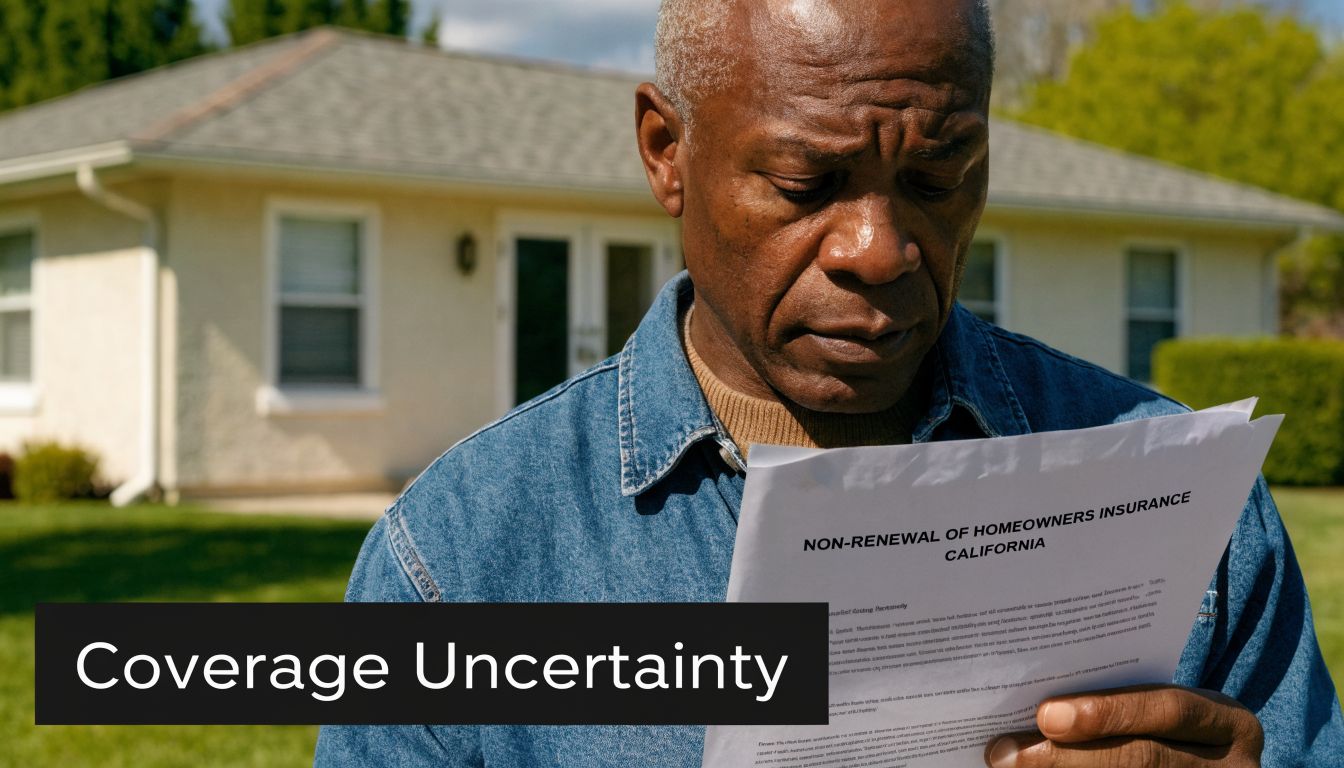
That's where the FAIR Plan steps in. It was created in 1968, but its role today is much larger than many homeowners realize. As of March 2026, the Plan reported $750 billion in total exposure, which was up 242% since September 2022, according to the California FAIR Plan key statistics page.
What that growth means for you
This isn't some rare edge-case product anymore. It has become a core part of the California home insurance safety net for people who can't get standard market coverage.
If you've been pushed into this market, you're not alone, and you're not automatically uninsurable. You're dealing with a market problem, not a personal failure.
Practical rule: If you've been non-renewed, your first job is continuity. Get fire coverage in place first. Then fix the gaps.
A lot of homeowners freeze because they think they need the perfect replacement policy immediately. You don't. You need a workable structure that protects the home now and then gets upgraded into a fuller protection plan.
Start with the right mindset
Use the FAIR Plan as one component, not the whole answer. You can read more about broader California home insurance options, but the key point is simple: fire coverage alone is not enough.
Your real goal isn't just getting a policy issued. Your goal is rebuilding a protection package encompassing the house, your liability exposure, your belongings, and the common losses the FAIR Plan leaves behind.
Understanding the FAIR Plan's Role for California Insurance
Think of the FAIR Plan as an emergency fire access system for homeowners who've been shut out of the regular market. It exists so a home doesn't go completely uninsured for basic property risks just because standard carriers won't offer coverage.
That doesn't mean it's a government homeowners policy. It isn't. The California FAIR Plan is a syndicated fire insurance pool backed by all property/casualty insurers licensed in California, not a state agency. For residential properties, the current maximum coverage limit is $3 million per location, according to the California FAIR Plan overview.
What the FAIR Plan is designed to do
Its job is narrow. It provides access to basic property insurance when the voluntary market says no.
That narrow mission matters because homeowners often expect it to behave like the HO-3 policy they used to have. It doesn't. It was built for availability, not broad convenience.
Here's the cleanest way to understand it:
- It is a last-resort access point: It helps homeowners get basic property coverage when standard insurers won't write the risk.
- It is not a taxpayer-funded bailout: Private insurers that are licensed in California back the pool.
- It is not broad protection: It addresses a specific insurance availability problem, not every loss a homeowner might face.
Why this distinction matters in real life
If you assume “state-backed” means broad, flexible, or easy to dispute, you'll go in with the wrong expectations. Read every form. Confirm every endorsement. Keep copies of notices and applications.
If a claim dispute or coverage interpretation issue turns serious, legal guidance may matter. Homeowners dealing with coverage disagreements can review what Lerner & Weiss APC insurance lawyers handle to understand when an insurance law issue goes beyond routine customer service.
The FAIR Plan is there to get you through a market access problem. It is not there to recreate the full homeowners policy you used to have.
Where it fits in a broader insurance plan
I tell clients to stop looking at the FAIR Plan in isolation. Your insurance portfolio should be coordinated. If your home coverage just changed, review your umbrella eligibility, car insurance liability structure, and life insurance needs too.
That broader planning mindset is what makes the difference between “I found a policy” and “I protected my household.” For more educational resources on related California insurance topics, see these insurance guides for California consumers.
What Your FAIR Plan Policy Actually Covers
A common pitfall for homeowners arises when they hear “property insurance” and assume it functions like ordinary home insurance. A basic FAIR Plan policy doesn't.
It's a named peril policy. That means it covers specific causes of loss listed in the form, rather than the broader open-peril approach many homeowners are used to.
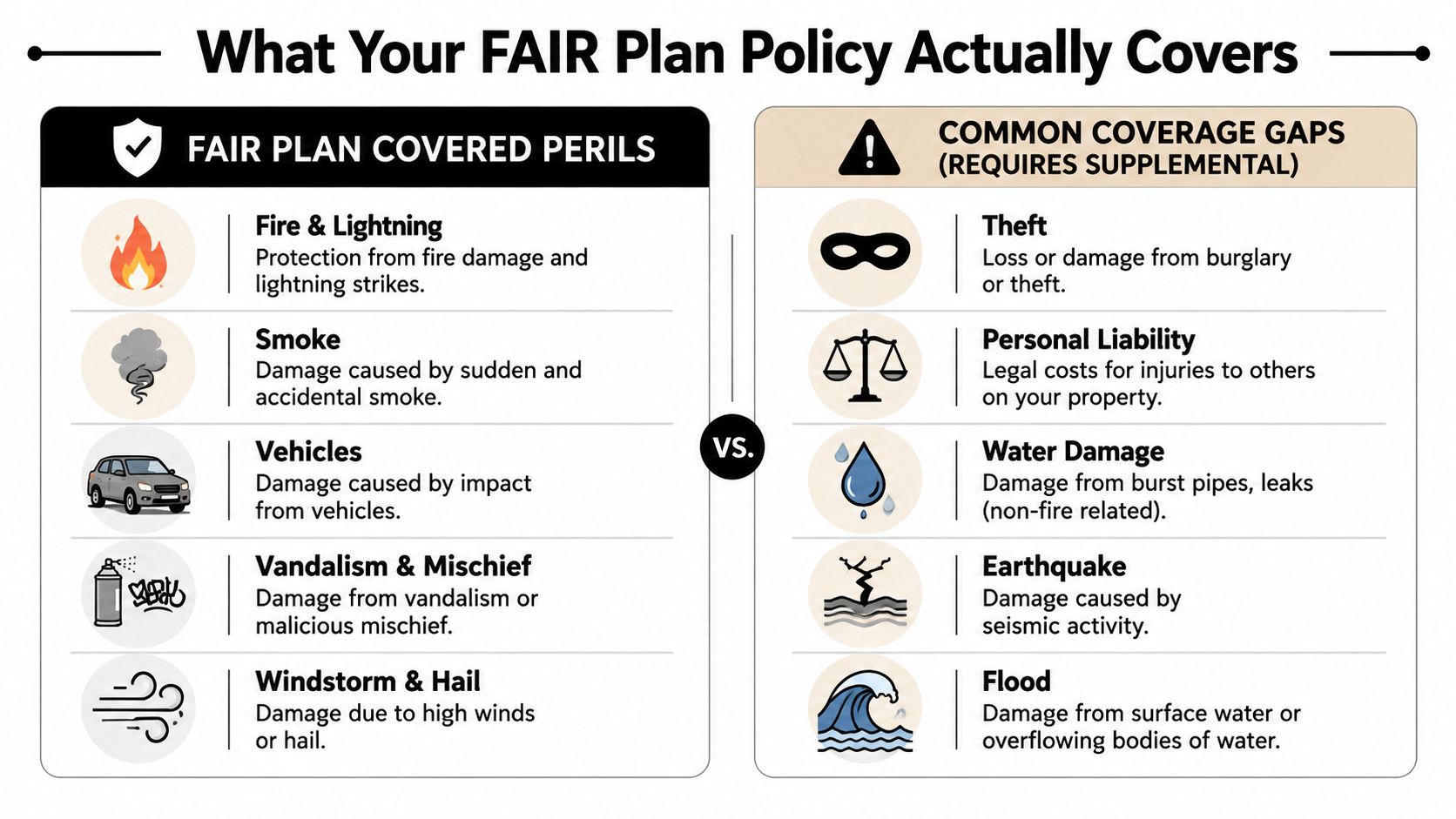
A practical consumer summary from Bankrate's California FAIR Plan explainer notes that a basic California FAIR Plan policy is limited to named perils like fire, lightning, and smoke, and does not include liability coverage, theft, water damage, or windstorm protection that are standard in most HO-3 policies.
What's commonly included
At the basic level, think fire-focused protection. The policy is meant to address a narrow set of property perils, not the broad range of everyday homeowner exposures.
That means your mortgage lender may accept it for minimum fire insurance purposes, but your financial exposure may still be huge.
What homeowners often assume is included, but isn't
In these instances, losses become expensive:
- Liability claims: If someone is injured on your property, basic FAIR Plan coverage doesn't automatically step in the way a normal homeowners policy would.
- Theft losses: Burglary and stolen property can become your problem if you didn't add the right supplemental policy.
- Water damage: Burst pipes, interior leaks, and other non-fire water issues are where many homeowners get blindsided.
- Wind and other broader perils: This is one of the biggest misunderstandings when people move from standard home insurance into FAIR Plan coverage.
FAIR Plan vs Standard Home Insurance HO-3
| Coverage Type | California FAIR Plan (Basic) | Standard HO-3 Policy |
|---|---|---|
| Fire and lightning | Covered | Covered |
| Smoke | Covered | Covered |
| Internal explosion | Covered | Covered |
| Liability protection | Not included in basic policy | Typically included |
| Theft | Commonly excluded without supplemental coverage | Typically included |
| Water damage | Commonly excluded without supplemental coverage | Typically included, subject to policy terms |
| Broader open-peril dwelling coverage | No, basic policy is named peril | Yes, typically broader |
| Personal property coverage | Limited or handled separately | Typically included |
| Detached structures | Limited or handled separately | Typically included |
| Additional living expenses | May require supplemental coverage | Typically included |
The blunt truth
A FAIR Plan policy can keep the lights on with your lender, but it can still leave you dangerously underprotected. That's why I never advise a homeowner to stop after getting the FAIR Plan bound.
If your old insurer gave you a full homeowners policy and you replaced it with only a FAIR Plan basic form, you did not replace your old coverage. You downgraded it.
Before you buy anything, compare every protection category line by line. If you want a useful place to organize your questions before speaking with an agent, review these California insurance FAQs.
How to Supplement Your FAIR Plan Coverage
The right move is to treat california fair plan property insurance like one half of a rebuilt homeowners solution. The second half is usually a Difference in Conditions policy, often called a DIC policy, plus any needed endorsements.
That combination is how many homeowners replace the protection they lost when a standard carrier non-renewed them.

Market pressure is a big reason this combo has become common. A California Department of Insurance fact sheet says California accounted for 20% of all U.S. non-renewed policies in 2023, and Moody's estimated FAIR Plan uptake offset about 60% of those non-renewals. The same fact sheet shows how widespread FAIR Plan use has become in the state's residential market. See the California Department of Insurance fact sheet.
What a DIC policy usually does
A DIC policy is the piece that fills major gaps the FAIR Plan leaves open. The exact form depends on the carrier, but the purpose is consistent. It helps rebuild the parts of a normal homeowners policy that basic FAIR Plan coverage doesn't provide.
In plain English, the FAIR Plan handles a narrow slice. The DIC policy helps restore the rest.
The coverage-combo strategy that actually works
Use this checklist when reviewing options:
Lock in the FAIR Plan first
Get the fire-focused policy in force so the property isn't left exposed while you shop for the rest.Match a DIC policy to the FAIR Plan
Ask specifically how the DIC handles liability, theft, water damage, loss-of-use type exposures, personal property, and other common gaps.Review endorsements carefully
Don't assume a policy “includes” something because the agent mentioned it in conversation. Confirm whether it is built into the form or added by endorsement.Check for overlap and holes Two policies can still leave a gap if one assumes the other covers something and neither does.
Questions to ask before you bind
Don't settle for vague assurances. Ask direct questions:
- If a pipe bursts, which policy responds?
- If someone falls on my property, where is the liability coverage?
- If personal property is stolen, is that covered at all?
- If I have to live elsewhere after a covered loss, what pays for that?
Agent's view: The most expensive FAIR Plan mistake isn't paying more premium. It's believing you bought complete protection when you only bought partial protection.
A licensed broker can help put those pieces together. One option homeowners use is Mai & Associates quote support for California insurance, which can help compare available combinations and review coverage gaps with the FAIR Plan structure in mind.
Steps to Secure and Manage Your FAIR Plan Insurance
The process feels bureaucratic the first time. It's manageable if you stay organized and move in order.
Step one, confirm the problem and act early
Once you receive a non-renewal notice, don't wait until the final week. Gather your current declarations page, the non-renewal notice, prior loss history if requested, and basic property details.
If you delay, you lose your advantage and time. Last-minute insurance decisions are where homeowners miss exclusions, forget supplemental coverage, or accept a poor fit just to get something issued.
Step two, work through a licensed property insurance agent or broker
The FAIR Plan is typically accessed through a licensed California property insurance professional. That matters because the application is only one part of the job. You also need someone to review whether the FAIR Plan alone is enough for your lender and your actual risk exposure.
A competent agent should help you answer practical questions, not just submit forms.
- Eligibility review: Can you obtain coverage in the standard market, or are you clearly in last-resort territory?
- Property details: Expect questions about construction, location, occupancy, and condition.
- Coverage selection: You'll need to choose limits carefully, especially if your prior policy had broader protection.
Step three, expect underwriting scrutiny
The FAIR Plan exists to provide access, but that doesn't mean every property sails through without questions. Underwriters may want clarification on property characteristics, condition issues, or other risk details.
Be accurate. Don't guess. If the square footage, updates, occupancy use, or prior claims picture is wrong on the application, you create problems for yourself later.
Step four, build your claims file before you need it
If a loss happens, document everything. Save photos, receipts, notices, policy forms, endorsements, and all communications.
That sounds obvious, but many homeowners don't keep a full policy packet. Then a claim happens and they can't prove what was added or what was missing.
After a loss, the homeowner who has organized records usually gets through the process with fewer avoidable disputes.
Step five, review the policy every renewal
This isn't “set it and forget it” insurance. Homes change. Costs change. Coverage forms change. Supplemental policies change.
Review the full package every year, especially if you renovated, bought expensive items, changed occupancy, or adjusted other California insurance lines like auto insurance or life insurance. The goal is coordinated protection, not random separate policies.
Avoiding Common Mistakes with Your California Insurance
Most FAIR Plan problems are self-inflicted. Not because homeowners are careless, but because the forms are unfamiliar and the assumptions they bring from standard home insurance no longer apply.

A major consumer warning from Kin's FAIR Plan coverage discussion is that policyholders often need a separate Difference in Conditions policy to cover water damage, liability, and theft. That's exactly where surprise out-of-pocket losses happen.
Mistake one, treating the FAIR Plan like full home insurance
This is the classic error. A homeowner gets the FAIR Plan, sees the word “policy,” and mentally checks the box.
Don't do that. Basic FAIR Plan coverage is narrow. If you stop there, you may have satisfied a lender requirement while leaving yourself exposed to common losses.
Mistake two, forgetting the second policy
Some homeowners buy the DIC policy, then fail to track renewal dates and endorsements as carefully as the FAIR Plan itself. That's a problem.
Your protection package only works if both pieces stay active and coordinated.
- Track both renewal dates: Put them on your calendar well in advance.
- Keep both declarations pages: You need them together, not separately stuffed into different folders.
- Ask for a full annual review: One policy change can affect the entire setup.
Mistake three, underinsuring the property
When homeowners are stressed after non-renewal, they often focus only on price. That's understandable, but dangerous.
If your limits don't reflect the home you own, the policy may be in force and still fail you when the loss is large.
Mistake four, ignoring the rest of the household risk plan
A homeowner who has just been non-renewed should also review:
- Auto and car insurance liability limits: Home liability changes can affect your broader personal risk posture.
- Renters insurance for family members: Adult children or relatives in separate residences need their own coverage.
- Life insurance needs: If housing costs and rebuilding risk would strain the family budget, life insurance deserves a fresh look too.
This is why expert review matters. A sharp agent doesn't just place a FAIR Plan application. They look for holes across the entire household insurance picture.
Your FAIR Plan Questions Answered
Can a FAIR Plan application be denied
Yes. Availability doesn't mean automatic approval. The property still has to meet underwriting requirements, and the application has to be accurate and complete.
Will a FAIR Plan policy satisfy my mortgage lender
It may satisfy the lender's fire insurance requirement, but that doesn't mean it gives you full homeowners protection. You still need to review the missing pieces, especially liability and common non-fire losses.
Is a FAIR Plan plus DIC policy more expensive than regular home insurance
It often feels less efficient than a traditional homeowners policy because you're rebuilding coverage in separate parts. The right question isn't just price. It's whether the combination protects you from the losses most likely to hit your household.
How can an agent help beyond the house itself
A good agent should coordinate your full California insurance picture, including home insurance, auto insurance, car insurance liability, renters insurance needs in the household, and life insurance planning. That review matters when one major policy changes.
If you need help sorting out california fair plan property insurance after a non-renewal, Mai & Associates can review your existing coverage, identify the gaps between a FAIR Plan and a DIC policy, and help you compare practical options for home, auto, renters, and life insurance in California.