California FAIR Plan Premium Calculator: A How-To Guide

You open the mail, see a non-renewal notice, and the first question hits fast. How am I supposed to insure this house now?
That reaction is normal. For many California homeowners, especially in higher wildfire-risk areas, the next step is looking up the California FAIR Plan premium calculator and hoping the number on the screen will bring some clarity. It can help, but only if you treat it as a starting point instead of a final answer.
A FAIR Plan estimate tells you one important part of the story. It does not tell you whether your overall protection is complete, whether your deductible is realistic for your household, or whether you still have major gaps in liability, water, earthquake, auto, renters, or life insurance planning. Those are separate decisions. They matter just as much.
Navigating Your California Home Insurance Options
A lot of homeowners land here after a stressful week. Their insurer has pulled back. Their mortgage still requires coverage. Their real estate taxes, utilities, and maintenance costs haven't gone down. But now the insurance piece feels unstable.
That's where the FAIR Plan usually enters the conversation. It exists for people who can't get coverage in the traditional market. The California FAIR Plan was established by statute in August 1968, and it isn't taxpayer-funded. It's backed by all property and casualty insurers licensed in California. As of March 2026, the plan reported $750 billion in total exposure, up 242% since September 2022, which shows how much its role has expanded as more properties move into harder-to-place risk categories, according to the California FAIR Plan Association overview.

If you're in this position, the goal isn't to panic-shop. It's to make clean, informed decisions in the right order.
What homeowners should do first
Start with the immediate need. You need a property policy path, and you need it fast enough to avoid a lapse. That often means reviewing your replacement cost, collecting basic property details, and using the FAIR Plan calculator to get an early estimate.
Then zoom out. Your home policy should fit into the rest of your protection plan. If you already have a standard policy elsewhere for another property, a renters policy, or bundled auto coverage, this is the moment to review the whole picture, not just one premium line item. A broader California home insurance review can help you sort out where FAIR Plan coverage fits and where it doesn't.
Practical rule: Use the calculator to regain control, not to make assumptions. It gives you a pricing direction, not a complete insurance strategy.
Why the estimate matters, but only as a first step
A homeowner in a hillside area may see an estimate that looks much higher than the premium they used to pay. That doesn't automatically mean the number is wrong. It may mean the property is now being priced in a very different risk environment.
The better mindset is this. The calculator is your first strategic move. It helps you answer, “What might the FAIR Plan portion cost?” The next question is the one that protects you better: “What else do I need so this policy works for my household?”
What the FAIR Plan Covers and What It Does Not
The FAIR Plan is often misunderstood because people assume it works like a standard homeowners policy. It doesn't. That misunderstanding causes expensive mistakes.
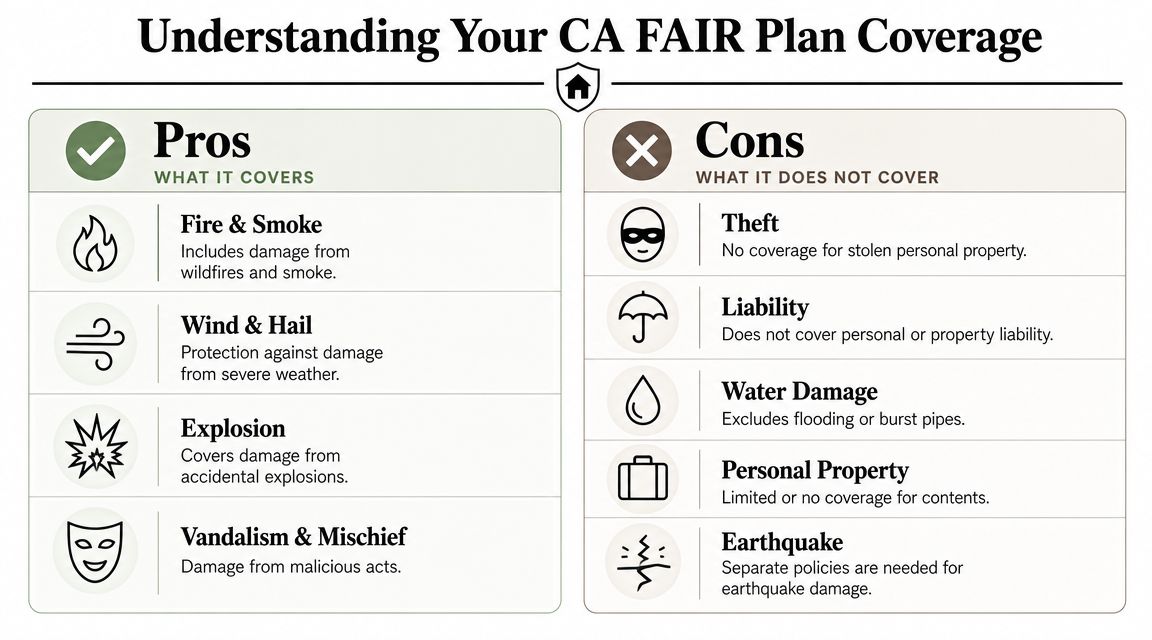
The FAIR Plan is a basic property solution for higher-risk situations. It can be essential coverage when the regular market says no, but it is not the same thing as broad homeowners insurance.
What the FAIR Plan is meant to do
Think of it as the property-fire side of the equation. It's there to give eligible Californians access to coverage when traditional carriers won't write the risk.
For homeowners, that means the estimate you get from the California FAIR Plan premium calculator is usually estimating only part of what you ultimately need. If you stop there, you may believe you're fully insured when you're not.
What that means in practical terms
A FAIR Plan policy can help with core property risks, but homeowners should not assume it includes the full protection many standard policies package together. Areas that often require separate attention include:
- Liability exposure: If someone is injured on your property or you cause damage to someone else's property, that's a different issue from insuring the structure itself.
- Water-related losses: Homeowners often assume sudden pipe issues or similar damage will fall into the same bucket as fire protection. They shouldn't assume that.
- Theft and broader contents protection: Personal belongings and full contents protection need careful review.
- Earthquake risk: In California, that's its own conversation. It should be handled directly, not assumed.
- Living arrangement disruption: If a loss makes the home difficult to occupy, you need to know what part of your insurance program responds.
That's why many homeowners pair FAIR Plan coverage with a Difference in Conditions policy, often called a DIC policy. A DIC policy is what turns a basic property solution into something closer to a usable overall protection package.
The two-policy mindset works better
If you remember one thing, make it this. Don't ask, “What does the FAIR Plan cost?” Ask, “What will my full home insurance structure cost once the gaps are addressed?”
That's also true for condo owners, landlords, and even renters navigating higher-risk locations. A basic property policy doesn't replace a full review of your household risk. If you're trying to coordinate personal property and liability protection outside a homeowners setup, a California renters insurance guide can help frame what belongs where.
The safest way to view FAIR Plan coverage is as one piece of a two-part build, not a finished product.
A Step-by-Step Guide to the Premium Calculator
The California FAIR Plan premium calculator works best when you slow down and enter the property details the way an underwriter would want to see them. Rushing through it usually creates a number that looks precise but isn't useful.
The most important point comes straight from the program itself. The calculator is a non-binding pre-application tool. It is based on the information you enter and is not a contract, binder, or offer of coverage, according to the California FAIR Plan premium calculator page.
Start with the right home value
The biggest input mistake is using market value instead of replacement cost value.
Those are not the same thing. Market value reflects what a buyer might pay for the home, taking land, neighborhood demand, school district appeal, and other real estate factors into account. Replacement cost value is about what it would take to rebuild the dwelling. The FAIR Plan calculator is driven by rebuild cost and location, not resale value.
If you enter a market price because it's the number you know off the top of your head, the estimate can be distorted from the start.
Agent's rule of thumb: If the number came from a listing site, a refinance estimate, or a recent sale in your neighborhood, it may be useful for real estate. It isn't the number the FAIR Plan calculator is built around.
Work through the property details carefully
When you use the calculator, gather your information first. You want the home details to match the property as it exists today, not as it appeared years ago in an old insurance file.
Focus on these items:
Dwelling amount
Use the replacement cost value for the structure. This is the anchor point for the estimate.Property location
Address accuracy matters. Even small location differences can affect how the property is viewed.Construction and age
The year built and construction type can influence the estimate. If the home has been materially updated, make sure your records reflect that.Coverage choices
Don't click through deductibles and options casually. Those selections change how much risk you keep and how much premium you pay.Insurance history
Be accurate. Cleaning up details later is harder than entering them correctly up front.
What works and what doesn't
What works is treating the calculator like a planning tool. Save the estimate. Compare deductible options. Check whether the dwelling figure still makes sense after a rebuild-cost review. Use the estimate to prepare for the conversation that comes next.
What doesn't work is treating the number as final, then building your household budget around it before the policy structure is complete.
For homeowners who need a broader framework around these decisions, the insurance resources in Mai & Associates guides can help you think through property, liability, and companion coverage issues in a more organized way.
Before you click submit
Pause and ask yourself three questions:
- Did I use rebuild cost, not market price
- Does the dwelling amount reflect the house as it stands now
- Am I looking for an estimate, or am I mistakenly treating this as a final quote
If you can answer those clearly, your estimate will be much more useful.
Key Factors That Drive Your FAIR Plan Costs
Once you get a number from the calculator, the next question is usually, “Why is it this high?” That's the right question.
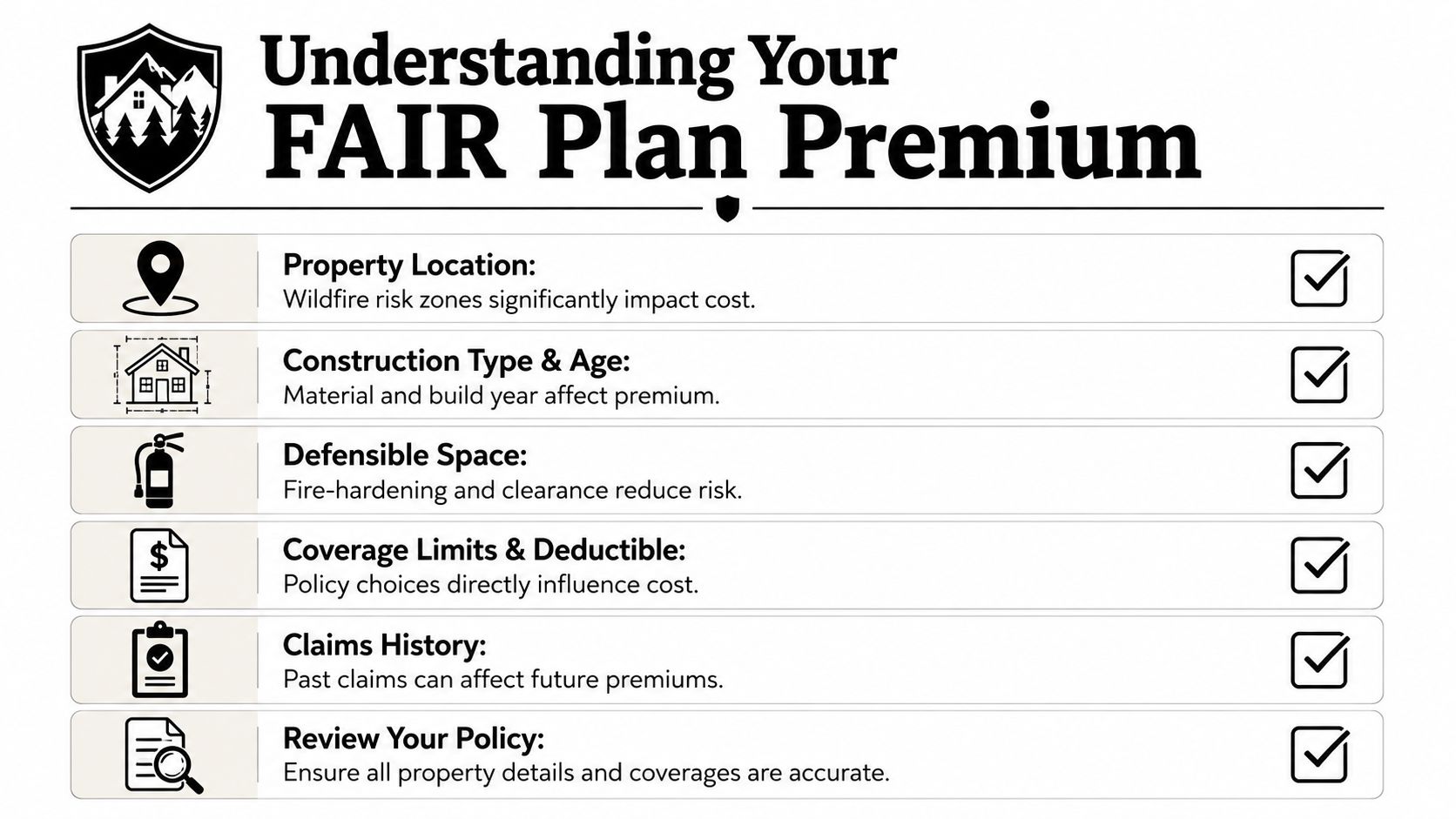
A FAIR Plan premium isn't random. It reflects a combination of coverage amount, property characteristics, location, and the choices you make inside the estimate. As a benchmark, a widely cited average annual FAIR Plan premium is about $3,200, compared with about $1,480 for a standard California homeowners policy, which means FAIR Plan pricing is more than double the typical standard-market price in that comparison. The plan also has a combined maximum coverage cap of $3 million for dwelling, other structures, and personal property, according to Bankrate's California FAIR Plan overview.
The cost drivers that matter most
Three factors usually shape the estimate more than anything else:
| Cost driver | Why it matters |
|---|---|
| Dwelling coverage selected | Higher replacement cost generally means a higher premium because more structure value is being insured. |
| Property location | Homes in wildfire-exposed or harder-to-place areas are priced differently from lower-risk locations. |
| Deductible choice | A higher deductible can reduce premium, but it also increases what you would need to absorb yourself after a covered loss. |
Those are the levers homeowners should understand before they decide the quote is reasonable or unreasonable.
A simple way to compare estimate scenarios
The calculator becomes more useful when you run more than one version. Don't use it once and stop. Use it to test how your choices change the result.
Here's a sample comparison format you can use for your own planning:
| Dwelling Coverage | Deductible | Estimated Annual Premium |
|---|---|---|
| Replacement cost value entered for the home | Lower deductible selected | Higher estimate relative to a higher-deductible version |
| Replacement cost value entered for the home | Higher deductible selected | Lower estimate relative to a lower-deductible version |
| Higher dwelling amount entered | Same deductible | Higher estimate relative to a lower dwelling amount |
This is intentionally a planning table, not a promise of rates. It shows how to think, not what your exact result will be.
Benchmark the estimate without overreacting
If your estimate comes in above what you used to pay in the standard market, that alone doesn't mean something is wrong. FAIR Plan pricing sits in a different part of the insurance market.
For a broader look at how homeowners insurance pricing compares in California, Home Ready Calculator's insurance analysis is a useful companion read. It helps put the difference between standard-market pricing and higher-risk property pricing into context.
A good estimate is one you understand. A confusing estimate is where bad decisions start.
Don't ignore the coverage cap
The $3 million combined cap matters most for larger or more expensive properties. If your rebuild exposure and related property needs push toward that ceiling, you need to know it early.
That's not a reason to avoid the calculator. It's a reason to use it strategically and then review whether the final structure can support the property you're trying to protect.
Why Your Premium Might Seem Too High or Too Low
Two homeowners can live in the same city and get very different FAIR Plan estimates. That surprises people until they look at the details.
One home may have a different location profile, a different construction profile, a different replacement cost, or a different deductible. Sometimes the issue isn't the house at all. It's the data entered into the calculator.
Common reasons the estimate feels off
If the number looks too high or too low, check these first:
- Replacement cost error: This is still the first place I'd look. A wrong dwelling value can throw off the estimate quickly.
- Address mismatch: If the tool struggles with the address or the location details are off, the result may not reflect the actual property.
- Deductible selection: Some homeowners click a lower deductible without realizing how much that can affect cost.
- Outdated property details: If the roof, updates, or build details aren't entered accurately, the estimate may not line up with reality.
The payment option also affects planning
Sometimes the premium itself isn't the only issue. The billing structure catches people off guard.
The FAIR Plan's triannual billing requires a 40% down payment, followed by two 30% installments, and both monthly and triannual payment options add a $4.50 fee per payment, which can total up to $54 per year, according to the FBIA FAIR Plan cost guide.
That matters when a homeowner says, “I can handle the annual number,” but hasn't looked at how the payments land during the year.
If the estimate fits your annual budget but the billing schedule strains your cash flow, the policy still may not feel workable in real life.
What to do when the result still doesn't make sense
Review every field before assuming the price is unfair. Then compare a few versions using different deductible choices and a confirmed replacement cost figure.
If the estimate is still confusing, treat that as a signal to get a second set of eyes on the policy structure, not as a reason to guess.
Your Next Steps for Complete California Insurance Protection
The California FAIR Plan premium calculator helps you get oriented. That's useful. It is not the finish line.
The next step is building the protection around that estimate. For many homeowners, that means pairing the FAIR Plan with a DIC policy, deciding whether earthquake coverage belongs in the package, and checking whether the deductible and payment structure fit the household budget. It's also a smart time to review the rest of your insurance. Auto insurance, renters coverage for other properties, and life insurance often get ignored when a home policy problem suddenly takes center stage.
If you want help moving from estimate to actual coverage design, request an insurance quote and have the whole risk picture reviewed at once. Mai & Associates handles California auto, home, renters, life, FAIR Plan review, and earthquake coverage conversations, which is useful when you're trying to solve more than one insurance problem at the same time.
The homeowners who make the best decisions here usually do two things well. They don't assume the calculator number is final, and they don't assume a FAIR Plan policy by itself equals complete protection.
If you're sorting through a non-renewal, trying to price FAIR Plan coverage, or figuring out whether you also need DIC, earthquake, auto, renters, or life insurance review, Mai & Associates is a practical place to start. The agency works with California households across multiple coverage lines, offers multilingual support, and can help turn a rough estimate into a coordinated insurance plan.