California FAIR Plan Cost: A 2026 Homeowner's Guide
You open the mail, see a non-renewal notice, and your stomach drops. If your home insurer is pulling out because of wildfire risk, the first question usually isn't academic. It's immediate. How am I supposed to insure my house now, and what is this going to cost me?
That's where the California FAIR Plan usually enters the conversation. For many homeowners, it isn't a good option so much as the only available one after standard insurers say no. The frustrating part is that people often focus on the FAIR Plan premium by itself, when the core issue is the total cost of adequate coverage. A bare-bones fire policy can leave major gaps, so the number on the first quote often isn't the whole story.
If you're trying to understand California FAIR Plan cost, it's similar to replacing a canceled homeowners policy with a patchwork solution. One piece may cover the structure for limited perils. Another piece may be needed for liability, theft, water damage, or living expenses after a loss. That combination is what matters.
Your Homeowners Policy Was Canceled Now What
A non-renewal letter can make you feel cornered. You may have a mortgage. You may live in a canyon, near brush, or in a ZIP code that insurers now view differently than they did a few years ago. None of that changes the fact that you still need coverage in place.
The California FAIR Plan exists for exactly this situation. The California Department of Insurance describes it as an option for people who can't obtain regular coverage in the standard market, which is why it's often called the insurer of last resort. That doesn't mean it's a scam, and it doesn't mean you've done anything wrong. It means the private market declined the risk.
Start with the immediate checklist
When clients are in this spot, I usually tell them to slow down and handle the problem in order:
- Check your cancellation and expiration dates. You need to know when your current policy ends so you can avoid a lapse.
- Gather your current declarations page. That shows your current dwelling coverage, deductible, endorsements, and liability limits.
- Pull together basic property details. Roof age, updates, square footage, and photos often matter.
- Ask for both the FAIR Plan option and any companion policy options. A FAIR Plan quote alone doesn't tell you enough.
Practical rule: Don't compare a canceled HO-3 policy to a FAIR Plan fire-only premium. Compare your old full package to the new full package you would actually need.
Why the cost question gets confusing
People hear "FAIR Plan" and assume it's one standard statewide price. It isn't. Some homes qualify for relatively modest premiums, while others face sharply higher costs because of wildfire exposure, property characteristics, and the need to add separate coverage layers.
That last point matters most. If your old policy bundled property coverage, liability, and common household risks into one contract, replacing it with a FAIR Plan can feel like buying the house in pieces. You may get one policy for fire-related basics and another to fill gaps.
That doesn't make the situation hopeless. It just means you need to price the whole solution, not just the first quote that lands in your inbox.
What the FAIR Plan Covers And What It Doesnt
The simplest way to think about the FAIR Plan is this: it's a spare tire, not a full replacement wheel set. It helps keep you legally and financially moving when standard coverage isn't available, but it isn't built to mirror a standard homeowners policy by itself.
The California FAIR Plan was established more than 50 years ago as a basic fire-insurance backstop, and by March 2026 it reported $750 billion in total exposure after a 242% increase since September 2022, according to the California FAIR Plan key statistics page. That rapid growth tells you how many Californians have been pushed into this fallback market.
What the base policy generally covers
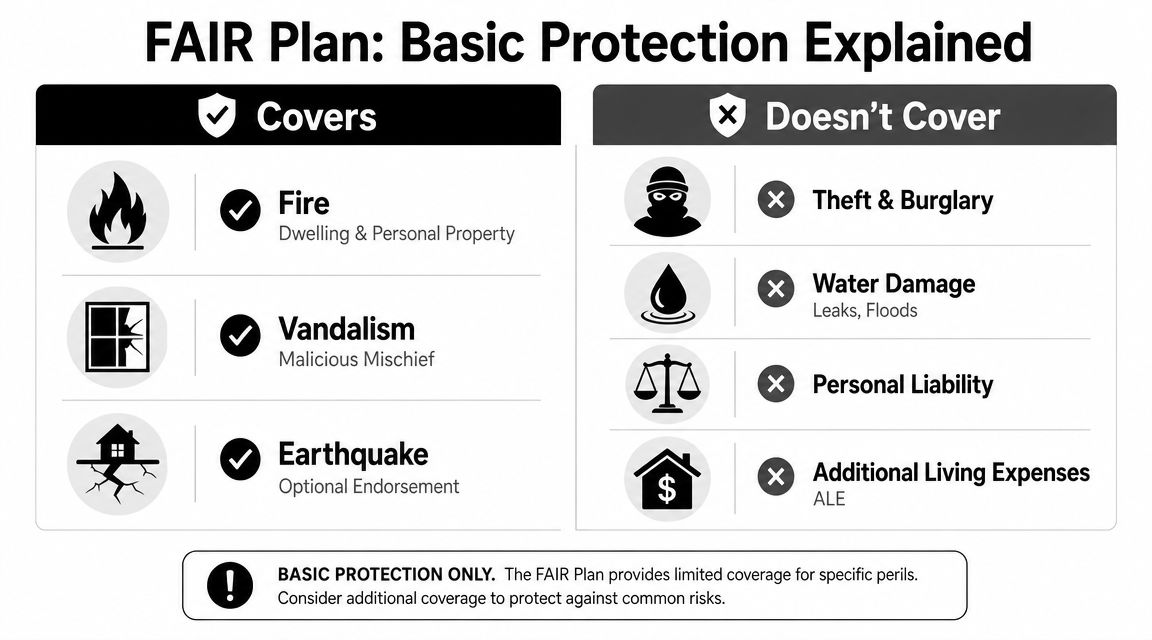
The base FAIR Plan is narrow. Per the California Department of Insurance information summarized in the verified data, it covers basic property perils such as:
- Fire
- Lightning
- Internal explosion
- Smoke
That narrow scope is why people often misunderstand the quote they receive. They think they have "home insurance," but what they really have is a limited property policy.
If you want a broader understanding of how standard policies approach homeowners insurance wildfire coverage, it helps to compare that broader protection with what the FAIR Plan leaves out.
What it usually does not cover in the base form
Homeowners often get caught off guard. The FAIR Plan's base policy does not include key protections that many people assume come with homeowners insurance.
Common gaps include:
- Personal liability. If someone sues you after an injury on your property, the base FAIR Plan doesn't function like a typical liability section in an HO-3.
- Theft and burglary. If someone breaks in and steals property, that's not the same as smoke or fire damage.
- Water damage from common household problems. Burst pipes and similar losses usually fall outside the basic FAIR Plan structure.
- Additional living expenses. If you have to move out after a covered loss, the bare policy may not provide the same kind of help a standard homeowners policy does.
The FAIR Plan is often best understood as basic property protection, not a complete household risk package.
That distinction explains why the California FAIR Plan cost can't be judged by the base premium alone. A policy can appear cheaper at first glance and still leave you badly underprotected.
Key Drivers of Your California FAIR Plan Cost
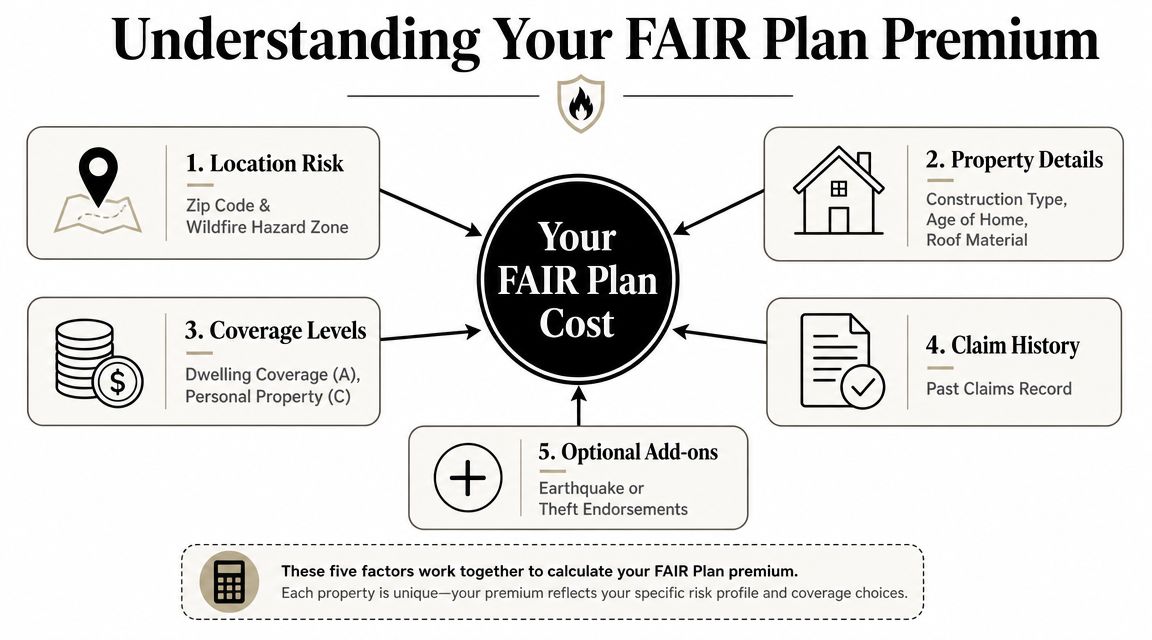
Once you understand the coverage limits, the next question is why one FAIR Plan quote looks manageable and another looks brutal. The answer usually comes down to a handful of rating factors that combine into a risk picture.
The base FAIR Plan also insures dwelling and personal property at actual cash value, and homeowners often need separate Difference-in-Conditions, earthquake, flood, or liability coverage to approximate a standard policy. The FAIR Plan can insure dwelling limits up to $3 million, and the insured must provide a defensible replacement-cost estimate to avoid underinsurance or overpaying, according to Bankrate's California FAIR Plan overview.
Location matters first
If your home sits near brush, in a canyon, on a steep hillside, or in a wildfire-prone ZIP code, the quote usually reflects that. This is why neighbors in different parts of the state can see wildly different numbers, even when their homes look somewhat similar on paper.
Think of location as the foundation of the quote. Other factors matter, but location often sets the tone.
Your home itself changes the math
Underwriters don't just price the map. They price the structure on the map.
A few property details that commonly affect cost:
- Construction type. Roofing, siding, and vents can influence perceived wildfire vulnerability.
- Age and condition. Older systems and deferred maintenance can create more concern.
- Claims history. A prior loss record can change how an insurer views the account.
- Replacement estimate. If you insure the home for more than needed, you may pay more than necessary. If you insure for too little, you may be exposed after a major loss.
The premium isn't the whole bill
This is the part many homeowners miss. Even if the FAIR Plan premium itself looks high or low, your total insurance cost usually depends on the coverage layers you add to make the package usable.
That often includes some mix of the following:
| Coverage need | Why it affects total cost |
|---|---|
| Liability protection | Often needs separate coverage outside the base FAIR Plan |
| Theft and water damage | Usually requires a companion policy or broader supplemental coverage |
| Earthquake or flood | Separate protection adds another bill if you want those risks covered |
| Better rebuilding alignment | A more accurate replacement estimate can raise or lower what you pay |
A FAIR Plan quote answers only one question: "What does basic fire-focused property coverage cost?" Most homeowners need a second question answered too: "What will it cost to protect the rest of my financial life?"
Sample FAIR Plan Premiums Across California
The easiest way to understand California FAIR Plan cost is to look at how uneven it is across the state. There isn't one clean number that tells the story.
Recent statewide data reported by the San Francisco Chronicle show an average premium of about $2,800 per year, up from about $1,800 four years ago, which means the average is roughly 50% higher than it was in that period, according to the Chronicle's FAIR Plan premium analysis. But averages can hide the actual shock.
One customer in downtown Los Angeles reportedly paid $91 a year, while two homeowners in a high-risk part of San Jose averaged over $21,000 per year. That's not a normal pricing spread you'd expect in a standard market. It's a sign that wildfire exposure and local property conditions are driving very different outcomes.
Sample California FAIR Plan Annual Premiums by Area
| Location / ZIP Code | Average Annual Premium |
|---|---|
| Downtown Los Angeles example | $91 |
| Statewide average | About $2,800 |
| Orinda 94563 | Just under $5,200 |
| Big Sur 93920 | Just over $11,000 |
| Geyserville 95441 | About $11,900 |
| High-risk San Jose example | Over $21,000 |
If you're trying to estimate where your property might land on that range, your city alone won't tell you enough. ZIP code, terrain, brush exposure, access, and home characteristics all matter.
For homeowners trying to compare local options in a dense urban market, this guide to Los Angeles home insurance options can help frame how standard-market pricing differs from FAIR Plan situations.
The big takeaway is simple. Don't let anyone tell you the FAIR Plan "usually costs X" and leave it at that. In California, one neighborhood can live in a completely different insurance reality than another.
How to Lower Your California Insurance Costs
You may not be able to change your ZIP code, but you still have levers. The goal isn't always to force the FAIR Plan premium down. Sometimes it's to reduce your total insurance spend while keeping the protection strong enough to matter after a real loss.
Work on the risk the insurer can see
Carriers respond best to conditions they can verify. A cleaner property profile and better fire resistance may help your account look more insurable over time.
Focus on practical items such as:
- Defensible space. Clear brush and maintain separation around the home where possible.
- Openings and ember entry points. Fire-resistant vents and well-maintained openings can matter.
- Roof and exterior upkeep. Deterioration raises concern, especially in wildfire-prone areas.
- Documentation. Keep photos and records of upgrades so your broker can present the risk accurately.
Adjust the policy structure carefully
You can also influence cost by how the policy is built.
A few smart checks:
- Review your deductible. A higher deductible may reduce premium, but only choose one you could afford after a loss.
- Don't insure based on market value alone. Insurance should be tied to rebuilding needs, not what a buyer might pay for the lot and location.
- Question every add-on. Some endorsements are necessary. Others depend on your risk tolerance and finances.
The cheapest policy is the one that looks affordable until you file a claim. The better target is efficient coverage, not stripped-down coverage.
Shop the package, not just one line item
People can save money in ways they don't expect. Even if you're stuck with the FAIR Plan for the fire portion, you can still shop for the companion policy and review your broader household insurance setup.
That can include:
- Auto insurance bundling opportunities with the carrier writing your supplemental property coverage
- Renters insurance for family members in the household who need separate protection
- Life insurance review so the family isn't relying only on home equity as a safety net
If you want a practical starting point for organizing those decisions, these California insurance guides can help you sort through home, car, renters, and life coverage questions in plain language.
Comparing FAIR Plan vs Private Home Insurance
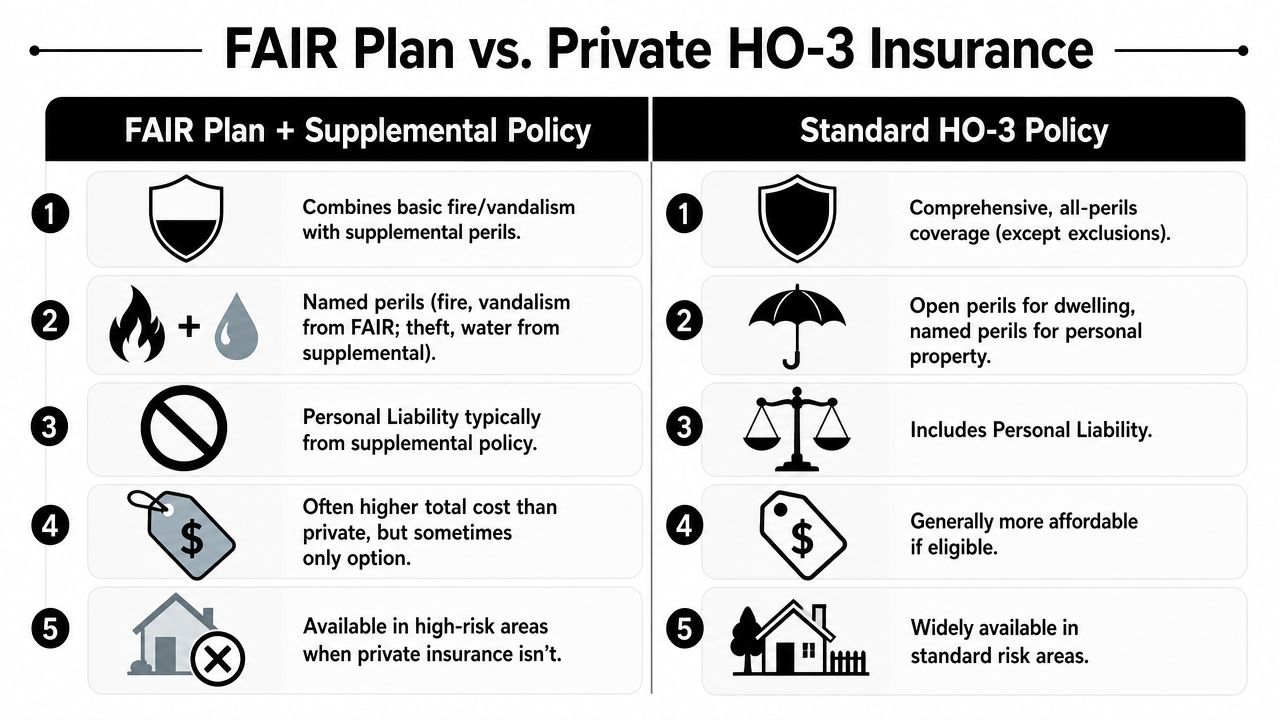
When people compare the FAIR Plan to private homeowners insurance, they often compare the wrong things. The fair comparison isn't FAIR Plan premium vs HO-3 premium. It's FAIR Plan plus supplemental coverage vs a standard private home policy.
That distinction matters because the FAIR Plan was built as limited, last-resort coverage. The California Department of Insurance page cited in the verified data notes that a FAIR Plan spokesperson previously put the average policy cost at about $3,200 per year, while the average California homeowners policy for $300,000 in dwelling coverage was $1,429 in 2025, as summarized on the California Department of Insurance FAIR Plan information page.
Side by side differences
| Feature | FAIR Plan plus supplemental policy | Standard private HO-3 |
|---|---|---|
| Basic structure | Multiple policies working together | One main homeowners policy |
| Fire coverage | Yes | Yes |
| Theft and common water losses | Often through companion coverage | Commonly built in, subject to policy terms |
| Liability | Usually added separately | Typically included |
| Claim experience | May involve more than one insurer | Usually one carrier handling the package |
| Availability | Often used when standard market declines the risk | Available only if the carrier accepts the property |
Convenience matters too
Cost gets the attention, but convenience matters during a claim. If your protection is split between a FAIR Plan policy and a wraparound or DIC-style companion policy, you may end up juggling separate bills, separate documents, and potentially separate adjusters.
That's not always a reason to avoid the setup. For many homeowners, there is no alternative right now. But it is a reason to understand the trade-off before choosing the lowest visible premium.
If you're trying to understand one of the common gap areas, this article on Big Bear homeowners insurance for plumbing gives useful context for how water-related losses can differ from the fire-focused protection of a FAIR Plan setup.
Think beyond the house itself
A complete family protection plan often goes wider than the dwelling policy. Homeowners in high-risk areas should also think about:
- Auto insurance, especially if bundling opportunities exist with a supplemental carrier
- Life insurance, so a disaster doesn't become both a housing crisis and an income crisis
- Earthquake coverage, if that risk matters in your area and financial plan
For a broader look at California home insurance choices, it helps to compare what a standard policy includes before accepting a patchwork solution as equivalent.
Get an Expert FAIR Plan Review from Mai & Associates
The California FAIR Plan can keep coverage in place when the standard market shuts the door. But it isn't a complete answer by itself. The hard part is figuring out whether your current setup protects your home, your liability exposure, and your budget in a realistic way.

A strong review should answer questions like these:
- Is your dwelling amount reasonable? Too low can create underinsurance. Too high can mean unnecessary premium.
- What gaps still exist? Liability, theft, water damage, and living expenses are common places where homeowners assume they have protection when they don't.
- Is there a better private-market option yet? Eligibility can change as carriers and underwriting conditions shift.
- Can the rest of your insurance program work harder? Auto, renters, and life coverage should fit the same household budget, not compete against each other blindly.
You don't need a faster quote. You need a clearer answer about whether the quote solves the problem.
If you want a professional review and a no-obligation comparison, you can request a California insurance quote online and have a licensed agent review the FAIR Plan side by side with available companion and private-market options.
If you're trying to make sense of California FAIR Plan cost without overpaying or leaving dangerous gaps, Mai & Associates can help you review your current FAIR Plan, compare supplemental coverage, and check whether a private insurer is available for your home, auto, renters, or life insurance needs.