California Fair Plan Guide: What Homeowners Must Know In

Your renewal notice arrives on a Tuesday, and the language is blunt. The carrier won't renew, your broker says the private market is done with the property, and the only quote left on the table is the California FAIR Plan. That's the moment most homeowners realize they're not choosing between a few good options anymore, they're trying to avoid being uninsured while figuring out what that last-resort policy really leaves exposed.
I've seen the same mistake over and over. A homeowner thinks the FAIR Plan means the house is “covered,” then finds out the policy they bought was really just the foundation, not the finished structure. If you're staring at a non-renewal, shopping for California insurance, or trying to make sense of home insurance, renters insurance, auto insurance, car insurance, or life insurance all at once, you need a clean, practical read on the FAIR Plan and the coverage stack that protects a household.
When a Last-Resort Policy Becomes the Only Option
The phone call usually starts with frustration. A homeowner in a wildfire-prone zip code gets a non-renewal, calls three carriers, and each one says no. By the time the FAIR Plan shows up in the conversation, it doesn't sound like jargon anymore, it sounds like the only way to keep the mortgage lender satisfied and the lights on at closing.
That's where the risk gets real. One family thinks they've done everything right, they accept the policy, and later discover the loss they suffered wasn't the kind the policy paid for. The bill still arrives, the repairs still need funding, and the supposed safety net turns out to be narrower than they expected.
What this guide is really for
This guide is for homeowners who need to stop guessing. It's for people who want a straight answer on what the California FAIR Plan is, why it exists, what it covers, what it doesn't, and what they should add so they aren't underinsured.
A practical shopper also needs context. If you're comparing options or trying to decode insurance terminology, the glossary at CA Home Auto's glossary is a useful starting point, and so is find homeowner protection services from HomeProBadge when you're building a broader protection checklist.
Practical rule: if a policy only satisfies the lender and nothing else, treat it as the starting point, not the finish line.
What the California FAIR Plan Is
A California homeowner who gets turned down by standard carriers usually ends up hearing about the FAIR Plan in the same breath as a lender notice or a renewal deadline. The California FAIR Plan is not a state agency. It is a statutorily created, involuntary association of insurers licensed to write property and casualty business in California, and it serves as the insurer of last resort for property owners who cannot get coverage in the standard market. The state oversees it through the California Department of Insurance, and participating insurers share the risk rather than taxpayers funding it. California Assembly hearing materials

Why it exists
The purpose was straightforward from the start. The Plan began as a last-resort fire insurance mechanism in 1968, giving California property owners a basic option when private insurers would not write the risk. That history still defines it, even though its role now reaches well beyond the narrow emergency backstop it was built to provide. California FAIR Plan background
How to think about it in plain English
The FAIR Plan works like the base layer for wildfire-prone properties, not a full homeowners policy. It can keep you from being uninsured on paper, but it does not replace the protections a standard policy usually wraps around the dwelling.
For a homeowner, the takeaway is direct. If the private market will not insure you, the FAIR Plan may be the path available, but it should be treated as one piece of a broader California insurance strategy, not the whole strategy. That approach applies whether you are reviewing home insurance, renters insurance, or the way your auto insurance and life insurance fit into the family budget. If you are comparing policy terms or sorting out the jargon, a practical glossary like California insurance terms helps keep the conversation grounded, and the checklist at find homeowner protection services is useful when you are building out the rest of your protection stack.
How Big the FAIR Plan Has Become
The numbers show this is no longer a niche backstop. As of March 2026, the FAIR Plan reported 684,388 policies in force, $2.02 billion in written premium, and $750 billion in total exposure. Those figures show how much California property risk has moved into a backup market that was never built to carry this load. FAIR Plan key statistics
The trend line matters more than the snapshot
The growth is not slowing. Exposure is up 242% since September 2022, policies are up 152%, and written premium is up 208% over that same period. Short-term movement is still strong, with exposure up 8% since September 2025 and policies up 6% in just six months.
That tells you two things. More homeowners are being forced out of the admitted market, and the residual market is becoming a larger part of California's insurance system whether anyone planned for it or not.
What that means for your renewal
If your neighbor is on the FAIR Plan now, your block is no longer unusual. The market has already started shifting around high-risk neighborhoods, and the next renewal can feel tighter than the last one. Homeowners should stop asking whether the FAIR Plan is “good” or “bad,” and start asking whether the way they are using it leaves a serious gap.
Bottom line: the larger the residual market gets, the more important it is to build your own coverage stack instead of relying on the base policy alone.
What the FAIR Plan Covers and What It Leaves Out
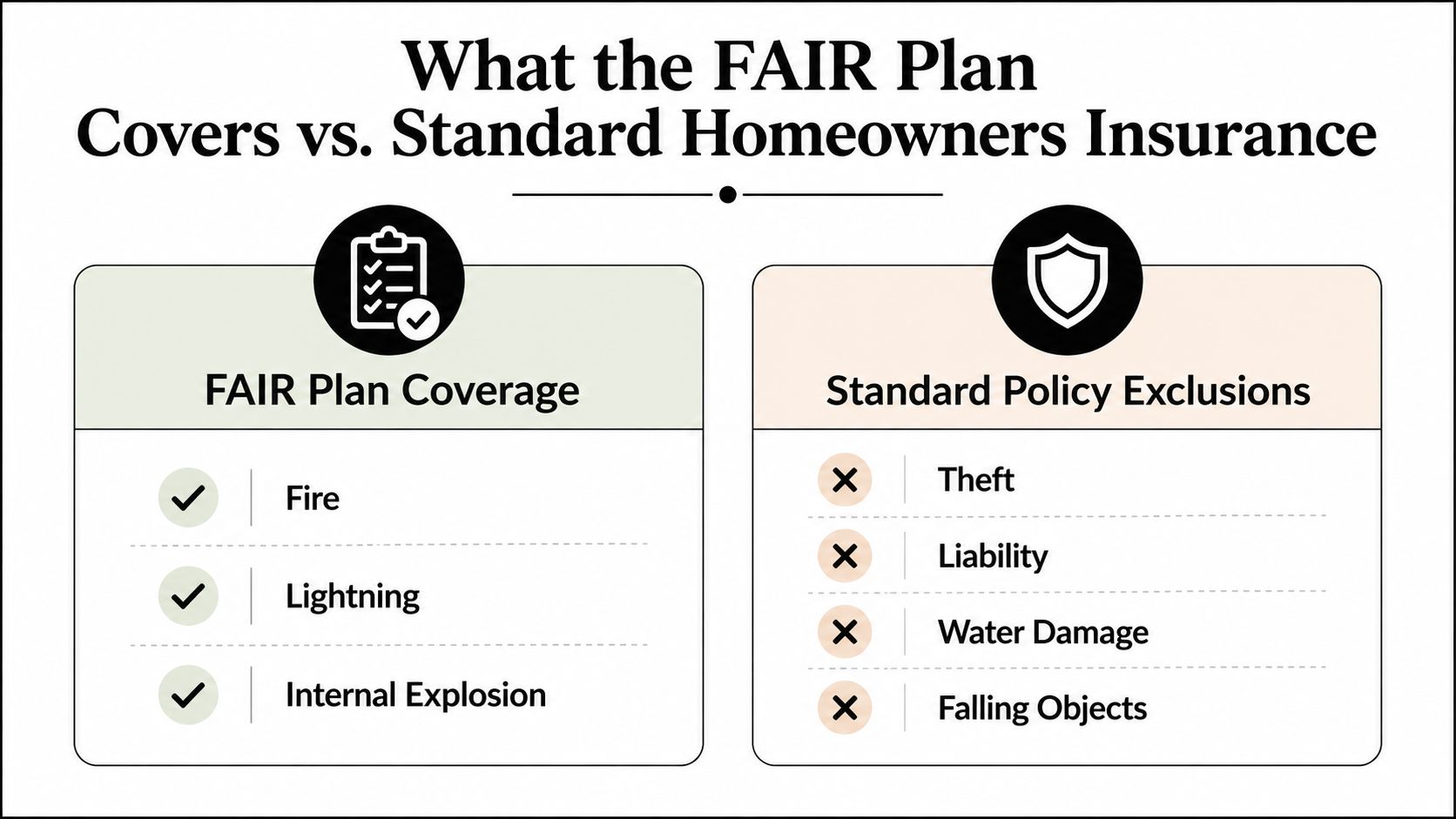
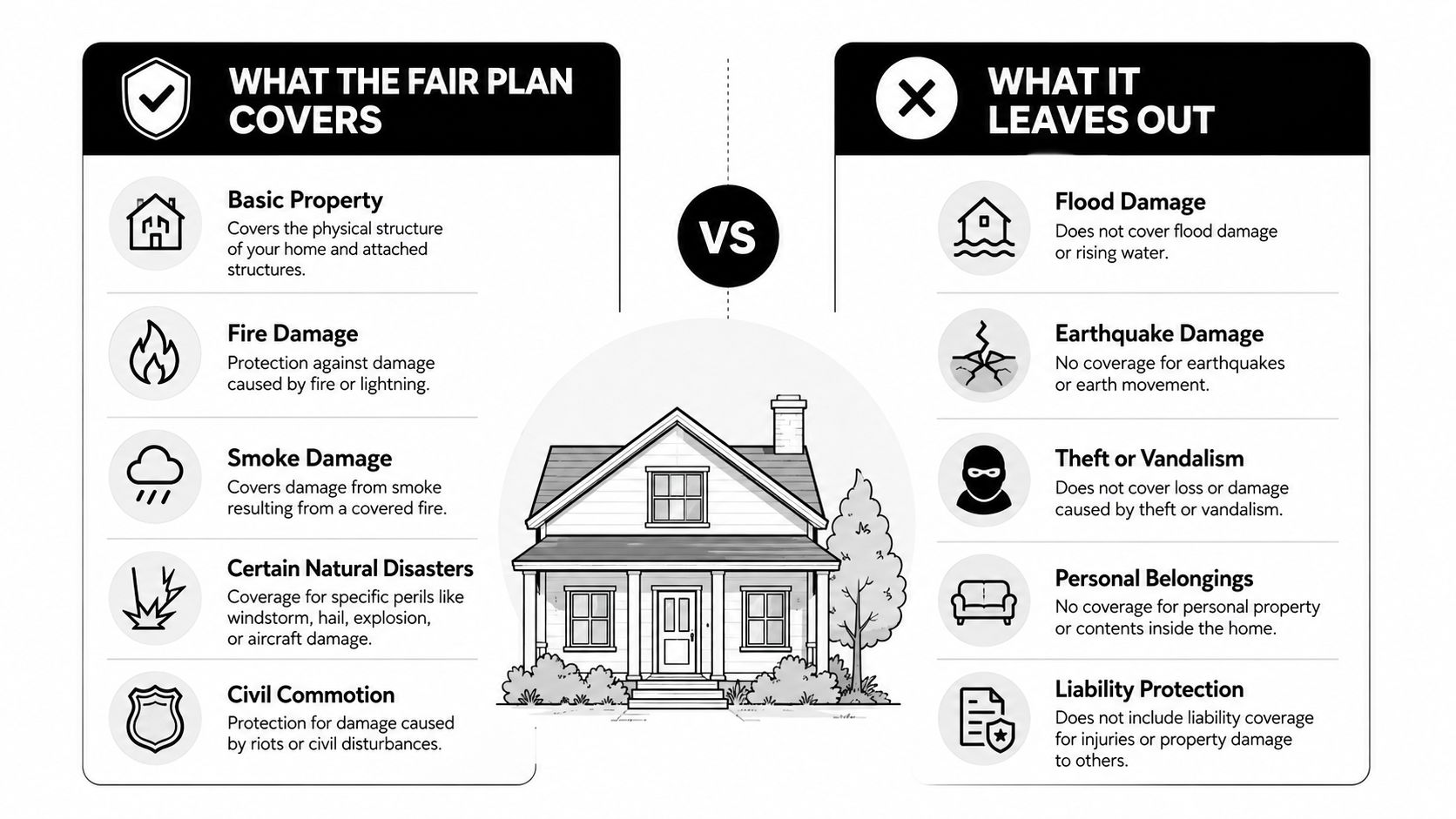
A FAIR Plan policy is bare-bones by design. It covers named fire-related perils such as fire, lightning, smoke, and internal explosion, and that is where the trouble starts for many homeowners. A standard homeowners policy usually does a lot more than that.
What the policy leaves uncovered
The missing pieces are what hurt families after a loss. The base policy does not include personal liability, additional living expenses, theft, water damage, flood, earthquake, or loss of use unless you buy separate coverage. A homeowner can satisfy a lender and still be exposed to the exact costs that drain savings after a claim.
There is also a coverage limit that matters for higher-value homes. The FAIR Plan's total coverage limit is $3 million, which replaced the former $1.5 million cap in the spring of 2020. As noted by Kin overview, rental-related additional living expense coverage is generally limited to 10% of the dwelling limit unless the policyholder buys a 20% option.
What this means at the kitchen table
If you only carry a FAIR Plan policy, you are not fully protected. You have fire-focused property coverage, nothing close to full homeowners insurance. That may satisfy the mortgage company, but it leaves real-world gaps that show up fast when a pipe bursts, a guest gets hurt, or a theft happens.
My rule for homeowners is simple. If the loss can happen without a flame touching the house, do not assume the FAIR Plan pays for it. Burst pipes, guest injuries, theft, and the cost of living somewhere else while repairs drag on all fall into that category.
For a practical look at how to build out the missing pieces, use this California coverage guide to compare the add-ons most homeowners need on top of the FAIR Plan.
How to Apply for a FAIR Plan Policy
A homeowner usually reaches the FAIR Plan after the standard market says no. That denial trail is the starting point, because the program exists for California properties that cannot get covered the normal way, not for anyone shopping for the easiest policy to buy.
What to gather before you start
Bring the property details before you call a broker. You need the construction type, year built, protective devices, claims history, photos, any mitigation records, and a realistic replacement cost estimate. Missing information slows the file down, and it usually turns into extra back-and-forth that should have been avoided at the start.
Who submits it
A licensed California broker who works with the FAIR Plan is the cleanest path. In some situations there may be a direct route, but a homeowner is usually better served by someone who is licensed, organizing the denial proof, and checking that the application is complete before it goes in.
What to expect
Underwriting is straightforward, but it is not forgiving. If the property has damage, weak defensible space, or sloppy documentation, expect delays. If the file is clean, the process moves more smoothly. The mistake I see again and again is waiting too long and treating the application like busywork.
For a practical consumer checklist while you compare coverage options, use CA Home Auto's guides alongside the FAIR Plan paperwork.
Layering Extra Coverage on Top of the FAIR Plan
A homeowner who stops at the FAIR Plan is leaving gaps wide open. The policy covers the dwelling fire risk, and the rest of your protection has to be added separately. That means building the rest of the coverage with a clear eye on what can still go wrong.
The core supplement is a DIC policy
A Difference in Conditions policy, or DIC, is the cleanest way to fill the biggest gaps. It can sit alongside the FAIR Plan and add protections such as theft, water damage, liability, and additional living expenses that the base policy leaves out. That difference is the gap between being technically insured and protected.
Other layers to consider
If you live in California, earthquake coverage deserves a separate conversation. So does flood coverage, because neither belongs in the FAIR Plan's base package. An umbrella policy can also matter if you have assets that would be exposed in a liability claim, and an auto-home bundle can simplify how everything is managed under one roof.
A workable stack often looks like this. FAIR Plan for the dwelling fire risk, DIC for the missing property and liability pieces, earthquake for seismic risk, and auto coverage that is coordinated with the same household review. For a broader picture of how those pieces fit into a California policy stack, review California home insurance options before you finalize the gaps you want covered.
Rule of thumb: if a policy doesn't cover the way you'd really lose money, it is not enough on its own.
Mai & Associates reviews FAIR Plan policies alongside broader California home insurance, renters insurance, auto insurance, car insurance, and life insurance options, so the household isn't making separate decisions in silos.
The Honest Pros and Cons of FAIR Plan Coverage
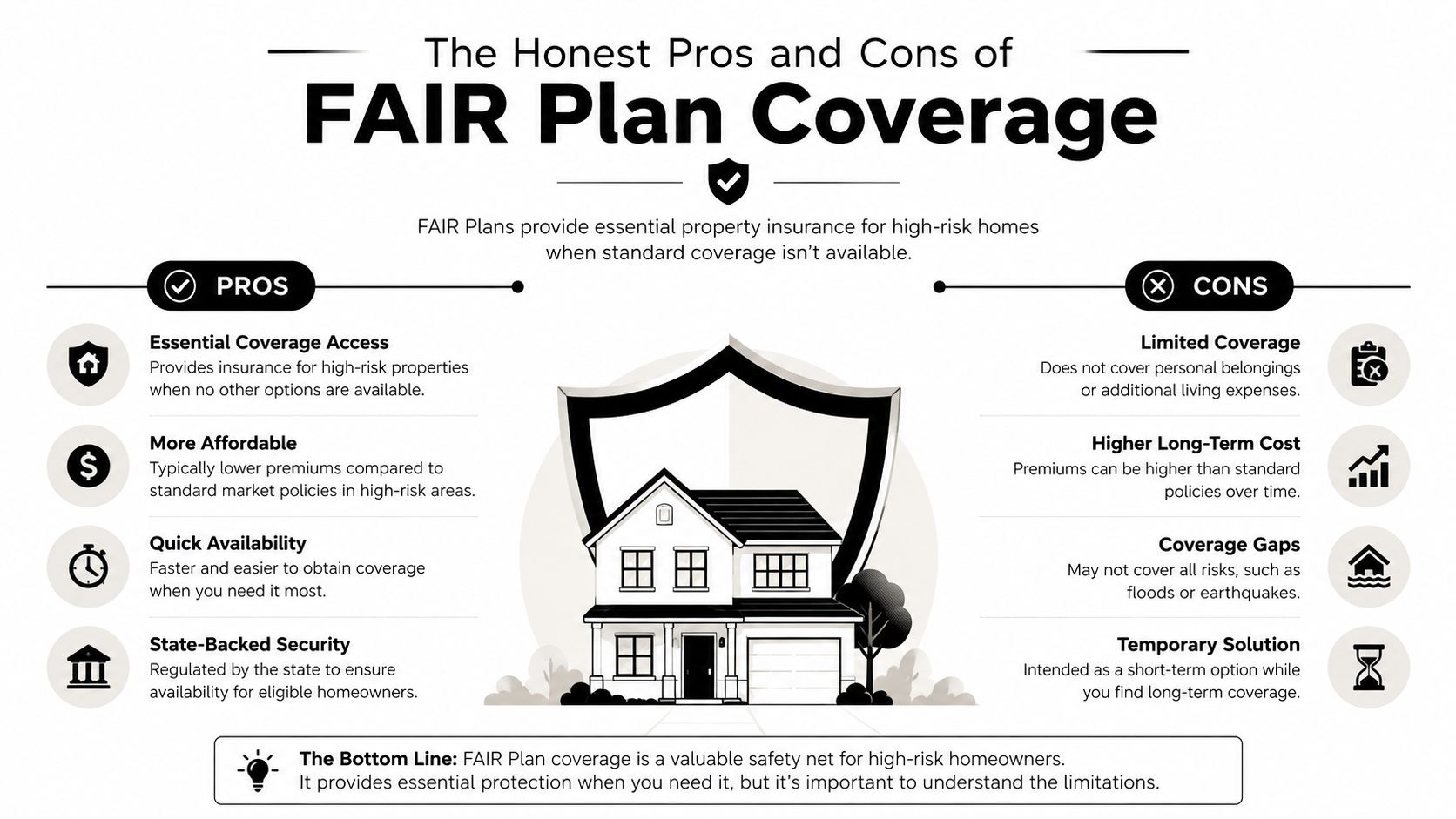
A FAIR Plan policy solves one problem cleanly. It gives a homeowner an offer when the standard market will not. That matters because your lender wants proof of insurance, not a story about why underwriting turned you down.
Where it helps
It can satisfy mortgage requirements, it can act as the base layer for a fuller protection stack, and it gives homeowners in hard-to-place areas a way to keep coverage in force. In a market where private carriers are pulling back, that is real value.
Where it falls short
The policy is thin, the claims process can feel slow, and the price is often disappointing. State regulators have also been pushing the Plan toward more transparency and better consumer treatment as its role grows, which tells you the system still needs work. 2026 reform announcement
What that means in practice
Use the FAIR Plan as the foundation, then add the missing pieces on top of it. A bare fire policy does not protect your belongings, your liability exposure, or your daily living costs if a loss makes the house unlivable. That is why a working California setup usually starts with the FAIR Plan and then adds the right wraparound coverage instead of pretending the base policy is enough.
If you want a plain-English refresher on the most common coverage questions before you review your own policy, see CA Home Auto's FAQ.
Mai & Associates reviews FAIR Plan policies alongside broader California home insurance, renters insurance, auto insurance, car insurance, and life insurance options, so the household is not making separate decisions in silos. If you need a clean answer on what your setup is missing, that review should start there.
Filing Claims, Reducing Risk, and Getting Expert Help
After a loss, move fast and document everything. Take photos, notify the carrier promptly, keep receipts, and coordinate any supplemental claim so the FAIR Plan and the wraparound policy aren't working at cross-purposes. If you need a plain-language walkthrough of the recovery process, get your storm claim approved is a useful reference for how careful documentation supports the claim file.
Make the property harder to insure badly
Future insurability improves when the house looks less like a fire trap. Clear defensible space, upgrade the roof, install ember-resistant vents, and keep written records of every improvement. Those are the kinds of changes that help a broker argue for better treatment when the next policy review comes around.
Don't renew blind
If you already have a FAIR Plan policy, read your declarations page and ask what's missing before the next renewal lands. Use CA Home Auto's FAQ if you want to understand common coverage questions before you call.
Mai & Associates reviews existing FAIR Plan policies, checks the admitted market for alternatives or wraparound quotes, and helps homeowners build a complete protection plan across auto, home, renters, and life coverage. If you want a no-obligation policy review and a straight answer on what your California insurance setup is missing, visit Mai & Associates and ask for a FAIR Plan comparison before you renew.