California Earthquake Insurance Cost: A Complete Guide

So, what does California earthquake insurance actually cost? There’s no single, simple answer. You could be looking at anything from under $800 a year to well over $5,000.
Think of it this way: your premium is based on a specific rate for every $1,000 of coverage you need to rebuild your home. So for a house valued at $700,000, it's not unusual to see an annual premium of around $2,478.
Getting Real About the Cost of Earthquake Coverage
For most of us living in California, the thought of "The Big One" is something we push to the back of our minds. But the financial devastation it could cause is a real and immediate threat. The first hard truth to accept is that your standard home insurance policy will not cover a dime of earthquake damage. Nothing. That leaves your biggest investment completely vulnerable.
This isn't just a homeowner problem, either. Your renters insurance won't pay to replace your stuff, and your auto insurance policy won't cover your car if the garage collapses on it during a quake. That's why a separate earthquake policy isn't just a nice-to-have; it's a critical financial shield in the Golden State, an essential part of a comprehensive California insurance plan.
Why Is Earthquake Insurance So Different Here?
The wild swing in costs isn't random—it's a direct reflection of risk. California's constant seismic activity creates an insurance landscape you won't find anywhere else in the country.
In 2024, California alone accounted for a staggering $3.58 billion in earthquake insurance premiums. To put that in perspective, the next highest state, Washington, had about $464 million. This huge gap shows just how much of the nation's seismic risk is concentrated right here. You can dig into the numbers yourself on the Insurance Information Institute's website.
When you combine that concentrated risk with California's high property values, you can see how the numbers add up so quickly. Even a seemingly small rate per $1,000 of coverage can lead to a significant premium when your home's replacement cost is over $500,000.
Setting a Realistic Budget for Your Policy
Knowing how this pricing works is the first step toward managing your budget. It's not a flat fee; it’s a custom calculation based on your home, your location, and your choices. This guide will walk you through exactly what drives your costs up or down and how to strike the right balance between what you pay and what you're protected for.
It's a lot like shopping for any other type of California insurance—a thoughtful approach is key. For a bit more background, it helps to understand what a standard home insurance policy covers in California, which really highlights why this separate coverage is so vital.
Key Factors That Determine Your Premium
Ever wonder how an insurance company lands on a specific number for your earthquake insurance quote? It’s not pulled out of thin air. Your final premium is a carefully calculated figure based on your home's unique risk profile, much like how your driving record impacts your car insurance rate.
For earthquake coverage, it all comes down to your property and how well it's expected to stand up to seismic shaking. Understanding what goes into that calculation is crucial because it shows you exactly where your money is going and, more importantly, which parts of your premium you can actually control.
First, let's clear up a common misconception: your standard homeowners policy does not cover earthquake damage. It's a completely separate policy, adding another layer to the true cost of protecting your home in California.
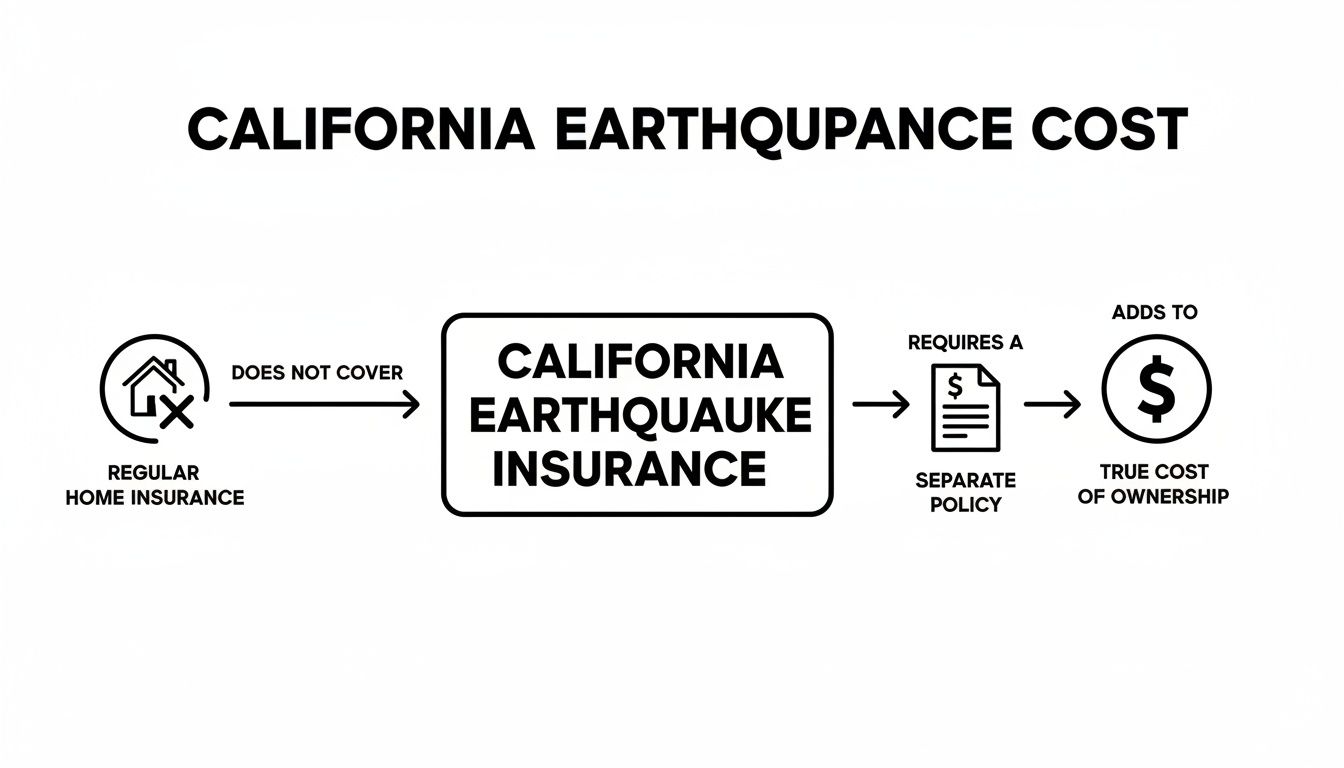
As you can see, this is a distinct financial decision that sits on top of your existing coverage. So, let's break down the three main ingredients that determine the price.
1. Your Home's Location and Seismic Risk
Where you live is, without a doubt, the single biggest driver of your California earthquake insurance cost. Living just a few miles closer to a major fault line, like the San Andreas or Hayward faults, can dramatically increase your premium. It's all about proximity to risk.
But it's not just about the fault lines themselves. Insurers dig deeper—literally—by looking at the ground beneath your house.
- Soil Type: Is your home built on solid bedrock or softer, sandy soil? Softer soils can amplify the shaking from a quake. Worse, they can be prone to liquefaction, a terrifying phenomenon where the ground temporarily acts like a liquid, which can cause a foundation to fail completely.
- Slope Stability: If your home is perched on a hillside, there's an added risk of landslides triggered by an earthquake. That risk is baked right into your rate.
A home’s zip code alone can make a huge difference. For instance, a homeowner in a high-risk area like Alameda County might see rates around $6.50 per $1,000 of coverage. Meanwhile, someone in a lower-risk community near Sacramento could find rates closer to $2.46 per $1,000. On a $700,000 home, that's the difference between paying $4,550 a year versus $1,722.
2. The Age and Construction of Your House
After location, the physical makeup of your house is the next biggest piece of the puzzle. Older homes, especially those built before modern seismic building codes were put in place in the 1980s, are almost always considered higher risk.
The materials and structure matter immensely.
- Wood-Frame Homes: These homes have more give and flexibility, which allows them to "ride out" the shaking better than more rigid structures. As a result, they typically get more favorable insurance rates.
- Brick or Masonry Homes: Unreinforced brick buildings are notoriously brittle and can be extremely vulnerable in a quake. Insuring them is often much more expensive, if you can get coverage at all.
- Foundation Type: This is a big one. Is your home properly bolted to its foundation? Do you have a reinforced cripple wall? Homes that have undergone a seismic retrofit to strengthen these known weak points can often qualify for significant discounts—sometimes up to 25% off the premium.
3. Your Coverage Choices and Deductible
The final piece of the puzzle is you. The specific coverage limits and deductible you choose have a direct and immediate impact on what you pay each year. This is where you have the most control over the final cost.
The deductible on an earthquake policy is a different beast than what you're used to with home insurance or auto insurance.
Instead of a flat dollar amount, an earthquake deductible is a percentage of your home's total insured value. This typically ranges from 5% to 25%.
Here’s the trade-off you need to consider:
- A higher deductible (like 25%) means you'll pay a lot more out-of-pocket if a major quake hits, but your annual premium will be significantly lower.
- A lower deductible (like 5%) offers much better financial protection after a disaster, but you'll pay for that peace of mind with a much higher yearly premium.
The table below breaks down how these choices can swing your premium in one direction or the other.
How Key Factors Impact Your Earthquake Insurance Premium
| Factor | Higher Premium Scenario | Lower Premium Scenario |
|---|---|---|
| Location | Home located near an active fault line (e.g., Hayward Fault) | Home in a lower-risk seismic zone (e.g., Central Valley) |
| Soil Type | Built on soft, sandy soil prone to liquefaction | Built on solid bedrock |
| Home Age | Pre-1980s construction, built before modern seismic codes | Newer construction built to current earthquake standards |
| Construction | Unreinforced brick or masonry structure | Modern, wood-frame construction |
| Foundation | Unbolted foundation with an unbraced cripple wall | Foundation has been seismically retrofitted (bolted & braced) |
| Deductible | Low percentage (e.g., 5%), less out-of-pocket risk | High percentage (e.g., 25%), more out-of-pocket risk |
| Coverage Limits | Higher limits for structure, personal property, and loss of use | Lower, more basic coverage limits |
Ultimately, choosing the right deductible is a personal decision that requires balancing your monthly budget against your financial risk tolerance. If you're new to these concepts, you can find simple explanations for key insurance terms in our comprehensive glossary. By understanding how location, construction, and coverage all interact, you can make a much more informed decision when it's time to get a quote.
Why Is California Earthquake Insurance Getting So Expensive?
If you've felt the sting of rising home insurance or car insurance bills lately, you're not alone. The same economic forces are at play with earthquake insurance, and many California homeowners are seeing their premiums climb.
It’s a frustrating reality, but the price hikes aren't random. They're a direct result of some powerful economic shifts, major advances in science, and what’s happening in the global insurance market. Let's break down the three biggest reasons your California earthquake insurance cost is going up.
The Skyrocketing Cost of Rebuilding a Home
The biggest and most straightforward factor is the soaring cost of construction. Think of your insurance policy as a promise: if a quake destroys your home, the insurer will pay to rebuild it. But what happens when the cost of lumber, concrete, steel, and skilled labor goes through the roof? The potential payout your insurer is on the hook for also skyrockets.
We’re not talking about a small jump, either. The price to rebuild a house in California has climbed dramatically in just the last few years. Insurers have to price their policies based on today's costs, not what it cost to build your home a decade ago. They need to collect enough in premiums to have the cash on hand to pay all their claims after a massive earthquake.
In short, even if the chance of an earthquake hasn't changed, the financial damage it would cause has. Premiums have to rise to cover that bigger financial risk.
A policy written just five years ago for a $700,000 home now has to account for a much higher replacement cost today. This is a huge reason why your renewal quote is likely higher than what you paid last year.
Better Science Gives a Scarier, More Accurate Picture
Another major driver is how much better our seismic science has become. The tools that geologists and seismologists use to map out earthquake risks are more powerful than ever. They can now run incredibly detailed simulations, predicting how a major quake would affect specific neighborhoods with stunning accuracy.
This is fantastic for public safety and emergency planning. But for insurance companies, this clearer picture often reveals a much higher risk of widespread damage than previously understood.
- Pinpointing Fault Lines: Scientists are constantly discovering new fault segments and learning how they connect. This sometimes raises the risk profile for entire communities that were once considered safer.
- Understanding Your Soil: We now have detailed maps showing which areas are built on soft soil that can amplify shaking or even turn to liquid (liquefaction) during a quake. A house on bedrock is a much better risk than one on landfill.
- Predicting Building Damage: Advanced computer models can now show how specific types of construction—like older homes not bolted to their foundations—will crumble under stress. This allows insurers to price risk far more precisely.
As this data gets better, insurers are forced to adjust their rates to reflect the true, scientifically-backed risk. For many urban areas, that means prices go up.
The Global Domino Effect: Reinsurance
Finally, there’s a massive, behind-the-scenes player called reinsurance. You can think of it as "insurance for insurance companies." No single company can afford to pay out all the claims from a truly catastrophic quake. So, your California insurer buys its own protection from a handful of giant, global reinsurance companies.
These reinsurers cover mega-disasters all over the world—hurricanes in Florida, wildfires in Australia, floods in Europe. When a catastrophe strikes anywhere, the global reinsurance fund takes a hit, and their financial reserves shrink. To rebuild those reserves, they charge primary insurance companies (like your provider) more for coverage.
That higher cost gets passed down the chain: from the global reinsurer to your California insurance company, and finally, to you as a higher premium. Recent market trends show this perfect storm of reinsurance costs, new seismic data, and construction inflation is pushing annual premiums for many homeowners into the $800–$3,000 range, and often much more for older, high-risk properties.
This is how a hurricane hitting the Gulf Coast can actually make your California earthquake insurance cost more expensive. It's a connected global market. For more deep dives into insurance trends, feel free to check out other articles on our blog.
Actionable Strategies to Lower Your Insurance Costs
While the factors that shape your California earthquake insurance cost can feel out of your hands, you actually have quite a bit of control. The key is to move from simply understanding the costs to actively managing them. A few smart, proactive moves can make a real difference in your annual premium, all without gutting the coverage your family needs.
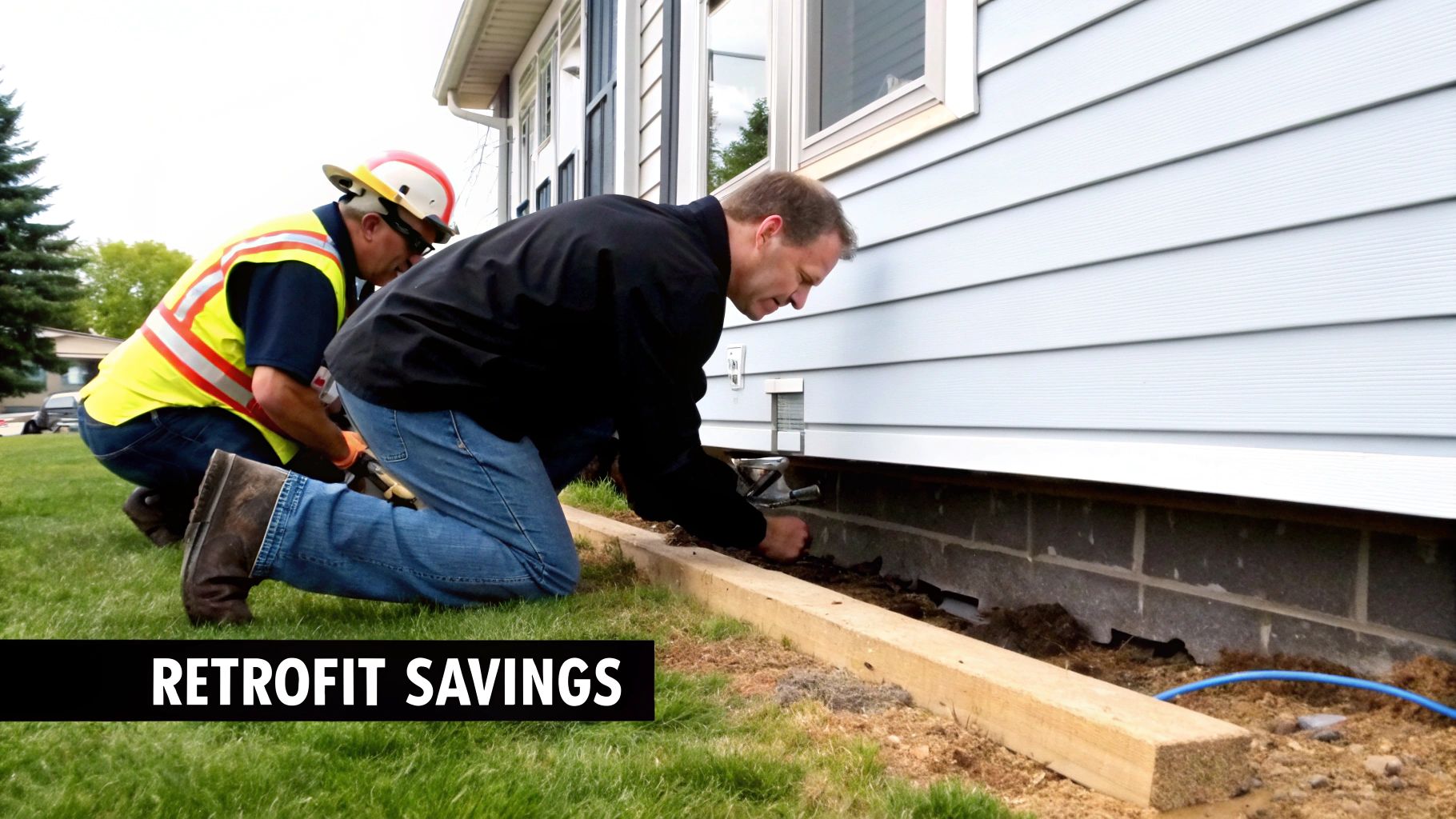
This is all about making strategic decisions that bolster both your home and your finances. From physical upgrades to smart policy tweaks, these strategies put you firmly in the driver's seat.
Fortify Your Home with a Seismic Retrofit
Hands down, one of the most effective ways to lower your premium is to make your home physically stronger and more resilient to shaking. This process, known as a seismic retrofit, focuses on reinforcing your house's weakest points—especially where it meets the foundation.
For many California homes, particularly older ones built before modern codes, this usually involves two key steps:
- Foundation Bolting: This is exactly what it sounds like. Your home's wooden frame is securely anchored to its concrete foundation, which keeps it from sliding off during a violent quake.
- Cripple Wall Bracing: If your house has a short "cripple wall" (that space between the foundation and the first floor), reinforcing it with plywood provides a huge boost in stability.
Insurers absolutely love these upgrades because they dramatically lower the odds of a catastrophic, expensive claim. When you invest in a retrofit, you're directly showing the insurance company that you've reduced their risk.
This isn't just a minor adjustment. A properly retrofitted home can earn you a premium discount of up to 25%. It's a significant saving that often helps the project pay for itself over time, all while making your home a much safer place to be.
Adjust Your Deductible to Match Your Risk Tolerance
As we’ve covered, your deductible is the most direct lever you can pull to influence your annual premium. But it's not like the flat-dollar deductible on your auto insurance. An earthquake deductible is a percentage of your home's total insured value, usually ranging from 5% to 25%.
Think of it as a financial balancing act. By choosing a higher deductible, you're agreeing to cover a larger chunk of the initial repair costs yourself. In exchange for you taking on more of that risk, the insurer gives you a much lower annual premium. A lower deductible, on the other hand, shifts more of the risk onto the insurer, which means you'll pay more each year.
The best way to find your sweet spot is to ask a straightforward question: "How much could I realistically afford to pay out-of-pocket tomorrow to start repairs?" Your honest answer will point you to a deductible that lets you sleep at night without busting your annual budget.
Review Your Coverage Limits Annually
It’s so easy to "set and forget" an insurance policy, but our lives and needs are constantly changing. It’s crucial to make sure you aren't paying for more coverage than you actually need. Take a few minutes each year to review your policy limits, paying close attention to your personal property and additional living expenses (ALE).
Have you downsized or sold off expensive furniture or electronics recently? You might be able to lower your personal property coverage. Does your policy have a sky-high limit for ALE, but you have family nearby you could stay with in an emergency? Dialing these amounts back to reflect your current reality can trim your premium. This same logic applies to all your policies, from home insurance to life insurance; a regular check-in ensures you're never overpaying.
Shop Around and Compare Your Options
Finally, the single most powerful strategy is to never assume the first quote you get is the best deal. The earthquake insurance market in California is a mix of the state-run California Earthquake Authority (CEA) and a number of private insurers. Their rates, coverage details, and rules for who they'll cover can vary wildly.
Getting quotes from multiple providers lets you see the whole picture and compare offers side-by-side to find the best value. This is where working with an independent insurance agency like Mai & Associates can simplify everything. We can do the legwork for you, gathering quotes from different carriers and explaining the subtle but important differences in their policies. Our goal is to help you make a confident, informed decision that truly protects both your home and your wallet.
So, you've done the research and you're ready to see what earthquake insurance would actually cost. Smart move. Getting quotes is the only way to turn abstract numbers into a concrete plan for protecting your home. It’s a lot like shopping for any other major financial product, from auto insurance to a mortgage—a little prep work goes a long way.

Before you start plugging your info into quoting tools or calling an agent, it helps to have a few key details about your property handy. This is what insurers use to figure out your specific risk profile and calculate your premium for the California earthquake insurance cost.
What You'll Need to Get a Quote
To make the process quick and painless, gather this info first. Having it ready ensures the quotes you get back are accurate and easy to compare apples-to-apples.
- Your Home's Vitals: When was it built? Is it one story or two? Is it a standard wood-frame house, or is it built with brick or masonry?
- Foundation Facts: You'll be asked about your foundation. Know if you have a slab-on-grade, a raised foundation, or one with a cripple wall.
- Square Footage: The total living area is a must.
- Retrofit History: This is a big one. Have you had any seismic retrofitting done, like bolting the foundation or bracing the cripple walls? Be ready to share this—it can unlock some serious discounts.
- Your Ideal Coverage: Have a ballpark figure in mind for how much coverage you want for the structure (dwelling), your belongings (personal property), and temporary living expenses (loss of use).
Comparing Your Three Main Paths to Coverage
In California, you basically have three different routes you can take to buy earthquake insurance. Each has its own benefits and drawbacks, and the right fit really depends on your current home insurance, your budget, and how much risk you're comfortable with.
A California Earthquake Authority (CEA) Policy
The CEA is a not-for-profit provider that’s publicly managed and partners with most of the big insurance companies.- The Upside: They are incredibly stable financially. Since they're backed by the state, you know they’ll be there to pay claims after a massive quake. They also offer a wide range of deductibles, from 5% up to 25%, giving you flexibility.
- The Downside: Their policies can sometimes feel a bit "no-frills" compared to private options, occasionally placing lower limits on specific things. You almost always buy a CEA policy through the same company that provides your homeowners or renters insurance.
A Standalone Policy from a Private Insurer
A number of private insurance companies write their own earthquake policies, operating completely outside of the CEA system.- The Upside: You can often find more comprehensive coverage here. Think policies that might cover swimming pools, detached structures, or offer higher limits on your personal belongings. In some areas, they can even be more affordable.
- The Downside: The onus is on you to check the financial health of the insurer. You want to be sure they have the capital to handle a catastrophic event without going under.
An Endorsement on Your Existing Homeowners Policy
This involves adding earthquake coverage directly onto your current home policy, like an add-on.- The Upside: It’s convenient. One bill, one company, one point of contact. Everything is bundled together.
- The Downside: This is getting harder to find in California because of the high risk. When you can find it, the coverage might be more limited than a standalone policy.
The only way to truly know which path is best is to get quotes from both the CEA and a few private carriers. This gives you a complete picture of the market and shows you where the real value is for your specific home.
You don't have to navigate this maze on your own. An independent agent can pull quotes from all these different sources and help you compare them side-by-side.
If you’re ready to see your numbers, you can get a same-day insurance quote from Mai & Associates and start comparing real options for your home today.
So, What's Your Next Move?
You've seen that the cost of California earthquake insurance isn't just some random number. It's a figure you can actually influence with smart decisions about your home and your policy. The big idea here is simple: paying a premium now is a far smaller price than facing the staggering cost of rebuilding your entire life after a major quake.
It’s time to put what you've learned into action. All that knowledge about risk factors, deductibles, and coverage types is your best tool for making a confident choice to protect your biggest investment.
Building Your Financial Safety Net
Securing your home is a huge step, but it’s really just one piece of the puzzle. A major earthquake can throw your whole world off-kilter, affecting everything from your car to where you’ll sleep at night.
This is where thinking bigger about your California insurance portfolio really pays off. A good advisor won't just sell you a policy; they'll help you see the whole picture, making sure your earthquake, home insurance, and auto insurance all work together without any dangerous gaps.
Think of your financial protection like an interconnected grid. You want to be sure that one catastrophic event can't trigger a domino effect that knocks down everything you've worked for.
By reviewing your entire insurance portfolio—from home and car insurance to renters or even life insurance—you can build a truly resilient plan. An expert can often spot ways to get you better rates while ensuring you're covered from all angles.
The best thing you can do now is get a clear picture of your home’s unique risk profile, pull together your property details, and take that final step. Don’t wait for the ground to shake to wonder if you’re prepared. Talk to an expert who understands the California lifestyle and can help you build a complete protection strategy, not just sell you a single policy.
Your California Earthquake Insurance Questions, Answered
When it comes to something as specific as earthquake insurance, it's natural to have questions. It’s not like your everyday car insurance or home insurance policy. To clear things up, let's walk through some of the most common things California residents ask about protecting their homes from a shake.
Do I Have to Get Earthquake Insurance in California?
Legally? No, the state of California doesn't mandate it. But that's not the full story.
Your mortgage lender might require you to carry an earthquake policy, especially if you live in a high-risk zone. It’s their way of protecting their investment—and yours. Your best bet is to check your loan agreement to see what it says.
Even if it’s not required, choosing to go without coverage is a massive financial risk. We see over 10,000 quakes a year here. Rebuilding out-of-pocket after a major one could be financially devastating for most families.
Wait, Doesn't My Homeowners Policy Already Cover Earthquakes?
This is probably the single biggest misconception out there, and the answer is a firm no. Your standard homeowners, condo, or renters insurance policy will almost always have a specific exclusion for "earth movement." That bucket includes earthquakes, landslides, and sinkholes.
To get covered, you absolutely have to buy a separate earthquake policy or add it as an endorsement. This is why getting a handle on the California earthquake insurance cost is so vital—it closes a huge, and potentially catastrophic, gap in your protection.
How Exactly Does an Earthquake Deductible Work?
Forget the simple flat-dollar deductible you're used to with car insurance. Earthquake deductibles are a different beast entirely. They're calculated as a percentage of your home's total insured value (your dwelling coverage limit), usually falling between 5% and 25%.
Let's make that real.
Imagine your home is insured for $500,000 and you have a 15% deductible. You'd be on the hook for the first $75,000 of repairs yourself. Your insurance policy only starts paying after you’ve covered that amount, up to your policy's limits.
Opting for a higher percentage lowers your annual premium, but it means you take on more risk. A lower percentage gives you more financial security after a disaster, but your policy will cost more each year. It's a trade-off you have to weigh carefully.
Can I Get Earthquake Insurance as a Renter?
Yes, you can—and you absolutely should consider it. Your landlord’s insurance covers the building itself, but it does zero for your personal belongings.
Renters insurance for earthquakes is designed to protect your stuff: furniture, electronics, clothes, you name it. It can also cover additional living expenses if the quake makes your apartment unlivable, helping you pay for a temporary hotel or rental. It's the only way to ensure a disaster doesn't wipe out everything you've worked for.
Trying to figure out California insurance—whether it's for earthquakes, your home, car, or family—can feel overwhelming. At Mai & Associates, our job is to make it simple. Our licensed agents are here to help you find the right coverage at a fair price, making sure you're truly protected. Compare rates instantly and get a no-obligation quote from Mai & Associates today.