Your Guide to California Earthquake Coverage in 2026

Let's clear up one of the most dangerous—and costly—misunderstandings for any California homeowner. Many people assume their standard insurance policy has them covered if the worst happens. But the hard truth is, your home, renters, or condo insurance almost certainly does not cover earthquake damage.
To protect your home and finances from a quake, you need a separate California earthquake coverage policy. It’s that simple, and that critical. As experts in all forms of California insurance, we can help you build a complete protection plan that includes not just earthquakes, but your home insurance, auto insurance, and life insurance needs.
Why Your Standard Home Insurance Is Not Enough
Living in California means living with the ever-present risk of earthquakes. It's just a fact of life here. Yet, there’s a huge gap between that reality and how most homeowners are financially prepared for it.
Think of it this way: your standard homeowners policy is built to handle specific risks like fire, theft, or a burst pipe. However, these policies almost universally contain an "earth movement" exclusion. This is the key detail. That single clause means your insurance company is off the hook for damage from earthquakes, landslides, and sinkholes. Relying on your regular policy for shaker-related damage is a massive gamble.
The Misconception That Puts You at Risk
Here in California, a surprisingly large number of homeowners are rolling the dice without even knowing it. They believe their standard policy is a catch-all, but it’s not. It's a common belief, but it leaves millions of people exposed to financial ruin.
This isn't just about earthquakes, either. It’s a good example of why you need to know exactly what your policy does and doesn’t cover. For instance, standard homeowners insurance often excludes certain types of damage, like a tree falling on your house under specific conditions. The principle is the same: standard policies have clearly defined boundaries, and you need separate coverage for risks that fall outside them.
Standard Home Insurance vs. Earthquake Coverage at a Glance
So, what are we talking about in terms of actual damage? Without a specific earthquake policy, you're on your own to pay for everything. We're talking about structural repairs, replacing your belongings, and even the cost of living somewhere else while your home is rebuilt. It’s a devastating financial blow.
This table breaks down the difference in stark terms. It shows what's protected by a standard policy versus a dedicated earthquake policy when the ground starts to shake.
| Damage Type | Covered by Standard Homeowners Insurance? | Covered by California Earthquake Coverage? |
|---|---|---|
| Structural Damage (Foundation, Walls) | No | Yes |
| Cracked Interior Walls and Ceilings | No | Yes |
| Personal Property (Furniture, Electronics) | No | Yes |
| Additional Living Expenses (ALE) | No | Yes |
| Damage from Fires Following an Earthquake | Yes (Standard fire coverage applies) | N/A (Covered by home policy) |
| Damage to Vehicles | No (Requires comprehensive car insurance) | No |
As you can see, your homeowners policy provides a shield—but that shield disappears the moment an earthquake hits. Only a separate policy steps in to cover the potentially astronomical costs of putting your home, and your life, back together.
For a closer look at what your standard policy does cover in non-earthquake situations, you can check out our complete guide to home insurance in California.
Understanding these coverage gaps is the first step. The next is closing them. At Mai & Associates, our entire focus is on helping Californians build a complete financial safety net. We don't just sell policies; we help you understand your risks and create a smart, aligned plan. Don't wait for a disaster to find out you're exposed.
What Does California Earthquake Coverage Actually Include?
Let's be honest, insurance policies can feel like they’re written in another language. When it comes to something as specific as California earthquake coverage, it’s easy to get lost. But it doesn't have to be that complicated. At its heart, an earthquake policy is designed to do one thing: help you put your life back together after the ground stops shaking.
Many Californians are surprised to learn their standard homeowners insurance won't cover earthquake damage. It’s a massive gap in protection, and it's the single most important reason earthquake insurance exists in the first place.
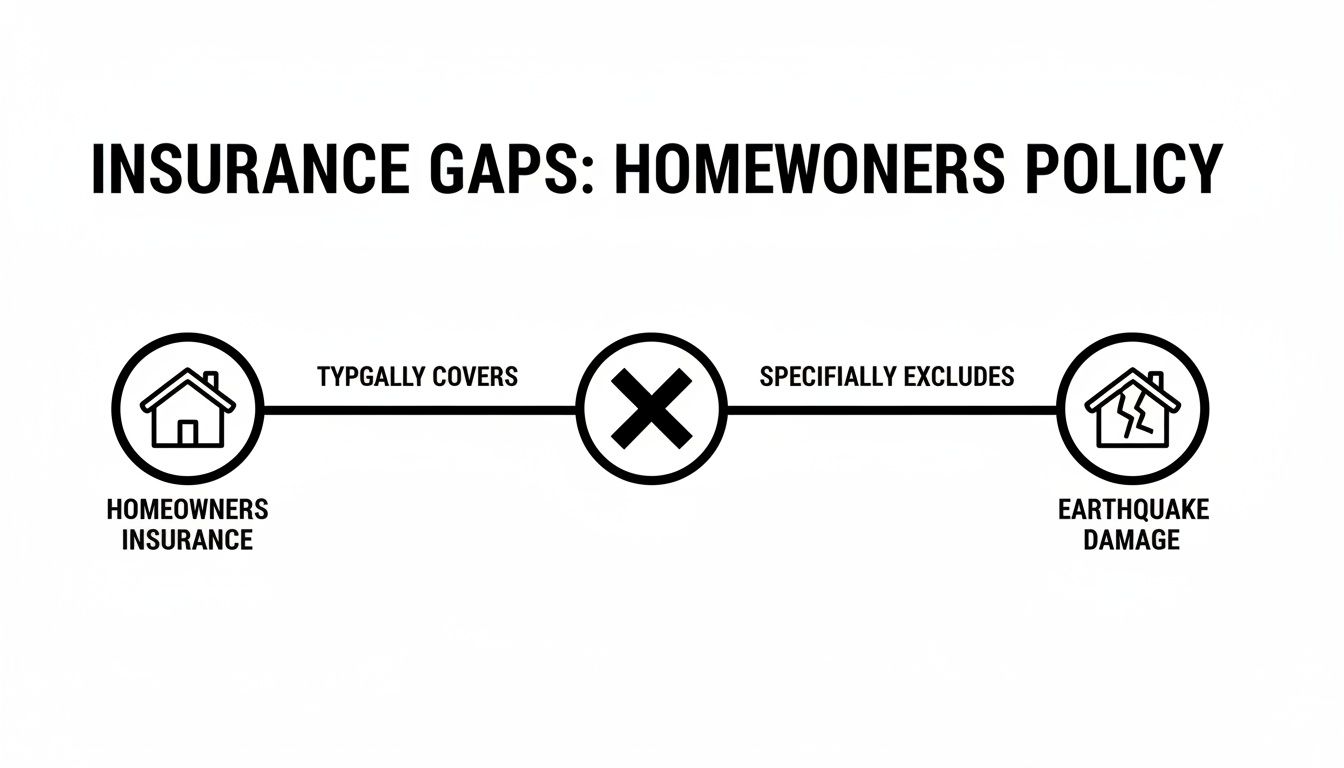
As you can see, without a separate earthquake policy, you're left completely exposed to one of our state's biggest threats.
The Three Core Parts of Your Policy
Whether you own a house, a condo, or rent an apartment, your earthquake policy will almost always be built around three key coverages. Think of them as the three legs of a stool—you need all of them for a stable recovery.
Dwelling Coverage: This is the big one. It's the money to repair or completely rebuild the structure of your home if it's damaged. We're talking about the foundation, the frame, the walls, and the roof. This coverage is what keeps a catastrophe from becoming a total financial loss.
Personal Property Coverage: What about everything inside? This part covers your belongings—the furniture, electronics, clothes, and all the things that make your house feel like home. It provides the funds to replace your possessions so you don't have to start from scratch.
Additional Living Expenses (ALE): Often called "Loss of Use," this coverage is a true lifesaver. If an earthquake forces you out of your home, ALE helps pay for temporary housing like a hotel or rental, plus other day-to-day costs, so your family has a place to live while repairs are being made.
Together, these three parts create a safety net to help you rebuild your home and your life without draining your savings.
How the Deductible Works (It's Different!)
Here’s where most people get tripped up. The deductible for California earthquake coverage works very differently than the one for your auto insurance or home insurance. Instead of a simple flat amount like $1,000, your earthquake deductible is a percentage of your total coverage limit—usually between 5% and 25%.
This difference is huge, and it's critical to understand.
Let's See It In Action: Imagine your home is insured for $500,000, and you have a 15% deductible. Your out-of-pocket cost isn't a few hundred dollars; it's $75,000 ($500,000 x 0.15). That's the amount you would have to cover for dwelling repairs before your insurance payout begins.
That number can be a shock, and it’s why picking the right deductible is such a personal decision. A lower percentage means a higher monthly premium, but less risk for you after a quake. A higher deductible will save you money on premiums but means you’re taking on more of the initial financial burden yourself. Finding that right balance is key.
This percentage-based system is just one of the unique features of specialty insurance. If you’re curious about how other policies work, you can explore our other insurance guides. The more you understand the fundamentals of California insurance, the more confident you'll be in building a financial plan that truly protects your family.
The Real Cost of California Earthquake Coverage
After realizing your standard home insurance won't help after a quake, the next question is always the same: how much is this actually going to cost me? There’s no simple, one-size-fits-all answer. The final price tag is a direct reflection of your home's specific risk.
It's a lot like car insurance. You wouldn't expect a teenager with a new sports car in downtown LA to pay the same premium as a retiree driving a minivan in a quiet suburb. Insurers look at earthquake risk the same way—the price is tailored to the specific risk they are taking on. Let's pull back the curtain on what they're looking at.
Key Factors That Determine Your Premium
Insurance carriers are essentially professional risk assessors. They look at a handful of critical factors to build a risk profile for your property and calculate a fair premium.
- Your Home's Location: This is the big one. Proximity to active fault lines is the single most important factor. A home in a high-risk seismic zone like the Bay Area or near the Elsinore Fault will always have a higher premium than a home in an area with less seismic activity.
- Age and Construction: When was your house built? Homes constructed before 1980, when modern seismic building codes started to become standard, are often more expensive to insure. What it's made of matters, too. A flexible wood-frame house tends to ride out the shaking better than a rigid brick or masonry home, which can crack and crumble.
- Foundation Type: How your home is attached to its foundation is crucial. A raised foundation that isn’t properly bolted and braced is a major red flag for insurers. During a quake, these homes can literally slide off their foundations, leading to catastrophic damage and, you guessed it, higher insurance costs.
- Rebuild Value: This is straightforward. The more it would cost to completely rebuild your home, the higher the potential claim. A $2 million home will cost more to insure than a $700,000 home because the insurer’s potential payout is that much larger.
The Northridge Effect on Insurance Costs
To really get a handle on the current market, you have to look back to the 1994 Northridge earthquake. That single event completely reshaped the landscape for California earthquake coverage. Insurers were hit with over $20 billion in losses, a staggering number that nearly broke the industry.
The fallout was immediate. Many insurance companies, terrified of a repeat, either stopped writing earthquake policies altogether or severely restricted them. This created the challenging and expensive market we still see today. The cost of coverage shot up, especially in high-risk areas where it's needed most. As a direct result of Northridge, insurers put strict new rules in place, making it much harder to get both homeowners insurance and earthquake policies. You can dig deeper into how this event continues to shape the industry through research on earthquake insurance statistics and facts.
Understanding the history here is critical. It explains why simply getting an online quote doesn't work well for earthquake coverage. You're not just buying a simple product; you're navigating a complex market that was forged by decades of financial risk and real-world disaster.
This is exactly why having an expert on your side makes all the difference. An experienced agent at Mai & Associates knows this market inside and out. We understand how all these factors play together and can check with multiple carriers to find the most competitive options for your entire insurance portfolio, from your home insurance and car insurance to specialized earthquake protection.
The CEA and FAIR Plan: Your Key Options for California Coverage
When you start looking for California earthquake coverage, you'll quickly run into two important names: the California Earthquake Authority (CEA) and the California FAIR Plan. It’s easy to get them confused, but they play very different—and sometimes complementary—roles in protecting your home.
Think of it this way: these aren't competing brands. For many Californians, especially those in high-risk areas, they are essential partners. One tackles the immense risk of earthquakes, while the other steps in to cover the growing threat of fire, which has made standard home insurance hard to find for many.
The Role of the California Earthquake Authority (CEA)
The biggest name in California earthquake insurance is the California Earthquake Authority (CEA). But it's not your typical insurance company. The CEA is a publicly managed, privately funded organization that was created after the devastating 1994 Northridge earthquake to keep earthquake insurance available and affordable.
You won't find a CEA office to walk into or a website where you can buy a policy directly. Instead, you purchase CEA policies through participating insurance companies—many of the same providers you might already use for your auto insurance or renters insurance policy. At Mai & Associates, we partner with these insurers, so we can easily add a CEA policy to your protection strategy.
The CEA was created to solve a critical problem: making sure California earthquake coverage didn't disappear from the market. By pooling risk across millions of households, it offers coverage that private insurers might not be able to on their own.
For most homeowners and renters, the CEA is the primary source for protecting their property and personal belongings from an earthquake.
The California FAIR Plan as an Essential Partner
This is where things can get a little confusing, so let's clear it up. The California FAIR Plan is the state's "insurer of last resort," but for fire insurance, not earthquake insurance. As wildfire risk has intensified, many traditional insurance companies have stopped offering home insurance in certain areas, leaving homeowners exposed.
The FAIR Plan was designed to fill that gap. It offers a basic fire insurance policy to property owners who can't find coverage elsewhere. Crucially, a FAIR Plan policy is very limited. It generally only covers damage from fire, lightning, and internal explosions. It does not cover theft, personal liability, water damage, or earthquake damage.
Creating a Complete Shield of Protection
So, how do you get complete protection if your standard insurer drops you? This is where the two plans can work together. For a homeowner in a high-risk fire zone, a common and effective strategy is to combine a California FAIR Plan policy with a separate CEA policy.
This two-policy approach creates a comprehensive safety net:
- The FAIR Plan covers your home's structure if it's damaged by fire.
- A CEA Policy covers your home's structure and belongings if they're damaged in an earthquake.
This solution has become a lifeline for thousands of Californians, ensuring they have a way to rebuild whether the disaster is fire or quake. Putting this combination together can feel complicated, but it's something our agents at Mai & Associates do every single day. We can help you secure both policies, making sure there are no gaps and that your home insurance, car insurance, and even life insurance all fit together into a solid financial plan.
Lower Your Earthquake Premiums by Retrofitting Your Home
The price tag on California earthquake coverage can feel steep, but you have more power to lower that cost than you might realize. The single best way to get a handle on your premium is to proactively make your home safer through a seismic retrofit.
Think of it this way: many older California homes have a critical vulnerability where the house frame rests on its concrete foundation. During a quake, the intense shaking can cause the entire house to slide off, which is often a total loss. A seismic retrofit is all about strengthening that connection and reinforcing your home's structure to stand strong against the earth’s movement.

What Does a Retrofit Actually Involve?
The term "seismic retrofit" might sound complex and expensive, but the most common projects are surprisingly focused and straightforward. They target the weakest links in your home's structure.
- Foundation Bolting: This is the big one. It involves anchoring the wooden frame of your house directly to the concrete foundation with heavy-duty steel plates and bolts. This is your number one defense against the house sliding.
- Bracing Cripple Walls: If your home has a crawl space, it likely stands on short, wood-framed walls known as "cripple walls." During a quake, these can buckle. Bracing them with structural-grade plywood adds tremendous stability and prevents a collapse.
- Securing Your Water Heater: A water heater that tips over can easily snap a gas line or flood a room, leading to fire and water damage. Simply strapping it securely to a nearby wall is a fast and cheap fix that insurers love to see.
Each of these upgrades makes your home a safer place to live. They also make your property a much lower risk for an insurance carrier, which is where your savings come in.
From a Safer Home to Serious Savings
Insurance companies reward homeowners who reduce their risk. A properly retrofitted house is far less likely to sustain catastrophic damage, meaning the insurer faces a much smaller potential claim. This is a classic win-win.
In California, the financial incentive is significant.
The California Earthquake Authority (CEA) gives premium discounts of up to 25% for older homes that have undergone a verified seismic retrofit. A discount that large can make all the difference in fitting California earthquake coverage into your budget.
Of course, this kind of structural work isn't a DIY project. It’s crucial to understand why hiring a licensed general contractor is so important. A professional ensures the job is done right and up to code, which is essential for both your family’s safety and for qualifying for those insurance discounts.
Better yet, programs like the Earthquake Brace + Bolt (EBB) grant provide eligible homeowners with up to $3,000 to help offset the cost of retrofitting, making this smart investment even more attainable.
Here at Mai & Associates, our job isn't just to sell you a policy. We're here to help you find every discount and credit you're entitled to. We can look at your home’s specifics and walk you through the steps to qualify for retrofitting discounts, making sure your entire California insurance portfolio is working as efficiently as possible for you.
Get Your California Earthquake Coverage Quote Today

Now that you've got a handle on the risks, policy types, and ways to make coverage more affordable, what's next? The most important step is turning that knowledge into action. Protecting your home with the right California earthquake coverage isn't just another task on a to-do list; it's one of the most significant financial decisions you'll make as a homeowner.
Moving from theory to a solid plan is simpler than most people think. It's all about taking a clear path forward, so you can have real peace of mind knowing you're prepared.
Your Simple Action Plan for Protection
Getting started doesn't mean wading through mountains of paperwork. We’ve broken it down into a few straightforward steps to find the best possible coverage for your specific home and budget.
- Gather Your Details: All you need to get the ball rolling is some basic info about your property. Have your address, the approximate year your home was built, and its square footage handy.
- Connect With an Agent: This is where the real value comes in. A Mai & Associates agent will work with you on a personalized assessment, looking beyond the basics to understand your financial goals and risk tolerance.
- Compare and Choose: We'll do the heavy lifting. Our team will shop your policy with top-rated carriers, comparing quotes to find that sweet spot between rock-solid coverage and an affordable premium.
This process takes the guesswork out of the equation. Instead of trying to navigate a complex market on your own, you get an expert partner dedicated to finding your best fit.
The Mai & Associates Advantage
In a crowded insurance market, what truly makes a difference is having a genuine expert in your corner. We specialize in all forms of California insurance, from home insurance and renters insurance to comprehensive auto insurance and protective life insurance.
Our strength is this holistic view. We don't see an earthquake policy as a standalone product, but as one crucial piece of your complete financial safety net. By bundling policies, we can often unlock significant savings for our clients.
This is especially critical right now. The number of Californians with earthquake insurance has fallen dramatically since the 1990s. Today, only about 10-15% of homeowners carry this vital protection—a staggering drop from the roughly 30% who were covered during the Northridge quake. This growing coverage gap leaves most of the state dangerously exposed, a trend you can learn more about in this analysis of California's earthquake insurance coverage gap.
We believe clear communication is the foundation of good advice. Our multilingual agents are fluent in English, Spanish, Armenian, Russian, and Vietnamese, ensuring you understand every detail of your policy.
Don’t wait for a tremor to find out you're financially exposed. The time to get protected is now. Let our team at Mai & Associates provide you with a personalized, no-obligation quote and make it easy to secure your home and family’s future.
Protect what matters most by starting your free California earthquake coverage quote today.
Frequently Asked Questions
When it comes to protecting your home and family, there's no such thing as a silly question. We get it. That's why we've put together answers to some of the most common questions our clients ask about California earthquake coverage. We want you to feel completely confident in the protection you choose.
Do I Need Earthquake Insurance If I Rent?
You absolutely should, especially if you want to protect your personal belongings. Think of it this way: your landlord’s insurance covers the box you live in—the walls, the roof, the structure itself. It does absolutely nothing for what’s inside that box.
If a quake hits and your furniture, TV, computer, and clothes are damaged, you're on your own to replace everything. A renters insurance policy with an earthquake add-on is designed for this exact scenario. It can also provide funds for Additional Living Expenses (ALE), helping you pay for a hotel or temporary rental if your apartment is unlivable after the disaster.
Is My Car Covered for Earthquake Damage?
This is a great question, and the answer depends entirely on your car insurance policy. If you only have the state-minimum liability coverage, then no, you're not covered. Liability is only for damage you cause to other people or their property.
However, if you have comprehensive auto insurance, you're in luck. Comprehensive is your protection against a whole host of non-collision events, including natural disasters like earthquakes, fires, and floods. A quick call to a Mai & Associates agent can confirm if your auto insurance is ready for the "big one."
An earthquake can do a number on your car in ways you might not expect—from a collapsing garage to a chunk of falling concrete on the street. Only comprehensive coverage protects your vehicle from these seismic surprises.
What Is the Claims Process Like After an Earthquake?
Filing a claim after a traumatic event can feel like a mountain to climb, but knowing the path forward makes it much less intimidating. It's a structured process.
- Document Everything. As soon as it's safe, take photos and videos of all the damage. Don't clean up or move anything until you have a good visual record.
- Contact Your Insurer. Call your agent or the claims department right away. They'll get the ball rolling and explain what to do next.
- Meet the Adjuster. An insurance adjuster will visit to inspect your home and assess the damage. Your photos and videos will be incredibly helpful during this step.
- Review Your Payout. Once the assessment is complete, you'll receive a report and a payment based on the covered damages, minus your policy's deductible.
For a more detailed look at this and other common insurance topics, head over to our full FAQ page.
Can I Get Coverage in a High-Risk Wildfire Area?
Yes, you can. This is a huge concern for many Californians, and it's where the California FAIR Plan and the California Earthquake Authority (CEA) team up to provide a crucial safety net.
If you can't get a traditional home insurance policy because of wildfire risk, you can purchase a basic fire policy from the FAIR Plan. Then, you can buy a separate California earthquake coverage policy from the CEA. By combining these two policies, you ensure you're protected from the state's two biggest threats. An experienced agent is your best ally in putting this puzzle together correctly.
At Mai & Associates, our licensed agents are experts at building a complete shield of protection—home insurance, auto insurance, life insurance, and earthquake insurance. We do the shopping and comparing for you to find the best coverage at the right price. Get your no-obligation quote today and let us help you find true peace of mind.