California Insurance Guide: Auto, Home, Renters & Life Insurance Comparisons
If you’re a California resident, you've probably watched your insurance bills climb and wondered if it’s just you. It’s not. The truth is, running a california auto insurance rate comparison has shifted from a good financial habit to an absolute must for managing your budget. But stopping there is a mistake. To truly optimize your finances, you need to look at your entire California insurance portfolio, including auto insurance, home insurance, renters insurance, and life insurance. Sticking with your current providers out of habit could easily cost you hundreds, if not thousands, of dollars every year.
Why Comparing California Insurance Rates Is Essential Now

So many Californians are feeling the pinch from rising premiums across the board. This isn't just a small price bump; it's a major market shift. Once you understand what’s causing these increases, you'll see why proactively comparing all your California insurance rates is so critical right now.
The cost to insure your car and home in the Golden State is being driven up by a perfect storm of economic factors. For auto insurance, more people are back on the road post-pandemic, leading to more frequent and severe accidents.
The Forces Driving Higher Premiums
There are a few key reasons behind this volatile insurance landscape, and they all work together to create a tough situation for both insurance companies and consumers.
- Soaring Repair Costs: Today’s cars are packed with sophisticated tech—sensors, cameras, and advanced driver-assistance systems. While these features make us safer, they make repairs for your car insurance claim incredibly expensive. A minor fender-bender that used to be a simple fix can now involve recalibrating sensitive electronics, which drives claim costs way up.
- Increased Medical Expenses: The cost of medical care keeps climbing. That means when someone is injured in a car accident, the resulting auto insurance claims are significantly higher than they were just a few years ago.
- Post-Pandemic Driving Habits: After years of lighter traffic, many drivers returned to the roads with more aggressive habits. This has led to more frequent and more expensive accidents across the state.
This new reality shows up in the hard numbers. We’ve seen some jaw-dropping spikes in California auto insurance rates lately, far outpacing national trends. For example, the average full coverage policy that cost $1,666 annually in June 2023 ballooned to $2,417 by June 2024. That's a staggering 45% increase in just one year. You can dig deeper into these trends and the factors behind a reported 54% rise from the prior year over on ABC7 News.
Broadening Your Insurance Horizon
In an environment like this, a thorough California auto insurance rate comparison is your best defense against overspending. It's also the perfect opportunity to take a look at your other California insurance policies. Bundling is often one of the simplest and most effective ways to get a significant discount.
| Insurance Type | Why It's Smart to Review Now |
|---|---|
| Auto Insurance | With rates rising this fast, loyalty doesn't always pay. Comparing your car insurance is a must. |
| Home Insurance | Wildfire risks and higher rebuilding costs are pushing home insurance premiums up. Bundling can help offset this. |
| Renters Insurance | It’s an affordable way to protect your belongings and often qualifies you for a multi-policy discount on your auto insurance. |
| Life Insurance | Getting a life insurance policy can provide crucial financial stability for your family and might unlock even more savings. |
Think of your insurance policies as a single portfolio, not a collection of separate plans. When you look at the whole picture, you can spot opportunities for both better protection and real savings. A simple bundle can often knock a healthy percentage off your total California insurance costs.
At the end of the day, the goal is to make sure you aren't leaving money on the table. Comparing quotes for all your policies, from car insurance to home insurance, puts you back in control of your expenses. Mai & Associates is here to make that process easy, helping you find coverage that truly fits your needs and your budget.
What Really Goes Into Your California Car Insurance Rate? The 6 Key Factors
Ever get an auto insurance quote and wonder where that number came from? It’s not pulled out of thin air. Instead, it’s a carefully calculated figure based on a handful of key factors that paint a picture of your specific risk profile. To truly master a california auto insurance rate comparison, you first need to understand what insurers are looking at.
Think of it like getting a peek behind the curtain. Once you see how these six elements work together, you'll know exactly which levers you can pull to find some serious savings on your car insurance.
1. Your Driving History
This is the big one. More than anything else, your track record on the road tells an insurance company how likely you are to file a claim. Insurers are in the business of managing risk, and a history of at-fault accidents or moving violations flags you as a higher risk. Even a single speeding ticket can nudge your premium up, while something more serious like a DUI will cause it to jump dramatically.
On the flip side, a clean driving record is your golden ticket. Years of responsible driving prove you're a safe bet, making you the ideal customer. This is where you'll see those valuable "good driver" discounts kick in, often taking a significant chunk off your premium.
2. Where You Live
It might seem strange, but where you park your car each night matters a lot. Insurance carriers have mountains of data broken down by ZIP code, and they know exactly which neighborhoods have more accidents, more vehicle theft, or more weather-related damage. This factor is also crucial for home insurance and renters insurance rates.
A driver living in a dense part of Los Angeles, for instance, will almost always pay more than someone in a sleepy suburban town. Why? More cars, more traffic, and higher crime rates simply mean there's a greater statistical chance of something happening to your vehicle.
It's not just about the city—it’s about the block. We've seen cases where two people with identical cars and driving records get different rates just because they live a few miles apart in areas with different claim histories.
This is why it's so important to keep your address current with your insurer. It's not just a formality; it ensures your rate is accurate for your specific location.
3. The Car You Drive
The make, model, and year of your vehicle are a huge part of the pricing equation. Insurers look at a few specific things when evaluating your car.
- Repair Costs: Is it a luxury vehicle or a sports car with expensive, hard-to-find parts? If so, your collision and comprehensive coverage will cost more because a potential claim would be more expensive for the insurer to pay.
- Safety Features: A car loaded with modern safety tech (like automatic emergency braking and blind-spot monitoring) can actually save you money. These features are proven to reduce the frequency and severity of accidents.
- Theft Magnet?: Some cars are just more popular with thieves. If you drive a model that consistently tops the "most stolen" lists, you can expect to pay a bit more for comprehensive coverage.
At the end of the day, a reliable and safe car like a Honda CR-V or Subaru Outback will almost always be cheaper to insure than a high-performance coupe or a luxury EV with a battery that costs a fortune to replace.
4. The Coverage You Choose
This is the area where you have the most control. The type of coverage, the liability limits you set, and the deductibles you agree to are the building blocks of your premium. You could choose California's bare-bones minimum liability limits to get the cheapest price, but that leaves you dangerously exposed if you cause a serious accident.
Raising your liability limits costs more, but it also buys you crucial financial protection. The same goes for deductibles—the amount you pay out-of-pocket for a collision or comprehensive claim. A low deductible means the insurer takes on more risk, so your premium is higher. Choosing a higher deductible, like $1,000, is a great strategy to lower your monthly payments.
5. Your Driver Profile
Your personal details also come into play because decades of data have shown correlations between certain demographics and risk. Age is a classic example. Young, inexperienced drivers—especially teenagers—statistically get into more accidents, so they face the highest auto insurance rates.
Rates tend to drop as you gain more experience behind the wheel and enter middle age, provided you keep your record clean. The number of years you've been a licensed driver is a simple but powerful metric for insurers.
6. Discounts, Discounts, Discounts
Finally, don't overlook the power of discounts. Not asking about them is like leaving free money on the table. Insurers offer a whole menu of ways to save, but you often have to be proactive. The single biggest money-saver is usually the multi-policy discount. You can get this by bundling your auto insurance with home insurance, renters insurance, or even a life insurance policy from the same company.
But don't stop there. Look for other common discounts for being a good student, installing an anti-theft device in your car, paying your entire premium upfront, or signing up for paperless billing. Each one might seem small, but together they can add up to a substantial reduction in your overall California insurance cost.
A Practical Guide to Comparing California Auto Insurance Quotes
Shopping for a better California auto insurance rate can feel like a major project, but it doesn't have to be. With the right approach, you can turn a confusing task into a simple, money-saving exercise. The real goal isn't just to find a cheaper premium—it's to find the best possible value, which means getting the right protection at the right price.
The secret is to be systematic. Before you even start looking for quotes, the first step is to get all your information in one place. This simple prep work ensures every quote you get is accurate and truly comparable.
Preparing for an Accurate Quote
To get a quote you can actually rely on, you need to have a few key details ready to go. Think of it as building a solid foundation for your comparison.
- Your Current Policy's Declaration Page: This is your cheat sheet. It lays out your current coverage limits, deductibles, and any add-ons for your auto insurance and home insurance. You'll use this as a blueprint to make sure you're asking other carriers for the exact same thing.
- Driver Information: You'll need the full name, date of birth, and driver's license number for everyone in your household who needs to be on the policy.
- Vehicle Information: Get the year, make, model, and Vehicle Identification Number (VIN) for each car. You'll also need a realistic estimate of your annual mileage—don't guess, as a lowball estimate could cause problems later.
- Driving History: Be ready to be upfront about any accidents, tickets, or claims for all drivers over the last three to five years. Insurers are going to pull your official MVR anyway, so honesty just makes the process smoother.
Once you have this info gathered, you're ready for the most critical part of the whole process.
The Importance of an Apples-to-Apples Comparison
Here’s the single biggest mistake people make: they compare quotes with different coverage levels. One quote might look like a steal, but it could be because it only includes California’s bare-minimum liability limits, leaving you dangerously exposed. A true comparison demands that every single quote is for the exact same policy.
This means you need to request identical numbers for:
- Liability Limits: If your current policy is 100/300/50 for bodily injury and property damage, every quote you get should match that.
- Deductibles: Make sure the comprehensive and collision deductibles (like $500 or $1,000) are consistent across all quotes.
- Uninsured/Underinsured Motorist Coverage: This is an incredibly important protection in California. Ensure it’s included at the same limits in each quote.
- Optional Coverages: If you have extras like rental reimbursement or roadside assistance, make sure your new quotes include them, too.
An "apples-to-apples" comparison is absolutely non-negotiable. It's the only way you can truly isolate the one thing you're trying to figure out: which company gives you the best price for the protection your family actually needs for all their California insurance policies.
The infographic below illustrates just a few of the key factors that go into calculating your premium, which shows why giving every insurer the same data is so vital.
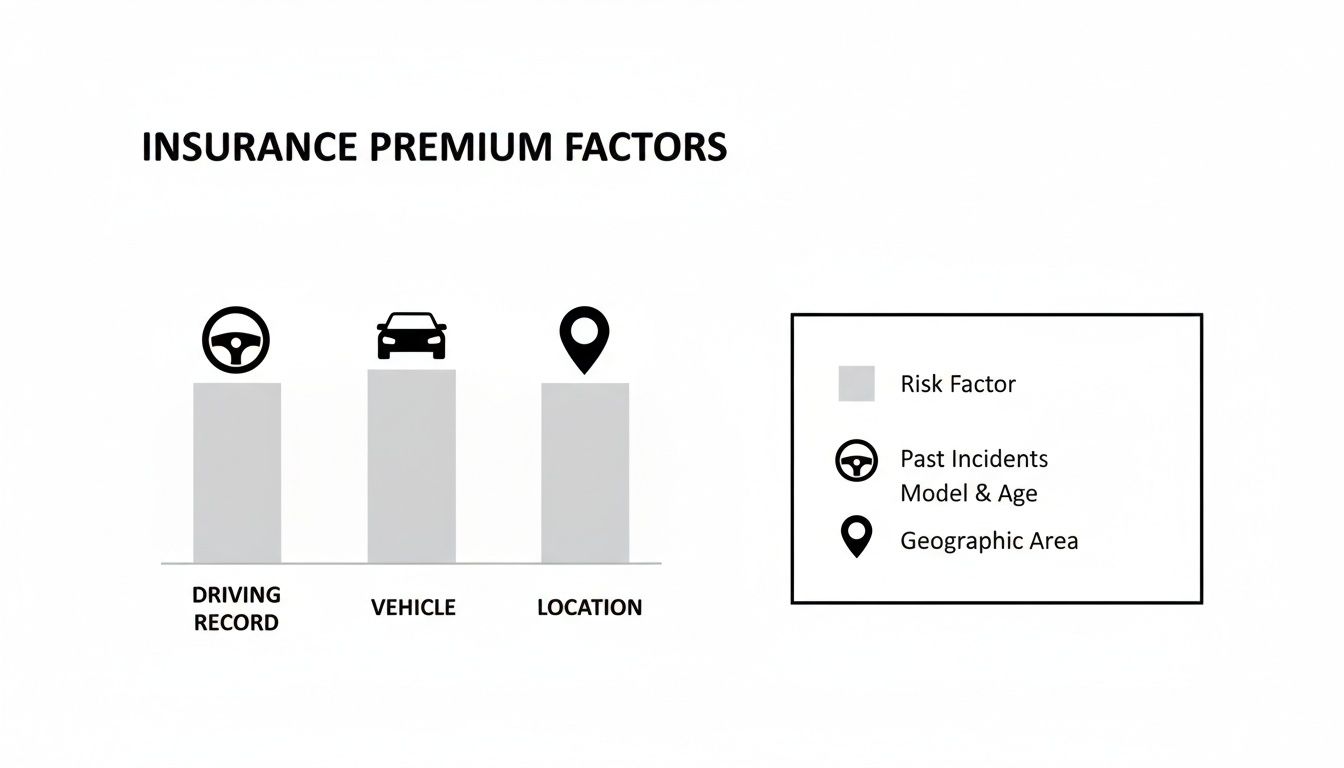
As you can see, things like your driving record, your car, and even your zip code are foundational to your rate. That’s why consistent information is the key to an honest price comparison.
Why Rates Vary So Dramatically Between Carriers
Even when you do a perfect apples-to-apples comparison, you'll still get a wild range of prices. Why? Because every insurance company uses its own secret sauce—a complex algorithm—to weigh risk.
One carrier might be hungry for customers with your specific driving profile, while another might see you as a higher risk. Their business goals and target markets are constantly shifting. This is precisely why shopping around is so essential. Blind loyalty to one company is one of the fastest ways to overpay for car insurance.
This table illustrates how premiums for different types of California drivers can vary significantly across top-rated carriers.
Sample Annual Premium Comparison Across California Driver Profiles
| Driver Profile | Carrier A (Annual Premium) | Carrier B (Annual Premium) | Carrier C (Annual Premium) | Best Rate Found |
|---|---|---|---|---|
| Good Driver, 35, San Diego | $2,150 | $1,890 | $4,980 | $1,675 |
| Young Driver, 22, Fresno | $3,800 | $5,100 | $4,100 | $3,450 |
| Family with Teen, Irvine | $4,550 | $4,980 | $5,100 | $4,550 |
The takeaway here is clear: the "best" carrier changes completely based on who you are. There's no single right answer, and the only way to find your best rate is to check the market.
Of course, doing this on your own can be a huge time sink. That’s where working with an independent agent from Mai & Associates makes all the difference. Instead of you filling out application after application, we do the legwork for you. We take your information once and shop it across our network of trusted carriers to find the most competitive price for the coverage you need—a true California auto insurance rate comparison without any of the hassle.
Getting to Know California’s Auto Insurance Rules
Every state has its own rulebook for auto insurance, and California’s is definitely unique. Getting a handle on these specific regulations is key to making a smart choice. They don’t just tick a legal box; they shape your coverage, your costs, and how protected you really are out on the road. A truly thorough California auto insurance rate comparison means looking past the price tag and seeing if a policy actually lines up with the state’s requirements.
These rules, from mandatory minimums to consumer protections, are in place for a reason. Knowing what they are helps you make a confident decision, ensuring you're not just legal, but truly covered.
California Minimum Liability Requirements
California law is very clear: every driver must have a baseline level of liability insurance. Starting in 2025, these minimums are going up to better reflect the real-world costs of accidents today.
Here are the new minimums you’ll need to carry:
- $30,000 for injury or death to one person.
- $60,000 for injury or death to multiple people in one accident.
- $15,000 for property damage.
But let’s be frank—these are just the bare minimums to keep you legal. A serious collision could easily blow past these limits, and you'd be on the hook for the rest. It's a risky financial move to only carry the state minimum.
The Big One: Proposition 103
You can't talk about California insurance without mentioning Proposition 103. This law, passed by voters way back in 1988, completely changed the game for how insurance companies can price their policies here.
The core of Prop 103 is consumer protection. It requires insurers to get any rate change approved by the California Department of Insurance first. The law explicitly states that rates can't be excessive, inadequate, or unfairly discriminatory, which gives you a strong defense against sudden, massive price hikes.
This single proposition is why our insurance market is so different from anywhere else in the country. Think about this: in 1989, the average annual auto premium in California was about $748. By 2010, it had actually dropped to $746. California was the only state where auto insurance costs went down over those 21 years, while the national average jumped by 43%. If you're a data nerd like me, you can read the full research on this unique pricing stability to see the numbers for yourself.
What About Uninsured and Underinsured Drivers?
Even with mandatory insurance laws, a surprising number of people in California are driving without any coverage. That’s where Uninsured/Underinsured Motorist (UM/UIM) coverage becomes a financial lifesaver for your auto insurance.
This is an optional add-on, but it's one I always recommend. It protects you if you get into an accident with someone who either has no insurance or has a policy that’s not nearly enough to cover your medical bills. With healthcare costs being what they are, UM/UIM is a small price to pay for major peace of mind.
SR-22 Filings: A Guide for High-Risk Drivers
If a driver gets a serious violation on their record, like a DUI or driving without proof of insurance, the DMV might require them to get an SR-22. It’s important to understand that an SR-22 isn't an insurance policy. It's simply a form your insurance company files with the state to prove you have the required liability coverage.
Needing an SR-22 automatically puts you in the high-risk category, which means your premiums will be much higher. And not every company is willing to file one. This is just one more example of why a knowledgeable agent is invaluable when you're doing a California auto insurance rate comparison—they know which carriers are right for your specific situation.
Real-World Strategies to Lower Your Car Insurance Costs
Alright, now that you know what goes into your premium, let's talk about how to take back control. Finding savings isn't about blind luck; it's about being strategic and knowing exactly where to look. With the right approach, you can cut what you pay for car insurance without giving up the protection you and your family really need.
These aren't just generic tips you've heard a dozen times. They're practical, actionable steps that work for California drivers. By stacking a few of these tactics, you can make a serious dent in your annual costs. It all begins when you start thinking of your California insurance policies as part of a single financial picture.
Bundle Your Policies for a Major Discount
This is almost always the lowest-hanging fruit and one of the most effective ways to slash your costs. Insurance carriers want to keep good customers, and they reward you for bringing more of your business to them. When you bundle multiple policies with the same company, you can often unlock a hefty discount, sometimes as much as 15-25%.
Don't just think about your car. The classic move is combining your auto insurance policy with home insurance or renters insurance. But you can also see great savings by adding a life insurance policy to the bundle. It's a true win-win: you get to simplify your financial life with one point of contact and pay less for much better overall coverage.
Take a Hard Look at Your Deductibles
Your deductible is simply the amount you agree to pay out-of-pocket for a comprehensive or collision claim before your insurance company steps in. The relationship here is straightforward: the higher your deductible, the lower your premium.
If you have a solid emergency fund set aside, think about bumping your deductible from $500 to $1,000. That single adjustment can drop your premium by a surprisingly significant amount. Yes, it's a calculated risk, but for drivers who can comfortably cover that higher amount, the long-term savings really add up.
Before you make the switch, ask yourself one simple question: "Could I write a check for the new deductible amount tomorrow without breaking a sweat?" If the answer is yes, this is one of the fastest ways to lower your monthly payment.
Don't Be Shy—Ask About Every Single Discount
Insurers have a whole menu of discounts, but they don’t always add them to your policy automatically. More often than not, you have to ask for them. The next time you run a California auto insurance rate comparison, make it a point to go down the list and see what you qualify for.
Here are a few that people often miss:
- Occupation Discount: Many carriers give special rates to people in certain jobs, like teachers, engineers, scientists, and first responders.
- Low-Mileage Discount: If you work from home or just have a short commute, you’re on the road less, which makes you a lower risk. Make sure your policy reflects how much you actually drive each year.
- Vehicle Safety Features: Modern cars are loaded with safety tech. Your insurer needs to know about your anti-lock brakes, airbags, anti-theft systems, and any of those newer driver-assistance features.
An experienced agent at Mai & Associates is trained to dig up every last discount for you. We know the ins and outs of what each carrier offers and can make sure you’re not leaving money on the table.
Consider Telematics (Usage-Based Insurance)
If you’re a genuinely safe and careful driver, a telematics program might be perfect for you. These usage-based programs use a small device in your car or a smartphone app to monitor your actual driving habits—things like how smoothly you brake, your average speed, and what times of day you're usually on the road.
Good driving gets rewarded with a lower premium. It’s a direct way to prove you’re a low-risk driver and get a rate based on your real-world performance, not just statistics. For many Californians, this can translate into big savings over a one-size-fits-all traditional policy.
Start Your Free California Auto Insurance Comparison Today

You now have a solid understanding of how to navigate California's complicated insurance market to find real savings. While it's true that rates are on the rise, the biggest takeaway should be this: you are in the driver's seat. A smart California auto insurance rate comparison is still the single most effective tool you have for lowering your premium.
This process doesn't have to be a headache. Partnering with an independent agency like Mai & Associates means you have an expert in your corner, turning a confusing chore into a simple, straightforward experience. We do all the heavy lifting for you.
Why Partner with Mai & Associates
We provide instant, no-obligation quotes from several top-rated insurance carriers, letting you see a true side-by-side comparison. Forget filling out endless forms on different websites. You give us your information once, and we find the best value for your specific needs, whether that’s for car insurance, home insurance, or bundling both with life insurance.
The goal is to move you from insight to action. This guide gives you the 'what' and the 'why'—our team provides the 'how,' delivering personalized expertise to secure your best rate, fast.
Having that dedicated guidance is more important than ever. California drivers are facing the third-highest anticipated auto insurance hikes in the nation, with average full coverage already approaching $221 a month ($2,652 annually). You can learn more about these insurance rate projections and see how they stack up against national trends.
Get Your Instant Quote Today
Our licensed agents are on standby to help you find every last discount, spot potential gaps in your coverage, and answer all your questions. We're also proud to offer multilingual support to serve California's diverse communities.
Our team provides assistance in:
- English
- Spanish
- Armenian
- Russian
- Vietnamese
Don't let another day go by overpaying for your auto insurance. Take the first step toward real savings right now. Contact Mai & Associates to start your free, no-hassle quote and discover just how much you could be saving on your California insurance.
Frequently Asked Questions
When you start digging into California insurance, a lot of specific questions tend to pop up. We hear them all the time. Here are some quick, straightforward answers to help you feel more confident as you compare auto insurance rates.
How Often Should I Shop for New Car Insurance in California?
We recommend taking a fresh look at your car insurance rates at least once a year. It's also a smart move to shop around after any big life change. Things like moving to a new ZIP code, buying a different car, getting married, or adding a teenager to your policy can all have a major impact on your premium.
Insurance rates are constantly in flux. The company that gave you the best deal last year might not be the most competitive one for you today.
Will a California FAIR Plan Policy Affect My Auto Insurance Rates?
It can, though indirectly. Since the California FAIR Plan is a last-resort fire insurance policy for your home, it doesn't cover vehicles. This means you miss out on one of the most significant discounts available: bundling your home insurance and auto insurance policies.
An experienced agent can often find a separate home insurance policy to pair with your auto coverage, helping you get back some of those multi-policy savings you'd otherwise lose.
Losing the bundling discount can be a serious financial hit. This is a perfect example of why working with an agent is so valuable—they can piece together different policies for home, renters, or even life insurance to rebuild that savings strategy for you.
Can I Get Affordable Car Insurance with a Bad Driving Record in California?
It's definitely possible, but it takes more work. A driving record with at-fault accidents or a few tickets will flag you as a higher-risk driver, which naturally means higher rates. The good news is that every insurance company calculates that risk a little differently.
Some carriers actually specialize in what's called "non-standard" insurance and are more willing to offer competitive rates to drivers with a spotty history. The trick is to be persistent in your search and to partner with an agent who works with a wide variety of insurers—not just the big names.
Ready to see how these insights apply to your own situation and find out how much you could be saving? The expert team at Mai & Associates is ready to run a fast, free, and personalized California auto insurance rate comparison for you. Get your no-obligation quote today!