California Auto Insurance Quotes Comparison Made Simple
If you want to lower your car insurance premium, the single most powerful thing you can do is run a California auto insurance quotes comparison. It’s not just a good idea; it's a financial necessity for every driver in the Golden State. Why? Because rates for the exact same coverage can swing by hundreds, sometimes even thousands, of dollars from one carrier to the next. This guide will help you navigate the world of California insurance to find the best rates for your auto, home, and life insurance needs.
Why Comparing California Insurance Is Non-Negotiable

California’s insurance market is massive and complex, which creates a competitive but often confusing landscape for consumers. You have dozens of insurers all fighting for your business, and that means prices for all types of California insurance can be all over the map.
As the nation's largest auto insurance market, California saw over $36.5 billion in personal auto premiums written in 2023 alone. With more than 13.1 million registered vehicles on the road, the demand is huge. You can dig deeper into the state's market dynamics in this comprehensive report.
The Financial Stakes of Not Comparing
Let's be blunt: if you're not comparing quotes, you're almost certainly overpaying. Each insurer uses its own unique formula to calculate risk. A driver one company views as high-risk could be another's ideal customer.
This isn’t just about car insurance, either. The same logic holds true for other critical coverages. It pays to shop around for:
- Home Insurance: Especially crucial for protecting your property in areas prone to wildfires or earthquakes.
- Renters Insurance: To make sure your personal belongings are covered against theft or damage.
- Life Insurance: For securing your family's financial future.
Bundling these policies can often lead to significant multi-policy discounts, but you'll only discover the real savings by comparing apples-to-apples across different providers.
Regulatory Changes Make Shopping Even More Critical
California’s insurance regulations don't stand still. Major changes are on the horizon, like the increase in minimum liability limits for auto insurance that takes effect on January 1, 2025. This update is a response to rising medical and vehicle repair costs, meaning your current policy might soon fall short or get more expensive.
Think of an annual insurance review as a critical financial check-up. As state laws change and market conditions shift, proactively comparing quotes ensures your coverage stays compliant and you’re still getting the most competitive rate out there.
The table below breaks down where a strategic California insurance comparison can save you the most money.
| Insurance Type | Why Comparison Is Crucial in California | Potential Savings |
|---|---|---|
| Auto Insurance | Intense market competition and varied risk models lead to huge price differences. | High |
| Home Insurance | Wildfire and earthquake risks cause major rate variations between carriers. | Very High |
| Renters Insurance | Bundling with an auto policy often provides the best value. | Moderate |
| Life Insurance | Rates depend heavily on health profiles, making shopping essential. | High |
At the end of the day, a diligent California auto insurance quotes comparison is about more than just finding a lower price. It's about locking in the right protection for your car, home, and family at a cost that makes sense in a constantly changing market.
How to Read an Auto Insurance Quote Like an Expert

Getting an insurance quote can feel like you’ve been handed a document in a foreign language. All those terms and numbers can be intimidating, but figuring them out is the single most important step in a solid California auto insurance quotes comparison. A low price only matters if the policy actually protects you when you need it most.
Think of your quote like a recipe for your policy. Each coverage is an ingredient, and the limits are the measurements. If you change one of those, the final result—and the price—will be completely different. This is why you always have to compare "apples-to-apples," making sure the core coverages are identical across every car insurance quote you look at.
To make sense of it all, let's break down the individual line items you'll find on a typical quote. The table below outlines the most common coverages, what they actually do for you, and what you should be thinking about when you see them.
Decoding Your California Auto Insurance Quote
| Coverage Type | What It Protects | Key Consideration For You |
|---|---|---|
| Bodily Injury (BI) Liability | Covers medical bills and lost wages for others if you cause an accident. | Are the limits high enough to protect your assets if you're sued? State minimums are often not enough. |
| Property Damage (PD) Liability | Pays to repair or replace someone else's car or property (like a fence) that you damage. | The cost to replace modern cars can easily exceed $25,000. Does your limit reflect this? |
| Collision | Covers repairs to your vehicle after an accident, regardless of who's at fault. | What is your deductible? A higher deductible lowers your premium but means more out-of-pocket cost for you. |
| Comprehensive | Protects your car from non-accident damage, such as theft, fire, vandalism, or hitting a deer. | Like Collision, your deductible is the key trade-off between your premium and your out-of-pocket risk. |
| Uninsured/Underinsured (UM/UIM) | Pays for your medical bills if you're hit by a driver with little or no insurance. | This is crucial in California. Can you afford your medical bills if an uninsured driver hits you? |
| Medical Payments (MedPay) | Covers medical costs for you and your passengers, no matter who caused the accident. | This can help cover health insurance deductibles and copays immediately after an accident. |
By understanding these core pieces, you can start to see how one policy stacks up against another, ensuring you’re comparing value, not just a price tag.
Breaking Down Liability Coverage
Liability is the absolute foundation of your car insurance policy. It's the part that covers damage you cause to other people. It’s always broken into two main components:
- Bodily Injury (BI) Liability: This is for people. It pays for their medical bills, lost income, and even legal fees if you’re at fault. You’ll usually see it written as two numbers, like $30,000/$60,000. That means the policy will pay up to $30,000 for one person's injuries and a maximum of $60,000 for the entire accident.
- Property Damage (PD) Liability: This is for stuff. It covers the cost to fix or replace the other person's car or any property you damaged, like a mailbox or storefront. This is the third number in the liability sequence, such as $15,000.
It’s really important to know that California's minimum liability requirements are changing in a big way. Starting January 1, 2025, the minimum limits are doubling from 15/30/5 to 30/60/15. This is the first increase since 1967 and was long overdue, reflecting the modern costs of cars and medical care.
When you're comparing quotes, always check the liability limits first. A quote that seems incredibly cheap is often just showing you the state minimum, which can leave you dangerously exposed in a serious accident. Most experts recommend carrying at least $100,000/$300,000/$50,000 to properly protect your assets.
Evaluating Coverage For Your Own Vehicle
Liability takes care of others, but Collision and Comprehensive coverages are what protect your own car. If you have a car loan or lease, your lender will almost certainly require you to have both.
Collision Coverage pays for your car's repairs after you get into an accident, whether it was with another car or you hit a pole. It doesn't matter who was at fault.
Comprehensive Coverage is for almost everything else. It handles damage from things like theft, vandalism, fire, hail, or hitting an animal.
The most important detail for both of these is your deductible—that's the amount you have to pay out of your own pocket before the insurance company starts paying. A higher deductible, like $1,000, will get you a lower premium. But a lower deductible, say $500, means you'll pay more for the policy but less if you have to file a claim. You can find more definitions in our insurance glossary.
Essential Optional Coverages
Beyond the core coverages, a few others are worth serious consideration for a complete policy, especially here in California.
- Uninsured/Underinsured Motorist (UM/UIM): This is a big one. It protects you and your family if you’re hit by a driver who has no insurance at all, or not enough to cover your medical bills. With so many uninsured drivers on the road, this is a coverage I strongly recommend.
- Medical Payments (MedPay): This helps pay medical bills for you and your passengers right away after an accident, no matter who was at fault. It's great for covering things like health insurance deductibles or co-pays without waiting for a settlement.
Getting comfortable with these terms is the first step. True expertise also means understanding related documents, like a Certificate of Insurance Template. When you can normalize all these key parts across every quote, you can finally see which one offers the best real-world value, not just the cheapest price. That's how you make a truly smart choice.
What Really Drives Your California Car Insurance Rate?
When you compare auto insurance quotes in California, the numbers that come back can seem all over the map. Why would one company charge hundreds more than another for the exact same driver and vehicle? It's not random. The price you pay is the result of a specific formula blending your personal details, California-specific regulations, and even broader economic trends.
Getting a handle on these factors is the first step to finding real savings. Insurers are essentially trying to predict risk, and they use a whole host of data points to do it. But here in California, the law puts strict guardrails on how they calculate that risk, which is a major advantage for consumers.
Your Driving Record Is Everything
In California, your rate is largely in your hands, thanks to a landmark voter-approved law called Proposition 103. This law forces insurance companies to prioritize three specific factors above all others when setting prices. This is a huge deal and makes our state very different from places where your credit score or neighborhood can unfairly inflate your premium.
By law, these are the top three rating factors in California for car insurance:
- Your Driving Safety Record: This is number one, period. A clean record free of accidents and tickets is the foundation for the lowest possible rate.
- Annual Miles Driven: It's simple—the less you're on the road, the lower the risk. Insurers offer significant discounts to drivers who log fewer miles each year.
- Years of Driving Experience: The more time you've spent behind the wheel, the better your rates tend to be. Experience is a good indicator of a lower-risk driver.
Proposition 103 was a game-changer. It means your premium has to be based primarily on things you can actually control—how safely you drive and how much you drive—not just on who you are or where you live.
Location Still Plays a Part, But It's Not the Star
While your ZIP code can't be the main reason your rate is high, it does still influence the final number. After an insurer has looked at your driving record, mileage, and experience, they can then adjust the rate based on local risk factors.
So, what does that look like in the real world? If you live in a dense urban area with more accidents, higher vehicle theft rates, and more lawsuits, you'll likely pay more than someone in a quiet, rural town. A driver in Los Angeles (90001) will almost certainly have a higher premium than an identical driver in a less congested city like Fresno (93722), even if they both have perfect driving histories.
Your Car and Your Coverage Choices
It's no surprise that the vehicle you choose to drive directly impacts what you pay for insurance. Insurers look at a few key things:
- Make and Model: A high-performance sports car costs a lot more to repair and insure than a reliable family sedan.
- Safety Ratings: Cars loaded with great safety features, like advanced driver-assistance systems and airbags, often qualify for discounts.
- Theft Risk: Some models are, unfortunately, bigger targets for thieves. That higher risk gets priced into your comprehensive coverage.
Beyond the car itself, the coverage levels you select are a major lever on your premium. Choosing higher liability limits and lower deductibles gives you much better financial protection if something goes wrong, but it will also increase your monthly cost.
The Bigger Picture: Market Forces and Rate Hikes
Finally, some factors that affect your premium are completely out of your hands. In 2025, many Californians saw their auto insurance premiums jump, with some facing increases as high as 54%. These hikes are a response to several pressures at once: new state-mandated minimum coverage levels, inflation driving up repair costs, a spike in auto thefts, and even major climate events like wildfires affecting the broader California insurance market.
With a staggering $36.5 billion in auto insurance premiums written in 2023 across the state's 13.1 million registered vehicles, these outside forces create massive ripples. You can learn more about the factors driving California insurance rate hikes to understand the current climate. This is precisely why shopping around and comparing options is no longer just a good idea—it's essential for keeping your costs under control.
A Practical Framework for Comparing Insurance Providers
Chasing the lowest price on a California auto insurance quotes comparison is a classic mistake, and it's an easy one to make. But a cheap policy can be a real trap. It might come from a carrier with a poor track record for customer service or shaky financial health, turning a simple claim into an absolute nightmare. A smart comparison looks past the monthly premium to gauge the carrier's real value and reliability over the long haul.
You have to shift your mindset from pure cost-saving to finding quality coverage. It's like buying a car—you wouldn't just grab the cheapest one on the lot without looking at its safety ratings, would you? The same logic applies here. This is about protecting you, your family, and your assets with the right California insurance.
Evaluating Financial Strength
First things first: you need to know if the company can actually pay its claims. An insurance policy is just a promise, and you need to be sure the carrier has the financial muscle to back it up, especially after a major event like a California wildfire or earthquake.
The industry benchmark for this is the A.M. Best rating. This independent agency is like a credit bureau for insurance companies, grading them on their financial health. You should be looking for carriers with a rating of "A-" (Excellent) or higher. Anything less is a gamble you don't want to take.
Assessing Customer Service and Claims Handling
A great price means absolutely nothing if you're met with radio silence or a bureaucratic nightmare when you file a claim. This is where reputation for customer service and claims handling is critical. You want a partner who makes the process smooth, not an adversary who fights you every step of the way.
A fantastic resource here is the annual J.D. Power U.S. Auto Insurance Study. They survey real customers and rank major carriers on what actually matters:
- Claims Handling: How fairly and quickly do they process claims?
- Customer Interaction: Are agents actually helpful and reachable?
- Billing and Policy Information: Can you easily manage your account and understand what you're paying for?
Picking a company that scores well in these areas will save you a world of frustration. For more tips on what to look for, you can check out our collection of insurance guides to help you choose wisely.
This flowchart breaks down the key factors insurers look at when they first calculate your rate. This is the starting point for any quote comparison.
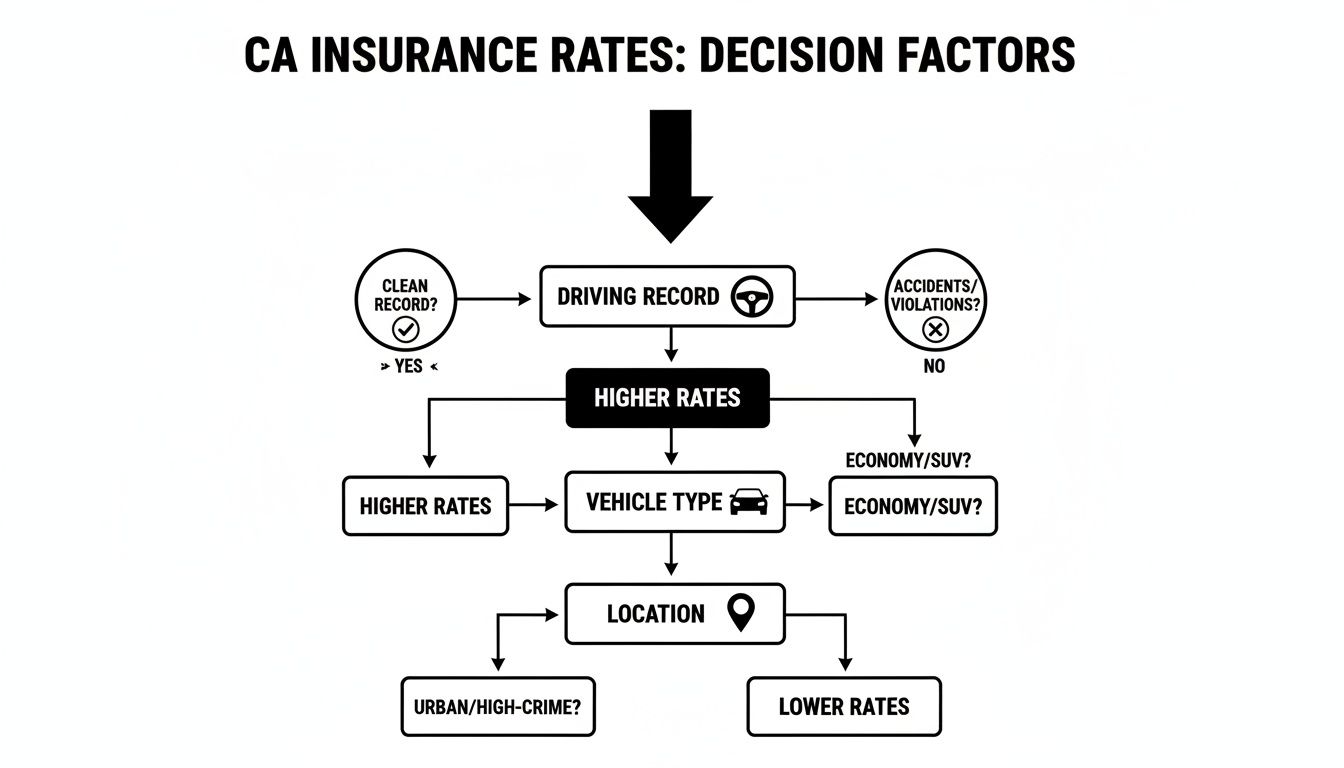
As you can see, things like your driving history, your car, and where you live set the foundation. But the quality of the carrier you choose is what determines your long-term peace of mind.
Comparing Discounts and Policy Features
Once you've narrowed down your list to a few financially sound carriers with good service reps, it's time to dig into the policy details. Not all discounts are the same, and some companies have unique features or endorsements that can add a ton of value.
A common mistake is assuming discounts are automatic. You often have to ask for them. A great agent will proactively identify every available discount, from multi-policy bundles for auto and home insurance to good student or defensive driving credits.
To keep everything straight, a simple scorecard is your best friend. It forces you to compare apples to apples, making the final decision much clearer.
Insurance Carrier Comparison Checklist
Use this scorecard to systematically compare potential auto insurance carriers on critical factors beyond just the monthly premium.
| Evaluation Metric | Carrier A (Score 1-5) | Carrier B (Score 1-5) | Carrier C (Score 1-5) | Important Notes |
|---|---|---|---|---|
| A.M. Best Rating | Look for "A-" or higher. | |||
| J.D. Power Score | Check both claims and service. | |||
| Premium Cost | Score lower costs higher (e.g., 5). | |||
| Discount Availability | How many apply to you? | |||
| Endorsement Options | Do they offer what you need? | |||
| Digital Tools (App/Site) | Ease of use for payments, claims. | |||
| Local Agent Support | Is there a local person to call? | |||
| Total Score | Sum of the scores above. |
This systematic approach takes you from just hunting for a low price to making a smart, value-driven decision. By scoring each potential provider on these key metrics, you can confidently choose a carrier that gives you a competitive rate and the reliable support you deserve.
Squeezing Every Dollar Out of Your Premium with California Discounts
After all the core rating factors are punched in, the final number you see on your auto insurance quote is all about the discounts. Don't mistake these for minor add-ons; we're talking about savings that can slash hundreds of dollars off your yearly premium. The catch? You often have to ask for them. The most valuable discounts aren't always applied automatically.
Think of it as a game where knowing the rules gives you a huge advantage. Each insurance company has its own playbook of discounts, and understanding the ones that pack the biggest punch in California is key. From how you drive to where you live, there are plenty of ways to bring that cost down.
California's Heavy Hitter: The Good Driver Discount
Here in California, one discount stands head and shoulders above the rest: the Good Driver Discount. This isn't just a friendly offer; it's mandated by state law. Insurers are legally required to give a discount of at least 20% to any driver who fits the state's criteria. Honestly, this single discount can be the difference between a policy that feels right and one that’s just too expensive.
So, what does it take to qualify? You need to:
- Have held a driver's license for the last three consecutive years.
- Have no more than one point on your driving record in that three-year period.
- Not have an at-fault accident on your record that caused injury or death.
- Have a clean record with no DUIs or other major violations.
Pro Tip: As you compare quotes, always double-check that the Good Driver Discount is listed if you know you qualify. That 20% is just the starting point—some insurers are more generous, making this a crucial detail to compare.
Bundling: The Easiest Path to Big Savings
One of the simplest and most powerful strategies for saving money on California insurance is to bundle your policies. Insurance carriers love managing all of your risk under one roof, and they reward that loyalty with some of their best discounts. When you combine your auto insurance with your other policies, the savings really start to add up.
This is where taking a step back to look at your whole insurance picture pays off. Ask for quotes that bundle your auto policy with:
- Home Insurance: This combo typically unlocks the biggest discount. If you own a home, it's a no-brainer.
- Renters Insurance: Even if you rent, you can protect your stuff and get a nice discount on your car insurance.
- Life Insurance: A few carriers will even shave a bit more off your premium for adding a life policy.
Bundling doesn't just save you cash; it also makes your life easier. One company, one bill, one number to call. When you’re getting quotes, make sure you ask for the bundled price to see just how much you can save.
Don't Forget to Ask About These Other Common Discounts
Beyond the big ones, there's a whole list of smaller discounts that can collectively make a real dent in your premium. The golden rule is to never assume anything is included. You have to specifically ask your agent or hunt for it in the quote details.
Run down this checklist and see what you might be missing:
- Multi-Car Discount: For households insuring more than one vehicle.
- Good Student Discount: A classic for young drivers who keep their grades up (usually a "B" average or higher).
- Telematics/Usage-Based Programs: Willing to use a small device or app that tracks your safe driving? Cautious drivers can see big rewards here.
- Defensive Driving Course: Completing an approved course can often earn a discount, which is especially popular for mature drivers.
- Professional/Affinity Groups: Are you part of an alumni association, a specific professional organization, or a partner employer group? You could qualify for a special rate.
- Safety Features Discount: Your car’s built-in anti-theft systems, airbags, and other safety tech can earn you a small discount.
By going through these one by one, you ensure you’re not leaving any money on the table. A truly effective quote comparison isn't just about the first price you see—it's about finding the carrier that rewards you the most for who you are.
Let an Expert Do the Heavy Lifting for You
After you’ve done your homework on coverage types, rate factors, and carrier reputations, the final step is actually getting and comparing quotes. This is often where the whole process grinds to a halt. The old-school way—calling a dozen different companies, repeating your driver's license number until you're blue in the face, and trying to make sense of wildly different quote formats—is a massive headache.
Thankfully, there’s a much smarter way to shop. Teaming up with an independent insurance agency turns this tedious chore into a single, productive conversation. Instead of you chasing down quotes, a licensed agent acts as your personal shopper, doing all the legwork on your behalf.
One Conversation, Dozens of Options
Working with an independent agent means you get instant access to rates from a whole network of top-rated California insurance carriers, all at once. You give them your information one time. That’s it. In return, you get a neatly organized, side-by-side comparison of your best options, saving you hours of frustration.
This completely removes the guesswork. A good agent will present you with quotes that are truly apples-to-apples, with identical liability limits, deductibles, and endorsements. This kind of clarity is crucial for making a smart decision based on real value, not just a lowball price that might hide serious gaps in your protection.
An expert advisor isn't just a convenience; they're your advocate. A good agent offers objective advice, helping you strike the right balance between robust coverage and your budget. Their main job is to protect your financial future.
For tailored advice and expert navigation of the market, experienced insurance agents can provide the clarity you need.
Thinking Beyond Just Your Car
Real financial security is about more than just your vehicle. This is where an independent agent truly shines—they can look at your entire financial picture and find opportunities to bundle policies for big savings and less hassle. They can seamlessly package your auto insurance with:
- Home Insurance: Essential for protecting your biggest investment, especially given California’s unique wildfire risks.
- Renters Insurance: A surprisingly affordable way to protect all your personal stuff from theft or disaster.
- Life Insurance: The bedrock of your family's long-term financial stability.
An agent reviews your whole insurance portfolio to find weak spots and recommend smart bundles that often come with significant discounts. This holistic approach ensures you aren't leaving any assets exposed, all while making sure you're not paying a penny more than you need to. And with multilingual support available in English, Spanish, Armenian, Russian, and Vietnamese, you can be sure nothing gets lost in translation.
This kind of expert guidance gives you a direct path to the best protection at a competitive price, without all the typical stress. You can see just how simple it is to get a multi-carrier insurance quote and let an expert find the perfect fit for you.
Frequently Asked Questions
When you're digging into a California auto insurance quotes comparison, a few common questions always seem to pop up. Here are some straightforward answers to help you navigate the process like a pro.
How Often Should I Compare California Auto Insurance Quotes?
The best practice is to shop for new auto insurance quotes at least once a year, right around your policy renewal time. Insurance rates are always shifting, and the company that gave you the best deal last year might not be the most competitive one for you today.
Beyond that annual check-in, certain life events should trigger an immediate rate comparison. Did you move to a new ZIP code, buy a new car, get married, or add a teenage driver to your policy? All of these can drastically change your premium, making it the perfect time to see if you can find a better rate elsewhere.
Will Comparing Multiple Auto Insurance Quotes Affect My Credit Score?
Nope, not at all. Go ahead and shop around freely—it won't hurt your credit score one bit. When you ask for an insurance quote, carriers perform what's called a "soft inquiry" to get your credit-based insurance score.
Unlike the "hard inquiry" that happens when you apply for a loan or credit card, a soft pull is invisible to lenders and has zero effect on your FICO score. You can get as many quotes as you want without any penalty.
Why Are Quotes From an Independent Agent Often Better?
Getting a quick quote online is one thing, but it rarely tells the whole story. Working with an independent agent gives you a huge advantage because they can pull quotes from a wide range of carriers all at once, saving you the hassle of filling out the same form over and over again.
But the real value is in their expertise. A licensed agent knows exactly where to look for discounts you might miss, like the big savings that come from bundling your auto insurance with home insurance, renters insurance, or life insurance. They also act as a safety net, pointing out dangerous coverage gaps that a cheap online quote might create. To see more answers to common questions, check out our full insurance FAQ page. That expert guidance ensures you end up with a policy that actually protects you, not just one with a low price tag.
Ready to see how much you could save with a truly comprehensive comparison? The licensed experts at Mai & Associates are here to help you compare quotes from multiple top-rated carriers for your auto, home, renters, and life insurance needs. Get your free, no-obligation quote today and find the best protection for your budget.