California Auto Insurance Laws 2026: Your Essential Guide
California's new auto insurance rules may make it easier to meet the legal minimum, but minimum coverage can still leave a driver badly exposed after one serious crash.
A lot of people hear that the state raised the required liability limits and assume that means they are fully protected. That is a risky assumption, especially in California, where repair bills, medical costs, and lawsuit exposure can rise fast. Legal compliance is only the starting line. Real financial protection is a different question.
A simple way to look at it is this. Your auto policy has two jobs. First, it helps you satisfy California's financial responsibility rules so you can drive legally. Second, it helps shield your savings, paycheck, and future income if you cause a costly accident. Those jobs overlap, but they are not identical.
That distinction matters even more in a state with high living costs and many uninsured or underinsured drivers. A low-limit policy may check the legal box while still leaving you to pay thousands out of pocket. If you want context on how claim amounts and settlements can grow after a crash, this guide to fair insurance payouts is a useful reference. For a California-focused overview of policy options and requirements, Mai & Associates also shares practical information about auto insurance in California.
Insurance also works best when you see it as part of a bigger safety net. Auto insurance covers liability on the road. Home or renters coverage protects where you live. Life insurance can help protect your family's finances. They work like different walls of the same house. If one wall is thin, a single loss can put pressure on everything around it.
Understanding California Auto Insurance in 2026
California auto insurance laws can look simple at first glance. You see a few required numbers, you buy a policy, and you assume you're done. In practice, most confusion starts after that. Drivers ask whether minimum coverage protects their own car, whether digital proof is enough, and whether cheaper legal options are smart options.
A good way to think about insurance is to separate legal compliance from financial protection. Compliance is what the state requires so you can drive legally. Protection is what keeps one accident from becoming a long-term money problem. Those are related, but they're not the same thing.
If you're trying to understand how claim values can outgrow a basic policy, this guide to fair insurance payouts helps explain why vehicle damage and settlement issues can become complicated after a crash. For a California-specific starting point, Mai & Associates also publishes practical information on auto insurance in California.
Why drivers get tripped up
Some parts of the law sound technical, but practical questions are ordinary:
- What do those numbers mean: Drivers often know they need liability coverage but don't know what each number pays for.
- Whose damage gets paid: Many people assume minimum liability covers their own repairs. It usually doesn't.
- What counts as proof: Having a policy and being able to show proof when asked are two different things.
- How much risk is left over: A legal minimum can still leave you exposed if costs rise above your limit.
Practical rule: Buy enough coverage for the accident you hope never happens, not just for the traffic stop you hope to avoid.
California insurance decisions also connect with broader planning. If you bundle auto insurance with home insurance, renters insurance, or life insurance, you may be able to simplify billing, reduce gaps, and make your coverage easier to review as your life changes.
California's New Minimum Liability Insurance Requirements
California raised the legal minimum liability limits starting January 1, 2025. For 2026, drivers must carry at least 30/60/15 liability coverage instead of the old 15/30/5 limits.
That change matters. But it also creates a common misunderstanding. Higher minimums do not mean high protection, especially in a state where repair bills, medical costs, and uninsured-driver problems can get expensive fast.
What 30/60/15 actually means
Those three numbers are the payment limits for damage you cause to other people in an at-fault crash:
- $30,000 for injury or death to one person
- $60,000 total for injury or death to more than one person in one accident
- $15,000 for property damage
Liability insurance works like paying for damage you accidentally cause in someone else's space. If you rear-end another car, injure another driver, or damage a fence, these limits set how much your policy can pay toward the other party's losses. Your own vehicle is a separate question.
California Minimum Auto Liability Limits Old vs. New 2026
| Coverage Type | Limit Before Jan 1, 2025 | Current Limit (2026) |
|---|---|---|
| Bodily injury to one person | $15,000 | $30,000 |
| Bodily injury to multiple people in one accident | $30,000 | $60,000 |
| Property damage | $5,000 | $15,000 |
The increase is a step in the right direction. Still, minimum coverage is closer to a basic legal entry ticket than a strong financial shield. One newer car, one trip to the emergency room, or one multi-car accident can push costs past those limits faster than many drivers expect.
That is where new buyers often get confused. California requires liability coverage, but the requirement is only the floor. It does not mean your policy will cover your own repairs, rental car costs, or every bill that follows a serious crash.
Where drivers often misunderstand liability
A few mix-ups come up again and again:
- They assume minimum coverage protects their car. It usually does not. Liability is mainly for the other party's injuries and property damage when you cause the accident.
- They underestimate property damage costs. A $15,000 property damage limit can disappear quickly if you hit a newer SUV, several vehicles, or public property.
- They focus only on staying legal. Legal compliance matters, but personal assets, savings, and future wages can still be at risk if losses go beyond your limits.
- They treat all drivers the same. A household with teen drivers, a long commute, or financed vehicles usually needs a different coverage conversation than a low-mileage retired driver.
For California business vehicles, liability questions can get even more technical. Federal filings and commercial obligations are a separate issue from personal auto rules. If that applies to your operation, this overview of protecting your fleet with MCS-90 gives useful background.
If you want a simpler side-by-side explanation of coverage options, Mai & Associates' California insurance guides are a practical place to start.
Minimum liability coverage helps you satisfy the law. It may still leave a large part of the financial risk sitting with you.
How to Prove Financial Responsibility in California
California doesn't just require drivers to have financial responsibility. It also expects them to be able to prove it. That's where many people get caught off guard. They paid for a policy, but the ID card expired, the app isn't loading, or they never understood that the state recognizes a few alternatives to a standard insurance policy.
Under California law, most drivers use insurance, but the state also allows a $35,000 DMV cash deposit or a $35,000 surety bond, and proof must be carried in the vehicle at all times, as described in this overview of California minimum car insurance requirements.
The practical ways drivers show compliance
For many drivers, the easiest route is still a regular auto policy with proof available in the car. That proof may be requested during a traffic stop, after an accident, during registration matters, or in other routine situations.
The lesser-used alternatives exist, but they're niche options:
- DMV cash deposit: This ties up a large amount of money.
- Surety bond: This is another formal financial responsibility method, but it isn't how most everyday drivers handle compliance.
- Standard insurance policy: This remains the most practical option for most households because it pairs legal proof with actual insurance protection.
Where SR-22 fits in
SR-22 causes a lot of confusion. It isn't a type of insurance policy by itself. It's generally a filing used to show the state that a driver carries the required coverage after certain driving issues. If an insurer files it for you, it works more like a certificate attached to your policy than a separate product.
Commercial drivers and business owners sometimes run into another layer of confusion because trucking and interstate filings use different rules than personal auto coverage. If you manage business vehicles, this explainer on protecting your fleet with MCS-90 gives helpful context on a filing that applies in a different regulatory setting.
Keep proof where you can actually reach it. The best policy in the world won't help much if you can't show valid proof when an officer or agency asks for it.
If you still aren't sure what form of proof you should carry or whether a special filing applies to your situation, Mai & Associates' insurance FAQ page covers many of the questions drivers ask most often.
Why Minimum Coverage Is a Major Financial Risk
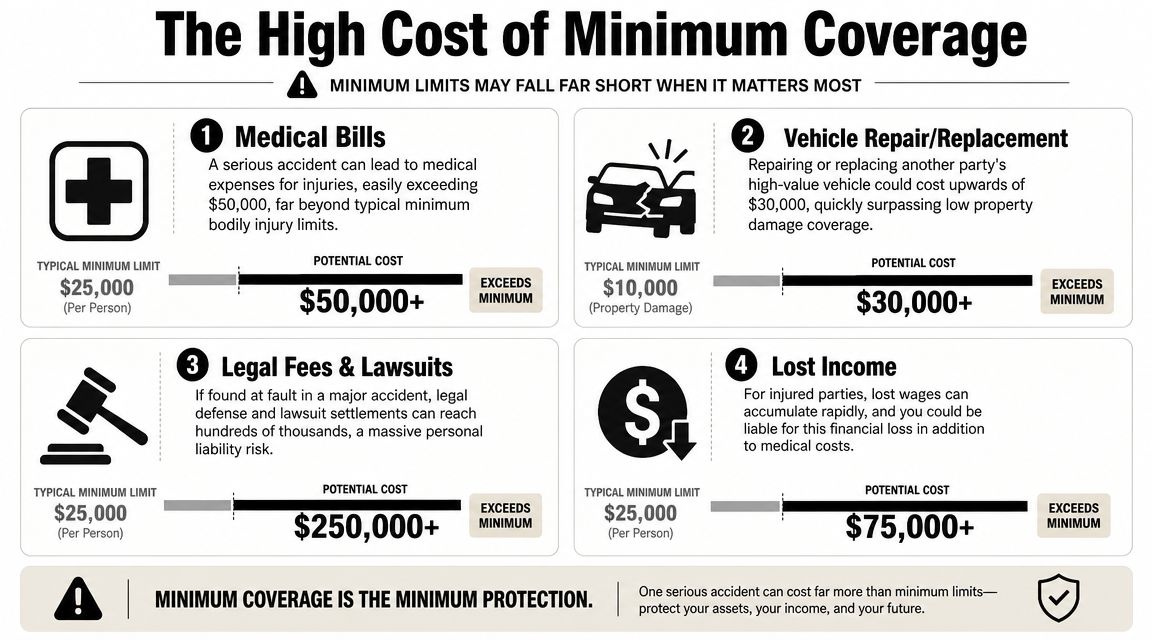
A minimum policy can satisfy California auto insurance laws and still leave a driver dangerously exposed. That's the part many people don't hear until after a claim. Legal minimums create a floor. They don't promise that the floor is high enough for real-world accident costs.
California also has a serious uninsured-driver problem. According to a 2025 Insurance Research Council report using 2023 data, 20.4% of California drivers were uninsured, or roughly 1 in 5 motorists, which ranked the state 8th highest in the nation for uninsured driving, as summarized by Victims Lawyer. That means even careful drivers can get hit by someone who has no insurance at all.
Why the minimum can run out fast
Here's the plain version. If the damage you cause is greater than your liability limit, your insurance may stop at that limit. The unpaid portion doesn't disappear just because your policy was legal. That shortfall can become your problem.
The same logic applies when the other driver is uninsured or underinsured. If they don't have enough coverage, you may need your own policy to step in.
Coverages that protect you instead of only the other driver
Three optional coverages deserve special attention:
- Uninsured/Underinsured Motorist coverage: This can help protect you and your passengers if the at-fault driver has no insurance or not enough of it.
- Collision coverage: This generally helps with damage to your own car after an accident, regardless of who hit whom.
- Other physical damage coverage: This generally covers non-collision losses involving your vehicle, such as theft or certain other physical damage events.
A useful way to think about it is this: liability coverage protects your wallet from claims by others. Collision and other damage protect your car. UM/UIM helps protect you from the other driver's lack of protection.
The real difference between legal and safe
Drivers often shop for the lowest monthly bill because insurance feels abstract until it's needed. Then the policy becomes very concrete. One crash, one injury claim, one uninsured driver, and suddenly the cheapest option may look very expensive.
If you want practical reading on coverage options and everyday insurance questions, the articles on the Mai & Associates blog are a helpful next step.
The Steep Penalties for Driving Uninsured
A routine traffic stop can turn into a long headache when a driver can't show insurance. The officer asks for license, registration, and proof of financial responsibility. The driver has the first two, but not the third. Maybe the policy lapsed. Maybe the card is outdated. Maybe there was never a policy in force.
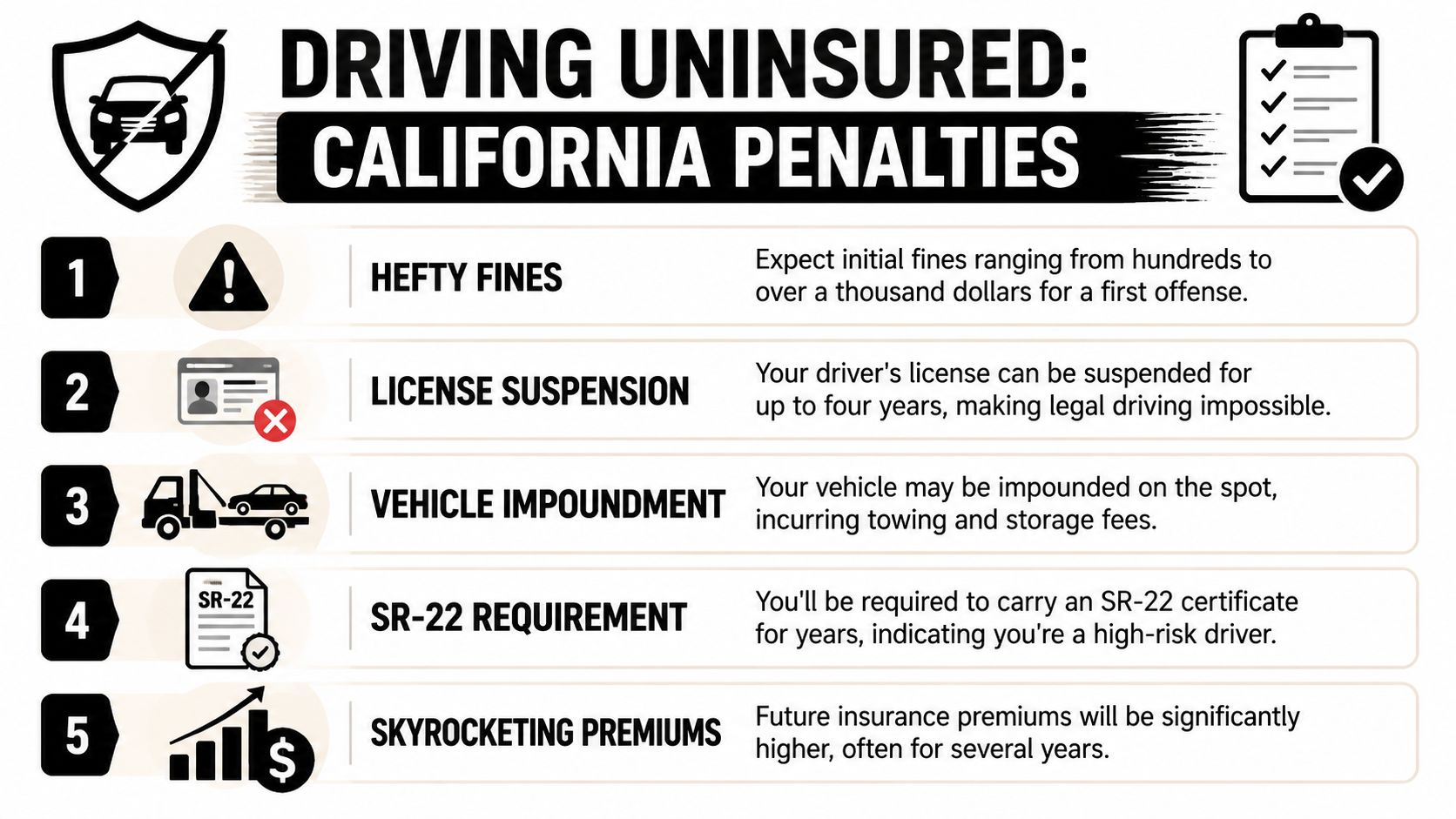
That moment can trigger far more than inconvenience. California warns that driving without insurance can lead to fines, license suspension, and vehicle impoundment, and recent affordability pressure has made compliance even harder for some households, as noted qualitatively in earlier guidance on state requirements.
How the trouble compounds
The first problem is legal. If the state treats you as uninsured, you may face penalties that affect both driving and vehicle use.
Then the practical costs start stacking up:
- Fines: Even before you deal with anything else, you may owe money to resolve the violation.
- License issues: A suspended license can disrupt work, school, and family routines.
- Vehicle impoundment: If your car gets towed, you're suddenly dealing with transportation problems on top of legal ones.
A lot of drivers underestimate the inconvenience cost. Missing work, paying for rides, arranging child pickups, or trying to reinstate driving privileges can create a chain reaction.
Why going uninsured can hurt after a crash too
If an uninsured driver gets into an accident, the problem isn't only the ticket or DMV consequence. It can also weaken that driver's financial position during the claim process. That's one reason carrying valid coverage matters even for people who don't drive often.
Insurance isn't just paperwork for the glove box. It's what keeps a traffic stop or minor accident from snowballing into a larger legal and money problem.
Insurance Rules for Special California Drivers
Some drivers need more individualized advice because their situation changes the insurance decision. A new California resident doesn't shop the same way as a parent adding a teen. A driver who needs special filings faces a different set of practical questions again.
One statewide baseline applies broadly: on January 1, 2025, California's statutory minimums increased to $30,000 for bodily injury coverage per person, $60,000 per accident, and $15,000 for property damage, and the change applies to new policies and renewals, according to State Farm's overview of the law change.
New residents
If you've moved from another state, don't assume your old policy setup fits California automatically. Start by checking whether your current insurer can write a California policy and whether your liability limits align with California requirements at renewal or on a new policy.
Also review the rest of your insurance picture at the same time. Moving is when people often discover they also need updated home insurance, renters insurance, or life insurance because address changes affect more than just the car in the driveway.
Parents of teen drivers
Adding a teen driver often changes how a family thinks about risk. Parents usually focus first on price, but the more important question is how much liability protection the household needs when an inexperienced driver starts using the vehicle.
Useful habits include:
- Reviewing all household vehicles: The newest or most valuable car may not be the best first car for a teen.
- Asking about student-related discounts: Insurers often have discount programs tied to driver profile or school performance.
- Checking deductible comfort: If a teen has a minor accident, can the family comfortably handle the deductible?
High-risk drivers
If you've had violations, a lapse, or another issue that makes coverage harder to place, don't treat that as permanent. High-risk status is often a pricing and underwriting problem, not a sign that insurance is out of reach forever.
Focus on the controllable parts:
- Keep coverage active with no new lapse.
- Follow any filing requirements carefully.
- Re-shop after your record improves.
- Raise questions before renewal instead of after cancellation notices arrive.
How to Lower Your California Insurance Premiums
Saving money on California auto insurance doesn't mean stripping your policy down to the legal minimum. A smarter approach is to protect the big risks while trimming waste, duplicate coverage, and avoidable pricing mistakes.
That same idea applies across your whole insurance plan. Auto insurance, home insurance, renters insurance, and life insurance often cost less and work better when they're reviewed together instead of one policy at a time.
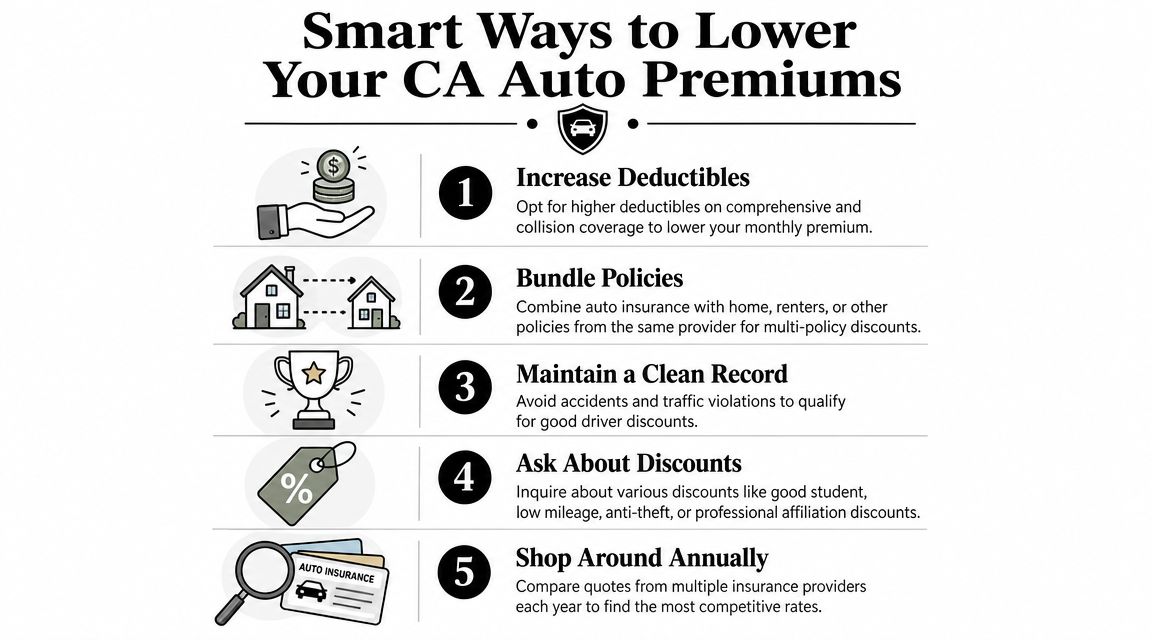
Five ways to cut cost without weakening protection
- Raise deductibles carefully: If you carry collision or other physical damage coverage, a higher deductible can lower premium. Just make sure the deductible still fits your emergency budget.
- Bundle policies where it makes sense: Combining auto insurance with home insurance, renters insurance, or life insurance may simplify coverage and reduce total cost.
- Keep your driving record clean: Safe driving helps more than almost any shopping trick.
- Ask for every available discount: Good driver, low mileage, anti-theft, student-related, and multi-policy discounts are all worth reviewing.
- Shop every renewal cycle: Pricing changes. So do life circumstances, vehicles, commute patterns, and carrier appetite.
What to review before you switch
The cheapest quote isn't always the best deal. Compare these side by side:
| What to compare | Why it matters |
|---|---|
| Liability limits | A lower premium may come from lower protection |
| Deductibles | Savings today can mean a bigger out-of-pocket bill later |
| UM/UIM availability | Important in a state with many uninsured drivers |
| Collision and comprehensive | Needed if you want protection for your own vehicle |
| Policy fit across households | Auto, home, renters, and life insurance often work better when aligned |
One practical option is to have an agency compare multiple carriers and review coverage gaps at the same time. Mai & Associates is a California agency that helps clients compare auto, home, renters, and life insurance options and review how those policies fit together.
Bottom line: The goal isn't the cheapest policy on paper. It's the lowest price for coverage you can still live with after a bad day.
If you want a second opinion on your current coverage, Mai & Associates can help you compare California auto insurance, home insurance, renters insurance, and life insurance options in one place, with multilingual support and no-obligation quote help.