California Auto Insurance Increase: Save Money in 2026
If your California car insurance premium jumped and you felt blindsided, your reaction is justified. California's average full-coverage premium rose from $1,666 in June 2023 to $2,417 in June 2024, a 45% year-over-year increase, with projections that the total 2024 increase could reach 54% according to the California Department of Insurance page citing Insurify data.
This isn't a routine price adjustment. It's a serious California auto insurance increase driven by multiple pressures hitting drivers at the same time. If you also carry home insurance, renters insurance, or life insurance, this is the moment to review everything together instead of treating each policy like a separate island.
Why Your California Car Insurance Bill Is So High
Most drivers think a higher bill means they had a ticket, a claim, or bad luck. Sometimes that's true. Right now, though, many careful California drivers are getting hit even with clean records because the entire market got more expensive.
The fastest way to understand the California auto insurance increase is to stop looking for one culprit. There isn't one. You've got a stack of problems landing at once: legal minimums changed, repair costs climbed, insurers adjusted prices after years of pressure, and affordability got worse across the market.
This isn't just your policy
Your premium reflects more than your driving history. It reflects what insurers expect to pay across thousands of claims in California's current environment. That means your renewal price can rise even when nothing changed in your own household.
If you want a basic primer on how California auto insurance policies work, it's useful to review the main coverage parts before you compare quotes. Then look at your own options through a local California-focused resource for auto insurance coverage in California so you can line up coverage, deductibles, and limits side by side.
Practical rule: Don't assume loyalty will protect your rate. In a hard market, staying put without reviewing your policy usually costs more.
What your bill is really telling you
A high renewal notice usually means one of these things is happening:
- Your carrier recalculated statewide risk: The company expects higher claim costs and raises rates across broad groups of drivers.
- Your existing limits are no longer cheap to insure: When required coverage rises, the floor price of a legal policy rises with it.
- Your vehicle costs more to repair than it used to: Newer parts, electronics, sensors, and labor rates make even moderate damage expensive.
- Your policy may be outdated: You could be paying for coverages that no longer fit, or carrying deductibles that don't match your budget.
That last point matters. I see plenty of drivers who focus only on the monthly payment and never check the structure of the policy. That's a mistake. The cheapest-looking policy can be the most expensive one if it leaves you exposed after a crash.
National Trends Driving Up Insurance Premiums
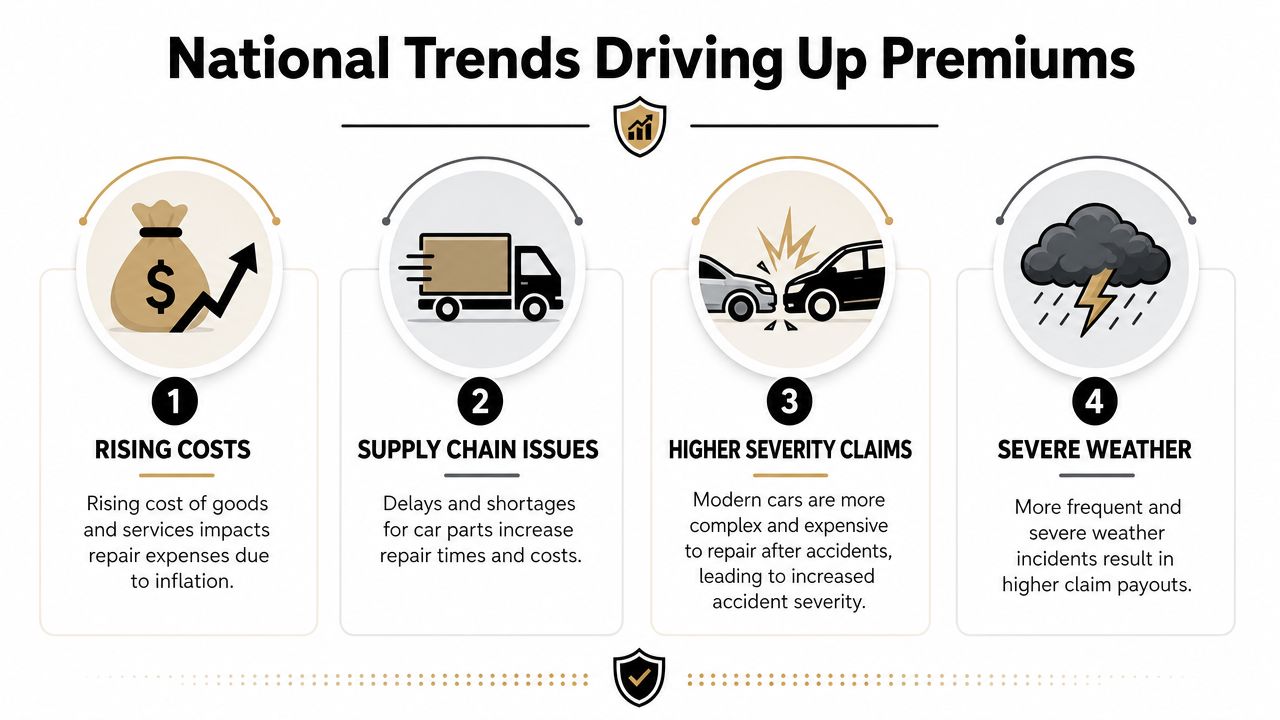
California has its own insurance headaches, but this price surge didn't appear out of thin air. The whole country has been dealing with rising auto insurance costs. The Insurance Information Institute noted that U.S. auto-insurance premiums rose about 15% in 2023 and 10% in 2024, with another average 4% increase projected for 2026, according to industry reporting summarized here.
That matters because it kills the myth that California drivers are dealing with a completely isolated problem. They're not. California is getting hit by the same national cost pressures, then adding its own state-specific issues on top.
Repairs got more expensive
Modern vehicles cost more to fix. That's true whether you drive a luxury SUV or a modest commuter car. Bumpers now hide sensors. Mirrors hold cameras. Windshields can affect driver-assistance systems. One accident doesn't just mean body work anymore. It can also mean calibration, specialized parts, and longer repair timelines.
Insurers price policies around expected claim costs. When parts and labor rise, premiums follow. That's not greed. That's math.
Delays and claim severity changed the economics
Claims don't stay cheap when cars sit in shops waiting for parts or specialized labor. Longer repair cycles can increase rental and claim handling costs. Severe weather also adds pressure by increasing claim volume in many markets.
For California consumers, the takeaway is simple. Your premium isn't only about how likely you are to crash. It's also about how expensive the average crash has become to settle.
You can keep up with broader insurance changes and consumer issues through the Mai & Associates insurance blog, especially if you're comparing auto insurance with home insurance, renters insurance, or life insurance decisions at the same time.
Rising premiums aren't proof that you became a worse driver. They're often proof that the underlying cost of fixing cars and paying claims changed faster than most people realized.
Why national trends hit California harder
California drivers feel national inflation in a market that is already tense. That combination creates a nasty result. Even responsible drivers start shopping more aggressively, reducing coverage, or delaying policy decisions. When that behavior spreads, the market gets less stable and pricing gets more erratic.
Here are the national pressures that keep feeding the California auto insurance increase:
- Inflation in repairs: Parts, paint, labor, and diagnostics all cost more.
- Vehicle complexity: Cars are harder to repair correctly after even low-speed accidents.
- Claims severity: A crash that once meant a simple repair now often involves much larger bills.
- Weather-related losses: More claims across the country put pressure on insurer profitability and pricing.
How New State Law Reshaped Your Liability Coverage
The single biggest structural change in California auto insurance arrived on January 1, 2025, when California raised its minimum liability limits from $15,000/$30,000/$5,000 to $30,000/$60,000/$15,000, according to the California Department of Insurance. The bodily injury minimums doubled. The property damage minimum tripled.
That's not a minor tweak. That's a complete reset of the legal minimum coverage floor.
What changed in plain English
Liability coverage pays for damage you cause to other people when you're at fault. The limits matter because they define how much your policy can pay before you may be left personally exposed.
Here's the comparison.
| Coverage Type | Limit Before 2025 | Limit From 2025 |
|---|---|---|
| Bodily injury per person | $15,000 | $30,000 |
| Bodily injury per accident | $30,000 | $60,000 |
| Property damage | $5,000 | $15,000 |
If you want more consumer-focused insurance explainers, the California insurance guides can help you decode policy language without the usual jargon.
Why this law raised prices
Drivers used to carry very low legal minimums for decades. That old structure didn't match current accident costs well. Medical bills and vehicle repair costs grew. The law finally caught up.
Here's how those categories work in a real-world crash:
- Bodily injury per person: The maximum your policy can pay for one injured person.
- Bodily injury per accident: The maximum your policy can pay for all injured people in one accident combined.
- Property damage: The maximum your policy can pay for the other party's vehicle or property you damage.
A lot of drivers used to think minimum liability was “good enough.” It often wasn't. A single newer vehicle can make the old property damage minimum look absurdly low. California's update fixed that problem from a legal standpoint, but it also made coverage more expensive.
Higher minimum limits are good public policy and bad news for anyone expecting yesterday's premium.
The mistake drivers are making now
Some drivers see the higher required limits and decide they should shop only for the absolute cheapest policy. That's understandable, but it's still risky. If your budget is tight, shop smart. Don't blindly slash protections that matter, especially uninsured motorist protection, medical-related coverages where applicable, and realistic liability limits above the minimum when your assets or income need protection.
The law increased what insurers must cover at the minimum level. That means your cheapest legal option isn't as cheap as it used to be, and in many cases it still may not be enough.
The Hidden Costs of an Unstable Insurance Market

The hard part about an unstable market is that the visible price increase isn't the whole problem. The hidden cost is what happens after enough people can't afford coverage comfortably.
California has approximately 4.7 million uninsured motorists, representing 17% of the state's 27.65 million licensed drivers, according to the cited figures in . That should concern every insured driver in the state.
Why uninsured driving raises your risk
When an uninsured driver causes a crash, the financial mess doesn't disappear. The costs still land somewhere. Insurers end up handling more uninsured motorist-related exposure, and those broader costs feed back into the market.
This is one reason a rising premium environment can become self-defeating. As coverage gets more expensive, some drivers cut corners or go uninsured. That creates more pressure on insured drivers, who then face even more pricing strain.
The market gets tighter in ways people don't expect
An unstable insurance market doesn't just charge more. It also becomes less forgiving.
You may run into:
- Stricter underwriting: Some drivers face fewer carrier options than they had before.
- Less flexibility on problem policies: Gaps in coverage, multiple incidents, or unusual vehicles can make placement harder.
- More pressure to accept bad fits: When options shrink, people keep overpriced policies or buy thin coverage they don't fully understand.
That spills over beyond car insurance. If your auto insurance is with one carrier, your home insurance or renters insurance is somewhere else, and your life insurance hasn't been reviewed in years, you're more likely to miss bundling opportunities and more likely to carry mismatched protection.
If you're insured in California, you need to think about the quality of the market around you, not just the line item on your bill.
A chaotic market punishes passivity. Drivers who don't review their policies, ask questions, and compare options usually absorb the highest costs over time.
Know Your Rights as a California Insurance Consumer
You don't control statewide pricing trends, but you do have influence. California insurance isn't a free-for-all. Rate changes go through a regulated process, and consumers have rights when a policy is priced, changed, non-renewed, or canceled.
That matters because many people open a renewal notice and assume they have no choice but to accept it. That's wrong. You may not be able to stop a market-wide increase on your own, but you can challenge errors, demand clarity, and shop aggressively.
What you should insist on
Start with the basics. If your premium went up, ask for a clear explanation of what changed. Was it a vehicle factor, a claims issue, a rating update, a discount that dropped off, or a broader company adjustment?
Then review these items carefully:
- Your listed drivers: Make sure no one is incorrectly added or misclassified.
- Your garaging address and vehicle usage: Errors here can distort pricing.
- Your discounts: Good driver, multi-policy, paperless, paid-in-full, and other discounts can disappear if no one checks.
- Your coverages and deductibles: Confirm they match what you intended to buy.
Watch for notices and deadlines
California consumers should read every notice from their insurer. Not just the bill. Renewal packets, non-renewal notices, policy change forms, and underwriting requests all matter. Missing a response window can leave you with fewer options than you should have had.
If your insurer plans to cancel or non-renew your policy, don't wait until the last week to react. Shop immediately, document every communication, and ask direct questions about what triggered the action.
When to escalate
If something doesn't look right, push for answers. If the explanation is weak or the paperwork doesn't match your record, escalate through the carrier's customer service and internal review process. You can also contact the California Department of Insurance for consumer assistance and complaint guidance.
Keep a paper trail. Names, dates, policy changes, billing notices, and emails matter when you're disputing an insurance issue.
The smartest consumers don't argue in generalities. They point to the exact vehicle, exact date, exact discount, exact notice, and exact inconsistency. That approach gets results faster.
Practical Steps to Lower Your California Insurance Bill
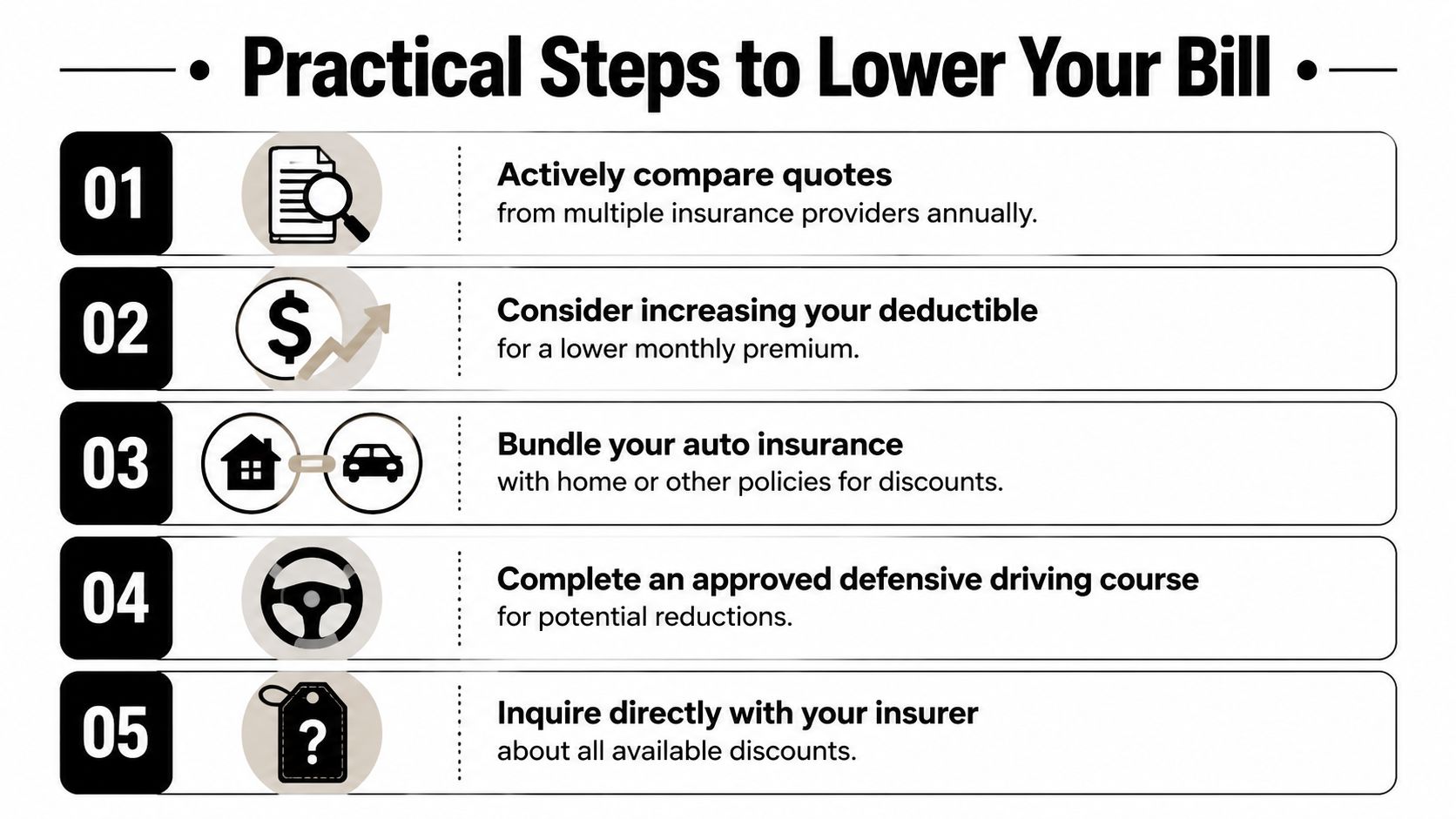
Now for the part that saves money. You don't beat the California auto insurance increase by complaining about it. You beat it by treating your insurance like a financial asset that needs active management.
Shop every renewal, not every crisis
Shopping for insurance often occurs only when the bill becomes painful. That's too late. Compare quotes regularly, especially after a major market shift, a move, a vehicle change, or a household change.
Get fresh pricing from multiple carriers. Don't compare only the premium. Compare liability limits, uninsured motorist protection, physical damage deductibles, rental reimbursement, and roadside coverage. A lower quote with weaker protection isn't a win.
If you're ready to compare options, start with a California insurance quote review and make carriers compete for your business.
Use deductibles strategically
Raising your deductible can lower your premium, but don't do it blindly. Pick a deductible you can pay without going into debt after an accident. A deductible that looks good on paper and wrecks your emergency fund isn't smart budgeting.
Bundle what should be bundled
This is one of the most overlooked moves in California insurance. If your auto insurance is separate from your home insurance, renters insurance, or even other household policies, you may be missing a legitimate savings path. Bundling can also simplify billing and reduce coverage gaps.
Review your entire insurance picture together:
- Auto and home insurance: Good fit for homeowners who want convenience and potential discount alignment.
- Auto and renters insurance: Often overlooked by renters who assume the savings won't matter.
- Household policy coordination: Multiple cars, drivers, and residences should be reviewed together.
- Life insurance review: Not a traditional bundle discussion for everyone, but it belongs in the same financial conversation if you're protecting family income.
Ask better questions
A lot of savings are hidden behind simple questions. Ask whether there are discounts for paperless delivery, automatic payment, annual payment, safe driving programs, student status where applicable, vehicle safety features, or mileage-related options.
And if you want a practical list of habits that can help reduce Georgia auto insurance costs, some of the driving and comparison-shopping principles translate well even though the market rules aren't the same.
Use an independent agent if the market feels messy
This is my strongest recommendation. In a volatile market, an independent agent can do what a single carrier cannot. They can compare multiple companies, catch coverage gaps, explain tradeoffs, and tell you when a cheap quote is hiding a bad policy structure.
That matters even more if you also need home insurance in a wildfire-prone area, renters insurance on a tight budget, or life insurance that fits a larger family plan. One coordinated review often produces better decisions than piecemeal shopping across five websites.
Here's the practical playbook:
- Pull your current declarations page: Don't shop from memory.
- List every policy in your household: Auto, home, renters, and life.
- Set your deductible based on cash reserves: Not wishful thinking.
- Ask for side-by-side comparisons: Same limits first, then adjust.
- Review annually: Insurance neglect is expensive.
If you want a clear second opinion, Mai & Associates can help you review your auto, home, renters, and life insurance together, compare multiple carriers, and find out whether you're overpaying, underinsured, or both. In this market, that kind of review isn't optional. It's one of the smartest financial moves a California household can make.