California Auto Insurance Grace Period: Your 2026 Guide
You buy a car on Saturday, sign the papers, and then someone tells you, “You've got a 30-day grace period.” Or you miss an insurance payment and assume you've got the same kind of buffer. That's where many California drivers get tripped up.
The phrase California auto insurance grace period sounds simple, but it usually refers to two very different situations. One involves a newly purchased car. The other involves a late premium payment on an existing policy. If you mix them up, you can end up driving without valid coverage, dealing with DMV problems, or scrambling to replace a canceled policy.
The confusion gets worse because some headlines make it sound like California gives you a broad legal pass to drive uninsured for a while. It doesn't. The safest approach is to treat a grace period like a narrow exception with rules attached, not a free pass.
Understanding the California Auto Insurance Grace Period
If you're reading this because you got a late payment reminder or just bought a car, start with this one rule: there isn't just one grace period in California.
One common misunderstanding comes from the way people use the phrase “30-day grace period.” As noted by Freedom General's explanation of California's new car insurance grace period, that headline can mislead drivers into thinking they can drive uninsured, when the term refers to different legal and policy concepts.
Two meanings that sound alike but work differently
The first meaning is the new car purchase grace period. This is tied to adding a vehicle to coverage and satisfying registration-related requirements.
The second meaning is the missed payment grace period. This is tied to your insurer's handling of overdue premiums on an existing policy.
They aren't interchangeable. A driver who just bought a car is dealing with one issue. A driver who forgot to pay their monthly bill is dealing with another.
Practical rule: If you don't know which kind of grace period applies, assume you need to confirm coverage before driving.
That's especially important in California because auto insurance rules affect more than just your car. Your policy history can influence how you shop for broader California auto insurance coverage options, and a lapse can spill into other parts of your insurance planning, including home, renters, and life insurance decisions.
Why people get this wrong
The term “grace period” often leads to the assumption, “I still have time, so I'm still protected.” Sometimes that's true. Sometimes it isn't.
A better analogy is this: a grace period is like having a deadline extension for paperwork, not always permission to use the thing itself. Registration timing and coverage timing can overlap, but they are not the same rule.
That difference matters most when a police officer asks for proof of insurance, a lender wants confirmation, or you get into a crash before your policy details are squared away.
New Car Purchase vs Missed Payment Grace Periods
You buy a car on Saturday, then realize Sunday night that your insurance bill for the old car is also overdue. Both problems get called a “grace period,” but they are not the same kind of problem. One is about adding a vehicle to an active policy. The other is about whether an existing policy is close to canceling.
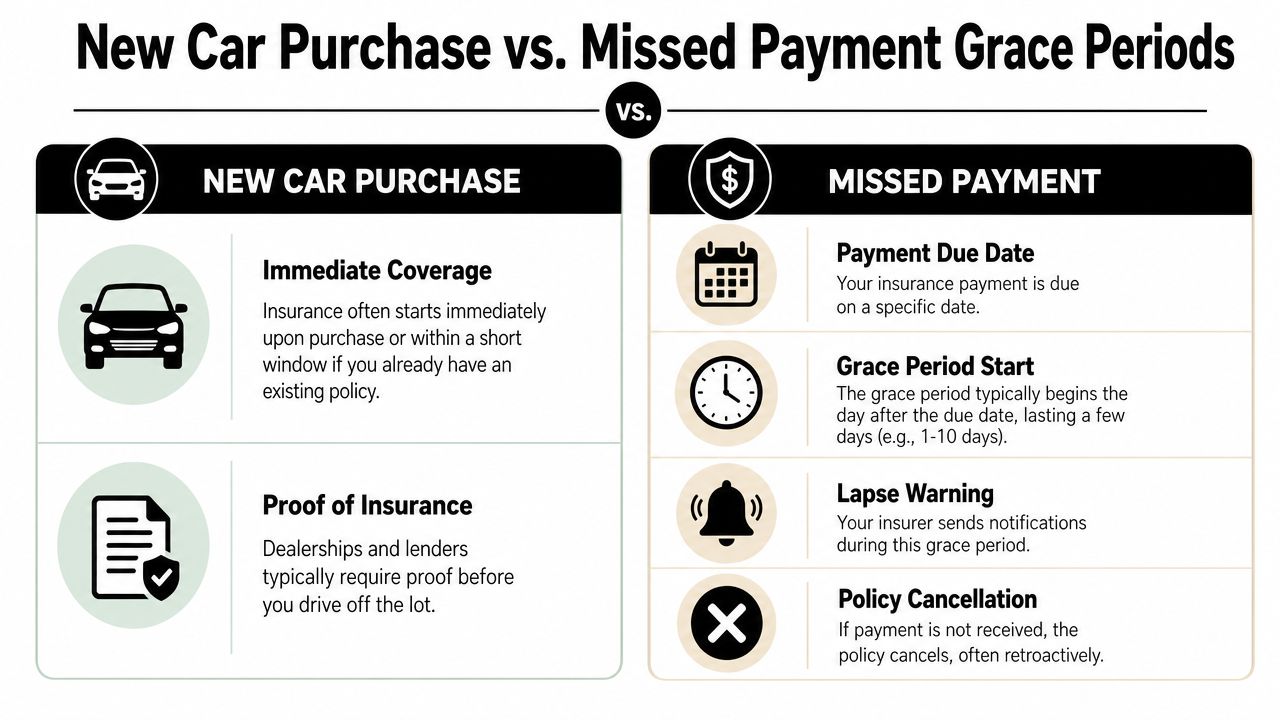
That distinction clears up most of the confusion.
The new vehicle purchase grace period
A new-car purchase grace period works like a short paperwork window after a car joins your household. As noted earlier, California gives you time to handle registration, and some insurers may give drivers with an existing policy a limited window to report and add the new car.
The part that trips people up is coverage. Time to register a car is not the same as automatic permission to drive it uninsured on public roads. If you already carry auto insurance, your current policy may extend some protection for a short time under its terms, but you should confirm that with your insurer before you drive.
A simple way to view it is this. The new-car grace period is about getting a newly purchased vehicle properly attached to an active policy.
The missed premium payment grace period
A missed payment grace period is a billing issue. Your insurer may allow a short amount of time to catch up before canceling the policy, but the rules come from the company and the policy contract, not from the new-car purchase process.
This is why the two situations should never be mixed together. Buying a car does not fix an overdue premium. Paying late on an old policy does not automatically create coverage for a newly purchased car.
Drivers often hear the same phrase and assume the same protection applies. It doesn't.
California auto insurance grace periods compared
| Feature | New Vehicle Purchase Grace Period | Missed Premium Payment Grace Period |
|---|---|---|
| Main purpose | Gives you time to report and add a newly purchased car, while also handling registration-related tasks | Gives limited time to pay an overdue premium before the policy cancels |
| Who controls it | Your insurer's policy terms, plus California registration rules | Your insurer and the billing terms in your policy |
| Typical timing | Varies. Registration and policy reporting windows are separate issues, and any temporary extension depends on your current coverage | Varies by insurer and policy. California does not set one universal grace period for every late payment |
| Does it mean you can drive uninsured | No | No |
| Big risk | Assuming paperwork time means driving coverage is automatically in place | Assuming late payment means the policy is still safely active |
The clearest way to separate them is this. A new-car grace period deals with adding a car to an active policy. A missed-payment grace period deals with saving a policy that is at risk of canceling.
A simple real-life example
Say you already insure a Honda under an active California policy, and you buy a used Toyota. Your insurer may give you a short window to report the Toyota and add it to the policy. That possibility exists because you started with active coverage.
Now change one fact. Your Honda policy already lapsed before you bought the Toyota.
In that situation, there is no active policy in the background to extend to the new car. You are not using a new-car grace period. You are trying to solve a lapse first, then get the Toyota insured. That difference is where many California drivers get caught off guard.
The Timeline from Missed Payment to Policy Cancellation
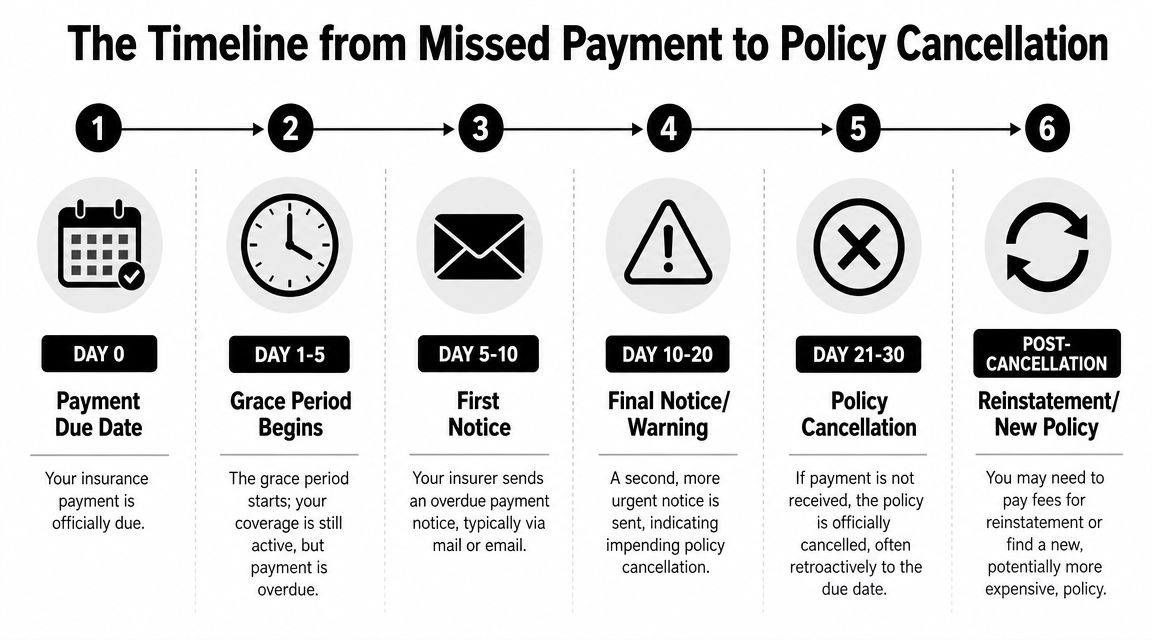
Miss a payment, and drivers immediately ask one question: “How much time do I really have?” The honest answer is that it depends on your insurer, but the bigger lesson is that the clock starts fast and the room for error is usually smaller than drivers expect.
What usually happens after the due date
First, the payment due date passes. At that point, your account is overdue.
Next, your insurer may send an overdue notice by mail, email, app alert, or a combination of those. The exact sequence differs by company, but the practical meaning is the same: they're telling you to fix the issue before the policy cancels.
Then comes the final warning. This is the notice drivers need to take seriously. It typically includes a cancellation date if payment isn't received in time.
If payment still doesn't arrive, the policy cancels. Once that happens, you may not have an extra safety window waiting for you on the other side.
Why the old COVID example still matters
California did have a notable premium grace period during the pandemic. On March 18, 2020, Insurance Commissioner Ricardo Lara asked insurers to give policyholders at least 60 days to pay premiums, as described in Goldberg Segalla's summary of the California notice.
That's useful historical context because it shows something many consumers miss: payment flexibility is often temporary and situation-specific, not a permanent right you can count on in ordinary times.
If you're relying on a grace period that you haven't confirmed with your insurer, you're guessing with your coverage.
What to do when the notice arrives
When you get a late notice, don't spend the next few days assuming there's plenty of room. Open it. Read the cancellation date. Confirm whether your payment method failed. Then call the insurer and ask one direct question: “If I pay today, will my policy remain active without a lapse?”
That question matters more than “Do I still have a grace period?” because it gets to the core issue, which is whether you still have valid coverage.
The Domino Effect The High Cost of an Insurance Lapse
Most drivers think the problem is the missed payment. In practice, the missed payment is often just the first tile to fall.

A lapse can start small. Maybe a card expired. Maybe the renewal notice went to an old email. Maybe you were switching carriers and the dates didn't line up. But once coverage stops, the consequences can stack up quickly.
According to The General's discussion of lapsed car insurance grace periods, the biggest risk is the compounding administrative penalty chain. A lapse can mean no reinstatement window, DMV registration trouble, and much higher premiums after a coverage gap.
First domino you're exposed on the road
The most immediate problem is simple. If you drive without active liability coverage, you're taking on the financial risk yourself.
If another driver hits you and there's confusion about timing, or if you cause a crash during a lapse, your position becomes much harder. You're no longer arguing about a billing issue. You're dealing with a coverage issue.
Second domino DMV problems
California links insurance compliance to vehicle registration. If proof of insurance disappears, registration problems can follow.
That can feel unfair to drivers who thought they were “only a few days late,” but the state's system doesn't really care about your intention. It cares whether required proof is on file.
Key takeaway: A lapse isn't just an insurance company issue. It can turn into a DMV issue.
Third domino higher future costs
Insurers often view a lapse as a sign of added risk. Even if you get covered again quickly, you may lose access to your old pricing, your old carrier, or your preferred billing setup.
That can also affect how you organize other coverage. If you were bundling auto with home insurance or renters insurance, a disruption in one policy can force you to revisit the whole package. The same goes for broader household planning, especially if you're reviewing life insurance and trying to keep all policies aligned with one budget.
Fourth domino stressful cleanup
Once a policy is fully canceled, the repair work takes time. You may need to seek reinstatement, apply for a new policy, update proof for the DMV, and explain the gap to future carriers.
That's why a lapse costs more than the late bill itself. It creates paperwork, uncertainty, and fewer good options.
A Practical Plan to Prevent or Recover From a Lapse
When a policy is in danger, speed matters. The best move is to act before the issue hardens into a cancellation.
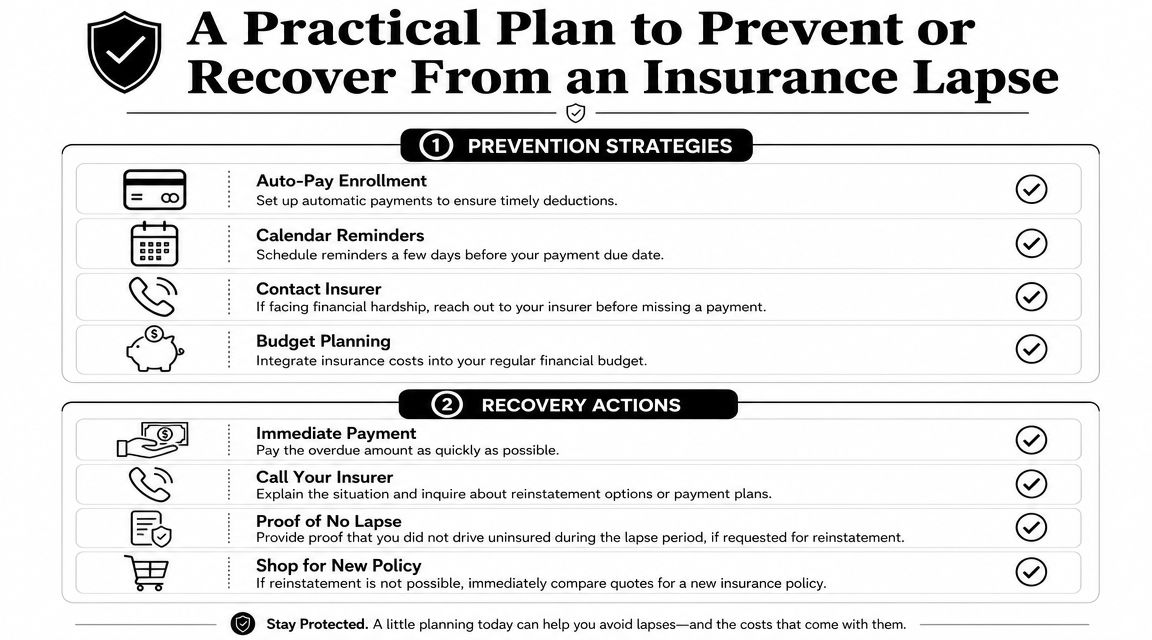
Prevention steps that actually work
A lot of lapse-prevention advice is obvious, but obvious still works when you do it consistently.
- Turn on autopay carefully: If you use automatic payments, make sure the card on file hasn't expired and the billing address matches.
- Set a backup reminder: Put a calendar alert on your phone a few days before the premium due date so you don't rely on one system.
- Read insurer emails: Many drivers ignore billing emails because they look routine. That's often where the first warning appears.
- Call early if money is tight: If you think you may miss a payment, contact the insurer before the due date. You may have options that are easier to discuss before the account becomes delinquent.
If you already missed the payment
Start with the insurer, not with guesswork.
Call the company and ask:
- Is my policy still active?
- If I pay now, will it be reinstated with no lapse?
- If there is a lapse, what date did it begin?
- Has any cancellation notice already been issued?
Write down the answers, the representative's name, and the date of the call. Save screenshots of payment confirmations and confirmation emails.
Pay first if you can. Confirm second. Document everything either way.
If you just bought a car and you're unsure about coverage
For buyers with an active auto policy, the practical window to add a new car is often 7 to 30 days, but California DMV rules still require evidence of insurance for vehicles operated or parked on public roads, as explained by the California DMV insurance requirements page.
That means you shouldn't assume you can drive a newly purchased car off the lot uninsured. If there's any uncertainty, get clarity before you leave with the keys.
If you need to line up coverage quickly, comparing options through a California insurance quote request can help you move from uncertainty to confirmed protection faster.
Reinstatement versus a new policy
These are not the same outcome.
Reinstatement usually means your old policy is restored, sometimes with fewer disruptions if the insurer allows it.
A new policy means you're starting over after a gap, which can be more expensive and can limit your carrier choices.
If reinstatement isn't available, don't delay shopping. The longer you stay uninsured, the harder the next step can become.
Keep proof organized
Save your ID cards, declarations page, payment receipt, and any written confirmation that shows when coverage started or resumed. If there's ever a DMV question, a lender question, or a dispute over whether your policy lapsed, that paperwork matters.
Let a California Insurance Agent Help You Stay Covered
Some insurance problems are easy to solve online. Others are not. A canceled policy, an urgent need for same-day car insurance, a difficult underwriting question, or a multi-policy review involving auto, home, renters, and life insurance usually goes faster with a licensed California agent.
An independent agent can compare multiple carriers, check whether reinstatement is still possible, and help you avoid buying the wrong policy just because you're under pressure. That matters when you've had a lapse, need to prove continuous coverage, or want to review whether your household policies still fit your budget.
It also helps to work with someone who understands California-specific issues, including high-risk areas, Fair Plan questions, and how one policy decision can affect another.
If you want direct help sorting out coverage or shopping alternatives, you can contact a California insurance agent at Mai & Associates. They offer support across auto insurance, home insurance, renters insurance, and life insurance, with multilingual assistance for California clients who want clear answers and quick next steps.
Frequently Asked Questions About California Insurance
Does home insurance have the same kind of grace period as auto insurance
Not necessarily. Home insurance and renters insurance can have payment rules that look similar, but they are still policy-specific. Don't assume your auto billing rules apply to your property coverage.
Will one late payment automatically raise my car insurance rate
Not always. A single late payment doesn't automatically mean your rate changes. The bigger problem is a lapse or cancellation, because that can affect future pricing and carrier options.
What is an SR-22 in simple terms
An SR-22 is a filing that shows proof of financial responsibility. Drivers usually run into it after certain violations or licensing issues. It isn't a separate insurance policy by itself. It's a form attached to coverage by an insurer that offers it.
Can a lapse in auto insurance affect my other policies
It can. If you bundle auto with home insurance or renters insurance, a lapse may force a broader review of your account. That doesn't always happen, but it's smart to check.
Can an agent help if my policy was already canceled
Yes. An agent can often help you compare carriers, look for reinstatement options where available, and rebuild a clean insurance plan after a gap. If you want answers to related questions, the Mai & Associates insurance FAQ page is a useful starting point.
If you want help comparing California auto insurance, home insurance, renters insurance, or life insurance, Mai & Associates can help you review options from multiple carriers and find coverage that fits your situation and budget.