Calculate Car Insurance: Your 2026 Guide
You're probably doing what most California drivers do when they need coverage. You open a few quote tools, type in the same car, the same address, the same driver details, and still get prices that don't line up. One quote looks manageable. Another feels absurd. A third is cheap enough to make you wonder what's missing.
That confusion is normal. Car insurance pricing isn't random, but it often feels like a black box until you know which inputs matter, which choices are fixed, and which ones you can change. If you want to calculate car insurance with confidence, the goal isn't just getting a number. It's understanding why that number showed up, and what to do next.
For California drivers, that matters even more because auto insurance decisions rarely live alone. The same household that needs a better car insurance quote may also need to review home insurance in a wildfire area, line up affordable renters insurance, or think about life insurance that protects income and family obligations. Good planning starts with the auto quote, then expands outward.
Why Your California Car Insurance Quote Can Vary So Much
A new client usually starts with the same reaction. “How can the same car cost so much more with one company than another?” In California, that question comes up every day because drivers aren't just reacting to one high price. They're reacting to a market where coverage has become meaningfully more expensive.
Bankrate reported that the average annual cost of full coverage car insurance in the U.S. was $2,697 in May 2026, while minimum coverage averaged $820 per year, or about $225 per month for full coverage and $68 per month for minimum coverage according to Bankrate's average car insurance cost analysis. When a California quote feels high, that frustration is grounded in reality.
What throws people off is that two drivers can look similar at first glance and still price very differently. One lives in a denser traffic area. One chose lower deductibles. One has a financed vehicle and needs broader physical damage coverage. One has a driving record that changes how the insurer reads future claim risk. The quote reflects all of that, even if the screen only shows one final monthly number.
Practical rule: Don't compare car insurance quotes by premium alone. Compare the driver details, the limits, the deductibles, and the vehicle use assumptions line by line.
That's why a smart starting point is reviewing a California-specific auto insurance page such as California auto insurance coverage options before you decide whether a quote is expensive or just built differently. Many “cheap” quotes aren't cheaper. They're just thinner.
A useful quote does two things at once. It fits your budget, and it still protects you well enough when the loss is real.
The Core Formula Behind Your Premium
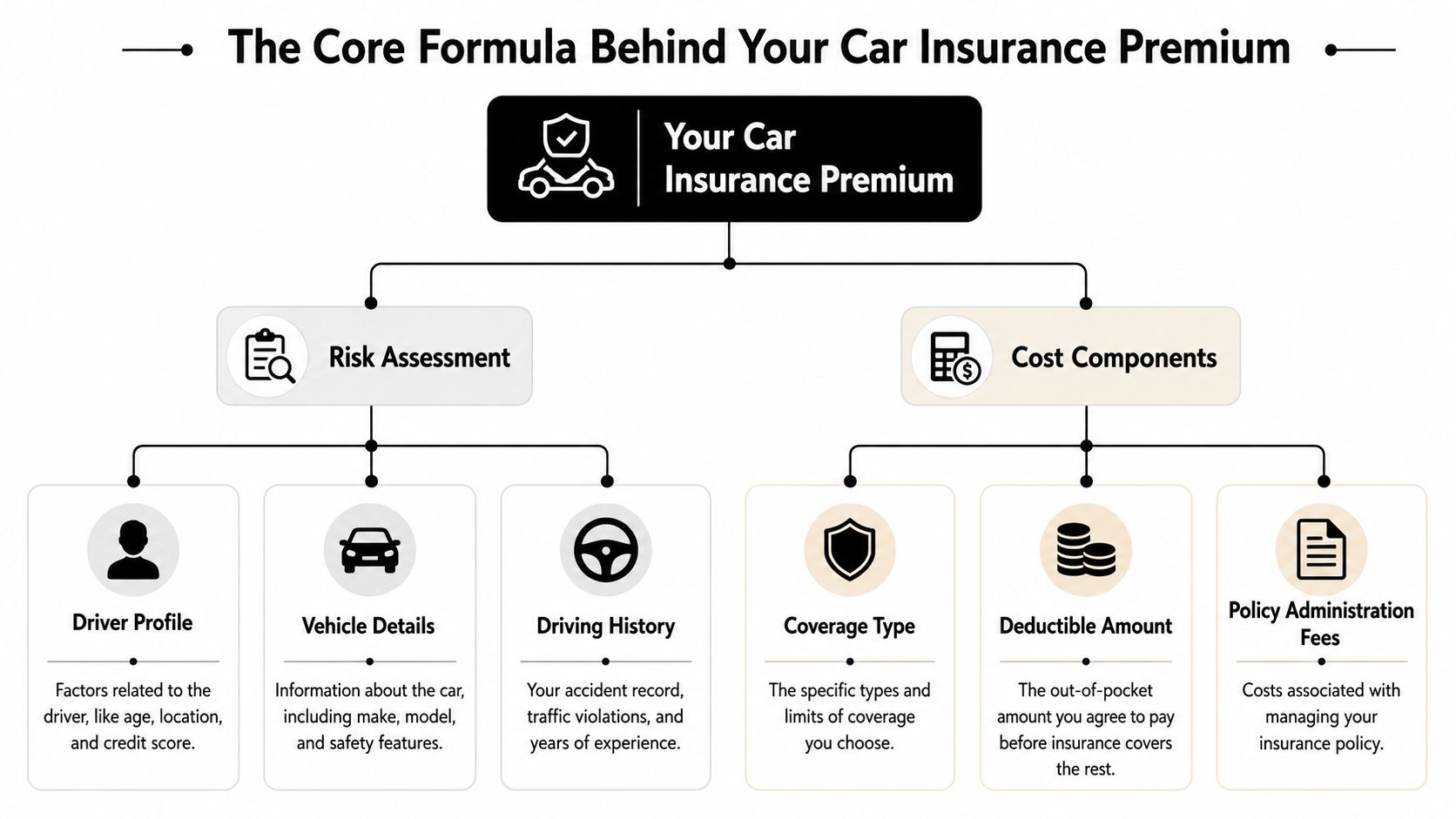
Car insurance companies all have their own rating systems, but the foundation is straightforward. Premium = expected future claims cost, plus expenses, plus profit. In trade language, insurers look at how likely a claim is and how expensive that claim would be, then build a price around that risk model, as explained in this breakdown of the modern auto premium risk equation.
Risk comes first
When you calculate car insurance, the insurer isn't pricing your car by itself. It's pricing the combination of you, the vehicle, the address, and the coverage design.
Three risk buckets usually drive the quote:
- Driver profile. Age, driving history, years licensed, and similar personal details shape how the carrier estimates claim frequency.
- Vehicle details. Make, model, year, repair complexity, theft appeal, and replacement cost affect severity.
- Location and use. Your garaging address, traffic environment, and mileage can change the loss picture quickly.
A technical glossary helps here because many shoppers mix up terms like premium, deductible, liability limit, and other coverages. If you need a plain-English refresher, this insurance glossary for California shoppers makes quote language easier to decode.
Your coverage choices change the math
Drivers often assume the company is only judging them. It isn't. The carrier is also pricing the structure of the policy you asked for.
Here are the pieces that usually move the premium most:
| Coverage choice | Why it affects price |
|---|---|
| Liability limits | Higher limits mean the insurer may pay more on a serious claim |
| Collision and comprehensive | Adding broader vehicle protection expands what the policy covers |
| Deductible | A higher deductible means you keep more of the smaller-loss risk |
| Vehicle financing or leasing | Lenders often require more coverage than an owner might choose on a paid-off car |
A quote is never just about “what car do you drive?” It's also about “what losses are you asking the insurer to absorb?”
Why the same car doesn't produce the same price
Most online calculators fall short because they give a number without showing the split between fixed factors and negotiable ones.
Some inputs are difficult or impossible to change in the short term. Your address, your recent driving history, and your vehicle may be set for now. Other inputs are levers. Your deductible, your liability limits, whether you compare quotes on identical terms, and whether you insure multiple policies together can all reshape the result.
That's the key to understanding how to calculate car insurance in a useful way. You're not trying to guess the insurer's secret formula. You're isolating the parts of the quote that you control.
Calculating Premiums for Real California Drivers
A practical demonstration of how the quote behaves in real life is more useful than abstract explanations. Below are three common California situations that show why premiums can move even when the car itself doesn't seem unusual.
These examples are qualitative on purpose. Carriers use proprietary formulas, so the exact figure will vary. What matters is how one change can alter the monthly cost, and why matching quotes line for line is the only fair comparison.
Young professional in Los Angeles
A young professional in Los Angeles usually faces a quote shaped by dense traffic, higher claim activity, and the need for practical protection on a daily-use vehicle. If the driver is financing the car, collision and full physical damage coverage may not be optional. In many cases, the first quote looks expensive because the deductible is set low and the policy is doing more than the buyer realizes.
A common adjustment is raising the physical damage deductible if the driver has enough savings to handle a larger out-of-pocket expense after a loss. That can lower the monthly premium, but it only works when the emergency fund is real. If it isn't, the lower premium may create stress at claim time.
For drivers in this market, a local comparison is helpful because territory matters so much. A focused page on Los Angeles auto insurance options can give useful context before you treat one quote as the market price.
Family household in Costa Mesa
A family in Costa Mesa often approaches insurance differently. The issue usually isn't just “What's the cheapest premium?” It's “How do we protect income, assets, and the household budget without overbuying?”
That driver may benefit more from reviewing liability limits than from stripping out coverage. In practice, I've seen families save money by cleaning up the structure of the quote instead of gutting the policy. They might match liability limits across competing carriers, choose a deductible that fits their cash reserves, and remove optional add-ons that don't serve the household well.
Bundling also becomes more relevant here. If the household already carries home insurance or renters insurance, comparing policies together can make the auto quote more competitive while simplifying renewals and coverage reviews.
Retiree in Escondido
A retiree in Escondido often has a different profile. Lower annual mileage, a more stable driving routine, and a paid-off vehicle can open up different choices. The big question is usually whether full coverage still makes sense relative to the car's current value.
That doesn't mean dropping protection automatically. It means reviewing whether the premium for broad physical damage coverage still aligns with what the car would realistically be worth after depreciation. For an older car, keeping liability protection strong while rethinking collision or other physical damage coverage can sometimes be the more rational move.
If a vehicle's value has fallen, revisit the coverage design. Don't keep paying for a setup you chose years ago without checking whether it still fits the car you own today.
Sample California Auto Insurance Premium Estimates 2026
| Driver Profile | Vehicle | Location | Coverage Details | Estimated Monthly Premium |
|---|---|---|---|---|
| Young professional | Newer financed sedan | Los Angeles | Full coverage, lower deductible, lender-required protection | Higher end of available quote range |
| Family household | Mid-size SUV | Costa Mesa | Full coverage, stronger liability limits, moderate deductible | Mid to higher range depending on limits |
| Retiree | Older paid-off sedan | Escondido | Liability-focused policy or selective physical damage coverage | Lower to mid range depending on vehicle value |
The lesson is simple. When you calculate car insurance, don't ask only, “What does this cost?” Ask, “Which input is causing this cost?” That question leads to better savings decisions than chasing the lowest number on the page.
Using Online Tools to Get Same-Day Quotes
Online quote tools are useful when you use them in the right order. Most shoppers do it backwards. They type in vehicle information first, click through the screens, and then accept whatever coverage defaults appear. That's how people end up comparing prices that were never built on the same assumptions.

Bankrate's guidance is more practical. A step-by-step method starts with the coverage target first, including state minimums, lender requirements, vehicle value, and asset protection, then moves to driver and vehicle inputs, and finishes by comparing at least three real quotes, as outlined in Bankrate's car insurance calculator guide.
Start with the coverage goal
Before you open any quote engine, decide which of these categories fits you best:
- State-minimum buyer if you need legal compliance only.
- Financed or leased vehicle owner if the lender requires broader coverage.
- Asset-protection buyer if you want higher liability protection because you have income, savings, or property to protect.
This step matters because a quote tool can't decide your risk tolerance for you.
Gather the details once
You'll get cleaner same-day quotes when you prepare the information in advance:
- Driver information such as license details and driving history
- Vehicle information including year, make, model, and estimated mileage
- Address and garaging location because where the car is kept affects pricing
- Current insurance details if you're switching and want a true apples-to-apples comparison
Compare on identical terms
A multi-carrier quote portal saves time only if you discipline the inputs. Keep the liability limits, deductibles, and major coverage options identical across every quote. If one carrier is quoting lower because it subtly reduced coverage, that isn't a win.
A straightforward place to begin is an online same-day insurance quote request where you can compare options without re-entering your entire life story on multiple separate sites.
Quote check: If two premiums are far apart, review the deductibles and coverage limits before you assume one company is overpriced.
What works and what doesn't
What works is entering complete information, choosing your target coverage first, and reviewing the proposal line by line.
What doesn't work is accepting defaults, comparing monthly payment alone, or assuming a direct-writer quote and an independent quote are built the same way. Online tools are fast. They're not self-correcting. The value comes from using them with structure.
Actionable Strategies to Lower Your California Insurance Costs
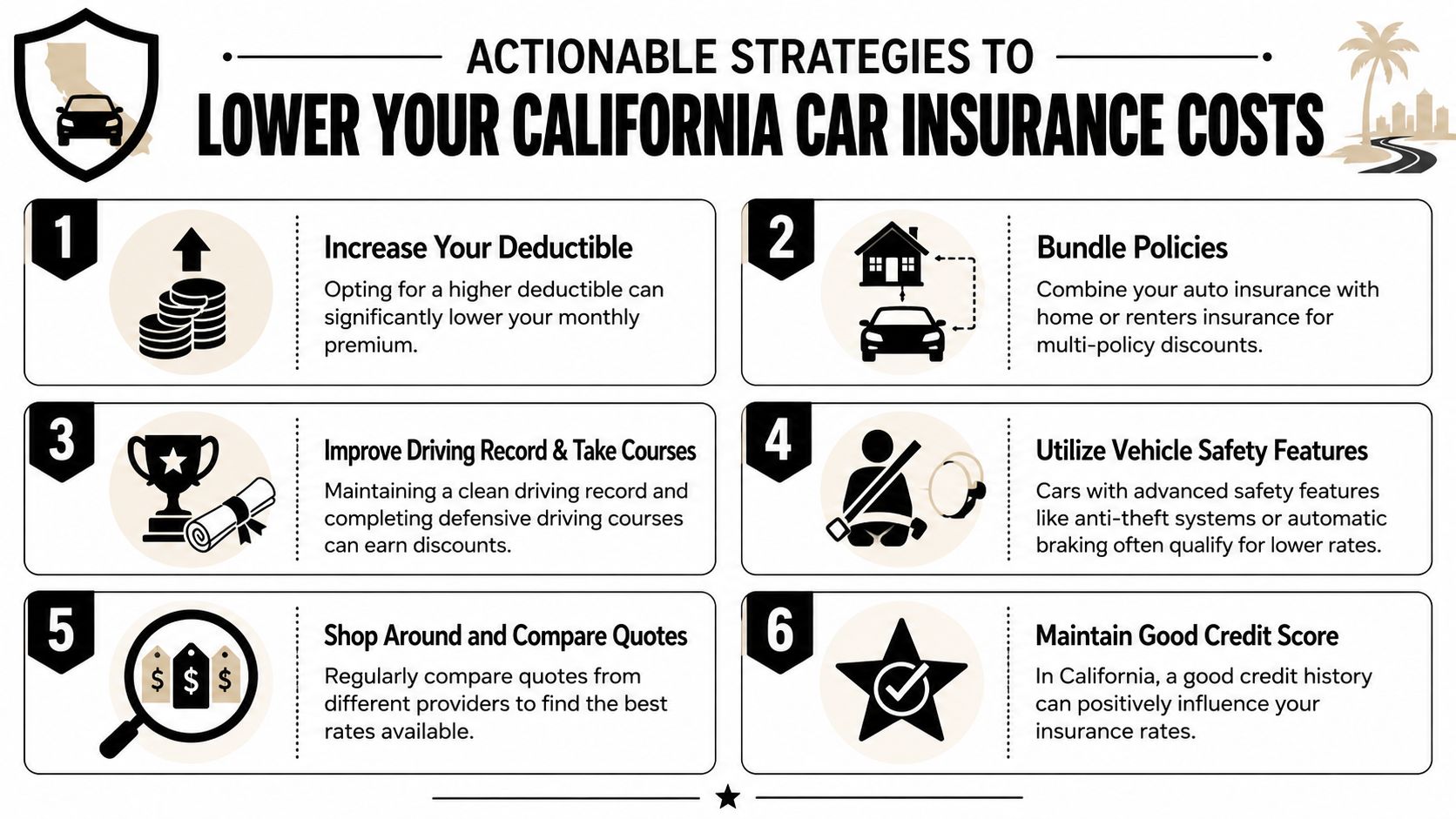
The best way to lower a premium is to separate fixed factors from controllable ones. You can't instantly change your age, your recent accident history, or where you already live. You can change how the policy is built, how carefully you compare it, and whether you're using all the discounts available to your household.
One of the more useful industry perspectives is to stop treating the quote as a black box and isolate controllable cost drivers such as raising deductibles, adjusting liability limits, and matching quotes line for line, as noted in Progressive's insurance calculator discussion.
Start with the levers you control
Here are the adjustments that usually deserve attention first:
- Raise the deductible carefully if you have enough cash reserves to absorb a claim.
- Review liability limits intentionally instead of accepting defaults that may be too low or unnecessarily high for your situation.
- Match every quote line for line so you can see true price differences.
- Reassess physical damage coverage on older vehicles whose value may no longer justify the same structure.
The mistake is changing all of these at once. Move one lever at a time and review the premium effect.
Bundle where it makes sense
Bundling is one of the most practical ways to reduce total insurance cost because it works at the household level, not just the car level. If you already carry or need home insurance, renters insurance, or even life insurance, ask for combined pricing.
This matters in California because many households buy policies in separate transactions. Auto gets renewed on its own. Renters coverage gets picked up later. Life insurance becomes a separate conversation altogether. When policies stay siloed, discounts and coverage coordination can get missed.
A bundled review can also uncover gaps. For example, someone may save on auto insurance while discovering the home policy needs attention because of wildfire exposure, or that renters coverage is too thin for personal property loss.
The cheapest single-policy quote isn't always the lowest household insurance cost.
What saves money and what backfires
Some savings moves are smart. Others look smart only until a claim happens.
Usually worth testing
- A higher deductible that fits your emergency fund
- Multi-policy bundling with auto and home or renters insurance
- Reviewing low-mileage usage if your driving habits changed
- Shopping multiple carriers on the same coverage structure
Often a bad shortcut
- Cutting liability limits just to force the payment down
- Dropping useful coverage without checking the car's actual risk
- Comparing quotes with mismatched deductibles
- Choosing a policy because the monthly number is low without reading exclusions and settlement terms
The right strategy doesn't just lower premium. It lowers premium without making the policy fragile.
California Car Insurance FAQs
Why do two Californians with the same car get different prices
Because the quote reflects more than the car. The insurer prices the driver profile, garaging address, driving history, mileage patterns, and the policy structure itself. Two people can insure the same model and still produce very different risk profiles.
Should I pick the cheapest quote if I only want to save money
Not automatically. A very low premium may come from higher deductibles, lower liability limits, or reduced physical damage protection. That can look efficient on the purchase side and feel inadequate on the claim side.
One of the most overlooked issues is total loss. The cheapest calculated premium can be misleading if it creates a deductible or coverage setup that leaves you short after a serious claim. Total-loss settlement math centers on actual cash value, which is broadly the vehicle's fair market value minus depreciation, as explained in this guide to how total-loss vehicle value is determined.
How do I know if my coverage is enough after a major loss
Ask a harder question than “What's my premium?” Ask, “What would the claim check likely look like if the car were totaled?” For older vehicles, depreciation matters. For financed cars, loan balance and vehicle value can diverge. For any driver, a deductible that felt reasonable during quoting can feel very different after an accident, theft, or wildfire-related loss.
That's why annual reviews matter. A policy that made sense when the car was newer or the household budget was different may not be the right fit now.
What are practical ways to lower costs without weakening the policy too much
Start with quote hygiene. Match quotes line for line, test deductible changes carefully, and review whether bundling auto with home or renters insurance improves the total picture. If you want a broader checklist, this roundup of proven ways to reduce insurance is useful as a companion read, especially for comparing common savings tactics with what works in practice.
Does car insurance planning connect to home renters and life insurance
Yes. Households rarely face risk one policy at a time. A California driver may also be a homeowner in a wildfire-prone area, a renter trying to protect personal property on a budget, or a parent thinking about life insurance to protect income and family goals. Reviewing those together can improve both pricing and overall protection.
If you want help reviewing your California auto, home, renters, or life insurance options, Mai & Associates makes it easy to compare carriers, check for coverage gaps, and get same-day guidance from licensed agents who understand how these policies work together.