CA FAIR Plan Quote: Your 2026 Guide to Getting Covered

You just opened a renewal notice and saw the number you didn't want to see. Maybe your carrier pulled out of your ZIP code, maybe the premium jumped, or maybe the underwriter said wildfire risk changed the math. Either way, you still need a policy that protects the house, the mortgage, and your peace of mind, and that's where a California FAIR Plan quote comes in.
In practice, this isn't a dead end. It's the next workable step when the standard market says no. The FAIR Plan is California's insurer of last resort, and its scale shows how many homeowners now depend on it, with $768 billion in total exposure as of June 2026, up 250% from September 2022, and $2.04 billion in total written premium, up 212% over the same period (California FAIR Plan key statistics). That kind of growth tells you something important, millions of Californians are being pushed into a backstop market, and they need to understand what the quote really means before they bind anything.
Why You Might Need a CA FAIR Plan Quote
A common call starts the same way. A homeowner in a wildfire-prone area gets a non-renewal, walks into the kitchen with a letter in hand, and asks what happens next. The answer usually isn't panic, it's process. If the private market won't write the home, a CA FAIR Plan quote becomes the way to keep the property insured while you sort out the rest of your protection.
The FAIR Plan exists for exactly that gap. It's not a downgrade in character, it's a state backstop for homes that are hard to place in the admitted market. The California Department of Insurance notes that FAIR Plan participation has grown steadily, including a rise in the share of residential policies from 2.5% in 2020 to 3.1% in 2022, with renewed policy volume reaching 905,620 that year (CDI residential insurance and FAIR Plan summary).
What that means for your household
If you own in a brush-heavy area, near the wildland interface, or in a zip code where admitted carriers have pulled back, the FAIR Plan can keep the mortgage alive and the home protected. It can also buy time to improve the property, re-shop the market, or add wraparound coverage that gets you closer to a full homeowners package.
That bigger picture matters beyond the house. A family's protection plan usually includes auto insurance, renters insurance for a tenant or secondary home, and life insurance for income replacement. The home policy is only one piece of the financial structure, and a non-renewal is often the moment people finally review the whole thing instead of just the roof over their heads.
Practical rule: If the private market has closed, treat the FAIR Plan quote as a bridge, not the final destination.
Checking Your Eligibility for the FAIR Plan
Before you spend time pulling records together, make sure the home fits the program. The FAIR Plan is designed for properties that can't get standard coverage, not for homes that haven't been shopped carefully enough. That distinction matters because the quote process moves faster when you already know you're in the right lane.

Basic eligibility checklist
- Private-market denial or non-renewal: You generally need proof that one or more traditional insurers won't write the home. That's the core logic of a last-resort market, it's there when the normal market won't take the risk.
- Basic property condition: The home must still be in insurable shape. The FAIR Plan is not for a dilapidated structure that needs major repair before any carrier could touch it.
- Location-driven risk, not neglect: A lot of applicants qualify because of wildfire exposure or similar geography-based concerns, not because the house itself is falling apart.
- Licensed agent or broker access: You won't usually walk in like a standard online purchase. The program is broker-mediated, which is why a clean submission matters.
The easiest way to think about eligibility is this, the FAIR Plan is for homes that are uninsurable in the private market for risk reasons, rather than those whose primary issue is under-documentation. A clean denial letter, a reasonably maintained property, and a broker who knows the workflow can save you days of back-and-forth. If you're unsure what your situation looks like, this FAQ is a good place to compare common homeowner questions before you start.
What a good first pass looks like
A home can be a fair candidate for the FAIR Plan and still need separate coverage to be truly protected.
That's why I always tell clients to think in layers. The FAIR Plan gets the dwelling placed, but it doesn't automatically solve liability, theft, or broader household protection. If the house is eligible, the next question is whether you can build the rest of the program intelligently.
Gathering Information for an Accurate Quote
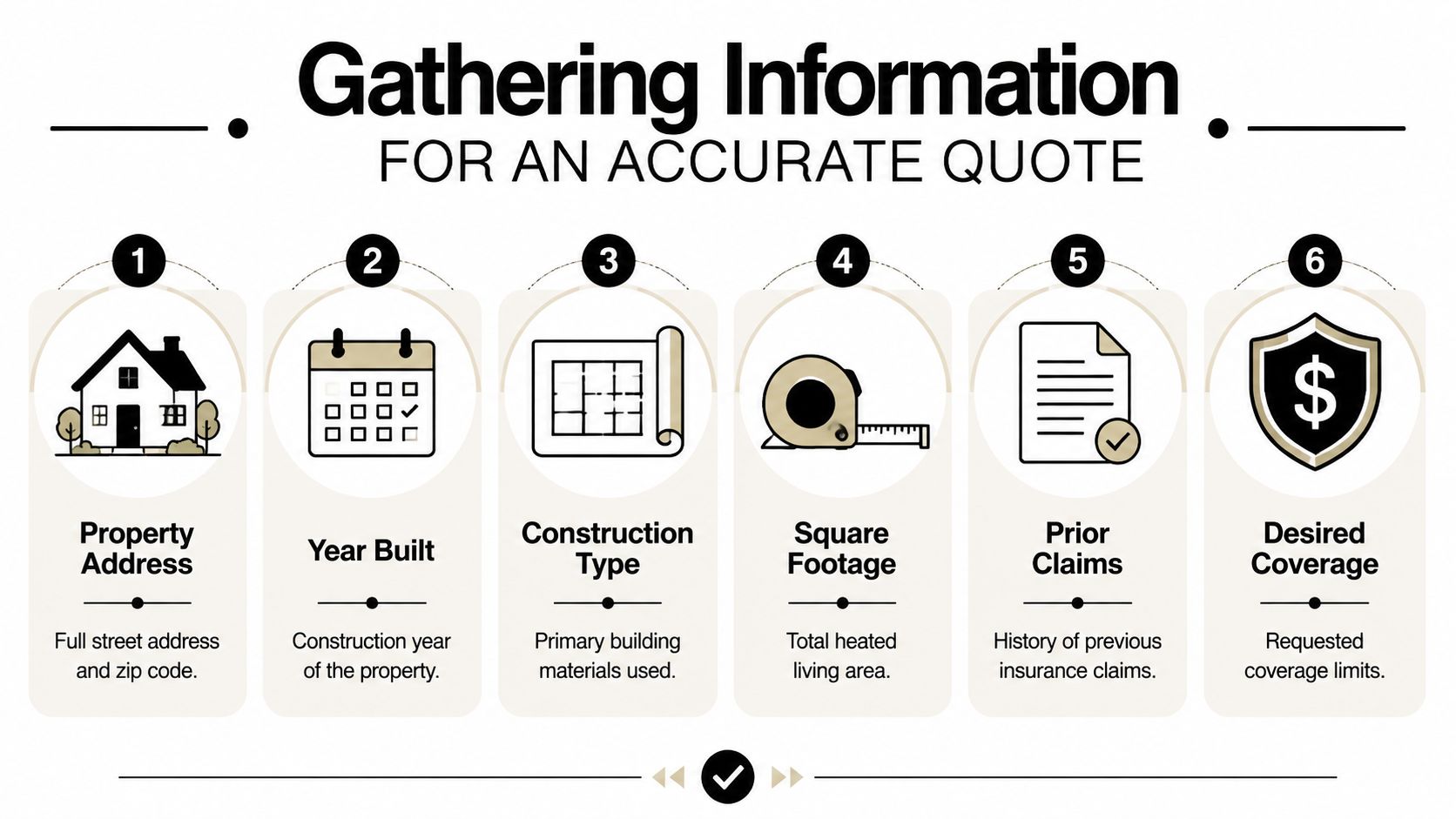
A lot of quote delays come from missing property details, not from the insurance company “being slow.” The more complete the file, the cleaner the rating, and the less likely you are to get bounced back for clarifications. That's especially true with a CA FAIR Plan quote, because the system relies on a broker workflow and specific property inputs.
The property facts you should have ready
Start with the basics, then add the items that underwriters usually ask for later. The FAIR Plan premium calculator flags that it may need building type, perils selected, construction class, deductible, occupancy, and number of units, and it starts from the property address (FAIR Plan premium calculator). If any of those are wrong, the quote can be off before it even gets close to binding.
The practical checklist is simple:
- Property address: The exact street address and ZIP code.
- Year built: Older homes often need more underwriting context.
- Construction type: Wood frame, masonry, or another major material profile.
- Square footage: The heated living area, not the garage or deck.
- Roof age and roof type: These details often matter more than homeowners expect.
- Prior claims: A broker needs the loss history to avoid surprises.
- Requested coverage limits: The amount you wish to insure.
If the property is higher value, the documentation gets more visual. For homes with combined coverage limits above $1,500,000, current exterior photos of all four sides and the roof are often required before a quote is finalized (TECT FAIR Plan guidance). That isn't busywork, it's the carrier checking condition before it agrees to take on the risk.
Why photo prep saves time
A lot of applicants wait until the quote is ready to start hunting for roof photos, inspection records, or old claim paperwork. That usually slows everything down. If you gather the property file first, your agent can move straight through the quote flow instead of stopping to chase missing details.
For a smoother property review and quote prep, this California insurance guide is worth keeping open while you assemble your file. It helps you think through the coverage picture before the quote is built, which is exactly when mistakes are cheapest to fix.
How to Request Your CA FAIR Plan Quote
A homeowner in a fire-prone part of California usually reaches this point after getting turned away in the standard market, or after a renewal comes back with terms that no longer work. The quote request itself is straightforward, but the path you choose matters because a FAIR Plan quote can describe the dwelling coverage and still leave out the protection you may expect to exist elsewhere.

Estimate tool versus broker submission
The online premium calculator gives you a rough read on the dwelling portion. It uses the address and basic property details to generate a baseline estimate, which is useful if you want to understand the likely direction of the price before you commit to a full application. It does not complete the placement on its own, because the actual quote has to be built around each coverage line and the broker's rating process.
The broker-led route is the part that turns an estimate into a policy request. According to the FAIR Plan agent guide, the broker logs in, enters the property into the dwelling premium calculator, selects the named perils, adds each coverage line separately, and then requests the quotation to bind. If any piece is left out, the result can be incomplete or misleading, which creates avoidable work later.
Why the broker route usually works better
A broker can catch the details the calculator will not flag. Missing rental value inputs, property condition questions, and the need to line up the FAIR Plan with separate protection later are all common sticking points. That is why requesting a homeowners quote through this California insurance team is often the cleaner first move for someone who wants the quote built correctly from the start.
Timing matters once the quote is issued. Consumer guidance says applicants typically have 60 days to pay and bind the policy, and accepted payment methods are limited to ACH, cash, check, or money order, with no credit cards accepted. An unbound quote is only a proposal, not active coverage, so waiting too long can force you to start over. If you are trying to avoid that back-and-forth, get the application and payment details lined up before the quote arrives, not after.
What Your FAIR Plan Quote Does and Does Not Cover
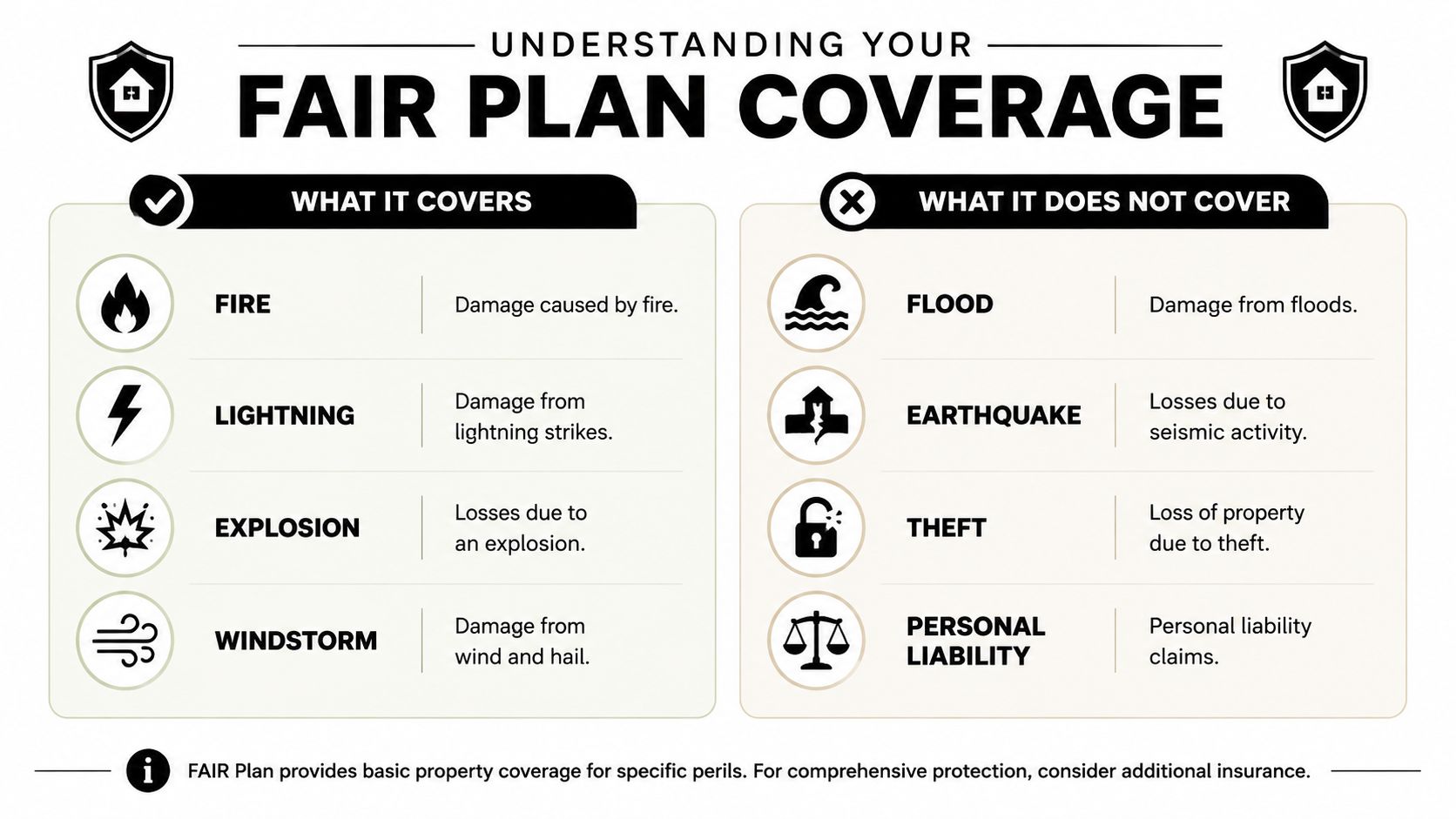
A California FAIR Plan quote often looks simpler than a standard homeowners quote, and that is where buyers can get surprised. It is a named-peril dwelling policy, so it covers specific causes of loss rather than the broader protection people usually expect from home insurance. The California Department of Insurance explains that homeowners still need separate coverage for liability, theft, and water damage if they want protection closer to a standard homeowners policy (California FAIR Plan coverage overview).
The coverage gap many homeowners overlook
The FAIR Plan is built around named perils, so the coverage stops at the perils listed in the policy form. That means the dwelling itself may have protection for certain losses, but it does not automatically carry the broader features people associate with a full homeowners policy. Many homeowners focus on the premium and assume the rest is handled, but the missing pieces can matter more than the base price.
A standard homeowners policy does much more. For a plain-language comparison, the guide on what homeowners insurance covers shows how a full policy reaches beyond the structure and into liability, personal property, and related living expenses. That difference shows up when the claim is not a fire claim, but a burst pipe, stolen belongings, or an injury on the property.
FAIR Plan versus a standard homeowners policy
| Feature | FAIR Plan quote | Typical HO-3 homeowners policy |
|---|---|---|
| Core structure | Named-peril dwelling policy | Broad homeowners policy |
| Fire-related loss | Covered within the named perils | Covered |
| Liability | Not included | Typically included |
| Theft of belongings | Not included | Typically included |
| Water damage | Not included in the standard form | Commonly included, subject to exclusions |
| Additional living expenses | Limited or separate | Usually part of the package |
The table highlights the critical differences. A homeowner who looks only at the premium number can miss the exposure that remains after the quote is issued. In practice, that is where many people realize the FAIR Plan is one piece of the solution, not the whole solution.
What to do with that information
The better question is, what would still be missing if you bought this today? Once you ask it that way, the quote becomes easier to evaluate. You can price the base FAIR Plan, then add the separate coverage needed to make the home policy functional for real-world losses.
If you are comparing home protection options in California, this home insurance resource helps place the FAIR Plan next to the broader market without treating it like a full replacement for standard homeowners coverage.
Your Next Steps After Getting a Quote
Once the quote arrives, do not stop at the premium. Compare the FAIR Plan with the separate coverage needed to fill the gaps, often through a Difference in Conditions or other wraparound policy. That layer helps cover what the FAIR Plan leaves out, especially liability, theft, and broader household losses.
A broker can help sort out whether the quote fits the home's actual exposure. The goal is not only to bind the FAIR Plan, it is to build a complete protection package around it. For some households, that means a FAIR Plan plus separate water, liability, and theft coverage. For others, it means shopping admitted carriers again later after mitigation work or property improvements have made the home easier to insure.
Do not compare the FAIR Plan premium by itself to your old homeowners policy. Compare the full program to the protection you need.
One more practical point matters here. After the quote is issued, the bind window can be short, and payment methods are limited to ACH, cash, check, or money order (ValuePenguin on FAIR Plan payment rules). If you are on a deadline with a lender or non-renewal date, that is not the time to guess at the next step.
Mai & Associates helps California homeowners review FAIR Plan policies, compare coverage gaps, and build a broader home, auto, renters, and life insurance picture that fits the rest of the household. If you want a clear review of your current policy and a quote that takes the missing pieces seriously, visit Mai & Associates and ask for a FAIR Plan review today.