Buying a First Car in California: A Practical Guide
You're standing on a lot in California, keys in your pocket, and the dealership is already talking monthly payments. That's how a lot of first-time buyers get pulled off track. They fixate on a number that sounds manageable, then discover the actual bill shows up in insurance, registration, maintenance, and the kind of fees nobody mentioned until the paperwork is in front of them.
Buying a first car in California is a budgeting problem before it's a car problem. The market already skews older on the new-car side, with the average new-car buyer around 53 years old and the 18 to 34 share of new-vehicle registrations falling from 12% in Q1 2021 to under 10% in 2025 (Demand Local). A lot of younger buyers are making a different call, too, since 65% of Gen Z buyers chose used vehicles for their first car purchase in 2023 (Demand Local). That's not a trend to ignore, it's a signal to stop shopping by sticker price alone.
What Buying a First Car Really Costs in California
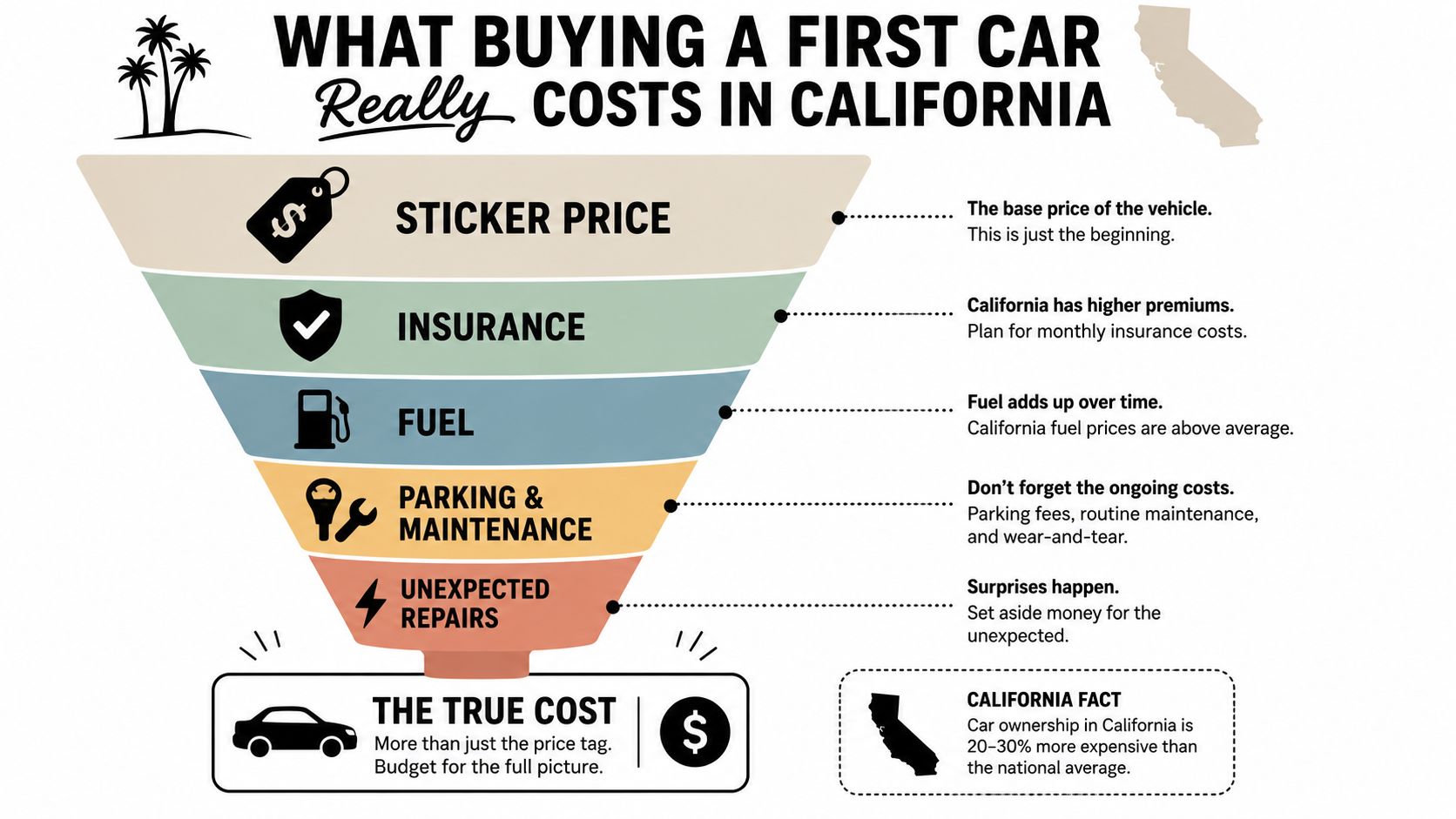
A first-time buyer usually thinks the hard part is picking the car. It is not. The hard part is what hits after the sticker price, and I see people get burned there all the time. They lock onto a payment they can tolerate, then insurance, registration, and upkeep push the actual cost well past what they planned.
The national ownership picture is the warning sign. One estimate put annual U.S. car ownership costs at roughly $5,264.58 before financing even enters the picture. That figure is a reminder that a car is never just a car. It comes with a stack of obligations, and California adds its own costs on top.
For California buyers, the smarter lens is total first-year outlay. Count the vehicle, insurance, registration, possible smog work, fuel, parking, maintenance, and the first repair you did not see coming. A shopper who leaves insurance for later is already behind, because the quote changes what you can afford. If you want to compare coverage before you commit to a car, start with a California auto insurance quote tool.
Practical rule: If the car only works when every other cost goes right, it does not work.
Treat insurance as a filter, not a cleanup step. A model that looks cheap on the lot can become a bad buy the moment the quotes come back higher than expected. The same goes for registration and the rest of the ownership math. If you want a place to compare local inventory before you get attached to one unit, the Cararam California location gives you a practical starting point.
The right question is simple. Do not ask whether you can afford the car. Ask whether you can afford to own it in California for a full year without stress. If that answer is shaky, keep shopping.
Building a Realistic Budget Before You Shop
Start with your take-home pay, not the dealer's monthly-payment pitch. Then carve the purchase into real buckets, down payment, loan payment, insurance, fuel, parking, and a maintenance reserve. If any one bucket breaks the budget, the car is too expensive.
For the payment itself, use the clearest affordability line I trust: no more than 10% of monthly take-home pay for a used car or 15% for a new car (Edmunds). That's a ceiling, not a target. If you can come in below it, do it. If you're already pressing the limit before insurance, you're shopping above your comfort zone.
Use prequalification before you ever visit a dealership
Walk into the store with a loan preapproval from a credit union or bank. That gives you a real rate, a real term, and a real maximum amount you can borrow. It also stops the dealership from stretching the deal just because your monthly payment “looks fine.”
A common mistake is letting a longer loan hide the true cost. One source recommends a 4-year maximum for first-time buyers, and I agree with that conservative ceiling because long terms usually keep you underwater longer and make it easier to overspend on the car itself (PNC). If the only way the car fits is by dragging debt out for years, it's the wrong car.
Match the budget to the car, not the other way around
A used car in the $8,000 to $18,000 range is often the better balance of reliability and total cost for a first buyer, especially when insurance and maintenance are part of the equation (Bumper). That range doesn't mean every car there is a bargain. It means you're less likely to overpay for depreciation you don't need.
A new $32,000 hybrid can make sense for some buyers, but only if the insurance, payment, and fees still leave breathing room. If not, the “newer is safer” logic is just expensive wishful thinking.
Don't let a low monthly payment trick you into a high total cost. Fees, insurance, and depreciation still get paid.
For a fast quote check before you lock in a shortlist, use this insurance quote page early, not after you're halfway through paperwork. That's how you avoid buying a car you can't realistically insure.
New vs Used and What That Means for Insurance
The new-versus-used decision isn't really about pride. It's about how much risk you want to carry, and how much the insurance company is going to charge you for that risk. On a first car, I usually push buyers toward used unless they have a strong reason to do otherwise.
| Factor | New Car | Used Car |
|---|---|---|
| Upfront cost | Higher, with more tax and fee exposure | Usually lower, easier to keep within budget |
| Financing | Often easier to stretch into a bigger loan | Usually smaller loan or cash purchase |
| Insurance impact | Typically pushes higher comprehensive and collision expectations | Often easier to tailor coverage to the car's value |
| Depreciation | Hits hardest right away | Already absorbed part of the drop in value |
| First-buyer fit | Works only if budget is strong | Often the sweet spot for affordability and practicality |
A new financed vehicle usually requires stronger coverage because the lender has skin in the game. That means the policy has to protect a more expensive asset. If you made a small down payment, gap insurance becomes worth serious attention because the loan balance can outrun the car's value if it's totaled early.
Used cars aren't automatically cheap to insure, though. Carriers still price for age, ZIP code, theft risk, and driver profile, so a “cheap” car in the wrong area can still cost more than expected. That's why I don't let buyers assume used means easy.
The practical line is this. If you're a first-time buyer with limited credit and limited cash, a well-bought used car is usually the smarter move. If you're leaning new because the monthly payment got stretched to fit, you're not buying safety, you're buying a longer bill.
The Inspection and Test-Drive Checklist
The worst first-car mistake is falling in love before the paperwork checks out. Emotional buyers miss clean title problems, inconsistent mileage, and obvious mechanical noise because the car “felt right.” That's not how you buy a car. You verify it, then you drive it, then you decide.
Check the paperwork first
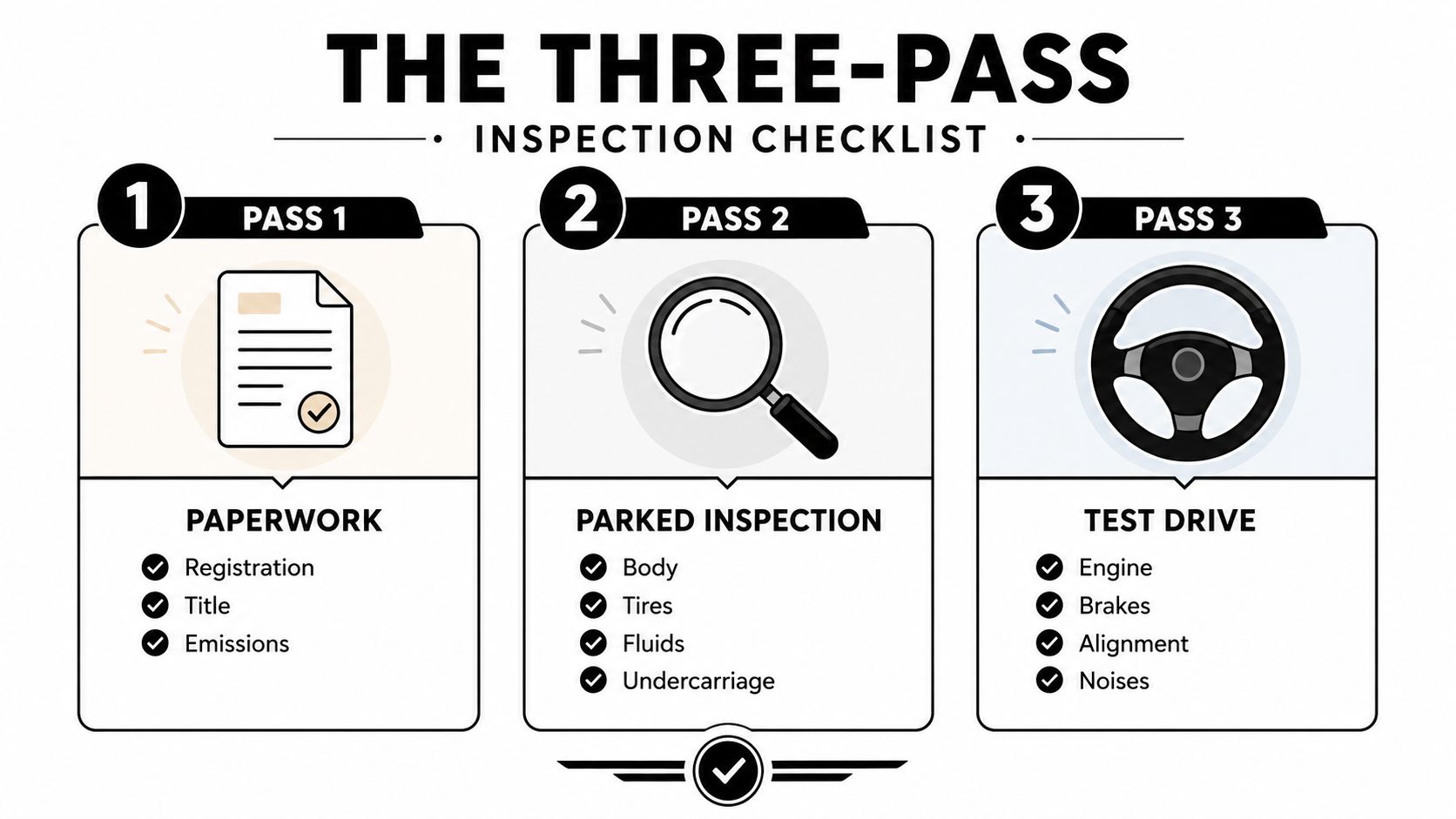
Start with the basics. Verify the vehicle's age, service record, mileage, history, previous owners, modifications, and whether the handbook is present, just like a disciplined buyer would do before money changes hands (The AA). Confirm the VIN or engine number matches the registration document, and in California, make sure the VIN also matches what's on the title.
You should also pull a vehicle history report and check the registration number against mileage consistency, write-off status, outstanding finance, and recalls. If the story doesn't line up, stop there. Don't try to “talk yourself into” a problem car.
Inspect the car while it's parked
Look for broken features, fluid leaks, mismatched panels, worn tires, and signs of modifications that weren't disclosed. If you see frame damage indicators or title brand issues, walk away. I don't care how good the price looks.
Drive it like you mean to keep it
The test drive needs to expose the car, not flatter it. Listen for exhaust smoke, engine knocking or rattling, and dashboard warning lights. On a manual, feel the clutch bite point. Watch for brake vibration, pulling, and steering behavior at highway speed. These are not cosmetic annoyances, they're expensive clues.
If the seller rushes the inspection, that's a warning sign by itself.
For a California-specific walkthrough of what to verify, the general guide resource is a useful companion when you're comparing paperwork and mechanical condition.
Negotiating the Out-the-Door Price in California
The only number that matters is the out-the-door price. Not the sticker. Not the “sale price.” Not the monthly payment the finance office tries to make sound painless. If you don't control the full number, you don't control the deal.
California buyers get hit with a fee stack that turns a fair-looking offer into an overpriced one fast. Sales tax, documentation fees, add-ons, and finance charges all sit on top of the car price. If the dealer is steering you toward paint protection, nitrogen-filled tires, or other extras you didn't ask for, the answer is no.
My rule: If you wouldn't buy it from a retail shelf on its own, don't let it get bundled into your car deal.
The cleanest advantage is a competing offer and a prequalified bank rate. A same-day insurance quote also helps because it shows you what the full monthly picture looks like before you sign. Dealers hate a buyer who knows the final number.
When the finance office pivots to “what do you want your monthly payment to be,” stay focused on total cost. A lower payment can hide a longer loan and a much bigger interest bill. That is how buyers end up paying for convenience they never wanted.
If you're buying from a private seller, the paperwork matters just as much. A practical guide on transferring a car title is worth reviewing before you hand over money, because one missing signature or bad odometer entry can stall the whole transfer.
What the California DMV sequence usually looks like
The order matters. Title transfer comes first, then registration, then any required smog certification, then plates or plate transfer. Dealerships often handle parts of this for you, but don't assume they got everything right until you see the paperwork.
Private-party buyers need to act fast. California has a 10-day transfer rule when buying from a private seller, and missing the filing window can create headaches you don't need. Small errors like a missing title signature or wrong odometer disclosure can slow down your ability to drive the car legally and complicate insurance handling.
Use a hard line with the seller and the dealer alike. If the numbers or the paperwork feel slippery, walk away. The best deal is the one you don't regret three weeks later.
Choosing Auto Insurance That Actually Fits a New Driver
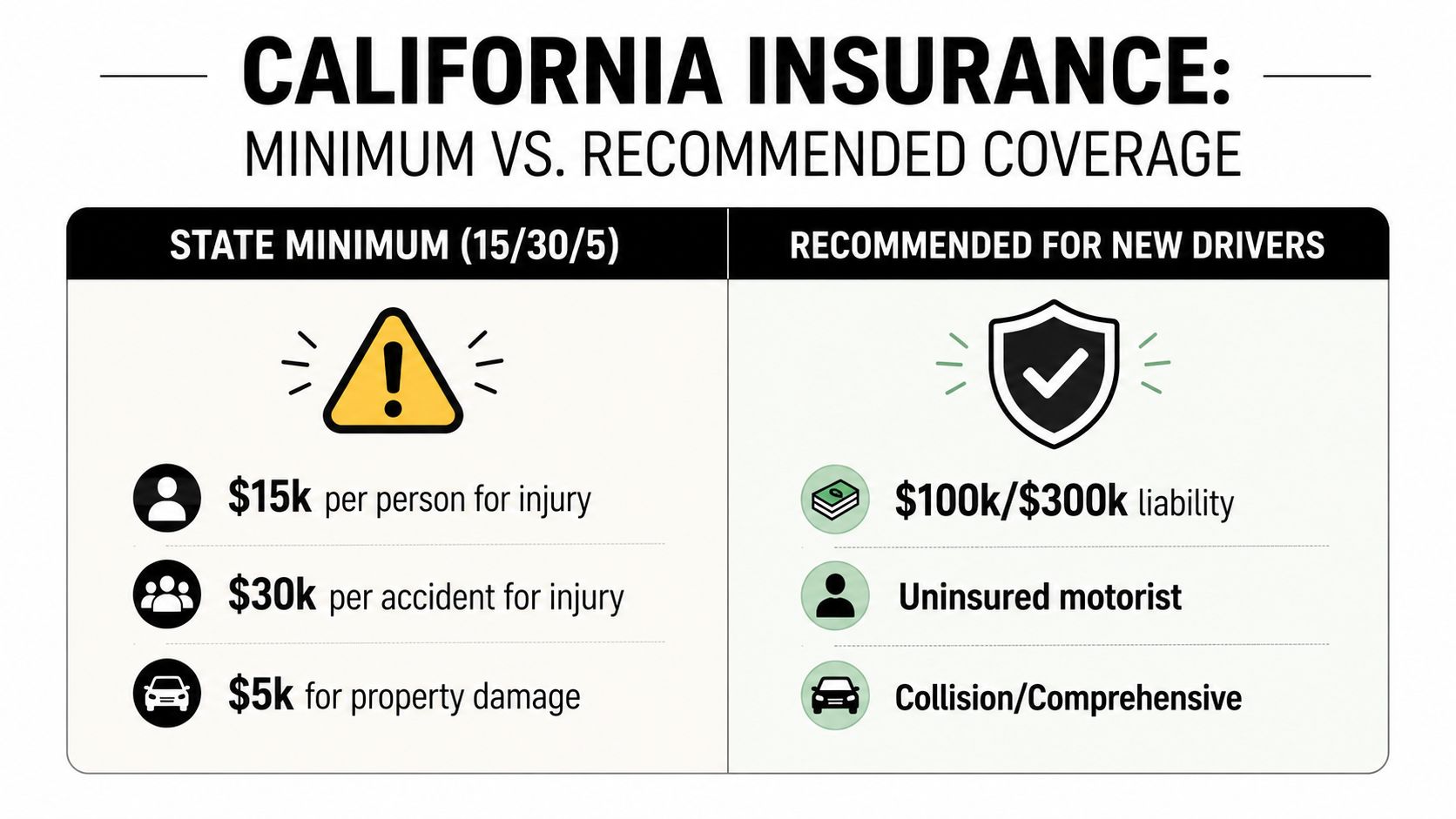
California's minimum liability limits, 15/30/5, are legal, but they're thin protection for a first-time buyer who needs room for real-world mistakes. Those limits cover only the bare minimum, and they disappear fast if there's a serious accident. If you have any assets worth protecting, the floor isn't the goal.
I prefer to think in terms of 100/300/100 with uninsured motorist coverage, plus collision and when the car still has meaningful value. That setup gives a new driver actual breathing room instead of a false sense of security. It's especially important if the car is financed.
What drives the premium up
California first-time drivers get punished by rating factors that are easy to underestimate. Age matters. License tenure matters. ZIP code matters. Theft and vandalism rates matter. At-fault accident history matters too.
That's why the same car can produce very different quotes for two different first drivers. You can't shop insurance like it's a fixed number. You have to compare identical coverage limits across carriers and see who really wants the risk.
If you want a direct place to compare policy options and not just chase the cheapest headline rate, this California auto insurance page is the right starting point for understanding the coverage structure.
Don't compare quotes the lazy way
Use the same liability limits, the same deductibles, and the same vehicle on every quote. Ask about bundling with renters or life insurance if you already have other coverage needs. Then look at the carrier's claims reputation in California, not just the premium.
If you want a practical outside reference point on young-driver pricing behavior, ISU Insurance Services young driver rates is a useful comparison resource to check while you're shopping. The point isn't to chase the cheapest number. The point is to buy a policy that won't collapse the first time you need it.
Bundling Coverage for a Smarter First Year of Ownership
Most first-time buyers treat auto insurance like a one-off purchase. That's a mistake. The first year of ownership is usually when gaps show up, and the cleanest way to manage them is to look at the whole protection picture at once.
If you rent, bundling auto insurance with renters insurance usually makes more sense than buying each policy from a different place and hoping the pieces fit. Renters coverage matters because your car isn't your only exposure. If you're building a household from scratch in California, the policy stack should reflect that.
Life insurance belongs in the conversation too, especially for young healthy applicants who often qualify without much friction. It's not about being dramatic. It's about giving a first buyer a basic safety net while they're still early in their financial life. Later, if you move toward homeownership, home insurance and even earthquake or wildfire-related planning can enter the picture.
That's where California-specific guidance matters. A lot of buyers in higher-risk ZIP codes don't realize how much a Fair Plan review or wildfire protection strategy can affect the overall protection plan. If your insurance discussions ignore that reality, you're getting a generic answer to a California problem.
For renters, this California renters insurance resource is worth keeping handy because it fits naturally into the same first-year planning conversation as auto coverage.
Use a 30, 60, 90-day ownership check
At 30 days, confirm the policy, registration, and payment setup are all correct. At 60 days, look at whether the car's actual use matches what you told the insurer. At 90 days, review the policy again with real driving habits, not optimistic ones.
That's the part most buyers miss. A first car isn't a one-time transaction. It's the start of a protection routine, and the people who manage it early usually spend less and get better coverage.
If you want straight answers instead of sales fluff, Mai & Associates can help you compare auto, renters, home, and life coverage with California-specific guidance that fits a first car purchase. They also handle multilingual support and real local insurance questions, so you're not guessing through the paperwork alone.