How to Buy Gap Insurance in California for 2026
Let's get straight to it—when you buy a new car, the last thing on your mind is it being totaled. But it happens, and if it does, Guaranteed Auto Protection (GAP) insurance can be a financial lifesaver. You can get it from the dealership, your lender, or directly from an auto insurance provider like us, which is almost always the cheapest route.
This isn't just another add-on; it's a specific protection against the gap between what you owe on your car and what it's actually worth. In California, with our sky-high vehicle prices, that gap can be a real problem. For residents navigating the complex world of California insurance, understanding this coverage is crucial for financial security.
Why California Drivers Should Seriously Consider Gap Insurance
We all know cars in California aren't cheap. What’s less obvious is how fast they lose value. The moment you drive a new car off the lot, depreciation kicks in, and GAP insurance is the financial safety net that catches you if the worst happens.
Here's a real-world scenario I see all the time. You buy a new car in Los Angeles for $40,000. A year later, it’s only worth $28,000 on the open market, but your loan balance is still $35,000. If your car gets stolen or totaled in an accident, your standard car insurance policy will pay out its current value—the $28,000.
That leaves you on the hook for the remaining $7,000 loan balance. You'd be making payments on a car you can't even drive anymore. GAP insurance is designed to cover that exact $7,000 difference.
Let's break down that example.
Gap Insurance Scenario At a Glance
| Financial Detail | Amount |
|---|---|
| Original Loan Amount | $40,000 |
| Loan Balance at Time of Loss | $35,000 |
| Car's Actual Cash Value (ACV) | $28,000 |
| Standard Insurance Payout | $28,000 |
| Financial "Gap" | $7,000 |
| Your Out-of-Pocket Cost with Gap | $0 |
| Your Out-of-Pocket Cost without Gap | $7,000 |
As you can see, what would have been a major financial hit becomes a manageable situation.
The Financial Risk in California's Market
This isn't a rare occurrence, especially here. High vehicle prices often lead to longer financing terms, making it incredibly easy to be "upside down" or "underwater" on your loan. Many drivers don't realize their standard auto insurance policy is there to cover the car's market value, not what they owe the bank. This concept is a core part of understanding auto insurance in California.
That's where GAP insurance steps in. It pays off the difference, bridging the gap between your car's value and your loan balance. This is so important when you consider that a new car can lose up to 60% of its value in just three years.
Think of it as a shield against depreciation. A total loss is bad enough; GAP coverage stops it from becoming a long-term financial nightmare, so you can move on without the weight of an old car loan.
Be Proactive with Your Primary Claim
When you're thinking about GAP, it's also a good idea to understand how your main insurance claim works. Knowing how to maximize your payout if your car is totaled is the first step and can actually shrink the gap that needs to be covered. A bigger payout from your primary insurer means less work for your GAP policy.
So, when is GAP a no-brainer? From my experience, you should absolutely get it if:
- You put less than 20% down on your car loan.
- You financed your vehicle for 60 months or longer.
- You’re leasing a car (in fact, most leases require it).
- You rolled negative equity from your last car into your new loan.
If any of these sound familiar, this guide will help you decide if GAP insurance is the right move for you.
Telltale Signs You Should Get GAP Insurance
Deciding whether you need GAP insurance can feel like a gray area, but from my experience helping California drivers, a few specific financial situations make the decision crystal clear. It's less about the make and model of your car and more about the structure of your auto loan.
So, when is it a must-have? Let's start with the biggest red flag: your down payment.
If you put down less than 20% on your new car, you're almost guaranteed to be "underwater" at some point. That low initial investment means the car's value will depreciate faster than you can pay it down, leaving you owing more than it's worth.
Long Loans and Leases Create a Bigger Gap
The length of your loan is another huge factor. Did you finance for 60 months or longer? Spreading payments out over five or more years means you build equity incredibly slowly. For the first few years, your loan balance will barely budge while your car's value plummets, creating that exact "gap" this insurance is designed to cover.
Leasing is another scenario where GAP insurance is practically non-negotiable. Most lease agreements in California even require it. Since you don't own a leased car, you have zero equity, leaving you completely exposed if the vehicle is totaled.
It’s no surprise the demand for this coverage is growing. The guaranteed auto protection (GAP) insurance market is on track to hit $4.8 billion in 2026, with a 10.0% compound annual growth rate. This is largely driven by today's higher car prices and more people understanding the risks. You can explore the full market report to see the data behind this trend.
When Old Car Debt Follows You
This is where things can get particularly dangerous. Did you trade in a vehicle you were still paying off and roll that old debt into your new loan? This is a classic recipe for immediate negative equity.
Here's a real-world example I see all the time: a driver owes $3,000 on their trade-in. That balance gets tacked onto their new $30,000 car loan. Right off the bat, they’re financing $33,000 for a car that's only worth $30,000. You're underwater the second you drive off the lot.
In this situation, GAP insurance isn't just a smart move—it's essential. Without it, a total loss means you're on the hook for the gap on the new car plus the remaining debt from your old one. It’s a financial nightmare.
If any of these scenarios hit close to home, you're a prime candidate to buy GAP insurance. It's a small price to pay for peace of mind, just like having solid home insurance or renters insurance protects your other major assets.
Alright, so you've figured out you probably need GAP insurance. That’s the first step. The next, and equally important, question is where to actually buy it. You’ll find you have three main options, and believe me, where you get your policy can make a huge difference in what you'll pay and how flexible it is.
This little decision tree is a great visual for figuring out if your car loan puts you in the "need GAP" category.
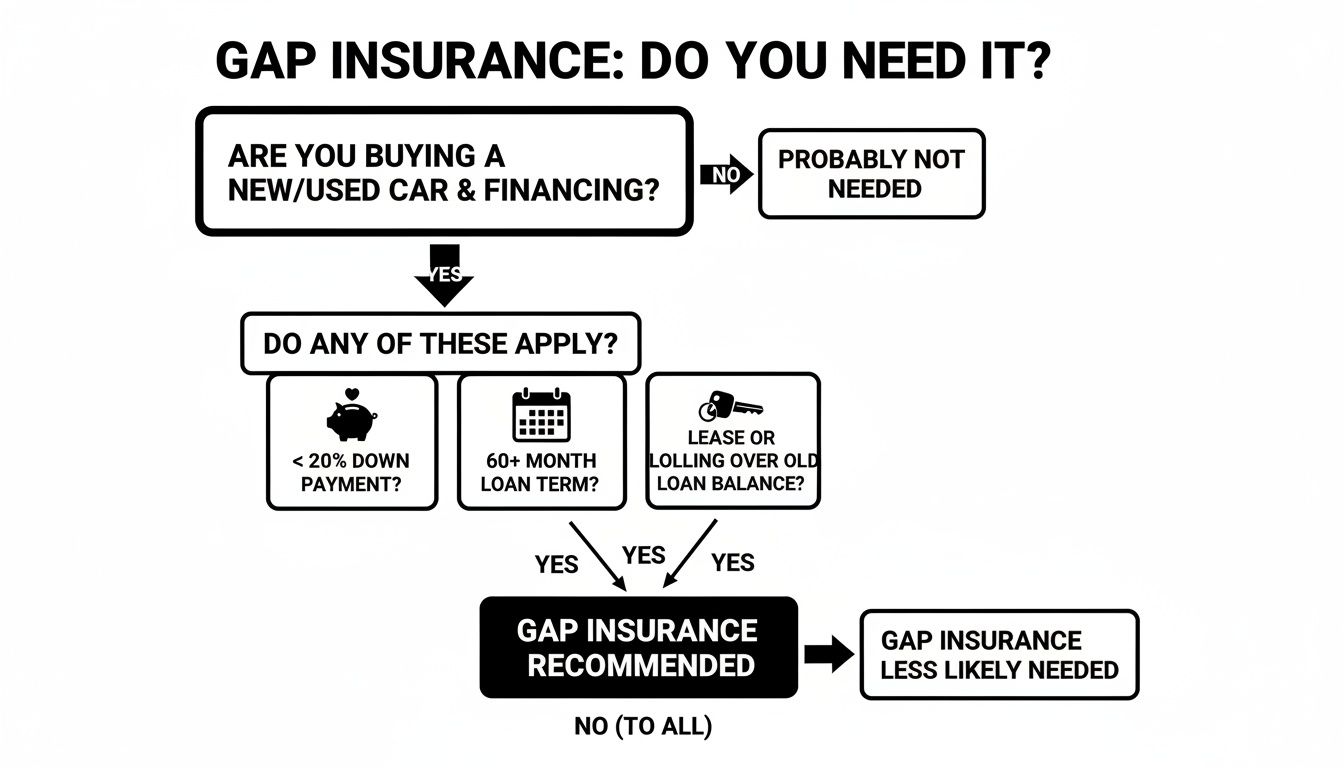
As you can see, factors like a small down payment or a loan term longer than 60 months are classic red flags. These are the exact situations where you can end up owing more than your car is worth, which is precisely the problem GAP insurance solves.
Comparing Where to Buy Gap Insurance
I've seen countless people overpay for GAP insurance simply because they didn't know they had other choices. Let's break down the pros and cons of the three main places you can buy coverage. This table gives a quick overview, and then we'll dive into the details.
| Purchase Point | Typical Cost | Pros | Cons |
|---|---|---|---|
| Dealership | $400 - $900+ (lump sum) | Extremely convenient; can be rolled into your auto loan. | Highest cost; you pay interest on it if it's part of the loan; less flexible. |
| Auto Lender | $300 - $700 (lump sum) | Often cheaper than the dealership; convenient if arranging financing. | Still a lump-sum payment that can accrue interest; less common than other options. |
| Insurance Carrier | $20 - $60 per year (added to premium) | Most affordable option by far; pay as you go, no interest; easy to cancel when no longer needed. | Requires you to have comprehensive and collision coverage. |
As you can tell, there's a clear winner for most people when it comes to cost.
At the Dealership
The finance manager's office is the first place you'll almost certainly be offered GAP insurance. It’s undeniably convenient—they just roll the cost into your auto loan, and you leave the lot with peace of mind.
But that convenience comes at a premium. A big one. Dealerships are notorious for marking up these policies significantly. And since that cost is folded into your loan, you'll be paying interest on it for years. A $600 policy can easily balloon to over $1,000 by the time you've paid off your car.
From Your Auto Lender
Your bank or credit union might also offer GAP insurance when you get your auto loan. This is often a better deal than what the dealership offers, especially if you’re a long-time customer with a good banking history.
The catch? It’s usually still a lump-sum payment that gets added to your loan, meaning you’re still paying interest on it. While it might be a bit cheaper than the dealer, it’s not the most cost-effective route.
Through Your California Auto Insurance Company
For the vast majority of drivers here in California, the smartest move is to get GAP insurance directly from your car insurance provider. Adding it as an endorsement to your existing auto insurance policy is almost always the cheapest option.
Instead of one big upfront fee, the cost is broken down into small, manageable additions to your regular premium. This means you don't pay a single cent of interest, and you have the power to cancel it the moment your loan balance drops below your car's value.
A Pro Tip from Experience: When you add GAP coverage through your insurer, it's all part of the same ecosystem. If your car is totaled, you only have one company to deal with for both your collision claim and your GAP claim. That single point of contact is a massive stress-reducer when you're already dealing with a lot.
When you're weighing these choices, getting professional auto insurance assistance can help you cut through the jargon and make a truly confident decision.
No matter who you're talking to, don't sign anything until you get clear answers to these questions:
- Is this a one-time fee or a recurring premium?
- If it’s a lump sum, how much interest will I actually pay on it over the life of the loan?
- What is the maximum amount the policy will pay out? (Is there a cap?)
- Can I cancel this policy for a prorated refund if I sell the car or pay off the loan early?
The answers will tell you everything you need to know about the true cost. If you want more straight-talk guides on California insurance, feel free to browse our other resources at https://cahomeauto.com/guides.
Our team at Mai & Associates is always ready to run the numbers for you. We can provide a same-day quote to show you just how affordable it is to add GAP coverage to your California insurance plan.
Getting a Handle on Gap Insurance Costs in California
When it comes to GAP insurance, the price tag can swing wildly. It all comes down to one crucial decision: where you buy it. For anyone driving in California, understanding the cost differences isn't just a good idea—it's the key to protecting your wallet. We're not talking about a few bucks here and there; the gap between providers can easily be hundreds of dollars.
Think about the last time you were at a dealership. They likely offered you GAP coverage for a one-time fee, probably somewhere between $500 and $900. They make it sound so easy, offering to roll that cost right into your auto loan. But that convenience comes at a steep price. You’ll be paying interest on that fee for the entire life of your loan.
Now, compare that to adding the same protection through your own auto insurance policy. With a carrier like Mai & Associates, you're looking at a much more manageable $20 to $40 per year. It’s just a small amount added to your regular premium, not a massive lump sum you have to finance.
Why the Huge Price Difference?
So, why is the dealership's offer so much higher? It’s all about their business model.
Dealerships and many lenders treat GAP insurance as a separate, high-margin financial product. They have sales quotas to meet and often tack on a significant markup for the convenience of signing everything in one place.
Insurance carriers see it completely differently. For us, it’s a simple, low-cost endorsement to your existing auto insurance policy. Because it’s part of a bigger package that might include your home insurance or even life insurance, we can offer it for a fraction of the cost. It's not a standalone profit-driver, which is what saves you money and makes the whole process, including claims, much simpler.
This pricing difference is even more important today. Post-pandemic inflation has already pushed motor vehicle insurance costs up by an average of 11.1%. While standalone providers might offer a one-time fee of $200-$300, bundling with your insurer often costs just $2-$5 extra per month. California rates can vary from national figures, but you can read more about how these costs break down to see just how much pricing can change by region.
A Pro Tip From Experience: Before you ever say yes to the dealership's GAP offer, make a quick call to your California insurance agent. That five-minute conversation could save you hundreds of dollars. More importantly, it will keep you from paying years of unnecessary interest on a rolled-in fee.
It's not just about the initial sticker shock; it's the total cost over the long haul. With interest rates where they are, financing a lump-sum policy just amplifies the expense. By choosing a small monthly premium through your insurer, you sidestep all those extra interest charges and keep more money in your pocket, all while getting the exact same essential protection for your car loan or lease.
Securing Your Gap Insurance Policy the Right Way

Alright, you know what gap insurance costs and where to look. Now for the final piece of the puzzle: actually buying the policy. Finalizing your coverage shouldn't feel like a chore. Honestly, if you have the right info on hand and know what to watch out for, you can get it done quickly and feel good about your decision.
Get These Details Ready First
To make this process as painless as possible, it helps to have a few things handy before you start calling around or filling out online forms. This ensures the quotes you get are accurate right from the start.
- Vehicle Information: The basics—your car's year, make, and model. The most important detail here is the Vehicle Identification Number (VIN). This is your car's unique fingerprint, and insurers use it to get precise details about your specific vehicle.
- Loan or Lease Agreement: Grab a copy of your financing contract. This is non-negotiable. It shows the insurer your total loan balance, who the lender is, and the loan term. Without this, it’s impossible to accurately calculate the potential "gap" you need to cover.
- Driver Information: You’ll need your driver's license number, plus the details for anyone else who will be listed on the policy.
Getting this stuff together takes a few minutes, but it saves a ton of back-and-forth later. When clients come to us at Mai & Associates with these details, we can often lock in a same-day quote for their California insurance needs. It just smooths everything out.
Don't Just Sign—Read the Fine Print
When you get that policy document, your first instinct might be to just find the signature line. Don't do it. Taking a few minutes to review the contract is the single most important thing you can do to make sure you’re getting the right protection.
First, zero in on the coverage limit. Some policies put a cap on their payout, often limiting it to a percentage of the car’s actual cash value (like 25% of the ACV). You need to make sure that limit is actually high enough to cover your potential gap.
Next, look for the exclusions section. This is where you find out what isn't covered. Most gap policies won’t pay for things like late payment fees, penalties, or negative equity you rolled into the loan from a previous car. It’s just as important to know what you’re not getting.
A Key Takeaway: Always find the cancellation clause. If you pay off your loan ahead of schedule, you should be able to cancel the gap policy and get a prorated refund if you paid upfront. You don't want to be stuck paying for coverage you don’t need anymore.
Finally, if something looks like legal jargon, ask what it means. A good agent will gladly break it down for you in plain English. That’s what we’re here for. We want you to feel completely confident in your auto insurance, home insurance, or any other policy. If you're ready to see how easy it can be, you can start the process by telling us a bit about your insurance needs on our site.
Common Questions About California GAP Insurance
So you've decided GAP insurance is a smart move. But a few questions are probably still rattling around in your head—that's completely normal. Let's tackle them head-on, because we get these all the time from drivers right here in California.
What If I Didn’t Buy GAP at the Dealership? Can I Add It Later?
Yes, but there's a catch. While tacking on GAP coverage when you sign your financing paperwork is the easiest route, many auto insurance carriers will let you add it to your policy later on.
The clock is ticking, though. This option is almost always reserved for new cars, and insurers have strict limits. For instance, they might require the vehicle to be under a year old and have fewer than 15,000 miles on the odometer. If you're thinking about it, my advice is to act fast. An agent specializing in California insurance can quickly tell you if your car still qualifies.
Does "Full Coverage" Already Include GAP Insurance?
This is probably the single most common point of confusion we see. The short answer is a firm no. "Full coverage" car insurance isn't a specific product; it's industry slang for a policy that includes both comprehensive and collision coverage.
Those coverages pay to fix your car or replace it up to its actual cash value (ACV)—what it’s worth the moment before an accident. They do absolutely nothing for the gap between that value and what you still owe your lender. GAP is a separate, specific add-on for that exact problem.
You can find more straight-to-the-point answers like this on our complete FAQ page.
Expert Takeaway: Here’s how I explain it to my clients: Collision and comprehensive protect your car itself (the asset). GAP insurance protects your loan (the liability). You need two different tools for two different jobs.
Is GAP Insurance Legally Required in California?
No, the state of California does not mandate GAP insurance. But that doesn't mean you can always skip it. It’s often a contractual requirement.
If you’re leasing, your agreement almost certainly requires it. Many auto lenders also demand it for specific loans, especially if you made a small down payment or financed your car for more than 60 months. In those cases, it’s the bank—not the state—that’s making the rule.
How Do I Get Rid of GAP Insurance When I No Longer Need It?
You can cancel your GAP policy anytime, but you should only do it once your loan is right-side up—meaning you owe less than the car's current value.
The process depends on where you bought it:
- Through your auto policy: This is the easy one. Just call your agent and ask them to remove the GAP endorsement from your California insurance plan. The change is usually effective immediately.
- From the dealership or lender: If you paid for it upfront as a lump sum, you'll need to dig out that contract and contact the provider listed. You may even be due a prorated refund for the unused time.
Always double-check your contract or give your agent a ring to make sure you’re following the right steps and not leaving yourself exposed.
At Mai & Associates, our job is to make insurance clear and straightforward. Whether you need auto insurance, home insurance, renters insurance, or life insurance, we're here to give you honest advice and find coverage that actually works for you. Get your free, no-obligation quote today at https://cahomeauto.com.