Business Owner Insurance: A Guide for California Businesses
You've probably already made a dozen decisions this week that feel bigger than they looked on paper. You picked a business name. Signed a lease, or decided to work from home. Ordered equipment. Set up payments. Figured out taxes. And somewhere in the middle of all that, someone told you to “get business insurance.”
That's usually the moment a new owner freezes.
If you're opening a boutique in Costa Mesa, running a design studio from Glendale, or launching a small service business anywhere in California, business owner insurance can sound like a vague, expensive requirement. Few grow up learning the difference between general liability, commercial property, and business interruption. They know auto insurance. They know home insurance. Business coverage feels like a different language.
You're not alone in that confusion. A 2025 small-business insurance survey by NEXT found that 92% of small-business owners already carry insurance, yet nearly 70% said business insurance is confusing and only 13% felt prepared for risk.
That gap matters. Many owners buy something because a landlord, lender, client, or gut feeling tells them they should. Fewer feel confident that the policy they bought matches how the business operates.
This guide is meant to make that easier. I'm going to explain business owner insurance the same way I'd explain it to a first-time California client sitting across the desk. Plain English. Real examples. Familiar comparisons to policies you already know, like car insurance, homeowners insurance, renters insurance, and life insurance. Once those parallels click, the business side starts to feel a lot less intimidating.
Starting a Business in California Is Hard Enough
A lot of California business owners hit the same wall. They don't object to insurance itself. They object to feeling like they have to buy a product before they understand what problem it solves.
Think about a new coffee cart operator. She's focused on permits, equipment, vendors, branding, and a location that gets real foot traffic. Then someone asks whether she has liability coverage, property coverage, or a Business Owner's Policy. Those terms sound technical, but the questions underneath them are simple. If someone gets hurt, who pays? If equipment is damaged, who pays? If the business has to stop for a while after a covered loss, what happens to income?
That's the same logic people already use in personal insurance.
With car insurance, you expect help after an accident. With home insurance, you expect help if your house is damaged. With renters insurance, you expect help if your belongings are stolen or damaged. With life insurance, you're planning for financial protection if something major happens to you. Business owner insurance works from the same basic idea. It transfers certain financial risks away from the business owner and onto an insurer, within the limits and conditions of the policy.
Why the confusion happens
Business insurance gets confusing because one business can face several types of risk at the same time.
- Customer risk: A visitor slips, falls, or says your business damaged their property.
- Property risk: Fire, theft, or vandalism damages your inventory, furniture, tools, or equipment.
- Income risk: A covered loss shuts down operations and interrupts your revenue.
- Operational gaps: Your business may also need separate coverage for autos, employees, or specialized services.
Business insurance isn't one product. It's a set of protections that should match how your business actually earns money.
That's why the right policy often depends less on your business name and more on your daily reality. Do customers visit your space? Do you carry inventory? Do you use a vehicle for work? Do you depend on computers, tools, or specialized equipment? Are you operating from home in a way that your personal homeowners or renters policy may not fully address?
For California owners, that conversation gets even more practical. Earthquakes, wildfires, dense traffic, high property values, and strict lease requirements all shape how coverage should be built. A generic online summary rarely explains that clearly.
What Exactly Is a Business Owner Policy
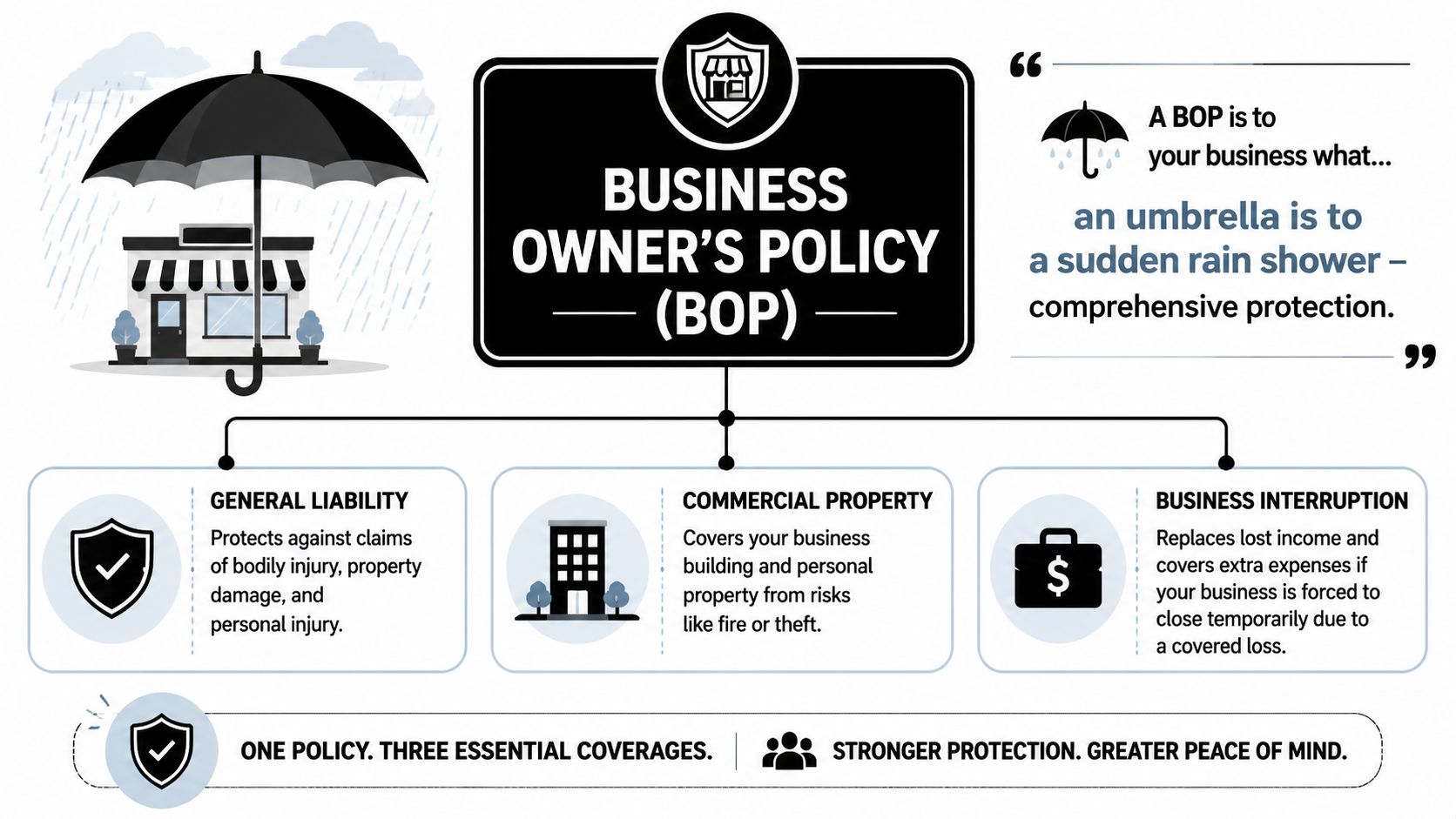
The easiest way to understand a Business Owner's Policy, often called a BOP, is this: it's the business version of a homeowners policy.
A homeowners policy doesn't cover every possible risk on earth, but it bundles several important protections into one package so you don't have to buy every piece separately. A BOP works the same way for many small businesses.
According to Maryland Insurance Administration consumer guidance, a Business Owner's Policy combines property insurance, general liability, and often business interruption coverage, typically at a lower cost than buying each policy separately.
The three core parts
General liability
This is the part many landlords and clients care about first.
If a customer slips on a wet floor in your store, or if your business is accused of causing damage to someone else's property, general liability is the coverage built to respond to that category of third-party claim. In personal terms, it's comparable to the liability part of your auto insurance or homeowners insurance. It's there for harm you may be legally responsible for causing to others.
Commercial property
This protects the business's physical stuff.
That can include your office contents, furniture, inventory, fixtures, equipment, and sometimes the building itself if you own it. If a covered event damages those items, commercial property coverage is the piece of the BOP designed to help.
If you already understand homeowners insurance or renters insurance, this part should feel familiar. It's the business version of protecting the place and property you rely on every day.
Business interruption
This is the coverage many owners don't think about until they need it.
If a covered property loss forces you to pause operations, business interruption coverage can help with lost income and certain ongoing expenses while you recover. That's a very different problem from replacing a chair, laptop, oven, or display rack. It's about protecting the business's ability to keep functioning financially after a disruption.
Why many small businesses start here
A BOP is popular because it's simpler than buying multiple separate policies from scratch. One package. One core structure. Less friction.
If insurance terms ever blur together, a business insurance glossary can help translate policy language before you compare options.
If you end up in a coverage dispute or need legal perspective on how a policy is being interpreted, some owners also consult Lerner & Weiss business insurance lawyers to better understand claim and policy issues.
Practical rule: A BOP is often a strong starting point for a small business, not an automatic finish line.
What a California BOP Covers and Excludes
A California BOP can be very useful, but owners need to slow down and read carefully. The biggest mistakes usually come from assuming “bundled” means “complete.”
Here's the cleanest way to think about it. A BOP handles several common business risks under one roof. It does not automatically insure every exposure your business has.
What the policy usually handles well
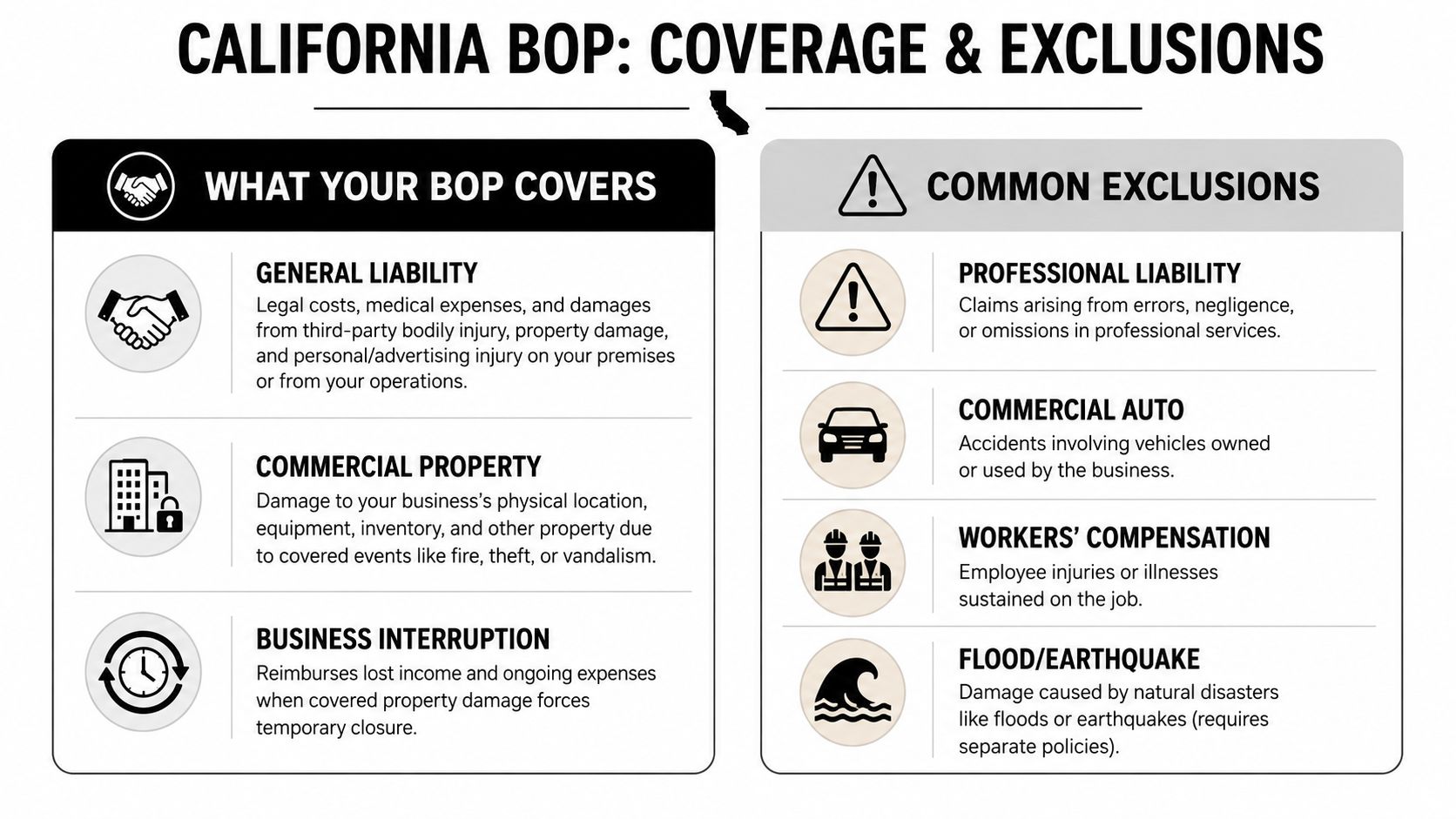
For many retail shops, offices, studios, and small service businesses, a BOP does a solid job covering the basics:
- Customer injury claims: Someone is hurt on your premises and alleges your business was responsible.
- Damage to business property: Covered events damage inventory, shelving, desks, computers, or equipment.
- Temporary shutdown after covered property damage: A covered loss interrupts operations and creates an income problem, not just a repair problem.
Those are major concerns for a small business. If your storefront suffers a fire or a break-in, you don't want to discover that you only insured your legal liability and forgot the property itself. A BOP is built to keep those core pieces together.
The exclusions that catch owners off guard
The Independent Insurance Agents & Brokers of America guidance on BOPs makes an important point: a standard BOP usually does not include flood or earthquake coverage, and it also does not include business auto coverage. Those exposures need separate policies or endorsements.
That matters a lot in California.
If you already carry car insurance for your personal vehicle, that doesn't automatically mean your business driving is covered the way you expect. If a vehicle is owned by the business, regularly used for work, or creates a commercial exposure, you need to review whether separate business auto coverage is required.
Earthquake risk is another big one. Many California owners assume property coverage means “all major disasters.” It doesn't. Standard BOP forms generally don't include earthquake coverage. That's a separate conversation. The same goes for flood risk.
A BOP is more like a well-built starter toolkit than a fully stocked warehouse. It covers a lot, but not every job.
Common gap areas to ask about
Some businesses also need protections that sit outside the standard BOP structure or depend on endorsements and carrier form details.
| Risk area | Why owners miss it | What to ask |
|---|---|---|
| Professional mistakes | Owners assume all lawsuits are covered | Ask whether you need professional liability or E&O coverage |
| Business vehicles | They already have personal auto insurance | Ask whether any car, truck, or delivery use creates a business auto need |
| Earthquake and flood | Property coverage sounds broad | Ask specifically whether those causes of loss are excluded |
| Employee injuries | “General liability” sounds broad enough | Ask whether workers' compensation is required for your setup |
| Equipment breakdown or crime | Owners focus only on fire and slip-and-fall scenarios | Ask which endorsements are available and which are not included by default |
Policy comparison matters. Two BOPs can sound similar in conversation and still differ in how endorsements, exclusions, and optional coverages are handled.
Is Your California Business Eligible for a BOP
Not every California business can buy a BOP. That surprises a lot of owners.
They hear that a BOP is economical and straightforward, then assume it's the default option for everyone with an LLC or small storefront. Insurers don't look at it that way. A BOP is generally designed for smaller, lower-risk operations.
According to Wolters Kluwer guidance for small businesses, BOPs are designed for smaller, lower-risk businesses, and certain industries such as restaurants or manufacturing may not qualify and may need a more customized Commercial Package Policy instead.
Businesses that often fit
A BOP often makes sense for businesses with a fairly predictable risk profile, such as:
- Retail stores: Small shops with inventory, customer foot traffic, and standard premises exposure.
- Professional offices: Consultants, designers, or similar office-based firms with limited physical hazard.
- Light service businesses: Operations that don't involve heavy manufacturing, major vehicle fleets, or unusually hazardous work.
These businesses usually need a practical blend of liability and property protection without highly specialized underwriting.
Businesses that may run into limits
Some operations trigger more complexity.
- Higher-hazard work: Businesses involving heavier equipment, more severe injury potential, or complex production risk.
- Industry-specific concerns: Some food businesses, manufacturing operations, and similar ventures may fall outside a standard BOP appetite.
- Nonstandard operations: If your business has unusual property, unusual exposures, or a risk profile that doesn't fit the carrier's BOP model, the insurer may decline that format.
That doesn't mean the business is uninsurable. It means the structure needs to change.
What happens if you don't qualify
If a BOP isn't the right fit, the usual next path is a Commercial Package Policy, often called a CPP. Think of that as the custom-built version. Instead of starting with a standard bundle, you assemble the coverages your operation needs.
That can be the better answer for a business with specialized property, more layered liability concerns, or industry-specific requirements. The policy may take more planning, but more customization is often exactly what the business needs.
If your business is too complex for a BOP, that's not bad news. It usually means your risks deserve a more tailored setup.
BOP vs Standalone Policies A Clear Comparison
Some owners need a bundle. Others need a menu.
That's the crucial decision. Do you want the convenience of a Business Owner's Policy, or do you need separate standalone policies so each coverage can be customized more precisely?
A useful personal-insurance comparison is this: a BOP is like bundling home and auto with one insurer because the package is easier to manage. Standalone policies are more like shopping each policy separately because one carrier fits your car best, another fits your home better, and a third offers the right life insurance design.
Side by side comparison
| Feature | Business Owner's Policy (BOP) | Standalone Policies |
|---|---|---|
| Structure | Bundles core coverages into one package | Buys each coverage separately |
| Best fit | Smaller, lower-risk businesses with common needs | Businesses with unusual, layered, or higher-risk exposures |
| Simplicity | Easier to understand and manage | More moving parts and more decisions |
| Customization | More standardized | More flexible |
| Coverage gaps | Can appear broad while still excluding key items | Easier to build around specific exposures |
| Administrative effort | Lower | Higher |
| Pricing style | Often attractive for qualifying businesses | Depends on the exact mix of coverages needed |
When a BOP is usually the better choice
A BOP often fits when your business is fairly straightforward. You want liability coverage, property coverage, and business interruption in one place. You don't have highly unusual equipment, a fleet, or a risk profile that pushes you outside standard underwriting.
This can be ideal for owners who want a strong baseline without building every policy piece from scratch.
When standalone policies make more sense
Standalone policies usually win when the business has risks that don't fit neatly into one package. Maybe you need specialized property terms. Maybe you need separate professional liability, inland marine, commercial auto, or industry-specific enhancements. Maybe one carrier is competitive on liability but not property.
In those cases, flexibility matters more than simplicity.
A simple way to choose
Ask yourself these questions:
Is my business low-complexity or high-complexity?
If it's low-complexity, a BOP may be enough. If it's high-complexity, standalone options may fit better.Do I want convenience or precision?
Convenience favors a bundle. Precision favors customization.Would one exclusion create a serious problem for me?
If yes, don't choose based on packaging alone. Choose based on exposure.
A cheaper bundle can still be the wrong policy if it leaves out the risk most likely to hurt your business.
How Much Does Business Owner Insurance Cost in California
Cost is usually the first question owners ask out loud and the last question they stop thinking about.
There is a national benchmark, but it should only be treated as a rough starting point. A 2025 compilation of small-business insurance statistics estimated that small business insurance spending averages around $341 per month across the U.S., with costs varying widely by industry, location, and specific coverage needs.

Why California pricing can look very different
California business owner insurance is shaped by local realities.
A storefront in a dense commercial district doesn't present the exact same profile as a home-based consulting business. A company with inventory, customer traffic, and leased space doesn't look the same as a solo operator with a laptop and no public visitors. Some locations bring more property concerns. Some operations bring more liability concerns. Some businesses face landlord requirements that push limits or endorsements higher.
Here are the big pricing drivers:
- Industry type: A quiet office generally rates differently than a business with more physical hazard.
- Location: Property risk, local conditions, and regional loss patterns can affect premiums.
- Revenue and operations: The more activity your business has, the more underwriting detail the carrier usually wants.
- Property details: Building characteristics, equipment, inventory, and square footage matter.
- Employees and payroll: Staffing can change the overall risk picture.
- Claims history: Prior losses often affect pricing and carrier appetite.
- Coverage choices: Limits, deductibles, endorsements, and separate policies all shape the final cost.
What to have ready before requesting quotes
The SBA advises owners to reassess insurance annually because business changes can make old coverage inadequate, and it also notes that underwriting commonly relies on details such as sales, payroll, receipts, property characteristics, and claims history in its business insurance guidance for small businesses.
That means you'll usually get better quotes, faster, if you have basic details organized:
- Business operations summary: What you do, how you make money, and whether customers visit.
- Property information: Address, square footage, and what property or equipment you need to insure.
- Financial information: Sales or receipts, and payroll if applicable.
- Loss background: Any recent claims or known issues.
- Vehicle use and special exposures: Delivery, tools, professional services, or anything unusual.
If you're ready to price options, a California insurance quote request is the practical next step.
Your Checklist for Buying Business Insurance in California
Buying business owner insurance gets easier when you stop treating it like a mystery product and start treating it like a checklist. You're matching exposures to coverage, just like you would when deciding how much car insurance or homeowners insurance you want.
This process also fits into your broader business planning. If you're working through budgets, reserves, and risk decisions at the same time, MyOfficeOps' financial planning guide is a useful companion resource because insurance works best when it's part of the larger financial picture.
Six smart steps
Assess your actual risks
Don't buy a template just because another business owner bought one. A retail shop, therapist, photographer, online seller, and contractor can all own small businesses while needing very different insurance structures.Gather the underwriting details first
Have your operations summary, property information, receipts or sales figures, payroll details if applicable, and claims history ready. Better inputs usually lead to better quote comparisons.Decide whether a BOP is even the right format
If your business is straightforward and eligible, a BOP may be the cleanest option. If the operation is more specialized, compare it against a custom package.Check exclusions before you focus on price
In California, owners need discipline. Ask directly about earthquake exposure, flood exposure, business auto, employee injuries, and any industry-specific coverage gaps.Compare carriers and policy forms, not just premiums
One quote may look cheaper because it covers less, excludes more, or handles endorsements differently. Read the form, not just the number.Review the policy every year and after major business changes
Growth creates insurance changes. New employees, new equipment, a larger location, added services, or bigger contracts can all make an old policy outdated.
Coverage should change when the business changes. Insurance that fit at launch may not fit a year later.
Triggers that should prompt a review
A policy review shouldn't wait for renewal paperwork to randomly land in your inbox. Use real business events as triggers.
- You hire people: Staffing changes can affect liability, payroll-based rating, and other coverage needs.
- You move or expand: A new location changes property and premises exposure.
- You buy equipment or inventory: Valuable property needs to be scheduled or included correctly.
- You sign bigger contracts: Clients or landlords may require different limits or proof of coverage.
- You add vehicles or delivery work: Personal car insurance and business use need careful separation.
If you want more California-specific insurance education, Mai & Associates guides offer additional reading on coverage topics owners often compare alongside their business policies.
Frequently Asked Questions About California BOPs
Does a BOP cover a home-based business
Sometimes partially, sometimes not enough.
That's where people get tripped up. If you run a business from home, don't assume your homeowners insurance or renters insurance fully covers business equipment, inventory, client visits, or liability tied to business activity. A BOP or separate business coverage may still be appropriate, depending on how you operate.
I'm a one-person LLC. Do I still need business owner insurance
You may.
Being a solo business doesn't eliminate risk. You can still lease space, own equipment, host clients, or face a liability claim. The fundamental question isn't how many people work in the business. It's what could create a financial loss if something goes wrong.
My landlord says I need business insurance. Are they asking for a BOP
Maybe, but not always by name.
Landlords usually want proof that you carry certain protections, often liability first. A BOP can satisfy that need for some businesses because it bundles liability with other useful coverage. But the lease may call for specific limits, endorsements, or certificates. Read the lease language carefully.
If I already have personal car insurance, do I still need business auto coverage
Possibly yes.
If the vehicle exposure is business-related, personal auto insurance may not be enough. The answer depends on who owns the vehicle, how it's used, and how often it's used for work. That's one of the most important questions to ask before assuming you're covered.
Is the cheapest BOP usually the best deal
Not necessarily.
A low premium can look attractive because the policy excludes key exposures or offers less favorable terms. Good business owner insurance is about fit, not just price. The right policy protects against losses most likely to hurt your business.
If you want answers to more common coverage questions, the Mai & Associates insurance FAQ is a helpful place to continue.
If you want help comparing business owner insurance options in California, Mai & Associates can walk you through the decision in plain English. Their licensed team can help you review coverage gaps, compare policy structures, and coordinate your business coverage with the personal policies many Californians already carry, including auto insurance, home insurance, renters insurance, car insurance, and life insurance.