Burial Insurance Cost: Affordable Options for 2026
For seniors in California, burial insurance cost usually falls between $14 and $162 per month for $5,000 to $10,000 in coverage. If you're trying to protect your family from funeral bills without buying a large life insurance policy, that range is the clearest starting point.
A lot of families begin this search the same way. A parent gets older, a health issue shows up, and someone in the family hesitantly asks, “What would happen if we had to pay for everything tomorrow?” That question often starts with burial insurance, but it rarely ends there. In California, people who are reviewing end-of-life planning are often also looking at their broader protection picture, including life insurance, auto insurance, home insurance, renters insurance, and car insurance, because one financial gap tends to reveal another.
Burial insurance is one of those topics people avoid until they can’t. The good news is that it’s much simpler than it sounds once you break it down into a few basic parts: what it covers, why prices vary, what a realistic California premium looks like, and when another option might make more sense.
The Unexpected Cost of Saying Goodbye
A family loses a parent. They’re grieving, fielding calls from relatives, and trying to make decisions quickly. Then the funeral home starts walking them through the bill. Service fees. Transportation. Preparation. Burial arrangements. The total is far higher than they expected.
That surprise is common. More than half of U.S. adults ages 45 and older think funeral costs are less than $10,000, but actual expenses often range from $15,000 to $20,000, and 30% in that age group haven’t considered how they’d pay for funeral expenses at all, according to Choice Mutual’s funeral cost research.
The hard part isn’t just the amount. It’s the timing. Funeral costs don’t arrive as a distant future problem. They arrive all at once, when the family has the least emotional energy to compare prices, move money, or sort out paperwork.
Why this catches families off guard
Funeral services are typically not priced until they are needed. That’s like shopping for car insurance after an accident or trying to add wildfire protection after smoke is already in the air. The need is real, but the timing is terrible.
Burial insurance steps into that gap. It’s a smaller life insurance policy built for one focused job: creating a pool of money your family can use for final expenses.
Burial insurance doesn’t remove grief. It removes one urgent bill from the middle of grief.
Why Californians feel this issue sharply
California families already juggle expensive essentials. Mortgage or rent, utilities, auto coverage, property insurance, and everyday living costs all compete for room in the budget. When funeral bills land on top of that, even a financially careful household can feel cornered.
That’s why many people treat burial insurance as part of a bigger protection plan, not a separate purchase in a vacuum. The same household that reviews life insurance for final expenses often needs to review car insurance, home insurance, or renters insurance for other gaps that could hurt the family later.
A practical first step is simple: know that burial insurance exists, know what California pricing generally looks like, and know that waiting usually narrows your choices rather than expanding them.
What Exactly Is Burial Insurance
Burial insurance is a small life insurance policy meant to help cover final expenses. You might also hear it called final expense insurance. It’s usually designed for people who want modest coverage, a simple application, and a benefit their family can access after death.
Burial insurance provides a dedicated emergency fund, structured as a policy. A large traditional life insurance policy is often built to replace income, support children, or protect a mortgage over many years. Burial insurance is much narrower. Its job is to help with costs tied to the end of life.
A simple way to think about it
If traditional life insurance is a full toolbox, burial insurance is one reliable wrench. It doesn’t do every job. It does one important job well.
That focus is why many buyers choose it later in life. They may no longer need a large policy for income replacement, but they still want to keep funeral costs from landing on their children or spouse.
Core idea: Burial insurance is life insurance with a smaller benefit and a simpler purpose. It’s there to give your family cash for final expenses, not to solve every long-term financial need.
How it differs from bigger life insurance policies
Burial insurance usually has a lower coverage amount than a traditional policy. The application is often easier too. Instead of a long underwriting process, many policies use health questions or a shorter approval path.
The tradeoff is straightforward. Easier approval often means a higher cost per dollar of coverage than a fully underwritten life insurance policy.
Here are the main differences in plain language:
- Smaller benefit amounts: Burial insurance is built for final expenses, not large estate or income-replacement needs.
- Simpler approval: Many applicants can qualify without the long process associated with some traditional policies.
- Lifetime structure: These policies are commonly designed to stay in force as long as premiums are paid.
- Flexible payout to the beneficiary: Your beneficiary typically receives the money and can use it where it’s needed most.
The two policy types families usually compare
Most shoppers run into two broad options.
Simplified issue
This type usually asks health questions. If your health history is manageable, this is often the better-value path because the insurer has more information to price the risk.
A person with controlled health conditions may still qualify. That’s one reason many advisors tell applicants not to assume they need the easiest policy before seeing the questions.
Guaranteed issue
This type is designed for people who may not qualify elsewhere. Approval is easier, but the policy usually costs more.
The reason is simple: when the insurer asks fewer questions, it takes on more uncertainty.
What a graded death benefit means
Some burial insurance policies don’t pay the full death benefit right away for every cause of death in the early policy period. This is often called a graded death benefit.
That phrase sounds technical, but the idea is simple. The policy may have a limited payout during the first part of the coverage period, then become fully payable later according to the policy terms.
That’s why families should read the first pages of a policy carefully. The premium matters, but the timing of full coverage matters too.
Key Factors That Determine Your Burial Insurance Cost
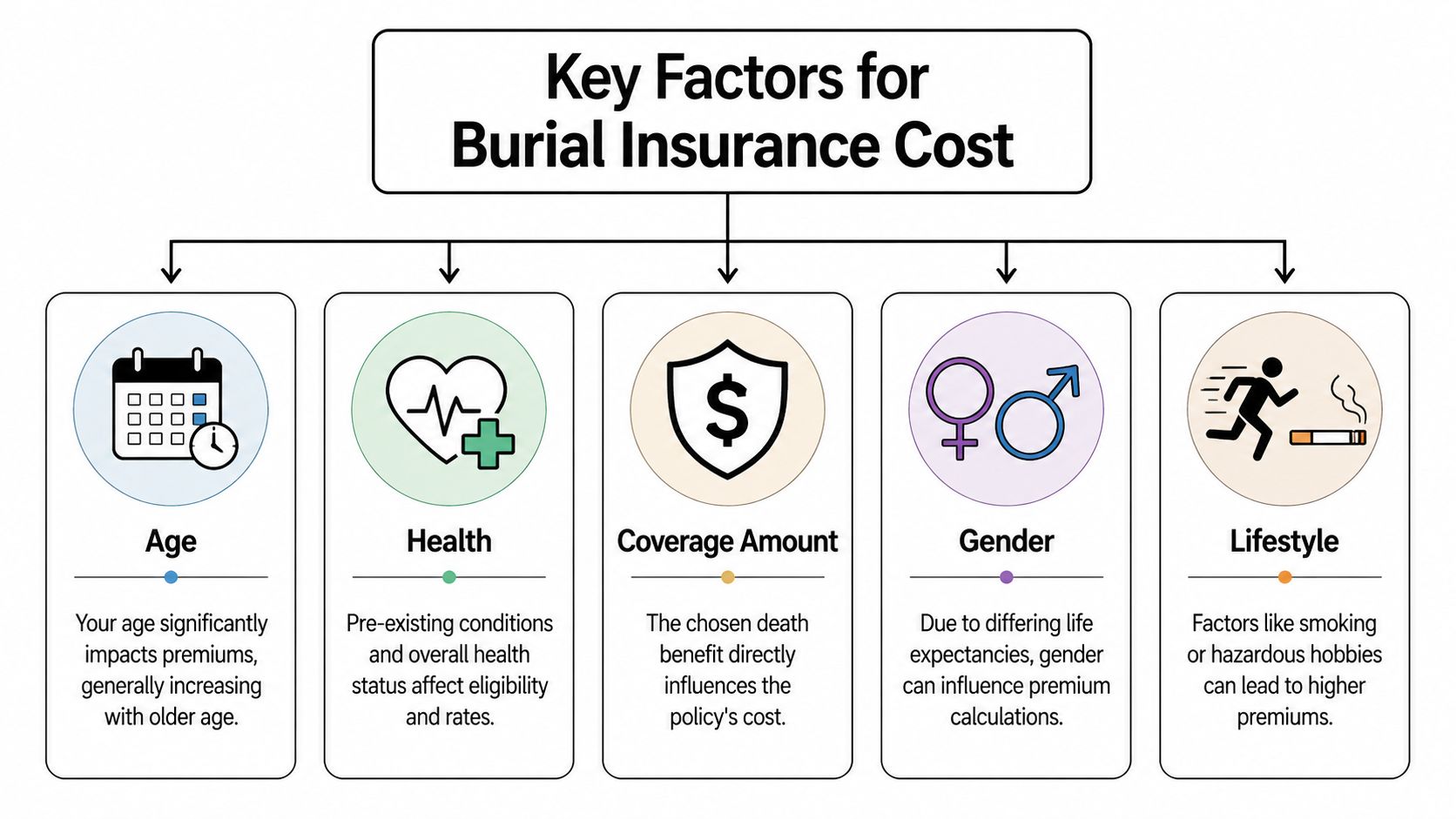
Burial insurance pricing isn’t random. Insurers look at a small set of factors and use them to estimate risk. Once you understand those levers, quotes make a lot more sense.
Before getting into the details, it helps to know this isn’t a fringe product. The global burial insurance market was valued at $256.95 billion in 2025 and is projected to reach $388.92 billion by 2032, growing at a 6.1% CAGR, with North America holding a leading share, according to Stellar Market Research’s burial insurance market report. In plain English, more families are using this type of planning because they want a cleaner financial handoff.
Age matters most
Age is usually the biggest pricing driver. The older you are when you apply, the more the insurer expects to pay the claim sooner. That shorter expected timeline usually means a higher monthly premium.
This is why burial insurance often rewards action, not delay. The person who applies earlier usually has more options and a better chance of locking in a manageable payment.
Health changes both eligibility and price
Health affects two things at once. First, it can affect whether you qualify for a simplified issue policy. Second, it affects whether your premium lands on the low end or high end of the available range.
A common mistake is assuming any diagnosis means guaranteed issue is the only choice. That’s not always true. Some conditions may still fit a policy with health questions, and that can lower cost.
Practical rule: Don’t self-decline. Let the application questions decide whether you qualify for a lower-cost option.
If you're helping a parent compare choices, these practical tips for parents' funeral coverage are useful because they focus on the actual family questions people ask before applying.
Coverage amount changes the premium directly
This part is intuitive. More coverage usually means a higher premium. If you insure a larger amount, the insurer takes on a larger potential payout.
The better question isn’t “What’s the biggest policy I can buy?” It’s “What amount would protect my family from the most likely final expenses and related bills?”
Gender can affect pricing
Insurers also price based in part on gender. That can feel strange if you haven’t bought life insurance before, but it follows the same logic as other risk-based pricing models. If one group is expected to live longer on average, premiums may differ.
That’s why sample quotes often show lower rates for women than men of the same age.
Policy type can change the math fast
A simplified issue policy and a guaranteed issue policy can look similar at a glance, but they don’t price the same way. A guaranteed issue policy usually costs more because the insurer accepts more uncertainty.
The product label matters. So does the wording around waiting periods and early-year benefits.
Small extras can still affect the total
Some policies offer optional riders or add-ons. These can raise the premium. Sometimes that extra cost is worth it. Sometimes it just makes a modest policy less efficient.
A careful quote review helps. If you want broader insurance education before you compare policy types, California readers can use these insurance planning guides as a plain-language reference point.
Sample Burial Insurance Costs in California for 2026
California shoppers usually want one thing first: a realistic monthly number. The most grounded starting point is this: for seniors ages 50 to 80 in California, burial insurance premiums typically range from $14 to $162 per month for $5,000 to $10,000 in coverage, and sample pricing shows a 55-year-old female paying about $18 per month for $10,000, while a 75-year-old male might pay about $45 per month for $10,000, according to Funeral Advantage’s California burial insurance overview.
Those figures are useful, but they don’t answer every real-world question. For example, what should you expect if you want more than a small policy, or if your health history pushes you away from the lowest-priced options? Since the verified California data gives a firm range for $5,000 to $10,000 coverage, the safest way to think about larger coverage is qualitatively: the premium usually rises as the coverage amount rises.
Estimated monthly premiums in California
The table below stays within the verified California examples and uses only figures supported by the available data.
| Age | Gender | $10,000 Coverage | $20,000 Coverage |
|---|---|---|---|
| 55 | Female | ~$18/month | Likely higher than the $10,000 example. Request a carrier quote. |
| 75 | Male | ~$45/month | Likely higher than the $10,000 example. Request a carrier quote. |
| 50 to 80 | Varies | Typical range: $14 to $162/month for $5,000 to $10,000 coverage | Usually higher than the verified $5,000 to $10,000 range. |
How to read these numbers without getting tripped up
The table isn’t a rate card. It’s a reality check.
If you’re younger, healthier, and applying for a modest death benefit, your burial insurance cost is more likely to sit toward the lower end of the California range. If you’re older, have more health concerns, or need a policy with easier approval, your premium can move upward.
Here are three simple ways to use the numbers:
- Use the range to set expectations: If you’ve seen ads promising a tiny payment without context, compare that message to the verified California range.
- Use the examples to anchor age differences: A 55-year-old female at around $18 per month and a 75-year-old male at around $45 per month show how age and gender can affect rates.
- Use carrier quotes to fill in the gaps: A quote is where your personal details turn a broad range into a real premium.
What California buyers often miss
A lot of people focus only on the monthly payment and ignore the fit. A cheaper policy that has the wrong structure, strict early limitations, or too little coverage can create the same family stress you were trying to avoid.
A good burial insurance quote answers two questions at the same time: “Can I afford this monthly premium?” and “Will this amount actually help my family when the time comes?”
That’s the lens to use when you compare offers.
Comparing Burial Insurance To Other Final Expense Options
Burial insurance is useful, but it isn’t automatically the best fit for every person. The right choice depends on age, health, cash flow, and whether you want flexibility or price certainty.

One of the most important ideas here is the break-even question. For a 75-year-old buying a $10,000 policy at $80 per month, premiums paid over 10 years total $9,600, which comes close to the death benefit, according to After.com’s burial insurance cost discussion. That doesn’t mean the policy is bad. It means timing and purpose matter.
Burial insurance versus prepaid funeral planning
A prepaid funeral or cremation arrangement can appeal to people who want to set up specific services in advance. Burial insurance usually offers more flexibility because the beneficiary receives funds that can be used where needed.
The tradeoff is control versus flexibility.
- Burial insurance: Good for families who want cash available and don’t want to lock every detail in today.
- Prepaid planning: Good for people who want service decisions made in advance and may prefer price certainty for selected arrangements.
Burial insurance versus savings
Using savings sounds simple, and sometimes it is. If you already have dedicated funds set aside and your family can access them easily, self-funding may work.
But self-funding has one hidden weakness. Money set aside for final expenses is often mentally reserved, not legally fenced off. A medical bill, home repair, or vehicle replacement can eat into that savings long before it’s needed for funeral costs.
Burial insurance versus an existing life insurance policy
Some families already have life insurance and wonder if they need a separate burial policy. Sometimes they don’t. If the existing policy is active, sufficient, and easy for beneficiaries to claim, it may already solve the problem.
Other times, the existing coverage has a different job. It may be earmarked for income protection, debts, or family support. In that case, a smaller burial policy can keep final expenses from competing with those other needs. If your household is reviewing both needs, this guide to expert guidance on family life insurance gives a useful broader frame.
For California readers weighing final expense coverage against larger protection goals, this life insurance overview for California can help clarify which policy type matches which job.
A simple pros and cons view
| Option | Main advantage | Main drawback |
|---|---|---|
| Burial insurance | Flexible cash benefit for final expenses | Lifetime premiums can add up |
| Prepaid funeral plan | Can lock in selected arrangements | Less flexibility |
| Savings | No insurance application | Funds can be spent for other needs |
| Existing life insurance | May already cover the need | May be intended for something else |
The best final expense plan isn’t the one with the lowest premium. It’s the one your family can actually use the way you intended.
Your Next Steps to Secure Affordable Coverage in California
California adds a layer of complexity that national articles often skip. Most online content leans on national averages, but burial insurance premiums can be 15% to 25% higher in California than in other states, which is one reason working with a California-based independent agent can matter when you compare options, according to Oliveira Funeral Homes’ discussion of state-specific burial insurance pricing.

That state-specific pricing issue matters because California families rarely make insurance decisions one policy at a time. A household that’s reviewing final expense planning may also be carrying high housing costs, multiple vehicles, renter exposure, or property concerns tied to wildfire areas. In practice, burial insurance often belongs inside a broader insurance review.
Start with the coverage amount, not the ad
Advertising tends to lead with a low monthly number. That can be misleading if the coverage amount is too small to help.
Start by asking:
- What bill are we trying to protect the family from?
- Do we want funds only for funeral costs, or also for related final bills?
- Who would receive and manage the money?
Once you answer those questions, the quote becomes easier to judge.
Apply while your options are wider
Burial insurance generally gets easier to afford when you apply earlier rather than later. Age and health tend to narrow choices over time, not improve them.
That doesn’t mean everyone should rush into a policy. It means you should compare while you still have room to choose among product types and underwriting styles.
Don’t assume health issues disqualify you
A lot of shoppers talk themselves into the most expensive path before they’ve even applied. They hear “no exam” and assume they must need guaranteed issue.
That isn’t always true. Some applicants with common, managed conditions can still qualify for more affordable options. Let the actual health questions do the filtering.
Review your whole protection plan at the same time
Burial insurance connects to the rest of California insurance planning in a very practical way.
If you’re making room in the budget for final expense coverage, it’s smart to review whether the rest of your household protection still matches your life today:
- Auto insurance: If drivers, vehicles, commute patterns, or garaging have changed, your current car insurance may no longer fit.
- Home insurance: Home value changes, wildfire concerns, and policy exclusions can create major gaps.
- Renters insurance: Many renters carry little or no protection for belongings and liability.
- Life insurance: A burial policy may solve final expenses, but it may not cover the larger needs of a spouse, partner, or children.
A strong insurance plan works like a net, not a single rope. Burial insurance helps with one specific fall. Auto, home, renters, and broader life insurance protect against others.
Compare with a California lens
When you shop, pay attention to more than just premium.
Look for:
- Policy type fit: Make sure you know whether you’re viewing simplified issue or guaranteed issue.
- Benefit timing: Check whether there are early-year limitations.
- Premium sustainability: Pick a payment you can keep long term.
- Local guidance: State-specific comparison matters more in California than many people realize.
If you’re ready to compare options across multiple lines of coverage, including final expense needs and the rest of your household protection, a California insurance quote request can help you start with actual numbers instead of generic national averages.
Frequently Asked Questions About California Burial Insurance
Is burial insurance the same as life insurance
Burial insurance is a form of life insurance, but it has a narrower purpose. It’s typically designed for final expenses and usually has a smaller benefit than policies built for income replacement or long-term family support.
Can I buy a policy for a parent
Often, yes, but the details depend on the insurer and the application process. In practical terms, families usually need the insured person’s knowledge, consent, and personal information. If you're helping a parent, it’s smart to gather medication lists, doctor information, and beneficiary details before you start.
What happens if the policy lapses
If premiums stop and the policy lapses, coverage can end. That means the protection you were counting on may no longer be there when your family needs it. This is why affordability matters as much as approval. A policy only helps if you can keep it in force.
Is burial insurance a good investment
It’s better to think of burial insurance as a protection tool, not an investment product. Its job is to create available cash for final expenses and reduce pressure on loved ones. If your main goal is growth, this isn’t built for that.
Buy burial insurance for certainty and convenience, not because you expect it to outperform other ways of saving or investing.
Is the death benefit taxable in California
Tax treatment depends on the details of the policy, ownership, and broader estate situation. For anything tax-related, it’s best to confirm with a qualified tax professional or estate professional before making decisions.
Where can I look up unfamiliar insurance terms
If you run into policy language that feels vague, use a plain-English reference before signing anything. A helpful starting point is this California insurance glossary, which can make common terms easier to understand.
If you're comparing burial insurance cost in California and want help looking at the bigger picture too, Mai & Associates can help you review life insurance alongside auto, home, renters, and car insurance so your coverage works together instead of leaving separate gaps. Whether you want a same-day quote, a policy review, or guidance suited for California risks and budgets, their team gives you a practical place to start.