Building Ordinance or Law Coverage: A CA Homeowner's Guide
Your home burns, the claim is approved, and you think the hard part is over. Then the building department reviews the rebuild and says you can’t put the house back the way it was. You now have to meet today’s code.
That’s where many California homeowners get blindsided. Their home insurance covers the direct damage from a covered loss, but it may not fully cover the extra cost of code-required demolition, upgrades, and reconstruction. In wildfire areas, earthquake-prone regions, and cities with active code enforcement, that gap can be financially brutal.
Building ordinance or law coverage is the part of home insurance designed to deal with that gap. If you own a home in California, this matters as much as choosing the right car insurance, renters insurance, auto insurance, or life insurance. Each policy protects a different part of your financial life. This one protects you from the cost of rebuilding under rules that didn’t exist when your home was first built.
The Hidden Cost of Rebuilding Your California Home
A lot of homeowners assume replacement coverage means, “My insurer will rebuild my house.” That’s only partly true. In many claims, the insurer agrees to pay for covered damage, but the city or county requires more than a simple replacement.

Take a common California scenario. A wildfire damages a home built decades ago. The roof, part of the framing, and several interior systems are affected. The homeowners policy may respond to the covered fire loss, but the rebuild may trigger newer requirements for fire-resistant materials, electrical work, plumbing changes, or other mandated upgrades.
That’s not a rare technicality. Data cited from the California Department of Insurance’s 2025 wildfire claims report says 35% of Fair Plan policyholders in wildfire zones faced uncovered ordinance upgrades averaging $45,000 per claim, while standard policies often cap this coverage at 10% of the dwelling limit according to this review of building ordinance coverage.
Why homeowners miss this gap
Homeowners often shop for home insurance by looking at the dwelling limit, deductible, and premium. That’s understandable. Those are easy to spot on the declarations page.
Building ordinance or law coverage is different. It usually shows up as an endorsement, a sub-limit, or specialized policy language. If no one points it out, it’s easy to assume it’s already handled.
Practical rule: Your policy may pay to replace what was there before. It may not automatically pay the extra amount required to satisfy current code.
Why this feels unfair in a claim
Homeowners often say, “But I didn’t choose these upgrades.” That’s exactly the point. You didn’t. The local authority required them.
Here’s the plain-English version of the problem:
- A covered loss happens: Fire, smoke, wind, or another covered event damages the house.
- The building department steps in: Officials review plans and apply current ordinances.
- The rebuild changes: Part of the home may need to be demolished, even if it wasn’t directly damaged.
- Costs rise fast: The difference between “repair” and “rebuild to current code” lands on your budget unless your policy addresses it.
For California homeowners, that hidden gap can be larger than expected. That’s why building ordinance or law coverage deserves the same attention you give to your auto insurance liability limits or your family’s life insurance planning. It protects against a real financial exposure, not a hypothetical one.
The Three Pillars of Building Ordinance Coverage
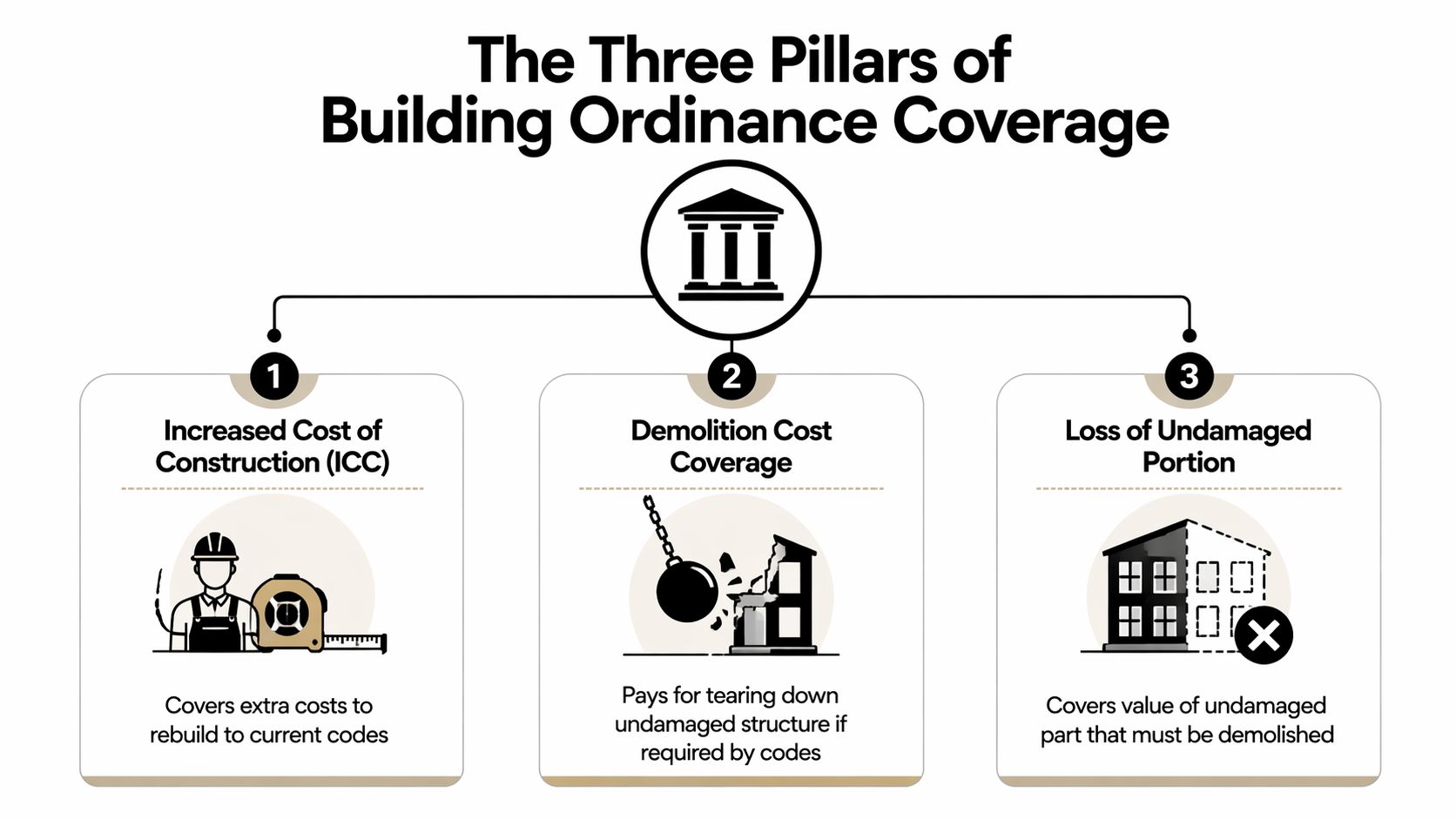
Building ordinance or law coverage works as three separate protections. That distinction matters because a code-triggered claim usually creates three different bills, not one.
A California homeowner often sees this after a wildfire claim, a shake-related loss, or a major fire in an older neighborhood. Part of the house is damaged. Another part is still standing. Then the city reviews the plans and says the remaining section cannot stay as-is because the rebuild has to meet current code. In cities that update and enforce local standards aggressively, including places such as Glendale or Costa Mesa, that decision can change the economics of the claim fast.
The easiest way to understand the coverage is to match each part to the bill it is meant to pay.
Coverage A for the undamaged part you still lose
Coverage A addresses the loss of the undamaged portion of the building.
This is the part that confuses homeowners most. A room, wall, roof section, or structural component may survive the covered loss, but the local building department may still require removal so the home can be rebuilt as one compliant structure. In plain English, you are losing part of the house that the fire, smoke, or other covered event did not destroy directly.
That is a real property loss. Coverage A is designed for that loss.
A practical example helps. If a hillside home in California suffers major damage on one side and the city requires the remaining connected structure to come down so the rebuilt home meets current structural or safety rules, Coverage A is the part that can respond to the value of what had been left standing.
Coverage B for demolition and debris removal
Coverage B pays for demolition cost and debris removal tied to the undamaged portion that must be torn down because of code enforcement.
Homeowners sometimes assume teardown is automatically folded into every claim payment. Often, the direct physical damage portion is. The added cost to demolish code-ordered undamaged sections is the separate problem.
That expense can be larger than people expect. In IRMI’s explanation of ordinance or law coverage, demolition costs are described as typically running at least $7 to $15 per square foot, and the same article notes that in some code-driven scenarios a building that is 50% destroyed may require a minimum of 30% of the building’s value in Coverage C.
For a larger California home, demolition alone can become a major out-of-pocket cost before a single board is replaced.
Coverage C for the cost of rebuilding to today’s code
Coverage C pays the increased cost of construction required to rebuild to current code.
This is often the largest exposure, especially in California. A repair that looks straightforward on paper can expand once current rules are applied to roofing, shear walls, foundation anchoring, electrical systems, plumbing, energy efficiency, fire resistance, or accessibility features required by the local authority. After wildfire losses, for example, code upgrades may involve ignition-resistant materials or other local requirements. After earthquake-related damage, structural retrofit requirements may change the scope again.
Coverage C is the money that addresses that difference between rebuilding what used to exist and rebuilding what the city will now approve.
How the three parts fit together
Homeowners usually understand this faster when they see the three parts side by side:
| Coverage part | What it addresses | Real-world problem |
|---|---|---|
| Coverage A | Value of the undamaged portion that must be removed | Part of the home survived, but code requires it to be taken out |
| Coverage B | Demolition and debris removal for that required teardown | You have to pay crews to remove more than the direct damage |
| Coverage C | Increased cost to rebuild to current code | The approved rebuild now requires newer materials, systems, or structural work |
If you review your declarations page or endorsement forms and run into unfamiliar terms, this California insurance glossary can help clarify the language.
Where homeowners get tripped up
Three misunderstandings show up again and again in California claims:
- “My dwelling coverage already handles this.” Dwelling coverage may pay to repair covered damage. It may not fully pay the extra cost created by ordinance or law requirements.
- “This only matters for very old houses.” Older homes usually face greater code-upgrade risk, but newer homes can still run into changed local requirements after a serious loss.
- “If part of the home must come down, the policy will just pay for it.” Only the policy language can answer that. The three pillars exist because each addresses a different financial hit.
That is the key point. Building ordinance or law coverage is not a single checkbox. It is a set of protections for three separate expenses that can appear in the same California claim.
Why This Coverage is Non-Negotiable in California
A Glendale homeowner gets smoke and fire damage on one side of the house after a wildfire. At first, the loss looks repairable. Then the city requires parts of the undamaged structure to be rebuilt to current standards before permits will be approved. The insurance claim has not changed. The rebuild obligation has.

That is why this coverage matters so much in California. The risk is not just the fire, quake, or other covered loss. The second risk is what your local building department requires after the loss.
California losses often trigger California code
In many states, a partial loss stays closer to a partial repair. In California, a serious claim can act more like opening a wall during a kitchen remodel and discovering old wiring, plumbing issues, and structural work that now must be corrected before the job can continue.
That problem shows up more often here because California combines older homes, catastrophe exposure, and active local enforcement. In a single California-focused overview, Hippo reports that 40% of homes were built before 1980, that some jurisdictions can require full code compliance if repairs cross a major value threshold, and that code-driven upgrades for electrical, plumbing, and wildfire mitigation can add $50 to $150 per square foot (Hippo’s building ordinance or law coverage overview).
For a homeowner, that means a claim can split into two bills. One bill restores damaged property. The other pays for bringing the home up to current code. Ordinance or law coverage is what addresses that second bill.
Wildfire and earthquake make the gap wider
California homeowners already know the headline risks. Wildfire can lead to requirements for fire-resistant materials, venting, defensible-space related features, or other hardening work tied to local rules. Earthquake damage can expose weaknesses in cripple walls, foundations, connections, or other structural elements that building officials may require you to correct during reconstruction.
A good way to picture it is this. The covered loss starts the engine. Code enforcement adds cars to the train.
That is why generic advice often falls short. A homeowner in Costa Mesa may face a different permit and reconstruction path than a homeowner in Glendale, even if both suffered similar levels of damage. The loss matters. The local trigger matters just as much.
The financial risk is bigger than many homeowners realize
Many California policies include ordinance or law coverage, but the default amount may not match the actual exposure. That is where understanding insurance policy limits becomes practical, not academic. If your limit is too low, the uncovered portion does not disappear. It becomes your problem.
And those costs can hit savings fast.
A code-upgrade shortfall can pull money from emergency reserves, retirement planning, or funds you expected to use elsewhere. For homeowners reviewing their California home insurance options, this coverage deserves the same attention as dwelling limits and deductibles because it protects against a different kind of rebuilding bill.
Why California homeowners need a local, not generic, answer
National articles often stop at a simple percentage recommendation. California homeowners need more than that. They need to ask how wildfire exposure, earthquake vulnerability, the age of the home, and local enforcement practices interact in their city.
That is the practical difference. Ordinance or law coverage is not just an add-on for older houses. In California, it is protection against the gap between what your house was and what your city will allow you to rebuild after a major loss.
Calculating Your Ideal Coverage Limits
A Glendale homeowner loses part of the house in a wildfire. The structure coverage looks adequate at first. Then the city requires upgraded wiring, added fire-resistive materials, and other work needed to bring the repaired home up to current code. The repair bill turns into a rebuild bill, and the gap shows up fast if ordinance or law limits were set by default instead of by calculation.
That is the key question here. How much code-upgrade coverage would keep you from writing a large check after a covered loss?
Many policies start with a percentage that sounds reasonable. In California, reasonable on paper can be far too small in practice. Wildfire rebuilds, earthquake-related damage, and city-specific enforcement can all change the math. A home in Costa Mesa may face a different rebuild standard than a similar home in another city, even if both had the same original damage.
Start with the number on your declarations page, then test it
Many insurers offer ordinance or law limits in the 10% to 25% of dwelling coverage range. Progressive’s explanation of ordinance or law coverage also notes that a 30-year-old home could face code upgrade costs of 30% to 75% of its replacement value. In higher-risk California areas, that is why many homeowners need to review whether 25% to 50% of the dwelling limit is a more realistic target for Coverage C.
A simple way to picture it helps. Your dwelling limit pays to rebuild what was there. Ordinance or law coverage pays for the difference between yesterday’s house and the house your city will permit today.
A practical California framework
You do not need contractor-level knowledge to get close. You need the right inputs.
Start with replacement cost, not market value
Market value includes land, school district, and neighborhood demand. Ordinance exposure tracks the cost to rebuild the structure and meet current rules.Factor in the age of the home
Older homes usually have a wider gap between original construction and current code. That gap often shows up in electrical, plumbing, roofing, foundations, windows, and fire-resistance requirements.Ask about local code triggers
Some cities are more likely to require broader upgrades once damage passes a certain threshold. In California, local practice matters. A partial loss can trigger requirements that feel much larger than the damaged area itself.Stress-test for wildfire and earthquake scenarios
Fire losses can bring stricter material and defensible-space related rebuild expectations. Earthquake damage can raise structural upgrade issues, especially for older homes or homes with known weaknesses.Review Coverages A, B, and C separately
Homeowners often focus on Coverage C because code-required upgrades can be expensive, but demolition and the value of undamaged portions can create their own gap. Ask for each bucket to be shown clearly.
If you want a broader outside primer before your quote review, understanding insurance policy limits can help you frame the discussion.
A simple decision table
| Home profile | Coverage concern | Conversation to have |
|---|---|---|
| Recently built home | Codes may still have changed since construction, especially in fire-prone areas | Ask whether current local requirements justify more than the default endorsement |
| Mid-age home | Partial code mismatch in systems and materials | Review likely upgrade costs for electrical, plumbing, roof, windows, and structural elements |
| Older home | Highest chance of a large code gap after a major loss | Test whether Coverage C should be set toward the higher end based on local enforcement and rebuild risk |
For homeowners comparing endorsements and base policies together, it helps to review how ordinance limits fit inside a broader California homeowners insurance strategy.
What to ask your agent to calculate
Ask for a real estimate, not a generic percentage.
- What would local code upgrades likely cost if my home had a major partial loss?
- What percentage of my replacement cost does that estimate represent?
- How would the answer change after wildfire damage? After earthquake damage?
- Does my city commonly require broader upgrades once repairs cross a threshold?
- Are Coverages A, B, and C each high enough, or is one of them the weak point?
- If the policy involves the Fair Plan, where exactly is ordinance or law coverage being provided?
A good quote review should feel less like picking a number and more like building a financial buffer around a known California risk.
Policy Endorsements and the California Fair Plan
A Glendale homeowner can do everything right after a fire. Report the loss promptly. Hire a contractor. Start plans to rebuild. Then the city requires upgraded vents, tempered glass, electrical work, or a different roof assembly because the repair crosses a code threshold. The insurance shock often starts there, because the policy may pay for the damaged house but not fully pay for the code-driven rebuild bill.
That is why ordinance or law coverage has to be checked in the endorsement, not assumed from the policy name.
The declarations page may show a line for this coverage, but the actual answer usually sits in the endorsement wording, the sub-limits, and whether the policy package is split between more than one carrier. In California, that split matters more than many homeowners realize. A home in Costa Mesa may face local code updates tied to remodeling and coastal requirements. A home in a wildfire corridor may face stricter rebuild standards after a fire loss. Earthquake damage can create the same problem if covered repairs trigger current structural rules.
Why the endorsement matters
The gap can be severe. Amwins notes that compliance with ordinances after a loss can add 50% or more to a claim’s total cost. Amwins also notes that standard policies often cap this coverage at 10% of the dwelling limit.
A simple way to picture it. If your Coverage A limit is $800,000 and ordinance or law is capped at 10%, you may have only $80,000 for demolition of undamaged portions, debris tied to code enforcement, and required upgrades. In many California rebuilds, especially after wildfire or major structural damage, that amount can disappear fast.
What this coverage usually does, and what it does not do
Ordinance or law coverage works like a second bucket of money that responds to code enforcement after a covered loss. It does not turn an uncovered problem into a covered claim.
If the house has old wiring and no covered loss occurs, this endorsement generally does not pay to bring the home up to code. If a covered fire damages part of the house and the city requires broader electrical upgrades during repairs, that is the kind of situation this coverage is built for.
Focus on three checkpoints:
- There has to be a covered loss. The endorsement usually follows the main claim.
- A code authority has to require the added work. Contractor preference alone is not enough.
- The endorsement limit still controls payment. Good wording with a low cap can still leave a large bill in your lap.
Homeowners who want a plain-English breakdown of how these pieces fit together can review our California insurance FAQ for policy endorsement questions.
The Fair Plan issue
California gets more complicated than generic insurance articles suggest. In high-wildfire areas, the California FAIR Plan is often part of the solution, not the whole solution. Many homeowners pair a FAIR Plan fire policy with a separate Difference in Conditions policy or other supplemental coverage.
That setup can work. It can also create confusion if no one maps out where ordinance or law coverage sits.
One policy may cover the direct fire damage. Another may handle liability, theft, or water losses. Ordinance or law coverage may appear in one place, be limited in another, or be missing entirely. A homeowner often finds the gap only after the adjuster, contractor, and building department start assigning costs to demolition, code upgrades, and undamaged portions that must be rebuilt.
Get it in writing. Ask which policy provides the coverage, which part of the endorsement applies, and what dollar limit is available for each type of ordinance expense.
That review matters even more if you are already reading guides on navigating home insurance claims. A claim is hard enough without discovering that your coverage was split in a way you never saw.
For a California homeowner insured through a FAIR Plan arrangement, the safest assumption is that nothing should be presumed. Verify the endorsement. Verify the limit. Verify which carrier will respond. That small policy review can prevent a six-figure surprise during rebuild.
How to File a Claim and Navigate the Process
After a major loss, ordinance-related claims move slower than homeowners expect. That’s because you’re not dealing only with the insurer. You’re also dealing with the local building department, permit requirements, and contractor estimates for code upgrades.

The smoother you document the process, the easier it is to show which costs came from the covered damage and which costs came from code enforcement.
Your first job is paper control
Right after the loss, save everything. Not just photos of the damage. Save every notice, inspection comment, permit requirement, and rebuild directive from the city or county.
Create one folder for:
- Loss evidence: Photos, videos, claim number, adjuster contact details
- Official notices: Red tags, correction notices, plan review comments, permit requirements
- Contractor pricing: Separate estimates for direct damage, demolition, and code-required upgrades
- Communication log: Dates, names, and summaries of every conversation
Get the contractor and adjuster speaking the same language
In many claims, complications arise during the estimation process. The contractor prepares a rebuild number. The adjuster asks what portion is direct damage and what portion is ordinance-driven. If the estimate isn’t broken out clearly, delays follow.
Ask the contractor to separate costs into categories. That makes it easier for the insurer to evaluate Coverage A, B, and C issues if those parts exist in your policy.
For homeowners who want an additional plain-English overview of the broader claims workflow, this guide on navigating home insurance claims is useful background reading.
Expect reimbursement questions
Some ordinance-related costs may be paid after the work is documented or incurred, depending on the policy wording and claim handling. That can catch homeowners off guard.
Keep copies of signed contracts, paid invoices, permit fees, and revised plans. In ordinance claims, documentation often decides how smoothly reimbursement goes.
If you need quick answers on common policy and claim concerns, a practical starting point is this California insurance FAQ page.
The sequence that usually works best
- Report the loss immediately
- Ask whether building ordinance or law coverage applies
- Request a copy of all endorsements and sub-limits
- Get written code requirements from the building department
- Obtain itemized contractor estimates
- Send updated documents promptly as requirements change
That rhythm keeps the claim organized and reduces the chance that code-required costs get buried inside a generic rebuild estimate.
Key Questions to Ask Your Insurance Agent Today
A good policy review is less about “Do I have this coverage?” and more about “How exactly does it work on my house?” Those are different questions.
Here are the questions that tend to uncover gaps.
Ask about limits, not just presence
If an agent says you have building ordinance or law coverage, keep going.
Ask:
- What are the exact limits for Coverage A, Coverage B, and Coverage C?
- Are those limits separate or shared?
- Is the amount built in, or did you add an endorsement?
- Would those limits still make sense for my home’s age and location?
A yes-or-no answer isn’t enough. You want numbers on the declarations page and wording in the endorsement.
Ask how your policy handles a partial loss
This is the question that reveals whether the agent understands California rebuild risk.
Try this: “If my home is only partly damaged, but the city requires me to tear down more of it and rebuild to current code, what part of my policy pays for each step?”
That question forces a practical explanation. It separates knowledgeable guidance from generic reassurance.
Ask about newer homes too
Many people think this coverage is only for older houses. That’s too narrow. Even newer construction can run into changed code, revised local standards, or project-specific rebuild requirements after a loss.
So ask:
- Do I still need this if my home is relatively new?
- What code changes since construction could matter in my area?
- Would a rebuild after wildfire or earthquake trigger anything beyond straight replacement?
Ask how this fits with your entire insurance plan
Homeowners should think in layers. If a big uncovered property bill would force you to liquidate savings, carry debt, or reduce other protection, then this decision affects more than the house.
That’s why it’s worth asking your agent to review your broader setup, including home insurance, car insurance, renters insurance for family members who lease, and life insurance if your household depends on one or two incomes. The goal is coordinated protection, not isolated policies that leave gaps.
“Show me how this policy responds if the building department gets involved” is one of the smartest questions a homeowner can ask.
Ask directly about Fair Plan structure
If any part of your home coverage involves the California Fair Plan, ask these questions in writing:
- Where is building ordinance or law coverage located, if anywhere?
- Is there a companion policy filling the gap?
- Who handles the claim if code upgrades are required?
- Are there exclusions or sub-limits I should know now, not after the loss?
That last question is the one many wish they had asked sooner.
Protect Your Home Properly with Mai & Associates
A serious California property loss doesn’t end when the flames are out or the damage is inspected. For many homeowners, a significant financial shock starts when current building code enters the conversation. If your policy doesn’t address that risk clearly, you could face major out-of-pocket costs at the worst possible time.
Mai & Associates helps Californians review coverage with that reality in mind. The agency provides quotes and policy reviews for home insurance, auto insurance, car insurance, renters insurance, and life insurance, with support designed for California risks such as wildfire exposure, Fair Plan gaps, and earthquake-related concerns. If you want a clearer picture of how your current policy handles ordinance issues, request a California insurance quote and policy review.
If you want a second set of eyes on your current coverage, Mai & Associates can review your home, auto, renters, and life insurance policies and help you spot gaps before a claim exposes them. With offices in Glendale, Westlake Village, Escondido, and Costa Mesa, the team works with Californians across the state to compare options and build protection that fits real-world rebuilding risk.