Your Guide to a California Builders Risk Policy
A builders risk policy is a special kind of temporary insurance designed to protect a building while it's being built or renovated. Unlike a standard home insurance in California policy that covers a finished house, this coverage protects your financial investment from the moment you break ground until the last nail is hammered in.
Your Project's First Line of Defense
Imagine you’re finally building your dream home in California or starting that major kitchen expansion you’ve saved up for. A builders risk policy is your financial safety net during this "course of construction." Think of it as a temporary shield that protects not just the rising structure, but also all the valuable materials sitting on-site, waiting to be installed.
It’s a unique kind of coverage that often gets confused with other policies. For example, your contractor’s general liability insurance is there to pay for damages they might cause to other people’s property—it’s not designed to protect your project from things like fire, theft, or a windstorm. And your regular California home insurance or renters insurance just won't cover a building that isn't finished and livable yet.
A builders risk policy fills a critical gap. It covers the structure and materials on-site during their most vulnerable phase—the construction period. It’s what stands between you and a potentially devastating financial loss from an unexpected event.
Who Needs This Coverage?
This isn't just for big commercial developers. If you have a financial interest in a project, you likely need a policy. I see all sorts of people get this coverage:
- Homeowners building a custom home or doing a major remodel that involves structural changes.
- General Contractors who are ultimately responsible for the project from start to finish.
- Property Flippers who buy, renovate, and sell homes for a living.
- Business Owners who are constructing a new office, warehouse, or retail space.
A good builders risk policy protects you right from the beginning. It covers the project through every phase, from learning the essential excavation steps for a solid foundation all the way to installing the final fixtures.
At the end of the day, anyone with money tied up in the project—the property owner, the bank lending the money, even the contractor—has a vested interest in making sure a builders risk policy is in place. It's the core insurance that secures the project itself, much like how California auto insurance protects your vehicle or life insurance protects your family's financial future. If you're new to these terms, our insurance glossary can help clear things up. Without it, you’re essentially leaving the entire value of your project exposed to risk, day in and day out.
Understanding Your Policy's Core Coverage
So, what exactly does a builder's risk policy do? Think of it as a specialized safety net for your construction project. Just like your California car insurance protects your vehicle from specific incidents, a builder's risk policy is designed to cover your project against certain events, which we in the insurance world call covered perils.
This coverage is all about protecting the physical stuff on your job site. That means the structure itself as it goes up, the materials you have stockpiled waiting to be installed, and even the on-site equipment that makes the work happen.
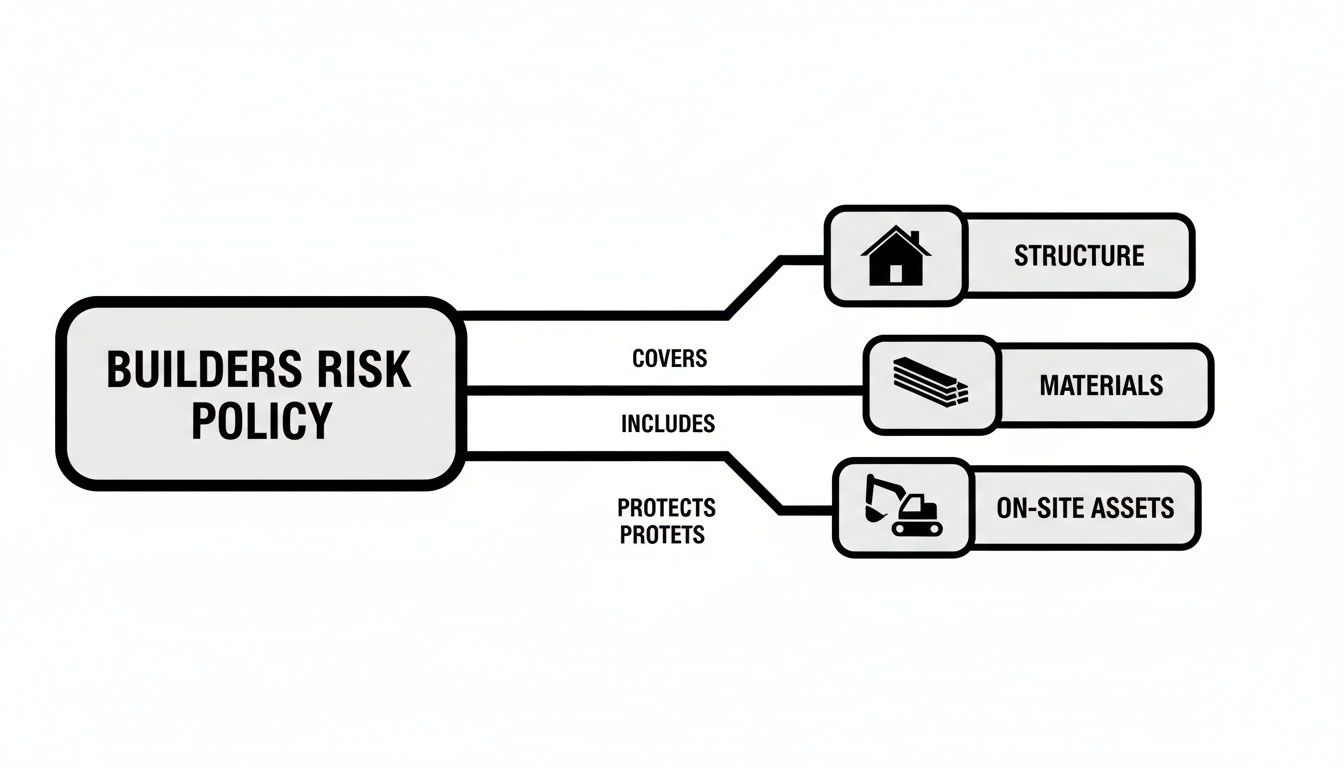
As you can see, the protection extends far beyond just the wooden frame of a building. It's about safeguarding all the valuable assets that are essential to completing the project.
What's Typically Covered vs. Excluded?
Most builder's risk policies are written on an "all-risk" basis. That’s a bit of a misleading term, though. It doesn't mean everything is covered. It means that anything is covered unless the policy specifically says it isn't. This gives you a broad layer of protection right from the start.
To make this crystal clear, let's break down what's usually included versus what almost always requires special attention.
Builders Risk Coverage At a Glance
| Typically Covered Perils | Commonly Excluded Perils |
|---|---|
| Fire (accidental, non-arson) | Earthquake & Flood (require separate coverage) |
| Theft of building materials | Faulty Workmanship (costs to redo bad work) |
| Vandalism & malicious mischief | Employee Theft (theft by your own team) |
| Wind, Hail, & Lightning damage | Normal Wear & Tear (gradual deterioration) |
| Explosions | Mechanical Breakdown of equipment |
| Damage from Vehicles or Aircraft | War & Terrorism |
This table gives you a good starting point, but always remember that every policy is different. The details are buried in the policy language, which is why reading it—or having an expert read it with you—is so important.
So, what does this look like in the real world?
- Fire: Imagine temporary wiring on a Los Angeles job site sparks a fire, destroying half the framing overnight. That's a covered loss.
- Theft: Your crew shows up to a San Diego site on Monday morning to find thousands of dollars in lumber vanished. A builder's risk policy is built for this.
- Vandalism: Someone breaks onto your site over the weekend and smashes newly installed windows and damages drywall. This is exactly what vandalism coverage is for.
On the flip side, it's just as crucial to know what isn't covered. These are your blind spots. For instance, the policy won't pay to fix a poorly built foundation—that's a workmanship issue. And in California, the big ones like earthquakes and floods are almost always excluded and need to be added on separately.
Understanding this balance is the first step to making sure you don't have any expensive surprises. While a builder's risk policy is unique, some of its principles overlap with what you might find in standard home insurance in California, which also has specific perils and exclusions. Working with an agent helps you spot these gaps and plug them before they can cause a problem.
Decoding the Key Parts of Your Policy
A builder's risk policy can seem packed with jargon, but think of it as the financial blueprint for your project. Just like your architectural plans, every line item matters and defines the strength of your final structure. Getting these details right from the start is what separates a minor hiccup from a project-ending disaster.
Let's walk through the core components you’ll find in every policy. Nailing these down ensures the protection you're paying for is the protection you'll actually get if something goes wrong.
Your policy isn't just a piece of paper; it's the financial scaffolding that keeps your project from collapsing when things go wrong. Understanding its parts gives you control.
Setting Your Coverage Limits
First up is the coverage limit. This is the absolute maximum amount your insurance company will pay out for a single covered loss. It's not a number to guess at.
Here’s the most common—and costly—mistake we see: setting the limit to the project's current cost or the loan amount. Instead, your limit must match the total completed value of the project. That includes all labor, materials, overhead, and even your expected profit.
Imagine a fire destroys a $1 million project when it's only half-built. If you only insured it for $500,000, you’re facing a massive shortfall. The payout won't be nearly enough to get the project back on track. Always insure for the final sticker price.
Understanding the Policy Term
The policy term is simply the length of time your coverage is active. Ideally, this perfectly aligns with your construction schedule, from groundbreaking to final walkthrough. But in the real world, projects hit snags. Supply chain delays, bad weather, or subcontractor issues can easily push your timeline back.
A standard policy might run for 12 months, but what happens if your project is going to take 14? You can't afford a gap.
Stay on top of your project timeline. If it looks like you’re going to run past your policy's expiration date, you need to contact your agent and arrange for a policy extension before it lapses. Even one day without coverage leaves your entire investment dangerously exposed.
Your Role in a Claim: The Deductible
The deductible is your contribution to a claim. It's the amount you have to pay out-of-pocket before the insurance company steps in to cover the rest.
For example, if you have a $5,000 deductible and suffer a $50,000 covered loss from theft, you'll pay the first $5,000. Your insurer then covers the remaining $45,000. Opting for a higher deductible can definitely lower your premium—much like with California car insurance—but make sure it’s an amount you can comfortably write a check for on a bad day.
Customizing Your Protection With Endorsements
No two projects are identical, and that's where endorsements come in. Think of them as add-ons or riders that plug specific gaps in a standard policy, tailoring it to the unique risks of your job site.
They are powerful tools for building a truly comprehensive safety net. Some of the most common and critical endorsements include:
- Debris Removal: Covers the often-surprisingly high cost of clearing a site after a fire, collapse, or major storm.
- Soft Costs: This is a big one. It protects you from the indirect financial bleeding caused by a delay, like additional loan interest, architectural fees, or permitting costs.
- Earthquake Coverage: Don't assume you have it. In California, coverage for earthquakes and earth movement is almost always excluded and must be added as an endorsement.
By strategically adding endorsements, you can transform a generic policy into one that’s custom-built for your project’s specific needs.
How Much Does Builders Risk Insurance Cost in California?
Let's get straight to the point: what will a builder's risk policy actually cost you? While there's no single price tag, a good rule of thumb is to budget between 1% and 5% of your total construction cost for the insurance premium.
For a small bathroom remodel, that might just be a few hundred dollars. For a ground-up custom home in an expensive zip code, you could be looking at several thousand. The final number all comes down to the specific risks of your project. It's a lot like California car insurance—a sports car garaged in a high-crime area will cost more to insure than a sedan in a quiet suburb.
Key Factors That Shape Your Premium
Insurance carriers don't just pick a number out of a hat. They're underwriters, which is a fancy way of saying they are professional risk assessors. They look at your project from every angle to figure out the likelihood of something going wrong.
Here are the main things they’ll zero in on:
- Project Budget: This is the big one. The higher the total value of the finished project, the more the insurer has on the line if a disaster strikes. That exposure is directly reflected in your premium.
- Location: Building in a crowded city center brings different risks (like theft) than a remote, rural site with slower emergency response times. And in California, location is everything.
- Construction Type: A classic wood-frame structure is viewed as a higher fire risk than a building made of steel or concrete. That difference will show up in the cost.
- Project Scope: There's a world of difference between a simple cosmetic update and a major renovation that involves digging a new foundation. The more complex the job, the more opportunities there are for things to go sideways.
As a starting point, remember that insurance costs typically fall somewhere between 1% and 5% of your total construction budget. But this is just an estimate. The only way to know for sure is to get a quote based on your specific plans.
California-Specific Cost Considerations
Building in the Golden State brings a unique set of challenges that insurers have to price in. If your project is in a high-risk wildfire zone or an area known for seismic activity, you can expect to pay a higher premium. It’s a simple reflection of the heightened risk, similar to how location impacts home insurance rates.
But there's some good news for California builders and property owners. The insurance market for construction projects has been "softening" lately. What does that mean for you? Increased competition among insurance companies is pushing rates down and making coverage easier to find. Even for projects in tricky locations, you have more power to shop around and land a competitive price. To get a better sense of the market, you can check out this report on global construction insurance trends. It's a welcome shift that's making this essential protection more affordable.
Navigating California's Unique Construction Risks
Let's be honest: building in the Golden State is a different ballgame. Your project isn't just up against typical construction delays or material theft. Here, you're facing a unique playbook of challenges, from seasonal wildfires to the ever-present threat of an earthquake. A standard, off-the-shelf builders risk policy just won't cut it.
Protecting your investment in California means getting smart about these local risks. It’s no surprise that the builders risk market is growing, as more people realize how essential this coverage is for seeing a project through to completion. The key is to manage these potential disasters proactively, often using formal risk assessment methods to spot trouble before it starts.
Confronting the Wildfire Threat
For anyone building in a high-risk wildfire zone, getting insured can feel like an uphill battle. Insurers are understandably wary, but you can absolutely improve your chances—and even secure better rates—by proving you're taking the threat seriously.
Think of it from the carrier's perspective. They want to see you're a responsible partner. Here's how you can show them:
- Create Defensible Space: This is non-negotiable. Get aggressive about clearing brush, dry grass, and any other flammable vegetation far away from your job site.
- Use Fire-Resistant Materials: When possible, choose materials that give your project a fighting chance, like metal roofing, fiber-cement siding, and tempered glass. This choice speaks volumes to an underwriter.
- Document Everything: Don't just do the work; prove it. A written wildfire mitigation plan that you can hand to your agent is a powerful tool.
The Inevitable Need for Earthquake Coverage
Here’s a hard truth: a standard builders risk policy almost never covers damage from earthquakes or earth movement. In a state practically defined by its seismic activity, treating this coverage as an optional extra is a gamble you can't afford to take.
An earthquake endorsement is the specific add-on that closes this massive, and frankly terrifying, gap in your coverage. Without it, a single tremor could financially flatten your entire project, leaving you with nothing.
This isn't just another line item. It's a foundational piece of your risk management plan in California. Just as you wouldn't drive a car without the right California auto insurance, you shouldn't build a structure here without earthquake coverage.
The Hidden Cost of Building Code Updates
Imagine this scenario: a fire damages 60% of your nearly finished commercial building. Your policy covers the repairs to the damaged section, which is great. But in the months since you broke ground, the city has adopted much stricter building codes for electrical and plumbing.
Now, you're on the hook to upgrade the undamaged 40% of the building to meet these new rules—an expense your basic policy won't touch. This is exactly where Ordinance or Law coverage saves the day.
This critical endorsement helps pay for the costly, mandatory upgrades to the undamaged portions of your structure. In a state like California where regulations are always evolving, it prevents a partial loss from snowballing into a complete financial disaster. To learn more about managing all your California insurance needs, from auto and home insurance to renters and life insurance, you can always check out our guide section.
Get Your California Builders Risk Policy Today

Ready to lock in the protection your project needs? Getting a builders risk policy in California is refreshingly straightforward. With the right details handy, you can get from application to a fully-insured project, sometimes in a single business day.
The first step is simply pulling together the key information about your build. Think of it like a pre-flight checklist for your project's financial security. The more organized you are, the faster and more accurate your quote will be.
What You'll Need for a Quick Quote
To find the best possible coverage at a competitive rate, we need a clear picture of what we're insuring. It helps us match you with the right carriers who understand your specific type of project.
Before reaching out, try to have these details on hand:
- Project Budget: This is the total estimated cost to complete the project, factoring in all materials, labor, and even your anticipated profit.
- Construction Timeline: We’ll need the projected start date and the expected date of completion.
- Site Address: The physical location is crucial. It allows us to assess location-specific risks, like proximity to wildfire zones or areas with higher rates of theft.
- Contractor Information: Details about your general contractor, including their license number and track record, help carriers gauge the project's risk profile.
Securing a policy isn’t just a formality; it's an active partnership to shield your investment. With a little prep work, getting covered is simple and fast.
Our Same-Day Quote Process: How It Works
We believe in making things easy. Once you have your project details ready, our process is built for speed and clarity. Our expert agents can help you compare builders risk policy quotes from multiple top-rated California carriers on the very same day.
Here's a quick look at how we get it done:
- Initial Consultation: We’ll start with a quick chat to go over your project details, understand your timeline, and identify any unique risks.
- Market Comparison: We immediately take your project to our network of A-rated insurers, shopping for the best fit in both coverage and price.
- Personalized Guidance: We don't just send you numbers. We walk you through your options, explain what they mean, and help you understand any endorsements you might need. You’ll know exactly what you’re buying.
Don’t leave your investment exposed for a single day. To protect your project from groundbreaking to final handover, you can request a fast, free insurance quote online or give us a call. Our team is ready to help.
Common Questions We Hear About Builders Risk Insurance
Even the most buttoned-up construction plan has its share of "what-ifs." When it comes to insurance, those what-ifs can feel overwhelming. Let's clear up a few of the most common questions we get from California clients about their builders risk policy.
Do I Need This for a Home Renovation?
Absolutely. A builders risk policy isn't just for giant, ground-up projects. In fact, it's critical for major home renovations. Think about projects that involve structural work—like adding a second story, blowing out a wall for an open-concept kitchen, or a complete bathroom gut.
Your standard California home insurance policy often has clauses that exclude coverage for the structure while it's under active construction. This creates a massive gap, leaving your biggest asset vulnerable right when it's most exposed. This is different from renters insurance, which covers your personal belongings, not the structure itself.
What If My Project Gets Delayed?
Construction delays happen. It's almost a rule of thumb. The one thing you can't let happen, though, is letting your insurance coverage run out.
If you see your timeline stretching beyond the policy's original end date, you need to call your agent immediately to file for a policy extension. Don't wait. If your coverage lapses for even one day, you’re flying without a net, and any loss during that time will come straight out of your pocket.
Key Takeaway: Think of builders risk as a specialized shield for your project during construction. It’s not the same as liability or standard property insurance—each policy has a very specific job to do, and you need the right tool for this phase of the work.
Will My Lender Require Builders Risk Insurance?
It's extremely likely. If you've taken out a construction loan to finance the project, your lender will almost certainly demand a builders risk policy. They have a huge financial stake in your build, and they need to know their investment is protected from physical damage until the job is done.
How Is This Different From My Contractor’s Liability Insurance?
This is probably the most important distinction to understand. The two policies cover completely different things and protect different parties.
Your contractor's general liability insurance is there to pay for damages they cause to other people or their property. For example, if their crew accidentally damages your neighbor's fence, their liability policy should cover it.
A builders risk policy, on the other hand, protects your property. It covers the actual structure and the materials on-site from things like fire, theft, or a windstorm—no matter whose fault it is. One protects against causing harm, the other protects your stuff from being harmed.
At Mai & Associates, our job is to make getting the right protection feel simple. Whether you're breaking ground on a new build or starting a major renovation, we can help you secure the right builders risk coverage. We also specialize in California auto insurance, home insurance, renters insurance, car insurance, and life insurance, offering expert advice and competitive quotes from the state's best carriers. Protect what you're building by visiting us at https://cahomeauto.com for a fast, no-obligation quote today.