Your Guide to Best Life Insurance for Young Adults
California is one of the most expensive places in the country to be young and underinsured.
If you are in your 20s or early 30s, life insurance can look easy to postpone. Rent is high. Student loan payments may still be following you. Saving for a home in Los Angeles, San Diego, or the Bay Area can feel harder than running a treadmill that keeps speeding up. In that kind of budget squeeze, it is reasonable to ask whether life insurance belongs on the list at all.
For many young Californians, the better question is how to buy the right amount without squeezing out other priorities.
Life insurance is not only for married couples with children. It can help cover private student loans with a co-signer, funeral and final expenses, shared bills with a partner, or money your family would need to sort out your affairs. In California, that conversation also sits next to real-world pressures that generic guides often miss, including high living costs, heavy debt loads, and the way wildfire risk can raise housing and insurance stress across a household budget.
A simple way to frame it is this. Term life works a lot like renting protection for a set number of years. You pay for coverage during the period when other people would be hit hardest financially if you died. For many young adults, that practical approach fits better than paying extra for features they may not need yet.
The best life insurance for young adults in California usually balances three things at once: enough coverage to protect the people tied to your finances, a payment that still leaves room for your emergency fund, and a policy structure that makes sense for where you are now rather than where you might be 20 years from now.
Why Life Insurance Is a Smart Financial Move in Your 20s
Young adults usually get the lowest life insurance prices they will ever see. That matters more in California, where rent, car costs, student debt, and family support can all compete for the same paycheck.
The common question is still fair. “I’m young and healthy. Why buy life insurance now?”
Because your 20s are often the easiest years to qualify.
Insurers price coverage partly on health and age. If you apply while your record is simple and your health is strong, you usually have more options and lower premiums. Waiting can make the same coverage harder to get if your health changes, you start smoking, or your prescription history becomes more complicated.

You are buying protection while it is cheap and simple
A good comparison is car insurance. You do not buy it because you expect to crash on the way home. You buy it because one bad event can create a bill you would not want other people to carry.
Life insurance works the same way. It creates a pool of money for the people who would have to deal with the financial mess you leave behind.
For a young Californian, that can include:
- Private student loans with a co-signer, especially if a parent helped you qualify
- Shared rent or bills with a partner or roommate who counts on your part of the payment
- Funeral costs and final expenses that family members would otherwise have to cover quickly
- Income support for parents, siblings, or a partner if you help them even informally
- Lease, car loan, or credit obligations that do not disappear just because someone dies
If you are new to insurance terms, a quick life insurance glossary for common policy language can help you read quotes without guessing.
Your future health is part of the decision
Many people focus only on price. Approval matters too.
At 25, applying for coverage can feel like locking in a favorable membership rate before the gym changes its pricing rules. You are getting access based on who you are now, not who you might be at 35 after a diagnosis, higher weight, anxiety medication, or a smoking habit changes the insurer's view of risk.
That is why buying early can be practical even if no one depends on you full time today.
California changes the math
Generic life insurance advice often assumes a lower-cost life. California rarely gives you that.
If you live in Los Angeles, Orange County, San Diego, or the Bay Area, your share of household expenses may be large even in your 20s. A sudden death can leave parents, a partner, or siblings trying to cover rent, move-out costs, travel, debt paperwork, and final bills in one of the most expensive states in the country. If your household is already stretched by high housing costs or student debt, there is less room for surprises.
Environmental risk adds another layer. Wildfires may not change life insurance pricing the way they affect home insurance, but they can strain a household budget by raising housing costs, forcing moves, and increasing overall financial pressure. In that setting, even a modest life insurance policy can act like a financial buffer when everything else feels expensive.
Start with the job the policy needs to do
You do not need a complicated policy to make a smart decision in your 20s.
For many young adults, the first goal is simple. Cover the people who would be financially affected if you died, and keep the premium low enough that you can still build savings. If you want a clearer breakdown of whole life vs term life, focus on how long you need coverage and whether you want to pay extra for permanent features now.
A practical rule is easy to remember. Buy coverage when qualifying is easier, your health is on your side, and the monthly cost still fits comfortably inside your California budget.
Decoding the Main Types of Life Insurance Policies
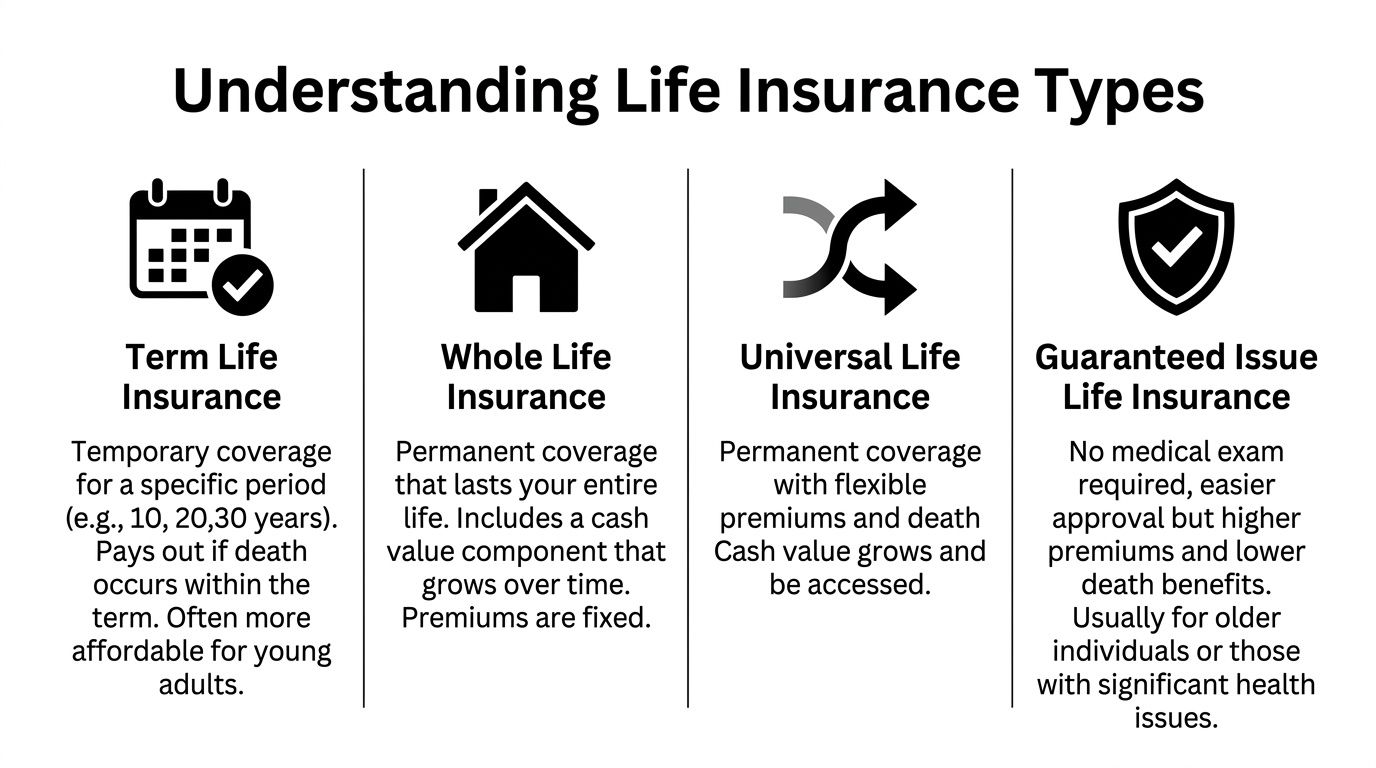
If life insurance feels confusing, it’s usually because four very different products get discussed as if they’re interchangeable. They’re not.
The easiest way to understand them is this: term life is like renting, and whole life is like owning. Renting is simpler and usually costs less upfront. Owning is more permanent, more complex, and usually more expensive.
Term life insurance
Term life covers you for a set period, such as 10, 20, or 30 years. If you die during that term, the policy pays a death benefit to your beneficiary. If the term ends and you’re still alive, the coverage ends unless you renew or replace it.
For most young adults, this is the most practical place to start because it’s focused and affordable. MoneyGeek’s 2026 analysis of term life insurance for young adults found rates under $20 per month for healthy non-smokers. In that analysis, Nationwide offered a $500,000 20-year term policy for young men at $13 per month, and MassMutual offered the same setup for young women at $16 per month.
That’s pure protection. No investment features. No cash value. Just coverage.
Whole life insurance
Whole life is permanent insurance. As long as you keep paying premiums, the policy stays in force for your lifetime. It also builds cash value, which is one reason premiums are much higher than term life.
Whole life can make sense for some people, but many young adults hear “it builds cash value” and assume that automatically makes it better. It doesn’t. It makes it different.
If term life is like renting an apartment, whole life is like buying a home. Buying may be valuable in the right situation, but it requires a larger commitment and usually a larger monthly payment. If your real need is affordable protection while you build savings, pay down debt, and stabilize your career, term often fits better.
For a more detailed outside explanation of that tradeoff, this guide on whole life vs term life is a useful comparison.
Universal life insurance
Universal life is another form of permanent insurance, but it adds flexibility. Premiums and death benefits can sometimes be adjusted, depending on the policy design and how the cash value performs.
That flexibility can sound appealing. In practice, it also means more moving parts. Young buyers who want simplicity often find universal life harder to evaluate because the policy isn’t as straightforward as a plain term contract.
Guaranteed issue life insurance
Guaranteed issue policies are designed for people who may have trouble qualifying elsewhere. Approval is easier because there’s typically no medical exam, but the tradeoff is usually higher cost and more limited value.
Most healthy people in their 20s or 30s won’t need this category. It’s usually not where the best life insurance for young adults begins.
A side by side view
| Feature | Term Life ("Renting") | Whole Life ("Owning") | Universal Life ("Flexible Owning") |
|---|---|---|---|
| Coverage length | Set period | Lifetime | Lifetime |
| Cost | Usually lowest | Usually higher | Usually higher and more variable |
| Cash value | No | Yes | Yes |
| Simplicity | High | Moderate | Lower |
| Best fit for many young adults | Often yes | Sometimes | Sometimes |
Term life is often the cleanest match when your goal is to protect income, debt, or future family needs without stretching your budget.
If you run into unfamiliar insurance language while comparing policies, a plain-English insurance glossary for California buyers can help you decode terms before talking with an agent.
How to Calculate Your Ideal Coverage Amount
A lot of people ask the wrong first question. They ask, “What policy should I buy?” before they ask, “How much money would someone need if I weren’t here?”
The cleanest framework is DIME:
- Debt
- Income replacement
- Mortgage
- Education
You don’t have to use it perfectly. You just need a number that reflects your actual life.
How DIME works for a young Californian
Start with debt. Think about loans, credit card balances, or anything a family member could get stuck sorting out. Then consider income replacement. If someone depends on your paycheck, even partly, how long would they need help?
Mortgage is obvious if you own a home. If you don’t, skip it. Education can mean future college funding for kids, but for younger adults without children, this line may be zero for now.
That’s one reason blanket rules can be unhelpful. A renter in Glendale with student debt needs a different number than a homeowner in Costa Mesa with a spouse and child.
A simple example
Take a 28-year-old software engineer in Glendale.
She rents, has student loans, helps her parents with some monthly bills, and doesn’t own a home yet. Her DIME estimate might focus heavily on debt and income replacement, while mortgage and education stay low or at zero. That’s a very California-style profile. High earnings potential, high living costs, and obligations that don’t show up in generic life insurance calculators.
If you want a better handle on the bills that keep showing up every month, this breakdown of fixed expenses is helpful when estimating what your family would need covered.
Don’t forget future growth
Young adults often underinsure because they buy for today’s exact budget and ignore the fact that life usually expands. Careers grow. Rent rises. A partner moves in. Kids happen. A condo purchase becomes possible.
That doesn’t mean you need to buy the biggest policy available. It means you should choose a number you can explain. If someone asked why you picked it, you should be able to say, “It covers my debts, gives my family breathing room, and matches the life I’m building.”
A good coverage amount isn’t random. It connects to real obligations and real people.
If you want more California-focused insurance education before requesting quotes, the Mai & Associates guides page is a practical place to keep learning.
Navigating California-Specific Insurance Challenges
National life insurance advice often assumes your location doesn’t matter much. In California, it does.
The need for life insurance is shaped by the same pressures that affect your other coverage decisions. High housing costs influence how much income replacement your family would need. Car dependence makes auto insurance part of the same financial safety net. If you rent in a wildfire-prone area, renters insurance and life insurance stop being separate conversations and start becoming part of one protection plan.

Wildfire exposure can affect the application conversation
This is one of the biggest gaps in generic articles.
According to MoneyGeek’s analysis of life insurance considerations for young adults, post-2025 wildfire seasons saw a 25% rise in young applicants disclosing “smoke inhalation” concerns, and applications in high-risk zones can face higher denial rates for related pre-existing conditions. That doesn’t mean living near wildfire risk automatically blocks you from getting life insurance. It means your broader risk profile may matter more than you expect.
If you live in places where air quality events and wildfire exposure are part of real life, local context matters.
Your life policy shouldn’t sit in a silo
A strong insurance setup for a Californian often includes several moving parts:
- Car insurance because many people commute, drive frequently, and need liability protection.
- Renters insurance for apartment dwellers who want protection for belongings and loss of use.
- Home insurance if you own property and need to think about wildfire exposure.
- Life insurance to protect income, debts, and family support needs.
The smart move is to make sure these policies fit together rather than contradict each other.
High cost of living changes the math
In lower-cost areas, a smaller policy may go further. In California, the same dollar amount may cover less time, fewer bills, and less breathing room for your family.
That’s why the best life insurance for young adults in California often isn’t just the cheapest policy. It’s the policy that fits your local reality. A low premium is good. A low premium attached to an amount that fails to protect anyone isn’t as useful.
When your living costs are high, your income is carrying more weight than you may realize.
If you’re comparing options in-state, a focused California life insurance resource can help you think through location-specific issues that national articles often skip.
Underwriting Secrets for Young Applicants
Underwriting is the part of life insurance that feels mysterious until you see what insurers are doing. They’re pricing risk. That’s it.
They look at your age, health, prescription history, nicotine use, driving record, and sometimes hobbies or occupation. For young adults, the good news is that this process often works in your favor, especially if you’re healthy and organized.

Why healthy young applicants often get the best deal
Some carriers now use accelerated underwriting, which relies on data analytics to reduce or eliminate the medical exam for qualifying applicants. Policygenius explains that carriers such as Banner Life use accelerated underwriting, and that approach can let a healthy, non-smoking 25-year-old secure a 40-year term policy for 40 to 50 percent less than if they waited until age 35.
That’s a powerful reminder that underwriting isn’t just about whether you pass. It’s also about when you apply.
What you can control before applying
You can’t change your age, and you can’t rewrite your medical history. You can control preparation.
Here are the habits that help:
- Be accurate on the application. If you vape, say so. If you take medication, list it. Inconsistencies slow things down.
- Gather basic records first. Have doctor information, prescription details, and family health history ready.
- Apply before a health issue turns into a longer file. If you know you’re healthy now, don’t assume that stays static.
- Ask whether no-exam underwriting is available. Younger applicants often qualify for simpler paths.
If an exam is required
Not every applicant gets an exam waived. If you do need one, treat it like a job interview for your risk profile.
A few simple habits can make the process smoother:
- Schedule it for a calm morning if possible.
- Stay hydrated beforehand.
- Avoid unnecessary stress the day before if you can.
- Follow the examiner’s instructions carefully.
None of that guarantees a better rate. It just helps you avoid avoidable problems.
Your application doesn’t need to be perfect. It needs to be honest, complete, and timed well.
What young adults often misunderstand
Many first-time buyers think underwriting is a pass-fail test. It’s usually more nuanced than that. Plenty of people qualify, but not all qualify at the same rate class. The difference between applying when you’re healthy and waiting until life gets messier can shape what you pay for years.
That’s one reason the best life insurance for young adults often starts with getting quotes earlier than feels urgent.
Common Life Insurance Mistakes Young Adults Should Avoid
The expensive mistakes usually aren’t dramatic. They’re ordinary assumptions that go unchallenged.
Thinking your work policy is enough
Employer life insurance is useful, but it usually shouldn’t be your whole plan. Workplace coverage can change when you change jobs, lose a job, or move into a role with different benefits.
A personal policy gives you control. It stays with you, not with your employer.
Buying only on price
Price matters. It just isn’t the only thing that matters.
A policy with a low premium can still be the wrong fit if the coverage amount is too small, the term is too short, or the carrier doesn’t give you the policy features you need. Many young buyers focus so hard on the monthly number that they forget to ask what problem the policy is solving.
Naming a minor as beneficiary without a plan
If you want a child to benefit from your policy, naming the child directly can create complications. Minors generally can’t just receive and manage funds the same way an adult beneficiary can.
This is one of those details that’s easy to miss when you’re buying your first policy online in a hurry. If a child is involved, slow down and get guidance on how to structure the beneficiary choice appropriately.
Waiting until life gets more expensive
People often assume they’ll buy life insurance after marriage, after buying a house, or after having children. The trouble is that those events also tend to make budgets tighter.
Buying before those milestones can be easier because the premium has more room in your budget and your health profile may be cleaner.
Choosing the wrong term length
A cheap policy with the wrong term can still miss the target.
If your goal is to cover your working years, a very short term may expire while you still need protection. If your main concern is a future mortgage or raising kids, think about the window when people would depend on your income most.
Skipping the beneficiary review
Choosing a beneficiary isn’t a one-time task. Relationships change. So do responsibilities.
Review your policy after major life events such as marriage, divorce, a new child, or a major debt payoff.
Good life insurance is boring in the best way. It quietly matches your real life and keeps up as that life changes.
Assuming you don’t need it because you’re renting
Renters often underestimate how much financial responsibility they already carry. You may not own a house, but you may still have debts, family obligations, shared expenses, or someone who’d need time to replace your contribution.
That’s why life insurance belongs in the same conversation as renters insurance, auto insurance, and the rest of a basic financial safety plan.
Get Your Personalized Quote with Mai & Associates
Once you know what type of policy you want and roughly how much coverage makes sense, the next step should feel simple.
It usually comes down to five actions.
Start with your real-life details
Have your age, tobacco status, general health history, and target coverage amount in mind. If you’re not sure about the number, use the DIME approach from earlier and come up with a range.
A range is enough to start. You don’t need to arrive with every answer finalized.
Compare carriers instead of guessing
Different insurers can price the same person differently. That’s why comparison matters.
A multi-carrier approach is especially useful if you want term life quotes alongside your broader California insurance planning for auto insurance, home insurance, renters insurance, or car insurance. Looking at the full picture can help you avoid overcommitting to one policy while leaving another gap exposed.
Ask California-specific questions
Don’t stop at “What’s the monthly premium?”
Ask how your location, wildfire exposure, housing situation, and long-term plans might affect your options. If you rent today but plan to buy in a few years, or if you live in an area where wildfire concerns touch other policies, that context matters.
Get the quote process moving
If you’re ready to shop, the easiest step is requesting a quote through the Mai & Associates online quote page. That gives you a direct path to compare coverage options without committing on the spot.
At this point, many people realize the process is less intimidating than they expected.
Use guidance if English isn’t your only language
Insurance is full of terms that can be misunderstood even by native speakers. Clear communication matters when you’re choosing beneficiaries, reviewing term lengths, or comparing policy types.
Mai & Associates offers support in English, Spanish, Armenian, Russian, and Vietnamese, which can make the process much easier for California households that want to review details carefully before making a decision.
The best life insurance for young adults is usually not the fanciest product. It’s the one that fits your budget, protects the people who matter, and works alongside the rest of your insurance plan.
If you want help comparing life insurance with your auto, renters, or home coverage in California, Mai & Associates offers no-obligation quotes, same-day comparisons from multiple carriers, and licensed guidance designed for California risks like wildfire exposure, high living costs, and coverage gaps that national one-size-fits-all advice often misses.