Best Life Insurance for Families in California: Your Essential Guide

For many California families, the best life insurance is the one that gives them the most peace of mind for the least amount of money. Often, that’s a Term Life insurance policy. It’s a straightforward and affordable way to protect your loved ones during their most vulnerable years—when the kids are young, the mortgage is new, and your income is essential.
Securing Your Family’s Future with the Right Life Insurance
Think of life insurance as the foundation of your family's financial plan. It's not just a policy; it's a promise that your loved ones can continue living the life you've built together, no matter what happens. It’s the safety net that ensures they can handle daily bills and chase their biggest dreams, even if you're not there. A comprehensive approach to California insurance means integrating life insurance with your auto and home policies for complete protection.
For California families, that promise has to cover some very specific, and often very large, financial obligations:
- Covering the Mortgage: A policy can completely pay off the house, lifting a massive weight off your family’s shoulders.
- Replacing Lost Income: The death benefit acts as a paycheck replacement, covering everything from groceries to childcare for years to come.
- Funding College Education: You can earmark funds to make sure your children’s dreams of a college education become a reality.
- Handling Final Expenses: It can take care of funeral costs, outstanding medical bills, and other debts, so your family isn’t left scrambling.
Finding the Best Fit for Your Family
There’s no magic "best" policy out there. The right choice is deeply personal and depends entirely on your family’s story. A young couple with a newborn and a 30-year mortgage has a completely different set of needs than a family whose kids are just a few years away from college. Your budget, your goals, and your current debts all shape what works for you.
This is where having a local guide for California insurance makes all the difference. At Mai & Associates, we help families across more than 50 California cities figure out these complex choices with personalized, multilingual support. We don't just sell insurance; we build a complete safety net, comparing quotes from top-rated carriers to find a policy that fits seamlessly with your home insurance and auto insurance coverage.
For families, life insurance is no longer a niche product but a core part of household finance. Globally, life premiums are expected to reach approximately $3.1 trillion in 2024, representing the largest portion of the global insurance market.
This massive scale is great news for families here in California. It means the companies we work with are financially stable, innovative, and competitive. With the United States accounting for nearly 27% of these global premiums, it’s clear that American families rely heavily on these policies to plan for mortgages, childcare, and college tuition. You can discover more insights about these global insurance trends and see how they're shaping the products available to you.
Comparing Term, Whole, and Universal Life Insurance
When you're trying to figure out the best life insurance for your family, it really boils down to one big question: do you need protection for a specific chunk of time, or for the rest of your life? That single question is the dividing line between the three main types of policies—Term, Whole, and Universal Life. Each one is built to protect your family in a completely different way, and the right fit depends on where you are in life, from paying off a new California mortgage to mapping out your financial legacy.
Term Life Insurance: The Foundational Safety Net
Term life is, by far, the most straightforward and affordable type of life insurance. It’s a huge reason why it's the go-to choice for young families juggling major, but temporary, financial responsibilities. Think of it like renting: you pay for protection for a set period—usually 10, 20, or 30 years—and if you pass away during that "term," your family gets a tax-free payout. Simple as that.
This kind of policy is perfect for covering specific debts that have a clear end date. For a California family with a new 30-year mortgage and little ones at home, it makes perfect sense to match their policy's term to the years they're most financially exposed. The goal is clear: make sure the house is paid for and your income is replaced until the kids can stand on their own two feet.
Here's a classic scenario for a family we might see in Escondido:
- The Family: A couple in their early 30s, two young kids, and a brand-new home.
- The Need: They need enough coverage to wipe out their $700,000 mortgage and replace one partner's $90,000 annual salary for at least 15 years.
- The Solution: A 30-year term policy with a $1.5 million death benefit. It's an affordable safety net that sees them through their highest-earning years and right up until the mortgage is gone.
Term life insurance is pure protection. It's designed to deliver the largest possible death benefit for the lowest possible premium, making it the workhorse policy for families who need maximum coverage on a budget.
Whole Life Insurance: Lifelong Protection and Guaranteed Growth
Unlike term insurance, whole life is permanent. It's designed to cover you for your entire lifetime. As long as you keep paying the fixed premiums, your beneficiaries are guaranteed to receive the death benefit. But its real power lies beyond just the payout; it also builds cash value that grows at a guaranteed rate, tax-deferred.
That cash value component works a bit like a forced savings account tucked inside your policy. You can borrow against it, use it to cover your premiums, or even cash out the policy later in life. This dual-purpose nature makes it a powerful tool for families who want more than just a temporary safety net.
We often find that whole life is the best choice for families who have already maxed out their 401(k)s and IRAs and are looking for another way to build wealth and plan their estate.
Take this family situation, for example:
- The Family: A couple in their late 40s in Glendale with teenagers and a solid financial footing.
- The Need: They want to leave a guaranteed, tax-free inheritance for their kids and also have a liquid asset they can tap into during retirement if other investments are down.
- The Solution: A whole life policy gives them permanent coverage and a predictable cash value they can count on, no matter what the stock market is doing. It’s also a smart way to handle estate taxes or ensure each heir receives an equal inheritance.
Universal Life Insurance: Flexible Permanent Coverage
Universal life (UL) is the other main type of permanent insurance, but it’s built for flexibility. With a UL policy, you can often adjust your premium payments and even your death benefit as your family's needs evolve over the years. That kind of adaptability is a huge plus for families whose financial lives aren't always straight and narrow.
The cash value in a universal life policy earns interest tied to market performance (or a minimum guaranteed rate), so it has the potential to grow faster than a whole life policy. The trade-off? It requires more attention. You have to make sure the cash value doesn't dip too low, or you risk the policy lapsing.
This makes universal life a solid option for families who are comfortable with a bit more hands-on management and want the freedom to tweak their coverage along the way.
Here’s how it might play out for a client:
- The Family: A small business owner in Costa Mesa in their 40s whose income can be unpredictable.
- The Need: They want lifelong protection but need to be able to pay less in premiums during lean years and contribute more when business is booming.
- The Solution: A universal life policy gives them the control to adjust payments while still building cash value and securing a death benefit for their family or business succession plan.
To help you see how these pieces fit together, we’ve put together a quick comparison.
Family Life Insurance Quick Comparison Guide
This table breaks down the core features of Term, Whole, and Universal Life insurance based on what matters most to families—from cost and duration to flexibility and cash value.
| Feature | Term Life Insurance | Whole Life Insurance | Universal Life Insurance |
|---|---|---|---|
| Primary Goal | Maximum protection for a specific period at the lowest cost | Lifelong protection with guaranteed growth | Flexible lifelong protection with adjustable premiums/payouts |
| Cost | Lowest | Highest (fixed premiums) | Moderate to High (flexible premiums) |
| Coverage Duration | Temporary (e.g., 10, 20, 30 years) | Permanent (your entire life) | Permanent (as long as funded) |
| Cash Value | None | Yes, with a guaranteed growth rate | Yes, with a variable interest rate |
| Best For Families... | With temporary needs like a mortgage or young children | Seeking guaranteed inheritance and an additional savings tool | Needing lifelong coverage with payment flexibility |
Ultimately, the choice between these three comes down to your family's specific financial roadmap and your comfort level with different features.
This decision tree can also help you visualize which path might be right for your family's needs based on homeownership, dependents, and income protection goals.
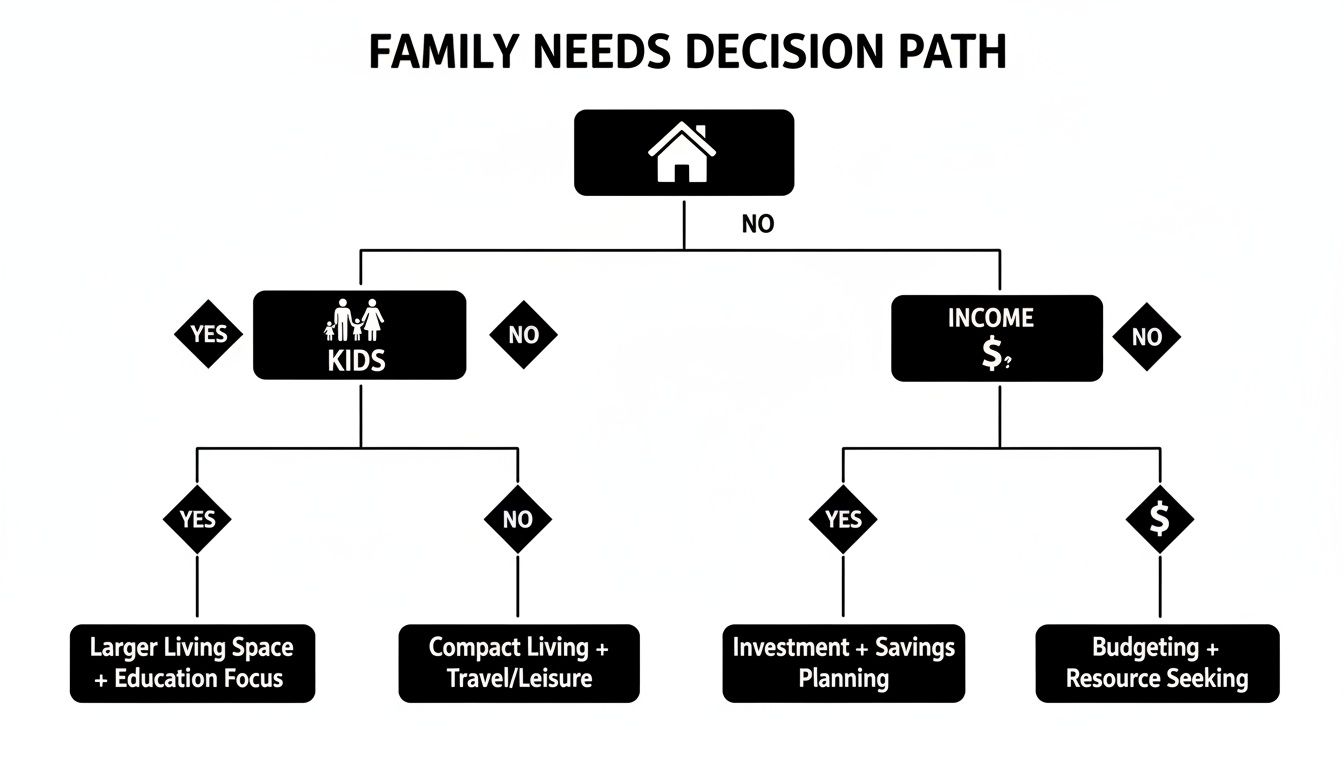
This flowchart shows how different family milestones and financial responsibilities often point toward specific types of life insurance solutions.
Recent data confirms that more and more families are recognizing life insurance as an essential part of their financial plan. In 2021, the U.S. individual life market saw policy sales and premium growth hit levels not seen in over 40 years. While term life dipped slightly in 2022, it came back in 2023 and is expected to grow 1%–5% in 2025 as it becomes easier to apply for online. For California families, these numbers just reinforce that both term and permanent policies are proven, reliable tools for financial security. You can learn more from the 2025 U.S. Individual Life Insurance Market outlook.
How to Calculate the Right Amount of Coverage
Deciding you need life insurance is the easy part. The real challenge is landing on the right number—how much coverage is enough? Many families get stuck here, often just multiplying their annual income by a random number. That's a huge gamble, especially in California, where this shortcut often misses major long-term financial burdens.
Instead of guessing, a better approach is to use a simplified version of the DIME method. This framework gives you a clear, structured way to figure out a realistic coverage amount by breaking down your financial needs into four key areas. It takes the guesswork out of the equation.

The DIME Method A Simple Framework
DIME is an acronym that stands for Debt, Income, Mortgage, and Education. By adding up the totals for each of these categories, you get a comprehensive look at what your family would actually need to maintain their lifestyle if you were gone.
Here’s a quick breakdown:
- D - Debt: Tally up all your non-mortgage debts. We’re talking credit cards, student loans, car insurance deductibles, and any personal loans. The idea is to leave your family with a clean slate.
- I - Income: Think about how many years your family would need your income to keep things running smoothly. A good starting point is 10 to 15 years, but you'll want to adjust this based on your kids' ages and your partner's ability to earn. Just multiply your annual salary by that number of years.
- M - Mortgage: This one's simple: what’s the outstanding balance on your mortgage? Paying off the house is one of the most powerful gifts you can leave, providing immense stability.
- E - Education: Project the future costs of your kids' college tuition. With the price of a California university education climbing every year, this is a big one. It's smart to plan for at least $100,000 to $150,000 per child for a four-year degree.
A California Family Calculation Example
Let's walk through this with a real-world example of a family in Escondido.
- Debt: They have $25,000 left on their car loans and $10,000 in credit card balances, for a total of $35,000.
- Income Replacement: One spouse earns $90,000 annually. With two young children, they decide they need to replace that income for 15 years. That comes out to $1,350,000.
- Mortgage: The remaining balance on their home is $650,000.
- Education: They want to ensure both of their kids have college funds, so they budget $125,000 for each, totaling $250,000.
Add it all up: $35,000 + $1,350,000 + $650,000 + $250,000 = $2,285,000. Based on this, they should be looking for a policy in the $2 million to $2.5 million range to be fully covered.
A crucial but often overlooked factor is inflation. A coverage amount that seems sufficient today may fall short in 10 or 20 years. Always build a small cushion into your calculation to account for the rising cost of living.
Common Pitfalls to Avoid
Even with a solid plan like the DIME method, it's easy to make a few common mistakes that can leave your family underinsured. A big one is forgetting about the cost of services a stay-at-home parent provides, like childcare. If that parent were to pass away, the surviving spouse might suddenly face childcare costs exceeding $20,000 a year in many parts of California.
Another classic mistake is relying entirely on the group life insurance offered at work. Those policies are rarely portable—meaning you lose it if you leave your job—and the coverage is usually just one or two times your salary. That's a nice little bonus, but it's nowhere near what most families actually need. Think of it as a supplement, never your main plan. Your personal California insurance plan, including life, auto, and home, should be your primary safety net.
For more detailed breakdowns on building a financial safety net, you can check out our other insurance guides.
Fine-Tuning Your Policy: Riders That Shield Your Family
A standard life insurance policy is the bedrock of your family's financial security, but riders are what turn that foundation into a custom-built fortress. Think of them as optional upgrades for your core coverage. They let you plan for life's curveballs, not just the final one, creating a safety net that’s far more responsive to your family’s real-world needs.
By adding riders, you build a policy that does more than just pay out when you’re gone. These enhancements can provide cash if you get a critical illness, pay your premiums if you become disabled, or even wrap your kids in affordable coverage. Especially for families in California, where living and healthcare costs are high, these customizations can be a game-changer.
Key Riders for Total Family Protection
You don't need every rider under the sun, but a few offer incredible value for families. When you’re hunting for the best life insurance for your family, it’s smart to look at add-ons that tackle those common "what if" scenarios. They usually don't cost much but can make all the difference when you need them most.
Three of the most powerful riders for families are:
- Child Term Rider: This lets you add a modest amount of term life insurance for all your children under one cheap rider. It covers final expenses and, more importantly, often guarantees their ability to buy their own policy later, no matter what health issues might pop up.
- Waiver of Premium Rider: If you become totally disabled and can't work, this rider steps in and pays your life insurance premiums for you. It's a critical backstop that keeps your policy in force even if your income disappears.
- Accelerated Death Benefit Rider: Often included for free, this feature lets you access a chunk of your own death benefit early if you're diagnosed with a terminal illness. That money can go toward medical bills or other end-of-life costs, easing the financial pressure on your loved ones.
How Riders Work in Real Life: A Scenario
Let's see how this works for a family in Glendale. The main breadwinner has a $1.5 million term life policy, and they've added both a Waiver of Premium rider and a Child Term rider.
Then, a serious accident leaves them unable to work. The Waiver of Premium rider kicks in, and the insurance company takes over the monthly payments. That crucial $1.5 million safety net for their family stays locked in, and they don’t have to pay a single cent for it.
Fast forward a few years. One of their children, who was covered by the Child Term rider, is now an adult and ready for their own life insurance. Thanks to that rider, they have the right to convert it into their own permanent policy without a medical exam, locking in affordable protection for their own future family.
Riders transform a static life insurance policy into a dynamic financial tool. They prepare your family not just for a worst-case scenario, but for the challenging life events that can happen along the way.
At the end of the day, the best life insurance is the one that’s actually built for your life. Riders give you the power to create coverage that is robust, flexible, and ready for whatever comes your way. A good agent can help you sort through the options and pinpoint the riders that make the most sense, ensuring there are no gaps in your family’s financial armor.
Navigating California Insurance: A Local Perspective
Choosing the right life insurance for your family isn’t just about picking a policy type. It's about understanding how your local environment shapes your needs, and for Californians, that means facing a unique financial and environmental landscape. A policy that seems solid on paper can leave you exposed if it doesn't account for the realities of living here.
This is where having a local expert in your corner makes all the difference. A generic coverage calculator won’t fully grasp California's high cost of living, which has a massive impact on how much income replacement and mortgage protection your family would actually need. Simply put, covering a $900,000 mortgage in Escondido is a completely different ballgame than a $400,000 mortgage somewhere else.

Weaving Life Insurance into Your Overall Protection
In California, your family’s financial safety net needs to be woven from more than just one thread. Your life insurance has to work hand-in-hand with your home insurance, auto insurance, and even your renters insurance. Without a connected strategy, you risk leaving dangerous gaps in your family’s protection.
Think about the ever-present threat of wildfires. Many homeowners are already underinsured or have to rely on the California FAIR Plan for basic fire coverage. What happens if the family's primary breadwinner passes away and, on top of that, the home is damaged in a fire? A life insurance policy can provide the cash to rebuild, but only a holistic plan ensures both the property and the family’s income are secure.
A holistic insurance strategy connects all the dots. It ensures your life insurance payout isn't immediately drained by unexpected home repair costs that your homeowners insurance didn't cover, safeguarding your family’s long-term financial health.
This integrated approach is essential for true peace of mind. For a deeper look at how these policies fit together, you can explore our detailed resources on life insurance in California.
Closing the Protection Gap with Local Insight
Even as more families buy life insurance, a huge protection gap still exists, especially in disaster-prone states like California. This means many people are underinsured for the real financial risks they face. Between 2011 and 2021, global economic losses from catastrophes reached about $2.3 trillion, but only $944 billion was insured. That leaves a staggering uninsured gap that families are forced to shoulder themselves.
For a family here, having a mortgage covered by property insurance but not backed by adequate life insurance can still lead to financial ruin if an earner dies. Agencies that understand how to combine life insurance, home insurance, and catastrophe-aware planning are key to closing both property and income-protection gaps.
Working with a local agency like Mai & Associates gives you a partner who gets this complex picture. We don't just sell you a life insurance policy; we review your entire insurance portfolio—from your car insurance and home policies to specialized earthquake or FAIR Plan coverage. Our goal is to make sure your family’s safety net has no weak points, giving you comprehensive protection built for the unique challenges of life in the Golden State.
Finding the Right Policy for Your Family with Mai & Associates
Deciding on life insurance is one of the biggest financial moves you'll ever make for your family. It's how you make sure the mortgage gets paid, college is funded, and their lives can continue without financial turmoil if you're not there. The right policy isn't just a check; it's the peace of mind that comes from knowing you’ve taken care of them.
But with so many choices out there—term vs. permanent, how much coverage is really enough—it’s easy to feel overwhelmed. You don't have to figure it all out on your own. Working with a local agency that knows the ropes can take the uncertainty out of the equation, making sure the policy you choose is the right fit for your unique situation.
Your California Insurance Partner
Here at Mai & Associates, we specialize in building financial safety nets for California families. Our agents live and work here, so we get the unique pressures of our state, from the high cost of living to specific local risks. We don't just sell you a life insurance policy in isolation; we look at the whole picture, integrating it with your home insurance and auto insurance to make sure there are no gaps in your protection.
We make the process straightforward and personal:
- Quick Rate Shopping: We pull quotes from multiple top-rated carriers at once, so you can see all your options.
- Same-Day Quotes: No waiting around. You get the numbers you need fast to make a smart decision.
- We Speak Your Language: Our team is fluent in English, Spanish, Armenian, Russian, and Vietnamese.
"A well-chosen life insurance policy is the ultimate backstop. It’s your promise to your family, guaranteed."
Protecting the people you love is too important for guesswork. Let our team walk you through a no-obligation consultation to find coverage that fits your budget and truly protects what matters most.
Take the first step today. Get an instant insurance quote and see just how simple and affordable peace of mind can be. We're here to help you secure your family's future.
Common Questions Families Ask About Life Insurance
Let's be honest, life insurance can feel complicated. Most families have similar questions when they start looking into it. Here are some of the most common ones we hear, along with straightforward answers to help you make sense of it all.
When Is the Best Time for a Family to Buy Life Insurance?
The short answer? As soon as someone else depends on your income. For most people, this happens when they get married, buy a house together, or have their first child.
The real secret is that premiums are always cheaper when you're young and healthy. Locking in a great rate in your 20s or 30s can save you a ton of money down the road. If you wait, you risk developing health conditions that can make your premiums skyrocket or even make it tough to get covered at all.
Should Both Parents Have a Policy?
Absolutely, yes. We can't stress this enough. Even if one parent stays at home, their contribution to the family is enormous.
Think about what it would cost to hire someone for childcare, cooking, cleaning, and shuttling kids to activities. That's a huge financial burden. A policy for the stay-at-home parent gives the surviving spouse the funds to keep the household running smoothly without facing a financial crisis.
A huge mistake we see is families only insuring the main income earner. The truth is, losing a stay-at-home parent can be financially devastating. In California, you could easily be looking at $20,000 or more a year just for childcare.
How Much Do My Health and Lifestyle Matter in California?
They matter a lot—it's one of the biggest factors insurers look at when setting your price. During the underwriting process, they'll review things like your:
- Age and gender
- Personal and family medical history
- Height and weight
- Tobacco and nicotine use
Even high-adrenaline hobbies like scuba diving or flying can raise your rates. The good news for Californians is that a healthy, active lifestyle can earn you serious discounts. Insurance companies save their best "preferred" rates for people in excellent health, giving you a powerful incentive to take care of yourself.
Can I Update My Policy as My Family Changes?
You bet, but your flexibility depends on the type of policy you choose. Many term life policies are convertible, which is a fantastic feature. It lets you switch to a permanent policy later on without having to go through another medical exam—a lifesaver if your health has taken a turn. Universal life policies are also known for being adjustable, often letting you change your premium payments or death benefit.
It's a smart move to check in with your agent every few years or after a big life event—like a new baby, a bigger mortgage, or a promotion. That way, your coverage always matches where you are in life. For more detailed answers, you can find a ton of information in our complete insurance FAQ section.