Finding the Best California Insurance Rates in 2026
Trying to find the best insurance rates California offers used to be a straightforward task. But if you’ve been shopping for a policy lately, you know the game has changed. What was once a relatively stable and affordable market for California insurance has been turned on its head by a mix of climate risks and new regulations.
Getting smart about your insurance is no longer optional—it's essential.
Why Finding Affordable California Insurance Is So Tough
Let's be real: getting affordable California insurance feels nearly impossible right now. If you've opened a renewal notice and been shocked by the price jump, you are definitely not alone. The state is dealing with a perfect storm of issues that are driving up costs across the board for auto insurance, home insurance, and even life insurance.
This isn't just a feeling; it's a market reality. To find a solution, you first have to understand what's causing the problem.
The Squeeze on Auto Insurance Rates
For decades, we had it pretty good. Thanks to Proposition 103, passed back in 1988, California drivers enjoyed some of the most stable auto insurance rates in the country. The regulation was incredibly effective, saving residents an estimated $154 billion between 1989 and 2015.
During that period, our premiums only went up 12.5% while the national average soared by 61.1%.
But that era of stability is officially over. After years of holding rates down, insurers are now getting approvals for massive increases. They jumped 13% in 2023 and another 15.4% in 2024, with an average 6% hike already on the books for 2025. You're not imagining it—that’s a cumulative increase of more than a third in just three years. You can read more about the forces driving these surges in California car insurance rates on latimes.com.
So, what's behind the sticker shock in California car insurance? A few key things:
- Skyrocketing Repair Costs: Modern cars are essentially computers on wheels. All those sensors, cameras, and advanced safety features mean even a simple fender-bender can lead to a shockingly expensive repair bill.
- Inflation in Medical Expenses: The cost of medical care after an accident keeps climbing. This directly impacts the liability portion of your auto insurance policy, pushing rates higher.
- A Return to Risky Roads: After a brief dip during the pandemic, people are driving more than ever. More cars on the road means more accidents, and insurers are adjusting rates to cover that increased risk.
Home Insurance and the Climate Challenge
The trouble doesn't stop at the freeway. California's home insurance market is in a full-blown crisis, driven almost entirely by the escalating threat of climate change. The sheer frequency and destructive power of recent wildfires have made insuring homes in many parts of the state a massive financial gamble.
The financial risks posed by wildfires may be outstripping the insurance rates that homeowners are paying. As a result, many major insurers have been canceling policies or declining to renew them, leaving thousands of homeowners scrambling for coverage.
This has created a domino effect, leading to three major problems for homeowners seeking California home insurance:
- Insurers Are Pulling Out: Since 2022, seven of California's top 12 home insurance companies have either stopped writing new policies or significantly restricted their business here.
- The FAIR Plan Is Overwhelmed: The California FAIR Plan was designed as an "insurer of last resort." Today, it's the only option for a growing number of people. Its policy count has more than doubled since 2021 as homeowners in high-risk areas find they have nowhere else to turn.
- "Last Resort" Coverage Is Costly: A FAIR Plan policy is not only more expensive, but it also offers much less protection than a standard homeowners policy. This forces many people to buy a separate "wraparound" policy just to get the basic coverage they need, adding even more to the cost.
Now that you understand the challenges, we can focus on the solution. This guide is designed to give you a clear, expert-led path to finding the best possible insurance rates for your specific needs, even in this tough California insurance market.
Decoding Your California Auto Insurance Premium
Ever feel like your car insurance rate is a complete mystery? You're not alone. But pulling back the curtain is the first step to finding the best insurance rates California drivers can get. While it’s no secret your driving record matters, a few Golden State rules dramatically change the game, giving you more control than you might think.
Here in California, Proposition 103 is a big deal. It forbids insurers from using your credit score to calculate your premium, which is common practice in most other states. Instead, they have to base their rates primarily on three things: your driving record, how many miles you drive each year, and your years of experience behind the wheel. This is fundamental to understanding California auto insurance.

Where You Live and How Much You Drive
Your address and how often you're on the road have a massive impact on your premium. Insurers are constantly analyzing ZIP code data for things like traffic density, accident statistics, and even vehicle theft rates. That’s why a move, even just across town, can trigger a noticeable rate change.
Think of it this way:
- A daily commuter in downtown Los Angeles might log 20,000 miles a year in heavy traffic. From an insurer's perspective, their exposure to accidents, fender-benders, and crime is significantly higher. The premium for their car insurance will reflect that.
- A remote worker in rural Shasta County who only drives 5,000 miles a year is a much lower risk. Less time on the road directly translates to a lower bill.
This is a huge opportunity for savings. If you’ve recently gone remote or switched to a hybrid schedule, make sure your insurer knows. Accurately reporting that drop in mileage can lower your auto insurance costs right away.
Your Driving Experience and Record
Of course, a clean driving record is your golden ticket. A history clear of at-fault accidents, speeding tickets, and DUIs will always earn you the best rates for California car insurance. A single at-fault accident can send your premium soaring by 40% or more, depending on how serious it was.
Key Takeaway: In California, how you drive has a far greater impact on your insurance bill than your financial history. The single most powerful thing you can do to lower your rate is to maintain a clean record for three to five years.
But you don't need a perfect record to save money. If you have a minor violation, completing a state-approved defensive driving course can sometimes help offset the points. It shows the insurance company you're serious about safe driving, which can lead to a discount.
Understanding Your Coverage Choices
The coverage you choose is the final piece of the puzzle. While California has minimum liability requirements, settling for the bare minimum can leave you financially devastated after a major accident. To build a policy that actually protects you, you need to know what you're buying.
When you're looking at options, you'll need to decide on things like comprehensive coverage, which answers the common question of does insurance cover broken car windows.
Here’s a quick rundown of the main coverages for your car insurance:
- Liability Coverage: This is the one you’re required to have. It covers injuries and property damage you cause to others if you're at fault.
- Collision Coverage: This pays to fix or replace your own car after an accident, no matter who was at fault. If you have a car loan or lease, your lender will almost certainly require it.
- Comprehensive Coverage: This covers damage from almost everything else—theft, vandalism, fire, flooding, or hitting a deer.
If you have an older car that isn't worth much, you might consider dropping collision or comprehensive to save some cash. For most people, though, that protection is essential. You can dive deeper into these options in our full guide to auto insurance in California.
By looking at your policy through an insurer’s eyes, you can focus on the factors you control—your driving habits, annual mileage, and coverage—to start taking charge of your premium.
Strategies for Lowering Your Home Insurance Costs
If you're a California homeowner, you know the stress of finding affordable home insurance. With major carriers pulling out of the state and premiums climbing, securing a policy that actually protects your home without costing a fortune feels like an uphill battle. It's especially tough for anyone living in a high-risk wildfire area.
But you have more control than you might think. By proactively making your home safer and more resilient, you can significantly improve your chances of getting better coverage and locking in the best rates available. This isn't just about saving a few bucks—it's about safeguarding your most valuable asset in a state with unique challenges for California home insurance.

The FAIR Plan and California's Shifting Market
Let's be direct: California's home insurance landscape has been completely reshaped by wildfires. The risk is just too high for many traditional insurers. This has pushed more and more homeowners toward the California FAIR Plan, the state's "insurer of last resort."
The numbers tell the story. The FAIR Plan's policy count exploded from 202,897 in September 2020 to 451,799 by September 2024. During that same period, its written premiums shot up an incredible 199%, from $424 million to over $1.26 billion. If you're having trouble finding coverage in a traditional market, particularly in a wildfire zone, you might end up here.
A critical warning: A standard FAIR Plan policy is bare-bones. It generally only covers damage from fire, lightning, and smoke. It does not cover liability, theft, or water damage, leaving you dangerously exposed.
This is a massive gap that many homeowners don't realize until it's too late. To get comprehensive protection, you'll need a separate "wraparound" or "Difference in Conditions" (DIC) policy to cover everything else.
Take Control by Hardening Your Home
Insurers think in terms of risk. The less risky your home is, the better your odds of getting approved for a traditional policy with a lower premium. This is where "home hardening" comes in—it's the process of making your property more resistant to fire.
These upgrades are what carriers want to see for California home insurance:
- Fire-Resistant Roofing: Class A fire-rated materials like asphalt shingles, concrete tiles, or metal are non-negotiable in high-risk areas.
- Defensible Space: This is all about creating a buffer. Clear a 100-foot zone around your home by removing dead vegetation, trimming trees, and keeping your yard tidy.
- Ember-Resistant Vents: Flying embers are a primary culprit in home ignition. Installing fine mesh screens over attic and foundation vents can stop them cold.
- Dual-Pane Windows: Tempered glass is far more likely to withstand the intense heat from a wildfire, preventing flames from getting inside.
To help you prioritize, we've put together a checklist of actions you can take to lower your risk profile and make your property more attractive to insurers.
California Home Insurance Risk Mitigation Checklist
Taking these steps demonstrates to insurers that you are a proactive and responsible homeowner, which can directly influence your eligibility for better policies and lower premiums.
| Mitigation Action | Potential Impact on Premiums | Best For |
|---|---|---|
| Install a Class A Fire-Rated Roof | High | All homes, especially those in Wildland-Urban Interface (WUI) zones. |
| Create 100 ft. of Defensible Space | High | Properties in moderate to high-risk wildfire areas. |
| Install Ember-Resistant Vents | Moderate to High | Homes in areas prone to wind-driven embers. |
| Upgrade to Dual-Pane/Tempered Glass Windows | Moderate | All homes in high-heat or fire-risk zones. |
| Clear Gutters & Roof of Debris | Low to Moderate | Every homeowner. A simple, low-cost/no-cost action. |
| Trim Trees & Remove Flammable Landscaping | Moderate | Homes with significant tree cover or flammable plants near the structure. |
Even tackling one or two of these items can make a real difference, not just in your premium costs, but in your family's safety. Beyond fire risk, don't forget other hazards. Taking steps for protecting your home from storm damage also helps keep your claims history clean.
Don't Forget System Upgrades and Key Add-Ons
Wildfire prep is huge, but so is the overall condition of your home. Insurers get nervous about old, failing systems. A new roof, updated electrical panel, or modern copper plumbing signals that you're less likely to file a costly claim for a leak or internal fire. Always let your agent know about recent upgrades—they can be a powerful negotiating tool for your home insurance.
Finally, you have to know what your policy doesn't cover.
- A standard HO-3 policy will not cover you for flood or earthquake damage.
- A FAIR Plan policy is even more limited, as we've discussed.
These perils require separate policies or endorsements. An independent agent can analyze your specific location and help you decide if earthquake or flood coverage is a smart investment for you.
For a deeper dive into all your options, take a look at our complete guide to home insurance in California. An expert review can help you find the perfect wraparound policy to supplement a FAIR Plan, giving you total peace of mind.
Finding Every Last Discount and Why Bundling Works
This is where the real savings are found. If you want to secure the best insurance rates California has to offer, you need to think like an insider. It really boils down to two key strategies: hunting down every single discount you're entitled to and bundling your policies together. It sounds simple, but getting it right can easily save you hundreds, sometimes even thousands, a year.
Most people are aware of the multi-policy discount, but that’s just scratching the surface. Insurance carriers have a whole menu of discounts available, and many won't be offered unless you specifically ask. Leaving even one of these on the table is like voluntarily overpaying for your California insurance.
Your Go-To Discount Checklist
Think about your life, your job, and your property—they're all potential sources for savings. Insurers reward people they see as lower-risk, and that goes way beyond just a clean driving record. Before you sign off on any quote, go through this list.
For Your Auto Policy:
- Good Student Discount: Got a high schooler or college student on your policy holding down a "B" average or a 3.0 GPA? That's a discount on your car insurance.
- Low-Mileage Discount: Many Californians are driving less these days. If you’re putting fewer than about 12,500 miles on your car per year, make sure you're getting credit for it.
- Vehicle Safety Features: Anti-lock brakes, airbags, and anti-theft systems are common, but they all count. Each one can shave a little more off your premium.
- Professional & Affinity Groups: Are you a teacher, engineer, or a member of an alumni association or credit union? Many carriers have pre-negotiated rates for these groups.
For Your Home or Renters Policy:
- Home Security: A monitored alarm system that covers both break-ins and fires is one of the biggest and most common discounts for home insurance.
- Protective Devices: Even simple things like having deadbolts, smoke detectors, and a fire extinguisher can earn you a small credit on home insurance or renters insurance.
- Claims-Free History: If you haven't filed a claim in the last three to five years, your insurer should be rewarding you for it.
A tip from my experience: Don't ever assume your insurance company automatically knows about these things. You have to be the one to tell your agent you installed a new alarm system or that your daughter made the honor roll. If you don't speak up, you won't get the savings.
The Power of the Bundle: A Real-World Example
Bundling is, without a doubt, the single biggest money-saving move you can make. When you place your auto insurance, home insurance, and renters insurance policies with the same company, you’re not just making your life simpler. You’re unlocking a multi-policy discount that can slash your premiums by 10-25%.
Let’s look at a scenario I see all the time.
Imagine a family in Orange County with two cars and a home. They also need some basic term life insurance. If they bought each policy from a different company, their yearly costs might look something like this:
- Auto Insurance: $2,400/year
- Home Insurance: $1,500/year
- Life Insurance: $600/year
- Total Annual Cost: $4,500
Now, watch what happens when they bundle. By placing their auto insurance and home insurance with one carrier, they could get a 20% discount on both policies. Some companies even throw in an extra small discount for adding the life insurance policy, too.
Suddenly, the math changes completely:
| Policy | Original Cost | Bundled Savings (20%) | New Cost |
|---|---|---|---|
| Auto Insurance | $2,400 | -$480 | $1,920 |
| Home Insurance | $1,500 | -$300 | $1,200 |
| Life Insurance | $600 | (Small discount may apply) | ~$580 |
| Total Annual Cost | $4,500 | ~$3,700 |
Just by making one smart move, this family put about $800 back in their pocket for the year, all without changing their coverage one bit.
This is the advantage of working with an independent agent at Mai & Associates. We can instantly price out bundled packages from dozens of California's best insurers to find the one that gives you the perfect mix of price and protection. If you just go to one company directly, you're leaving money on the table.
Beyond the Basics: Securing Your Future with Renters and Life Insurance
When Californians think about insurance, cars and homes usually top the list. That makes sense. But focusing only on auto insurance and home insurance can leave you surprisingly exposed.
Renters insurance and life insurance are often an afterthought, but they’re two of the most affordable and powerful tools you have for protecting your finances and your family. Let's break down why they're so critical.
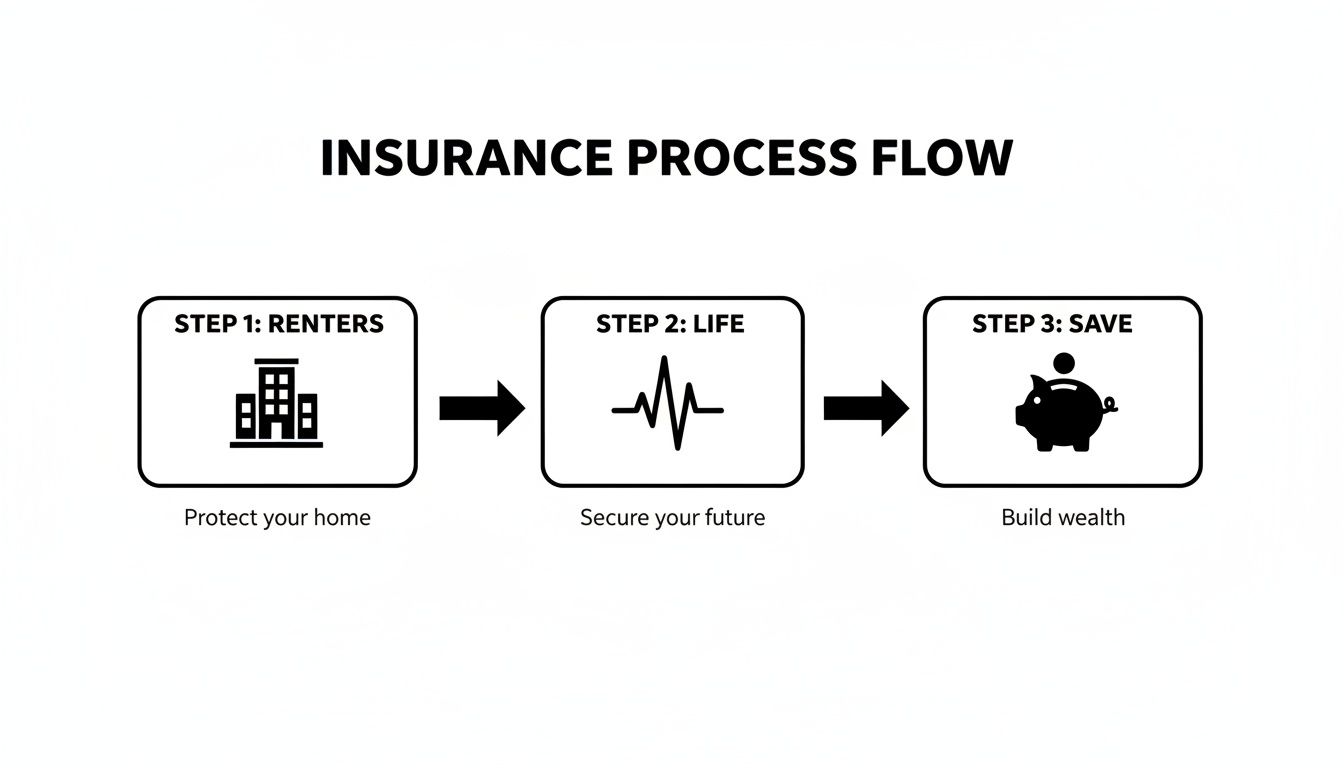
As you can see, renters insurance protects what you have now, while life insurance secures your family’s future. Both are key steps toward real financial peace of mind.
The Myth of "Too Expensive" Renters Insurance
So many renters I talk to think coverage is a luxury they can't afford, or they mistakenly believe their landlord’s policy covers their stuff. Neither is true.
Think about it this way: a young professional renting in Glendale probably has a laptop, furniture, clothes, and electronics easily worth over $20,000. A burst pipe or a small kitchen fire could destroy all of it in an instant. A basic renters insurance policy—which often costs less than a couple of weekly coffees—provides the cash to replace everything.
But it’s not just about your belongings. The liability coverage is arguably even more important. If a friend slips and injures themselves in your apartment, your policy can cover their medical bills, shielding you from a lawsuit that could derail your financial life for years. You can find more details in our complete guide on renters insurance in California.
Lock in Low Life Insurance Rates While You Can
Life insurance isn't for you; it's for the people who depend on you. For a young family in San Diego with a mortgage and kids, a policy ensures their world doesn't fall apart financially if the worst should happen.
When you're starting out, you'll generally look at two main options for California life insurance:
- Term Life Insurance: This is the most popular and affordable choice. You get coverage for a set period, like 20 or 30 years, designed to last until your mortgage is paid off or the kids are grown.
- Whole Life Insurance: This is a permanent policy that lasts your entire life. It’s more of an investment, as it builds cash value over time that you can borrow against. It's a great tool for estate planning.
The absolute best time to buy life insurance is when you’re young and healthy. Getting a policy in your 20s or 30s can lock in surprisingly low rates for decades. If you wait until your 40s or 50s, that same coverage could cost you significantly more.
Think of renters and life insurance not as bills, but as a core part of your financial plan. They protect what you’re building today so you can have a secure tomorrow.
This forward-thinking is especially crucial in California. Our California insurance market has been on a rollercoaster for years, particularly with property coverage. In 2021, for example, massive wildfires caused some insurers’ loss ratios to hit an unbelievable 241.6%, dwarfing the 10-year average of 109.7%. These numbers show just how unstable things can be—and why shopping around is non-negotiable.
This is where working with a broker like Mai & Associates really pays off. We navigate this complexity for you, finding budget-friendly bundles for auto insurance, home insurance, renters insurance, and life insurance that deliver better protection than what you'd likely find on your own.
Your Game Plan for a Better Insurance Rate
Alright, let's put what you've learned into action. We’ve covered the complexities of California's insurance market and the specific things that move the needle on your rates. Now it's time to use that inside knowledge to secure some real savings.
The key to finding the best insurance rates California has to offer isn't about grinding through hours of phone calls. It’s about being prepared and then letting an expert do the heavy lifting. This simple process puts you in the driver's seat.
Get Your Ducks in a Row Before You Quote
First things first, grab your current insurance policies. Having your car insurance, home insurance, or renters insurance "declaration pages" in hand is crucial. These documents spell out your current coverage, deductibles, and what you’re paying—this is your starting point, the number we want to beat.
With your current policy as a reference, let’s make a quick checklist based on what we've discussed.
- Available Discounts: Did you recently add a security system? Is your student maintaining a 3.0 GPA or better? Have you started working from home and cut your mileage? Jot down every single discount you might be eligible for.
- Your Current Needs: Has life changed? Maybe you bought some new electronics that need better renters insurance coverage, or you've welcomed a new baby and are thinking about life insurance.
- Risk Reduction: Have you taken steps to "harden" your home against wildfires or completed a defensive driving course? Make a note of it. These proactive measures can definitely pay off.
Walking into a conversation with this information ready ensures nothing gets missed and no potential savings are left on the table.
Let an Expert Do the Shopping for You
Once you have your notes organized, you’re ready for the final and most effective step. Instead of tackling the market alone, you can tap into an independent expert who will navigate it for you. This is where we come in, instantly comparing rates from a whole network of top-tier carriers.
An independent agent works for you, not a specific insurance company. Our only job is to find the best policy for your situation and budget by comparing every option, including bundles, to maximize your savings.
This expert review is what turns your prep work into actual money in your pocket. By taking this final step, you can feel confident you’re getting coverage that truly fits your life.
Ready to see the difference? You can get a no-obligation quote from Mai & Associates right now and find out just how much you could be saving on your California insurance.
Your California Insurance Questions, Answered
Finding the right California insurance can feel like a moving target. It’s a unique market, and we get a lot of great questions from clients trying to make sense of it all. Here are some of the most common ones we hear, along with some straightforward answers from our team.
How Often Should I Be Shopping for New Insurance Rates?
I tell my clients to check for new rates at least once a year. Think of it like an annual check-up. Insurers are constantly adjusting their pricing, so the company that gave you the best deal last year might be more expensive this time around.
You should also shop for quotes immediately after any major life event. These moments are prime opportunities to save money.
- Buying a new car or home: This is the perfect trigger to see how much you can save by bundling your auto insurance and home insurance policies.
- Your commute changes drastically: If you’re now working from home instead of driving 50 miles a day, your auto premium should reflect that.
- Getting married or having a baby: Life changes like these often qualify you for new discounts and definitely signal a need to review your life insurance.
Will One Little Accident Really Hike Up My Auto Insurance?
It’s not a guarantee, but it’s likely. In California, your driving record is one of the biggest factors in your premium, so an at-fault accident will probably cause an increase. A minor fender-bender won't hit you as hard as a serious collision, though.
A Pro Tip from Our Team: If you’ve maintained a clean record for years, ask about "accident forgiveness." Some of the best carriers offer it as a feature for your auto insurance, preventing your rate from jumping after your first minor incident. It's a huge perk.
I Was Just Dropped by My Home Insurer Because of Wildfire Risk. What’s My First Step?
First, take a breath and don't panic. This is an unfortunate reality for thousands of California homeowners right now, and you do have options.
Your very first move should be to call an independent insurance agent who knows the California insurance market inside and out. They can instantly see if any other standard insurance companies are still an option for your property. If not, they’ll get you set up with the next best thing.
Your agent will help you get a policy through the California FAIR Plan. This is the state's insurer of last resort, and getting this coverage in place quickly is critical. You can't afford a lapse in home insurance coverage, and your mortgage lender requires you to be insured.
Is the California FAIR Plan My Only Choice in a High-Risk Area?
It’s your foundational safety net, but it shouldn't be your only coverage. The FAIR Plan was created to provide basic fire insurance when traditional carriers won't. The key word is basic—it does not cover major risks like personal liability, theft, or most water damage.
An experienced agent will create a complete shield of protection. This usually means pairing that FAIR Plan policy with a separate "Difference in Conditions" (DIC) policy. This second policy fills in all the critical gaps the FAIR Plan leaves behind, giving you comprehensive home insurance coverage that truly protects your home and assets.
Piecing together FAIR Plan policies, finding wraparound coverage, and uncovering hidden discounts is exactly what we do at Mai & Associates. Our licensed agents can compare options from dozens of carriers in minutes, finding the perfect fit for your needs and budget. See how much you could save by visiting us at https://cahomeauto.com for a fast, no-obligation quote today.