Finding the Best Earthquake Insurance California Has to Offer

Finding the best earthquake insurance California offers isn't about finding one perfect company. It’s about building the right strategy for your specific home, your finances, and your peace of mind. Your choice almost always boils down to two distinct paths: coverage through the state-managed California Earthquake Authority (CEA) or a policy from a private insurance carrier.
Let's break down the fundamental differences, because that’s the first real step toward protecting your biggest asset.
Your Guide to California's Top Earthquake Insurance Options
For most California homeowners and renters, the first big shock after an earthquake isn't the tremor itself—it's the discovery that their standard insurance policy offers zero protection. That's right. A standard home insurance or renters insurance policy explicitly excludes damage from seismic events like ground shaking, leaving a massive financial hole.
Your auto insurance (or car insurance) only helps if you have comprehensive coverage for vehicle damage, and life insurance is for a completely different purpose. This reality means you must buy a separate, dedicated earthquake policy.

This puts California residents at a critical crossroads. You have to decide between the two main sources for earthquake coverage, and each has its own unique approach to pricing, policy flexibility, and how they handle claims.
The Two Paths to Earthquake Coverage
Navigating your options really starts with understanding the marketplace. Every provider falls into one of two camps, and your choice will have a huge impact on your policy’s structure and what you pay.
- California Earthquake Authority (CEA): Think of the CEA as a publicly managed, not-for-profit organization. It partners with residential insurance companies to offer standardized earthquake policies across the state. The main mission here is to make coverage accessible and relatively affordable for as many people as possible.
- Private Market Insurers: These are the for-profit insurance companies you see advertising everywhere. They design their own earthquake policies from the ground up, which often means they're more customizable. They compete with each other on features, pricing, and coverage limits, giving you a true alternative to the state-run option.
The crucial takeaway is this: earthquake insurance isn’t a simple add-on; it's a standalone decision. Your homeowners policy won’t save you. You have to be proactive and choose between the CEA and the private market to secure your financial future in California.
To get started, here’s a high-level look at how these two paths compare.
| Feature Comparison | California Earthquake Authority (CEA) | Private Market Insurers |
|---|---|---|
| Provider Type | Publicly managed, not-for-profit entity | For-profit insurance companies |
| Policy Availability | Offered through your existing home insurer | Available directly or via independent agents |
| Coverage Structure | Standardized, less flexible options | Often more customizable and comprehensive |
| Pricing Model | Based on standardized risk calculations | Competitive pricing based on company models |
Picking the right path demands a closer look at the nitty-gritty details of the policy, the costs, and your own tolerance for risk. An independent agency like Mai & Associates can pull quotes from both CEA-participating carriers and private insurers, helping you find that sweet spot between solid protection and good value for your home.
Understanding California's Unique Earthquake Risk
Living in California means living with a geological certainty: the ground beneath our feet is always moving. The real question isn't if a major earthquake will hit, but when and where. This constant seismic threat creates a massive financial risk that your standard insurance policy won't touch, which makes finding the best earthquake insurance California has available a crucial step for every homeowner and renter.
Unfortunately, many Californians are caught in what we call the "protection gap." This is the staggering difference between the potential cost of earthquake damage and the small number of people who are actually insured for it. Thinking your standard home insurance or renters insurance has you covered is a bet you're guaranteed to lose.
The Financial Aftershock of Being Uninsured
The financial fallout from a major quake can be far more destructive than the shaking itself. Your standard home insurance policy—the one that covers fire, theft, and liability—has a specific exclusion for damage caused by earth movement. If an earthquake cracks your foundation, buckles your walls, or renders your home uninhabitable, you're on the hook for 100% of the repair costs.
This isn't a minor detail; it's a hard line drawn in the sand. That exclusion applies to almost all standard policies. Your auto insurance only helps if your car is damaged (and you have comprehensive coverage), not your house. A life insurance policy certainly won't rebuild your property. The reality is blunt: without a dedicated earthquake policy, your biggest asset is completely unprotected.
California’s past is a stark reminder of this danger. The state has experienced six of the ten costliest earthquakes in U.S. history. Yet, an alarmingly high number of residents remain uninsured, staring down potential financial ruin from a single event.
The real-world consequence is that thousands of families could be displaced and left paying a mortgage on a home that is unlivable or needs hundreds of thousands of dollars in repairs—all with zero help from their primary insurer.
California's Outsized Risk Profile
The sheer scale of California's seismic risk is unlike anywhere else in the country, and the insurance market reflects that. While California is the most earthquake-prone state, this significant threat remains woefully underinsured. According to the California Department of Insurance, earthquake insurance premiums written in the state hit about $3.58 billion in 2024. That’s nearly eight times more than in Washington, the next largest market. This number tells you exactly how insurers view the state’s elevated risk—a risk that standard homeowner and renter policies are explicitly designed to sidestep. You can explore more data on seismic risks and insurance coverage to grasp the full picture.
This is precisely why you have to buy separate coverage, either as an add-on to your existing policy or as a standalone policy from a specialty carrier. Ignoring this isn't a small oversight; it's a conscious decision to self-insure against a multi-billion-dollar catastrophe. For anyone serious about protecting their financial future, understanding this gap is the first step toward finding the right solution.
CEA vs. Private Earthquake Insurance: Making the Right Choice
When it comes to getting the best earthquake insurance California has to offer, you're faced with two main paths. You can go with the publicly managed California Earthquake Authority (CEA), or you can explore the open market of private insurance carriers. This isn't just about price shopping; it's about understanding two fundamentally different approaches to protecting your biggest asset.
Let's be clear: your standard home insurance or renters insurance policy will not cover earthquake damage. Period. The same goes for auto insurance (it only covers your car) and life insurance (which serves a totally different purpose). The responsibility to shield your home's structure and your personal belongings from a seismic event rests entirely on the earthquake policy you choose.
This decision tree helps frame the financial risk you're automatically exposed to as a California homeowner.
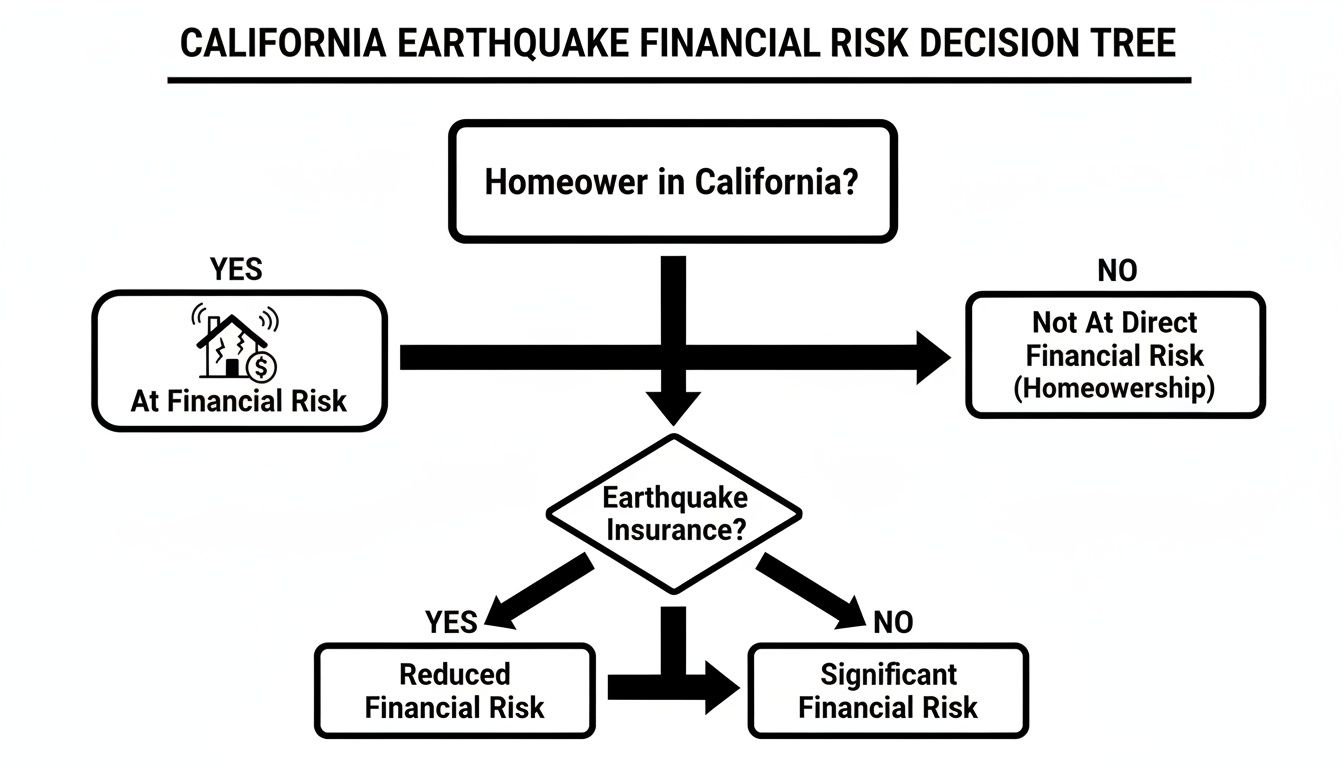
As you can see, simply owning a home here puts you in a vulnerable position. Proactive coverage isn't a luxury; it's a critical part of a sound financial plan.
To help you decide, let's break down the real-world differences between CEA and private market policies.
CEA vs. Private Earthquake Insurance A Detailed Comparison
The table below cuts through the noise and directly compares the California Earthquake Authority (CEA) with private market insurers across the features that matter most when you're evaluating a policy.
| Feature | California Earthquake Authority (CEA) | Private Market Insurers |
|---|---|---|
| Coverage Scope | Standardized, "a la carte" options for dwelling, personal property, and loss of use. Often excludes extras like pools, fences, or detached structures. | Broader and more customizable. Often includes or offers add-ons for pools, masonry, detached structures, and other unique property features. |
| Deductibles | Percentage-based, ranging from 5% to 25% of your dwelling coverage. A single deductible applies to both dwelling and contents. | Highly varied. Options can include traditional flat-dollar amounts, tiered percentages, or separate deductibles for dwelling and personal property. |
| Premium Cost | Standardized rates based on large-scale risk modeling. Can be very competitive, especially in lower-risk zones. | Competitively priced based on individual underwriting. A well-retrofitted home might find a better rate and more coverage than a comparable CEA plan. |
| Underwriting | Must be purchased as an add-on through your existing home insurance provider. Limited underwriting flexibility. | Stand-alone policies available from various carriers. Underwriting is based on the carrier's own risk appetite and criteria. |
| Financial Backing | Not-for-profit, publicly managed entity with $19.4 billion in claims-paying resources. Backed by its own reserves, reinsurance, and participating insurers. | For-profit companies backed by their own capital reserves and reinsurance. Financial strength varies by carrier (check A.M. Best ratings). |
| Flexibility | Less flexible. Policies are structured with set options, making it simple but potentially leaving coverage gaps. | More flexible. Policies can be tailored to cover specific needs and unique property characteristics, offering more comprehensive protection. |
Ultimately, the choice comes down to your personal risk tolerance and property needs. The CEA offers a straightforward, reliable product, while the private market provides a competitive landscape where you can often find more tailored and comprehensive coverage.
Coverage Flexibility and Customization
One of the first things you'll notice is the difference in customization. Private market policies are often built to be more comprehensive and adaptable. It's common to find plans that cover things like swimming pools, masonry walls, or detached fences—assets that the standard CEA policy typically excludes or limits.
The CEA, on the other hand, provides a more standardized menu of options. You pick and choose your coverages "a la carte." While this keeps things simple, it can leave you with gaps if your property has unique features. If you have an expensive custom landscape or a detached art studio, a private policy will almost always be better suited to protect those specific assets.
Deductible Structures and Financial Impact
This is where the two paths really diverge. CEA policies use percentage-based deductibles, which can range from 5% to 25% of your dwelling coverage. Choosing a higher deductible will lower your premium, but it also means you'll pay a massive amount out-of-pocket before your insurance kicks in.
Private insurers offer a much wider range of deductible options. Some provide a simple, flat-dollar deductible, which is far easier to plan for in a crisis. Others might offer tiered percentages or even separate deductibles for your home's structure versus your personal belongings, giving you more control over where you want to assume risk.
The core difference comes down to philosophy. The CEA’s model is built for mass accessibility, making basic coverage affordable for more people. Private insurers operate in a competitive market, so they create more nuanced products for homeowners who want greater certainty and fewer financial surprises after a disaster.
Premium Costs and Pricing Models
It's a myth that the CEA is always the cheapest option. Because you buy a CEA policy through your existing home insurance company, its rates are standardized based on massive, state-wide risk models. This can lead to very competitive premiums, especially if you live in a lower-risk area.
However, private carriers set their own underwriting rules and can get aggressive with pricing to earn your business. If you own a newer, seismically retrofitted home in a moderate-risk zone, you might easily find a private policy that's not only more comprehensive but also cheaper than a comparable CEA plan. The only way to know for sure is to get quotes from both.
Financial Stability and Longevity
After a major earthquake, you need absolute confidence that your insurer can pay your claim. This is where the CEA's unique structure really shines.
The California Earthquake Authority (CEA) is the largest residential earthquake insurance provider in the U.S., with over 1 million policyholders and about two-thirds of the state's market share. As a not-for-profit, it holds $19.4 billion in claims-paying resources, and its reserves grow faster than for-profit companies. This rock-solid financial footing has earned the CEA a B++ (Good) rating from A.M. Best. You can learn more about the CEA’s financial strength and structure and see for yourself how it's built to withstand a catastrophic event.
Private insurers are also rated for financial strength by firms like A.M. Best, and top-rated carriers are incredibly reliable. Still, their for-profit nature means they have to balance shareholder returns with claim reserves. For homeowners seeking the ultimate peace of mind, the state-backed security of the CEA is often the deciding factor.
Decoding Your Earthquake Insurance Policy and Costs
An earthquake insurance quote can feel like you're trying to read a foreign language. To get the right policy for your home, you first have to understand what you're actually looking at—the core coverages, the tricky deductibles, and what's driving that final price tag.
Let's cut through the jargon and get straight to what matters.

Unlike a standard home insurance policy that bundles everything together, earthquake coverage is more "a la carte." You have to pick and choose your limits for different protections, and every decision you make directly affects your premium.
Key Coverage Components Explained
Getting a handle on these three main parts of the policy is crucial. They're the foundation of your financial safety net if a major quake hits.
- Dwelling Coverage: This is the big one. It's the money to repair or completely rebuild the structure of your house, from the foundation to the roof, including things like an attached garage. The coverage amount should be based on your home's replacement cost, not its market value.
- Personal Property Coverage: Think of this as the coverage for all your stuff—the furniture, electronics, clothes, and everything else inside your home. The limits here are usually much lower than your dwelling coverage and can be customized. A smart move is to maintain a detailed earthquake home inventory, which will make filing a claim infinitely easier.
- Additional Living Expenses (ALE) or Loss of Use: If a quake makes your home unlivable, ALE is a lifesaver. It covers the cost of a hotel or rental, meals, and other essentials while your home is being repaired. It keeps you from having to pay a mortgage and rent at the same time.
It’s easy to get these confused, but remember they are entirely separate from your other policies. Your auto insurance only covers damage to your vehicle, and standard renters insurance also requires a separate earthquake add-on. For a deeper dive into what a standard policy covers, take a look at our guide on renters insurance in California.
The Reality of Percentage-Based Deductibles
This is where most people get tripped up. Your home insurance likely has a flat-dollar deductible, but earthquake deductibles are almost always a percentage of your dwelling coverage, typically ranging from 5% to 25%.
The financial impact of this is huge.
For example, if your home is insured for $500,000 in dwelling coverage and you have a 15% deductible, you are on the hook for the first $75,000 of structural damage. The insurance company doesn't pay a dime until your costs exceed that amount.
This percentage system is exactly why finding the best earthquake insurance California has to offer requires a serious look at your own finances. A lower deductible will give you a higher premium, but a higher deductible—while cheaper upfront—leaves you with a massive out-of-pocket risk.
What Determines Your Premium
The cost of California Insurance for earthquakes is anything but standard; it’s a hyper-specific calculation based on your home's unique risk profile. Premiums here are dramatically higher than elsewhere in the country. In California, you can expect annual costs anywhere from $1,248 to $2,744 for a home with around $500,000 in coverage.
Several key factors drive your final rate:
- Location: How close you are to an active fault line is the number one factor.
- Home Age & Construction: Older homes, especially those without seismic retrofitting, are considered higher risk. A masonry or brick home will cost more to insure than a modern wood-frame house.
- Foundation Type: Homes with a raised foundation and an unbraced "cripple wall" underneath are a red flag for insurers and will lead to higher premiums.
- Rebuilding Cost: It's simple—the higher your dwelling coverage limit, the more you'll pay in premiums.
Knowing what goes into your quote puts you in the driver's seat. It allows you to have a much more productive conversation with your agent and make choices that truly fit your budget and risk tolerance.
How to Choose the Right Earthquake Insurance for Your Home
Figuring out which earthquake policy is best isn't just about comparing features on a page. It's about matching the policy to your life—your home's specific risks, your budget, and what you'll need to get back on your feet after a quake.
Let's walk through a few common scenarios. Seeing how different people with different needs choose their coverage will help you zero in on whether the CEA or a private insurer is the right fit for you. It's about taking the guesswork out of the decision.
The First-Time Homebuyer in a Moderate-Risk Zone
Imagine a young family who just bought their first home. It’s a newer, wood-frame house in an area with some seismic risk, but not a major hot spot. Their biggest priorities are keeping costs down while making sure their new investment is protected. They need something straightforward and affordable.
For them, a California Earthquake Authority (CEA) policy is usually the perfect place to start.
- Why it works: The CEA’s menu-style options let them pick and choose. They can focus on essential dwelling coverage to protect the structure itself and maybe choose lower limits for personal belongings to keep the premium manageable. Since their home is newer and built to modern codes, CEA rates are often very competitive.
- Key Consideration: The main thing they need to figure out is the deductible. They should pick a percentage that results in a dollar amount they could realistically cover with their savings, finding that sweet spot between a lower premium and a manageable out-of-pocket cost.
This route gives them a solid, no-frills foundation that protects their biggest asset without breaking their budget—a huge win for anyone just starting out as a homeowner.
The Owner of an Older Home in a High-Risk Area
Now, let's think about someone with a 1950s-era home on a raised foundation, located just a stone's throw from a major fault line. Their main goal is getting the most comprehensive protection possible. While the cost matters, their biggest fear is being left with massive repair bills after a major earthquake.
In a situation this serious, a private market insurance policy is almost always the better bet.
- Why it works: Private carriers simply offer more flexibility and often broader coverage. This homeowner might find a policy that specifically addresses the vulnerabilities of older homes. If they've done seismic retrofitting, a private insurer might even reward them with a better rate.
- Key Consideration: They should hunt for private policies with more creative deductible options. Some offer lower percentages for the main dwelling or even have separate, smaller deductibles for different types of coverage.
For older, higher-risk properties, the private market is invaluable. The ability to find coverage for unique structural elements or secure a flat-dollar deductible provides a level of protection that basic plans just can't match.
The Landlord with a Rental Property
Finally, consider an investor who owns a duplex. Their main concern isn't their own furniture; it's the building itself and the rental income it produces. If an earthquake makes the units unlivable, they're hit twice: first with repair costs, and second with lost rent.
Here too, a private market insurance policy is typically the best tool for the job.
- Why it works: Many private policies offer excellent "loss of use" or "fair rental value" coverage, which is designed to replace that lost rental income while the property is being repaired. They're also more likely to cover other structures on the property, like a detached garage or fencing, which are common with rental units.
- Key Consideration: The landlord must ensure the policy's dwelling limit is high enough to cover the cost of rebuilding the entire structure, not just one unit.
These examples really drive home one point: the right policy depends entirely on your situation. For a deeper dive into protecting your primary residence, take a look at our complete guide to California home insurance. An experienced agent can help you analyze your own profile and pull quotes from both the CEA and private insurers to find the absolute best fit.
How to Get Your California Earthquake Insurance Quote
Alright, you’ve done the research. You know the difference between a CEA policy and a private one, and you have a good idea of what your home needs. Now comes the part where the rubber meets the road: getting and comparing quotes.
This isn’t just about punching in your address and picking the cheapest option. Finding the best value—that sweet spot of solid protection at a fair price—takes a bit of strategy.
Partner with an Independent Insurance Agency
Here’s the single most effective move you can make: work with an independent insurance agency. Unlike agents who are captive to a single brand, independent agents have access to the whole marketplace. They can pull quotes from a wide range of private carriers and the California Earthquake Authority (CEA).
This gives you a genuine side-by-side comparison, laying all your options out on the table. It's especially critical if you're in a high-risk area or have a more complex situation, like needing coverage for a home under the California FAIR Plan. An independent agent works for you, not the insurance company.
The real advantage here is seeing the big picture. A good independent agent won't just look at your earthquake risk in a vacuum. They'll review your entire insurance portfolio—home insurance, auto insurance, and life insurance—to make sure your earthquake policy fits seamlessly into your overall financial safety net.
Take Proactive Steps to Lower Your Premium
You have more power over your insurance costs than you might realize. Before you even start requesting quotes, there are things you can do to make your home a much more attractive risk to insurers, which translates directly into lower premiums.
The biggest impact comes from seismic retrofitting. Bolting your foundation and bracing your cripple walls makes your home far more resilient to shaking. Programs like Earthquake Brace + Bolt (EBB) can even offer grants to help cover the costs. If you've done any retrofitting, make sure your agent knows—the discounts can be significant.
Of course, opting for a higher deductible will also bring down your annual premium, but that's a trade-off you need to be comfortable with financially.
The smartest approach is to combine professional guidance with proactive home preparation. By working with an agency that lives and breathes the California market, you can confidently weigh your options. To see what that looks like for your specific property, you can get a personalized insurance quote from our team at Mai & Associates. We’ll help you analyze every angle to secure the right coverage for your home.
Frequently Asked Questions About California Earthquake Insurance
When you start digging into earthquake coverage, a lot of questions pop up. It’s totally normal. Here are some straightforward answers to the questions we hear most often from California homeowners just like you.
Is Earthquake Insurance Mandatory In California?
Nope, there's no state law that says you have to buy earthquake insurance in California. Your standard home insurance or renters policy won't cover earthquake damage, so it's a separate, optional decision.
That said, some mortgage lenders might make it a requirement for your loan. This is especially true if you're buying in an area they've flagged as a high-risk seismic zone. So while it’s not legally required, it's something you really should consider to protect your biggest asset.
How Much Is The Deductible For Earthquake Insurance?
This is where things get a little different from your typical auto insurance or home policy. Earthquake deductibles aren't a flat dollar amount; they are calculated as a percentage of your dwelling coverage. You'll typically see options ranging from 5% to 25%.
Let's put that into perspective. If your home is insured for $500,000 and you choose a 15% deductible, you'd be on the hook for the first $75,000 of structural repairs before the insurance money kicks in. Understanding this is absolutely key to choosing the best earthquake insurance California has for your financial situation.
Can I Lower My Earthquake Insurance Premium?
Yes, you can, and there are a few smart ways to do it. The most impactful thing you can do is seismically retrofit your house. Simple upgrades like bolting the foundation or bracing cripple walls can make a huge difference in how your home withstands a quake, and insurers reward that with some serious discounts.
A few other effective strategies include:
- Opting for a higher deductible: If you're comfortable taking on more of the initial financial risk, your annual premium will be lower.
- Re-evaluating your coverage limits: Maybe your main concern is just rebuilding the structure. You could lower the coverage for personal belongings to save some money.
- Partnering with an independent agent: An agent who isn't tied to one company can compare quotes from both the CEA and private insurers to find the best deal for your specific home.
For more answers on all things California insurance, from home insurance and car insurance to life insurance, head over to our comprehensive FAQ section.
Ready to see what your options look like? The team at Mai & Associates is here to make it simple. We’ll pull no-obligation quotes from multiple top-rated carriers, giving you the clarity you need to get the right protection at a fair price. Protect your home today.