Find the best auto insurance rates california today
If you've ever looked at your California auto insurance bill and thought, "Why is this so high?", you're asking the right question. The short answer is that drivers in the Golden State are up against a tough combination of crowded cities, sky-high repair costs, and unique state laws. Getting a handle on these moving parts is the first step to finding a great rate without sacrificing coverage for your car insurance needs.
Why Is California Car Insurance So Expensive?
It’s not just you. Navigating the California insurance market can feel overwhelming, but when you understand what’s driving the costs, you can start to take back control. The price you pay for car insurance is a mix of big-picture economic trends and specific details about where and how you drive.
Many of the biggest cost drivers are things you can't really change. Think about the sheer number of accidents in your zip code, local car theft rates, or the soaring price of parts and labor—these all push premiums up for everyone. For example, if you live in a dense area like Los Angeles, you’ll almost always see higher rates because the risk of a fender bender is just that much greater. We actually have a whole guide on finding quality auto insurance in Los Angeles that dives deeper into how location is a game-changer.
The Financial Squeeze on California Drivers
The last few years have been particularly tough on drivers' wallets. Back in 2020, the average yearly premium was sitting around $1,857. After a state-mandated pause on rate hikes, things took off.
By June 2023, that average for full coverage had shot up to about $2,417. And it's not stopping there—projections show it could hit nearly $2,681 by the end of 2024. That's a staggering 45% increase in just a handful of years, and it puts real financial pressure on millions of households.
This sharp spike is happening because insurance companies are trying to catch up with the rising cost of paying out claims. The good news? You don't have to just accept it. We're about to walk through exactly how you can push back against these trends and lower your own bill.
The Bottom Line: Statewide trends set the stage, but your personal rate comes down to factors you can actually control. Your driving record, how much you're on the road, and the discounts you claim make all the difference.
Proposition 103 and Your Rate
Here in California, things are a bit different thanks to a law called Proposition 103. It's a game-changer because it forces insurance companies to calculate your premium based on three specific factors, in this exact order of importance.
It's crucial to understand these because they show you exactly where to focus your energy for the biggest impact on your wallet.
Primary Factors Influencing Your California Auto Insurance Rate
| Rating Factor | What It Means For You | How It Impacts Your Rate |
|---|---|---|
| Driving Safety Record | Your history of at-fault accidents and moving violations (tickets). | This is the #1 factor. A clean record gets you the best rates. A single ticket or accident can cause a significant jump. |
| Annual Mileage | The total number of miles you drive in a year. | The less you drive, the lower your risk of an accident. Reporting low mileage can lead to substantial savings. |
| Years of Driving Experience | How many years you’ve been a licensed driver. | More time behind the wheel suggests you're a more predictable, lower-risk driver. Experience equals savings. |
This framework is your roadmap. Keeping your record clean and accurately reporting your mileage can unlock serious savings. We’ll show you how to make these factors work for you, plus how to find every discount and bundle policies like auto, home, renters, and life insurance to get the absolute best deal possible.
How Insurers Actually Calculate Your Premium
Ever wonder what goes on behind the curtain when an insurer spits out a quote? It’s not just guesswork. In California, it’s a highly regulated process, thanks to a landmark law called Proposition 103. This law forces insurance companies to prioritize how you drive over who you are, which is great news for responsible drivers.
Understanding these mandatory rating factors is the key to unlocking the best rates. They show you exactly which levers you can pull to lower your costs.
As you can see from the numbers below, California auto insurance costs have been on a steep climb. This makes it more critical than ever to get a handle on how your personal premium is put together.
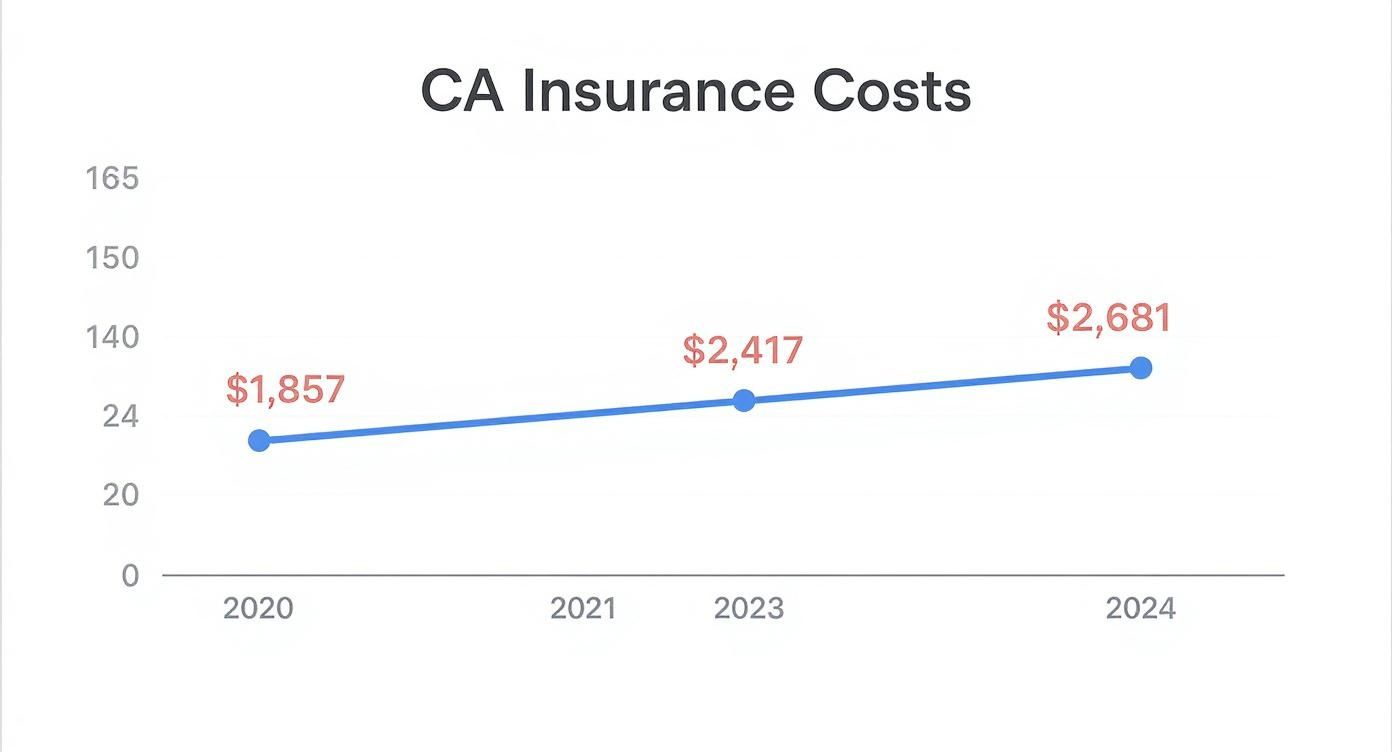
This trend isn't just a statistic; it's a real financial squeeze on drivers across the state. The good news is, you have more control than you think.
The Big Three: Your Record, Mileage, and Experience
In California, insurance carriers are required by law to weigh three specific factors above all others, and they have to do it in this exact order.
- Your Driving Safety Record: This is number one, the most heavily weighted factor by a long shot. A clean record—free of at-fault accidents and moving violations—is the single most powerful tool you have for securing a low rate.
- Your Annual Mileage: This one is just simple math for the insurer. The less you’re on the road, the lower your statistical chance of getting into an accident.
- Your Years of Driving Experience: More time behind the wheel signals stability and skill. An insurer sees someone who’s been licensed for 15 years as a much lower risk than a driver who just passed their test last year.
Think about it this way: a single speeding ticket can have a bigger impact on your premium than almost any other personal detail. In a real-world scenario, that ticket could easily hike your rate by 20% or more at renewal. A DUI is catastrophic, often tripling your premium overnight and making it incredibly difficult to find coverage at all.
Other Key Factors That Shape Your Final Price
While the "Big Three" set the foundation, other details help the insurer build a complete picture of the risk they're taking on. These secondary factors can still swing your final quote significantly.
Your location, for instance, matters a lot. A driver in dense, high-traffic San Francisco will almost always pay more for insurance than someone in a quieter area like Fresno. It all comes down to the local rates of theft, vandalism, and accidents.
The car you drive is another big piece of the puzzle. A brand-new sports car is far more expensive to repair or replace than a five-year-old sedan, which drives up the cost of your collision and comprehensive coverage.
If you need a quick refresher on what those coverage types mean, you can check out our handy glossary of common insurance terms.
Finally, the coverage limits and deductibles you select are direct levers on your cost. Opting for higher liability limits gives you more financial protection, but it will increase your premium. Likewise, choosing a lower deductible means the insurer pays more out-of-pocket after a claim, which translates to a higher upfront cost for you.
Bundling your auto policy with your home insurance, renters insurance, or even life insurance is another powerful move. Insurers love loyalty and reward it with multi-policy discounts that can seriously reduce your overall bill.
The numbers really drive home how much these factors matter. The average full coverage premium in California is around $3,119 per year, which is 16% higher than the national average. But look at the extremes: a driver with a recent DUI could see their annual premium jump to over $7,700. A newly licensed 18-year-old driver might face costs topping $8,100. These figures show just how much your personal profile and driving habits influence the final price you pay.
Unlocking Every Possible Insurance Discount
One of the biggest mistakes I see drivers make is leaving money on the table. Insurers have a whole menu of discounts available, but they don't always put them on a silver platter for you. If you're serious about finding the best auto insurance rates in California, you have to look beyond the standard "good driver" discount.
It's easy to assume your current policy already includes every discount you're eligible for, but in my experience, that's rarely true. You need to be your own advocate and ask about every single one. You'll likely be surprised at what you find.

Beyond the Basics: Bundling and Loyalty
Everyone's heard of bundling, and for good reason—it’s often the heavyweight champion of discounts. When you combine your auto insurance with other policies from the same company, the savings can be huge. This is one of the most effective strategies in California insurance.
Think about pairing your car insurance with:
- Home Insurance: This is the classic combo. Homeowners can often slash their combined premiums by up to 25% just by putting both policies under one roof.
- Renters Insurance: Don't own a home? No problem. Bundling a renters policy can still trim a nice chunk off your auto premium.
- Life Insurance: Some carriers even give you a break for bundling auto and life insurance. It's a smart way to protect your family's future while saving cash today.
This multi-policy approach shows the insurer you're a committed, long-term customer—a profile they are always happy to reward with better rates.
Digging Deeper for Uncommon Savings
This is where many drivers miss out. There are dozens of less-common discounts that fly under the radar but can really add up.
For instance, many insurers have "affinity" programs that offer special rates to members of certain professional organizations, university alumni groups, or even specific employers. Are you a teacher, a nurse, an engineer, or a first responder? There might be a discount waiting for you that you never knew existed.
Pro Tip: Make it a point to ask your insurance agent for a complete list of professional, occupational, or alumni groups that qualify for discounts. You could already be a member and not even realize it's a key to savings.
Technology and Education-Driven Discounts
These days, your premium isn't just about your past driving record; it's also about your current habits and commitment to safety. Technology and education are two powerful tools that can directly lower your costs.
Here are a few options to explore:
- Telematics Programs: Often called usage-based insurance, these programs use a simple smartphone app or a small device to track your actual driving habits. Things like smooth acceleration, gentle braking, and avoiding late-night trips can earn you a pretty significant discount based on how safe you actually are.
- Defensive Driving Courses: Completing a state-approved defensive driving course can often shave a few percentage points off your premium. This is especially useful for younger drivers or anyone trying to offset a minor ticket.
- Good Student Discount: If you have a high school or college student on your policy who keeps their grades up (usually a "B" average or better), you can qualify for a discount. It's a great way to reward their hard work and ease the high cost of insuring a young driver.
To help you keep track, here’s a quick checklist of common discounts to ask about.
Common California Auto Insurance Discounts Checklist
| Discount Type | Potential Savings (%) | Who Typically Qualifies |
|---|---|---|
| Multi-Policy (Bundle) | 10% - 25% | Customers with auto plus home, renters, or life insurance from the same carrier. |
| Good Driver | 20%+ | Drivers with a clean record for the past 3-5 years (no accidents or major violations). |
| Good Student | 5% - 15% | Full-time high school or college students under 25 with a "B" average or better. |
| Telematics/Usage-Based | 5% - 30% | Safe drivers willing to share their driving data via an app or device. |
| Vehicle Safety Features | 2% - 10% | Owners of cars with features like anti-lock brakes, airbags, and anti-theft systems. |
| Low Mileage | 5% - 15% | Individuals who drive less than a certain number of miles per year (e.g., under 7,500). |
| Defensive Driving Course | 5% - 10% | Drivers (often 55+ or young drivers) who complete an approved safety course. |
| Affinity/Professional Group | 5% - 15% | Members of specific alumni associations, professional organizations, or credit unions. |
Don't forget to ask about other possibilities, too, like discounts for paying your premium in full or setting up automatic payments. For a deeper dive into policy features, check out our guides on California insurance options to learn more about auto insurance, home insurance, and more.
Smart Plays to Bring Down Your Premium
Getting every last discount is a great start, but the real, long-term savings come from making proactive choices. Think of these as your playbook for keeping your insurance costs in check year after year. It's all about finding that perfect balance between what you pay and what you're protected for, so you aren't overspending or leaving yourself vulnerable.
Locking in the best auto insurance rates in California is less about a secret trick and more about making a series of smart, deliberate decisions.
Adjusting Your Deductible—The Right Way
One of the fastest ways to see your premium drop is by raising your deductible. This is the amount you agree to pay out-of-pocket on a collision or comprehensive claim before your insurance company starts paying. When you take on more of that initial risk, insurers thank you with a lower rate.
For example, bumping your deductible from $500 to $1,000 can often knock 15% to 30% off that portion of your premium. But it's not free money. You have to find your personal sweet spot.
Expert Tip: Never raise your deductible to an amount you couldn't comfortably pay tomorrow. A good deductible is high enough to save you money on your premium, but low enough that it won’t stop you from actually using your insurance when you need it.
Getting Your Coverage Limits Just Right
California sets minimum liability limits, but let's be honest—they're rarely enough to protect you if something serious happens. That said, it's also possible to have too much of a good thing. Your coverage should match your financial reality. If you own a home or have significant savings, higher liability limits are non-negotiable.
On the other hand, if you're driving an older car with a low resale value, paying for top-tier collision and comprehensive coverage might not make sense. You could easily pay more in premiums over a year or two than the car is even worth. In that scenario, some drivers choose to drop those coverages and pocket the savings. It's a personal call that requires a quick calculation: your car's value versus what you're paying to protect it.
The Power of a Clean Driving Record
Here in California, nothing impacts your rate more than your driving record. Period. Keeping it clean isn't just about avoiding the hassle of a ticket; it's a core financial strategy. A single at-fault accident or a major violation can spike your premium for three, sometimes even five, years.
On the flip side, a clean record proves you're a low-risk driver. This unlocks the best rates and qualifies you for the state-mandated 20% "Good Driver" discount. This is where safe, patient driving literally pays off in your wallet, year after year.
Your Car Choice Matters More Than You Think
Long before you even call for a quote, the car you choose to drive has already had a massive say in your insurance premium. Insurers have a ton of data on every model, and they focus on a few key things:
- Repair Costs: Is it a car with pricey, specialized parts or one where repairs are cheap and easy?
- Safety Ratings: Vehicles that protect occupants well in crash tests usually earn better rates.
- Theft Rates: If your car is on a "most stolen" list, your comprehensive coverage will reflect that risk.
A practical sedan or a family-friendly SUV will almost always be cheaper to insure than a souped-up sports car or a high-end luxury vehicle. Here's a pro tip: when you're car shopping, get insurance quotes on your final two or three choices before you sign the papers. That one simple step can save you from a major case of sticker shock and is a key part of landing the best California car insurance deal from day one.
How to Compare Car Insurance Quotes The Smart Way
Getting a handful of car insurance quotes is the easy part. The real skill—the one that saves you serious money—is knowing how to compare them effectively. This is where you move from just shopping around to actually making a smart decision, ensuring you get the right protection without overpaying.

So many drivers just scan for the lowest number and click "buy." That's a huge mistake. A cheap quote isn't a good deal if it leaves you exposed with liability limits that are too low or a sky-high deductible you can't possibly afford after an accident. To truly find the best auto insurance rates in California, you need a solid framework for an apples-to-apples comparison.
Creating a True Apples-to-Apples Comparison
First things first: you need to set a baseline. Before you even start looking for quotes, decide exactly what coverage levels you want. This means nailing down specific dollar amounts for liability, uninsured motorist coverage, and what you’re willing to pay for collision and comprehensive deductibles.
Then, when you request quotes, you must use that exact same set of numbers for every single company. It’s the only way to see which insurer is genuinely offering a better price for the same product.
Here’s a quick mental checklist to keep things consistent:
- Liability Limits: Do all quotes have the same bodily injury and property damage limits (e.g., 100/300/50)?
- Deductibles: Are the comprehensive and collision deductibles identical across all options (say, $1,000 for both)?
- Extra Perks: Did you add the same endorsements, like rental car reimbursement or roadside assistance, to each quote?
It’s common to see a quote that looks much cheaper, only to realize it has a $2,500 deductible instead of the $1,000 you asked for. That’s not a better deal; it’s just a different, riskier policy.
Looking Beyond the Price Tag
The cheapest policy isn't always the best one. An insurer's reputation and its ability to actually pay claims are just as critical as the premium. Before you sign anything, spend a few minutes digging into the company itself.
Look up their financial stability ratings from agencies like AM Best. A strong rating (think "A" or higher) is a good sign that the company has the financial backbone to pay out claims, even after a widespread disaster. You should also check customer satisfaction surveys and complaint data from the California Department of Insurance. This is real-world feedback on how a company treats its customers when they actually need help.
A low premium means nothing if the company disappears or fights you tooth and nail over a legitimate claim. A financially stable insurer with a solid service reputation provides a kind of peace of mind that a bargain-basement price simply can't buy.
The market is also under a lot of pressure right now. Historical data from the California Department of Insurance shows that from 1991 to 2021, losses for insurers grew dramatically. The loss ratio even hit an astonishing 126.66% in 2020. This means insurers paid out far more in claims than they collected in premiums, forcing them to push for higher rates just to stay in business.
The Value of an Independent Agent
This is exactly where working with an independent agent can be a game-changer. Instead of you having to track down quotes one by one, an agent does all the legwork. We can pull quotes from multiple carriers at once, making sure the coverage details are perfectly aligned for a true comparison.
More importantly, an agent understands the fine print. We know how to spot unusual exclusions or tricky conditions that might be buried deep in a policy document. We know from experience which companies have the best claims service and which ones are a better fit for drivers with specific needs. That expert guidance is invaluable, and you can start the process with a no-obligation quote to see how we can simplify your search for great California car insurance.
Common Questions About California Auto Insurance
Even after you've compared quotes and picked a policy, it's natural for a few questions to pop up. Making sure you have solid answers is the final piece of the puzzle, giving you the confidence that you've truly found the best auto insurance deal in California.
How Often Should I Shop for New Insurance?
I always tell my clients to make it an annual habit. Set a reminder to shop for new car insurance quotes about a month before your current policy renews. Rates are always shifting, and the company that gave you the best deal last year might be hundreds of dollars more expensive this time around.
You should also get fresh quotes anytime a major life event happens. For example:
- You move to a new zip code.
- You buy a new car.
- A teen driver is getting their license.
- An old ticket finally drops off your driving record.
Events like these change how an insurer sees you. What might not be a big deal to your current company could mean a huge discount with another one.
Don't Mistake Loyalty for Savings: It's a common misconception that sticking with one insurance company for years gets you the best deal. Often, the opposite is true. Insurers can slowly raise your rates over time—a practice sometimes called "price optimization." A quick annual check keeps them competitive and ensures you aren't leaving money on the table.
What Happens If My Coverage Lapses?
Letting your car insurance lapse, even for just one day, is a serious mistake in California. It's not just that driving without insurance is illegal and comes with hefty fines; it also brands you as a high-risk driver to every insurance company.
When you try to get a new policy, that lapse in your history will almost always lead to higher premiums. Insurers see it as a sign of instability, and they'll charge you more to cover that perceived risk. Maintaining continuous coverage is one of the easiest ways to keep your rates low.
Can Insurers Use My Credit Score in California?
Absolutely not. This is a big one that trips people up, but California law explicitly prohibits insurers from using your credit score to set your auto insurance rates.
While your credit history is a huge factor in most other states, California's Proposition 103 forces insurers to prioritize what really matters: your driving record, how many miles you drive each year, and your years of driving experience. This creates a much fairer system where your premium is based on how you drive, not your financial background.
Do I Need More Than Minimum Coverage?
Legally, you only need California's minimum liability coverage, which is $15,000 for injury to one person, $30,000 for injury to multiple people, and $5,000 for property damage. But in the real world, those limits are dangerously low.
Think about it—a single fender bender with a newer car can easily cause more than $5,000 in damage. A moderately serious accident can blow past the $15,000/$30,000 injury limits in a heartbeat. Once those limits are maxed out, you're on the hook for the rest, which could put your home, savings, and future earnings at risk.
If you have any assets to protect, increasing your liability limits is one of the smartest things you can do. The extra cost is usually small, but the peace of mind it buys is priceless.
Finding the right auto insurance, home insurance, renters insurance, or life insurance policy can feel overwhelming. The licensed agents at Mai & Associates are here to cut through the confusion. We provide same-day quotes from multiple carriers to find a policy that fits your life and your budget. Visit us at https://cahomeauto.com to compare rates instantly and get expert guidance on California insurance you can trust.