Basic Life Insurance: A Californian's Guide for 2026
You're probably doing what a lot of California families do. You pay the mortgage or rent, keep up with car insurance, worry about wildfire season, and tell yourself you'll deal with life insurance when things calm down.
The problem is that things rarely calm down.
For many households, basic life insurance starts as a checkbox during open enrollment at work. It feels simple, affordable, and good enough for now. Then a child arrives, a home loan gets bigger, or one spouse steps back from paid work to handle childcare. Suddenly that little workplace benefit doesn't feel so big anymore.
Securing Your Family's Future in the Golden State
A couple in Glendale has two kids, one car payment, one mortgage, and a calendar full of ordinary California expenses. Another family in San Diego rents now but wants to buy. A single parent in the Inland Empire is trying to keep tuition savings, groceries, and commuting costs moving in the right direction.
Different households. Same question. If something happened tomorrow, would the people you love be financially okay?
That's where life insurance belongs in the conversation. Not as a gloomy topic, but as a tool that helps a family keep its footing when income disappears. It can help cover rent or mortgage payments, daily bills, debt, childcare, and long-term goals that don't stop just because life turns hard.
The scale of this issue is greater than commonly understood. The global life insurance market reached $8.25 trillion in 2025, yet the global mortality protection gap still stood at roughly $414 billion per year in premium-equivalent terms, which shows how many families remain underprotected (global life insurance statistics).
Why Californians feel this pressure so clearly
California families tend to notice financial gaps faster because the financial pressures are significant. Housing costs can be heavy. Commuting can be expensive. Replacing one person's contribution to the household, whether that contribution is a paycheck or full-time childcare, can change the entire budget.
That's why life insurance works best when you treat it as part of a broader protection plan. If you're renting while you build toward homeownership, it also helps to look at practical coverage basics like California renters insurance options. And if you're thinking about long-term family protection beyond insurance alone, this guide to protecting loved ones through estate planning is worth reading.
Life insurance doesn't replace grief. It removes financial panic from the middle of it.
What basic life insurance can do right now
Generally, the first job of basic life insurance is simple:
- Keep the household running: It gives survivors money to handle bills without immediate scrambling.
- Protect major obligations: A policy can help prevent a mortgage, rent payment, or debt from becoming a crisis.
- Buy time: Your family may need breathing room to make good decisions instead of rushed ones.
This is the fundamental point. Peace of mind isn't abstract. It's knowing your family would have options.
What Is Basic Life Insurance Really
When people say basic life insurance, they usually mean the life insurance offered through an employer. It's often the first policy someone ever gets, and for good reason. Enrollment is usually straightforward, payroll deduction makes it feel painless, and there may be little or no medical screening for the base amount.

Why employer basic life insurance is usually affordable
Employer plans work on a group basis. The insurer covers a pool of employees instead of pricing each person as a completely separate case. That group structure often lowers cost.
A concrete example helps. In employer-administered group Basic Life plans, a fixed $300,000 death benefit might cost around $26.40 per month, and premiums are typically 30 to 50% lower than comparable individual term coverage because risk is spread across the employee group (group plan example from Standard).
What you're actually buying
Think of employer basic life insurance as the starter version of protection. It gives your beneficiaries a death benefit if you pass away while the policy is active and you're still eligible under the plan.
That can be useful, especially if you've never had coverage before. It's one reason many Californians start with workplace benefits and then compare them with individual life insurance options in California.
Practical rule: If your employer offers basic life insurance, take a close look at it. It may be a strong foundation. It just may not be enough on its own.
Where people get tripped up
The word “basic” sounds reassuring, but it also hints at the main limitation. This coverage is often designed as a foundation, not a full plan for a family with a mortgage, children, or one income supporting several people.
Common sticking points include:
- Coverage may be modest: The amount might not match your real household needs.
- Portability can be limited: If you leave the job, retire, or your benefits change, the coverage may not follow you in the same way.
- Options may be narrow: Employer plans can be useful, but they don't always offer the same customization as an individually owned policy.
A simple way to think about it is this. Employer basic life insurance is like the spare tire in your trunk. You'll be glad it's there when you need it. But you wouldn't want to mistake it for a complete long-distance driving plan.
The Main Types of Life Insurance Policies Explained
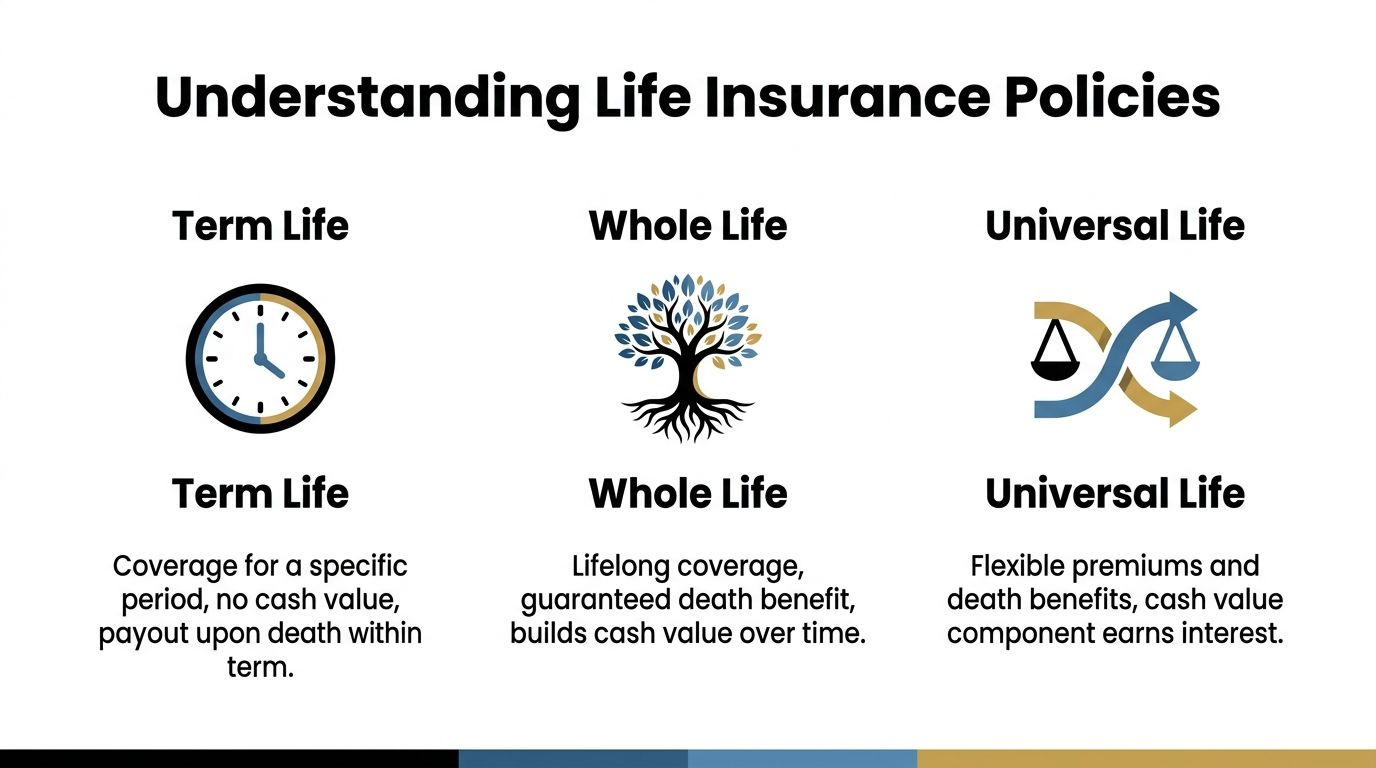
Once you move past workplace coverage, you'll encounter three big categories: term life, whole life, and universal life. The names can sound technical, so I like to compare them to cars.
Term life is like leasing. Whole life is like owning. Universal life is ownership with more moving parts and more flexibility.
Term life works like a lease
Term life gives you coverage for a set period. People often choose it when they want protection during their highest-responsibility years, such as while raising children, paying down a mortgage, or covering working years when income matters most.
Why many families like it:
- It's straightforward: You pay for coverage during the term.
- It fits temporary needs well: Mortgage years, child-raising years, and debt-heavy years are common examples.
- It's easier to explain: There's usually less complexity than permanent policy designs.
The tradeoff is simple. If the term ends, the policy doesn't keep going forever unless there's a feature that allows a different path forward. Term is about protection, not building cash value.
Whole life works more like owning a car outright
Whole life is permanent coverage. It's built to last for life as long as the policy stays in force, and it typically includes a cash value component that grows over time.
People usually consider whole life when they want predictability. The design is often attractive to buyers who like stable premiums, lifetime coverage, and the idea that part of the policy has value during their lifetime.
Whole life tends to fit people who want:
- Long-term certainty
- A policy with cash value
- A more structured, less flexible design
The downside is usually cost. Permanent coverage generally asks for a bigger commitment than term.
Universal life adds flexibility, but also more decisions
Universal life is another form of permanent insurance, but it's built with more adjustable features. Depending on the policy, premiums and death benefits may have some flexibility, and there's usually a cash value component tied to the policy structure.
That flexibility can be appealing if your income changes over time or you want more room to adapt. It can also create confusion if you don't review the policy carefully and understand how it's designed to perform.
A flexible policy can be useful. It also asks the owner to pay attention.
A side-by-side comparison
| Policy type | Best simple analogy | Coverage length | Cash value | Flexibility | Good fit for |
|---|---|---|---|---|---|
| Term life | Leasing a car | Set period | No | Lower | Families focused on income replacement and budget |
| Whole life | Owning a car | Lifelong | Yes | Lower | People who want permanence and predictability |
| Universal life | Owning with adjustable features | Lifelong if maintained | Yes | Higher | Buyers who want permanent coverage with more options |
Which one tends to fit which household
A young family in Orange County trying to protect income during mortgage years often starts by looking at term. A buyer who wants lifelong coverage and likes a more fixed design may lean toward whole life. Someone with changing business income may ask whether universal life's flexibility matches their needs.
There isn't one universally “best” policy. There's only the policy that best matches your budget, your risk tolerance, your timeline, and what you want the coverage to do.
That's why a good life insurance conversation usually starts with your life, not the product brochure.
How Much Life Insurance Coverage Do You Need
At this point, many people get bad advice.
The shortcut you hear most often is the 10x income rule. It's easy to remember, but it misses a lot of real life. It especially fails for people with uneven income, co-signed obligations, or household roles that don't show up neatly on a paycheck.
The common 10x income rule fails many people, especially the 20% of U.S. workers in the gig economy. A better calculation accounts for income volatility, co-signed debts, and the replacement value of non-monetary contributions like childcare that many standard calculators overlook (coverage guidance from Guardian Life).
A better way to think about coverage
Instead of asking, “What multiple of income am I supposed to buy?” ask, “What financial hole would my death leave behind?”
That question is more useful because it works for many California households, including freelancers, stay-at-home parents, blended families, and couples with uneven earnings.
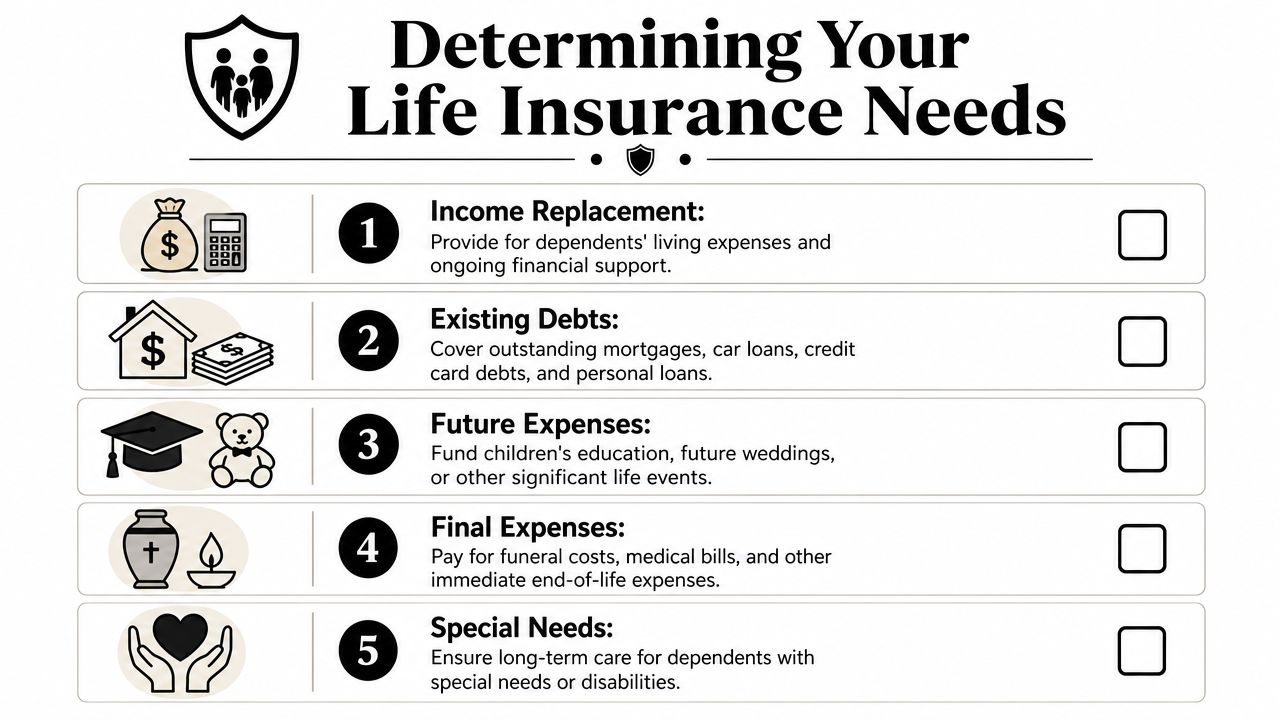
A practical framework is DIME:
- Debt: Credit cards, personal loans, co-signed balances, and vehicle loans
- Income: How much support your family would need and for how long
- Mortgage: Or rent support, depending on your housing plan
- Education: College, trade school, or other long-term child expenses
California examples that change the math
A software contractor in Los Angeles may have strong income one year and weak income the next. A parent in Sacramento may not earn wages right now but may provide childcare, school transportation, meal prep, and elder support that would be expensive to replace. A married couple in the Bay Area may both work, but one may carry the health insurance and most of the retirement contributions.
Those details matter more than a rule of thumb.
If your household depends on your time, your labor, your credit, or your income, that contribution deserves a place in the calculation.
Build your estimate in layers
Start with the immediate needs first, then move outward.
Short-term bills
What would your family need right away to stay afloat? Think about monthly living costs and any urgent obligations.Big debts
Mortgage balances, car loans, and other debts don't disappear because a family is grieving.Future goals
Education funding and child-related support often get forgotten when people choose a number too quickly.Special situations
A child with ongoing care needs, support for aging parents, or a family business can change the picture substantially.
Don't overlook unpaid work
This point gets missed all the time. A parent who doesn't bring home a paycheck may still be carrying an enormous economic load. If that person died, the surviving household might need paid childcare, after-school help, transportation support, household management, and schedule flexibility.
That's why coverage should reflect replacement cost, not just salary.
A simple test
When you settle on a coverage amount, ask one more question: would this amount protect my family's lifestyle, or would it just delay financial stress?
That single question usually tells you whether your estimate is realistic.
Customizing Your Policy with Common Riders
A life insurance policy doesn't have to be one-size-fits-all. Riders are optional add-ons that modify the policy, a lot like choosing features when you buy a car. The base model works, but certain upgrades can make the policy fit your real life much better.
Three riders many families ask about
Accelerated death benefit rider
This rider may allow access to part of the death benefit if the insured becomes terminally ill and meets the policy's conditions. Families often value it because serious illness can create both emotional strain and sudden expenses.
Waiver of premium rider
If the insured becomes disabled and qualifies under the policy terms, this rider may keep the coverage in force without requiring ongoing premium payments. That can matter when a health event interrupts income at the exact moment insurance becomes more important.
Child rider
A child rider usually provides a smaller amount of coverage for eligible children under one rider attached to the parent's policy. Many people don't buy it for the payout alone. They buy it because it can help with final expenses and creates one more layer of planning in a difficult category of risk.
How to decide if a rider is worth it
Not every rider belongs on every policy. Some add real value. Others sound appealing but don't match your situation.
A useful filter is to ask:
- Does this rider solve a real problem in my household?
- Would I regret not having it if life changed suddenly?
- Do I understand the conditions for using it?
Think in terms of “what could interrupt the plan”
A family that relies on one income may prioritize the waiver of premium rider. A household with a serious family medical history may want to ask more about living-benefit style features. Parents with young children may want to understand child-related options even if they ultimately decide to keep things simple.
Policies are contracts, so details matter. Riders can be valuable, but only if you understand what triggers them, what they cost, and where their limits are.
Riders are best used to cover the awkward gaps that a standard policy leaves open.
Buying Life Insurance in California Step by Step
Buying life insurance feels intimidating until you break it into pieces. In practice, it's usually a sequence of decisions, forms, and follow-up.
The process in plain English
Step 1. Figure out your goal
Before you shop, decide what the policy needs to do. Replace income for a set period? Protect a mortgage? Cover long-term family obligations? The clearer the job, the easier it is to choose the right product.
Step 2. Compare more than one offer
Don't stop at the first quote. Different insurers evaluate applicants differently, and policy design matters just as much as price. If you want to learn the questions smart shoppers ask across multiple policy types, these California insurance guides are a useful starting point.
Step 3. Complete the application carefully
Accuracy matters. Life insurance applications ask about health, medications, lifestyle, and history. If something is unclear, ask before submitting. A rushed answer can create problems later.
What happens after the application
Some policies require a medical exam. Others may not, depending on the product and applicant profile. If there is an exam, it's usually focused on basic health information.
Then underwriting reviews the file. That means the insurer is deciding whether to offer coverage and on what terms. This is the part people tend to overcomplicate. Really, the company is just evaluating risk based on the information it has.
Questions worth asking before you buy
A short list can save you from expensive misunderstandings later:
- Is this policy term or permanent?
- Can the policy be changed later if my needs change?
- What riders are available, and which ones are useful for me?
- What happens if I miss a payment?
- If this is workplace coverage, what happens when I leave my job?
A calm way to approach it
Don't try to master every insurance term in one sitting. Start with your need, compare options, and ask direct questions until the policy makes sense in ordinary language.
If an explanation sounds polished but still feels confusing, keep asking. You're not buying jargon. You're buying a contract that your family may depend on.
Get Your California Life Insurance Quote with Mai & Associates
Choosing life insurance is easier when someone helps you connect the policy to real California life. That means looking at your budget, your housing costs, your family responsibilities, and the kind of protection gap you'd leave behind.
It also helps to work with an agency that understands that insurance decisions rarely happen in isolation. Life insurance sits next to car insurance, home insurance, renters insurance, and liability decisions. Many Californians want one place to compare options across all of them, especially when they're reviewing coverage after a move, a marriage, a home purchase, or a new baby.
Why California-specific guidance matters
Rules change, and California households feel those changes fast. Starting January 1, 2025, California legally requires all drivers to carry minimum auto liability coverage of $30,000/$60,000/$15,000, which is a good reminder that working with an agent who follows changing state requirements matters across all lines of coverage, not just life insurance (California auto minimum update).
That matters if you're reviewing life coverage and also realizing your auto, home, or renters coverage may need an update. It's one reason many families prefer to get a California insurance quote from an agency that can look at the full picture instead of one isolated policy.
What to look for in an agency
The strongest insurance relationship usually includes three things:
- Carrier choice: You want options, not a single canned answer.
- Clear explanation: A good agent should be able to explain term, whole, universal, and riders without hiding behind jargon.
- California fluency: Wildfire concerns, housing costs, renter needs, and changing car insurance rules all shape the advice that makes sense here.
If you're shopping for life insurance in California, those details matter. So does responsiveness. When families finally decide to act, they usually don't want a week of back-and-forth just to get clarity.
Life insurance works best when it's understandable, properly sized, and coordinated with the rest of your protection plan.
If you want help comparing life insurance, car insurance, auto insurance, home insurance, or renters insurance in California, Mai & Associates can help you review your options, compare carriers, and get clear answers without pressure. For many California families, that's the fastest way to turn “I need to deal with this soon” into a real plan.