Bad Driving Record Insurance: Lower Costs in 2026
You open your California auto insurance renewal and see the premium has climbed by hundreds of dollars. The cause may be one speeding ticket, an at-fault accident, a DUI, or a lost good-driver discount. Even if you haven't filed a claim, the insurer may now view your driving history as a stronger sign of future risk.
That situation is stressful because the label high risk affects more than the price of car insurance. It can make standard coverage harder to find, create an SR-22 filing obligation, and force you to think carefully about liability limits and uninsured motorist protection. The right response isn't to buy the cheapest policy without checking what it covers. It's to understand how California insurers evaluate your record, then compare coverage that fits both your driving history and your budget.
Introduction to Bad Driving Record Insurance
A California driver named Elena receives a renewal notice after a single speeding conviction. Her policy hasn't changed, her car is the same, and she hasn't caused an accident. Yet the insurer recalculates her risk and removes the clean-driver pricing she previously received. She now needs to decide whether to stay with the carrier, shop among other insurers, or ask an agent about bad driving record insurance.
The phrase doesn't describe one special policy sold by every company. It usually refers to auto insurance for motorists whose tickets, accidents, DUI convictions, license issues, or coverage lapses make them more expensive to underwrite. Some drivers remain eligible for standard policies with a surcharge. Others may need a nonstandard carrier or an SR-22 filing before they can legally reinstate driving privileges.
The practical distinction: A high-risk label changes how insurers price and accept your application, but it doesn't remove your right to compare policies.
California drivers also need to separate the legal requirement from the protection they require. A policy can satisfy the state's minimum obligation while leaving serious gaps after a collision, especially when the other motorist has little or no insurance. Your record may raise the cost of coverage, but cutting protection too aggressively can expose your savings, income, and vehicle to a much larger loss.
This guide focuses on California auto insurance while connecting the decision to broader household protection. Home insurance, renters insurance, and life insurance aren't priced from your driving record in the same direct way, but reviewing them together can reveal liability and financial-protection gaps. The immediate task, however, is clear: identify what changed, find insurers willing to work with your record, and keep future violations from stacking up.
Understanding Bad Driving Record Insurance
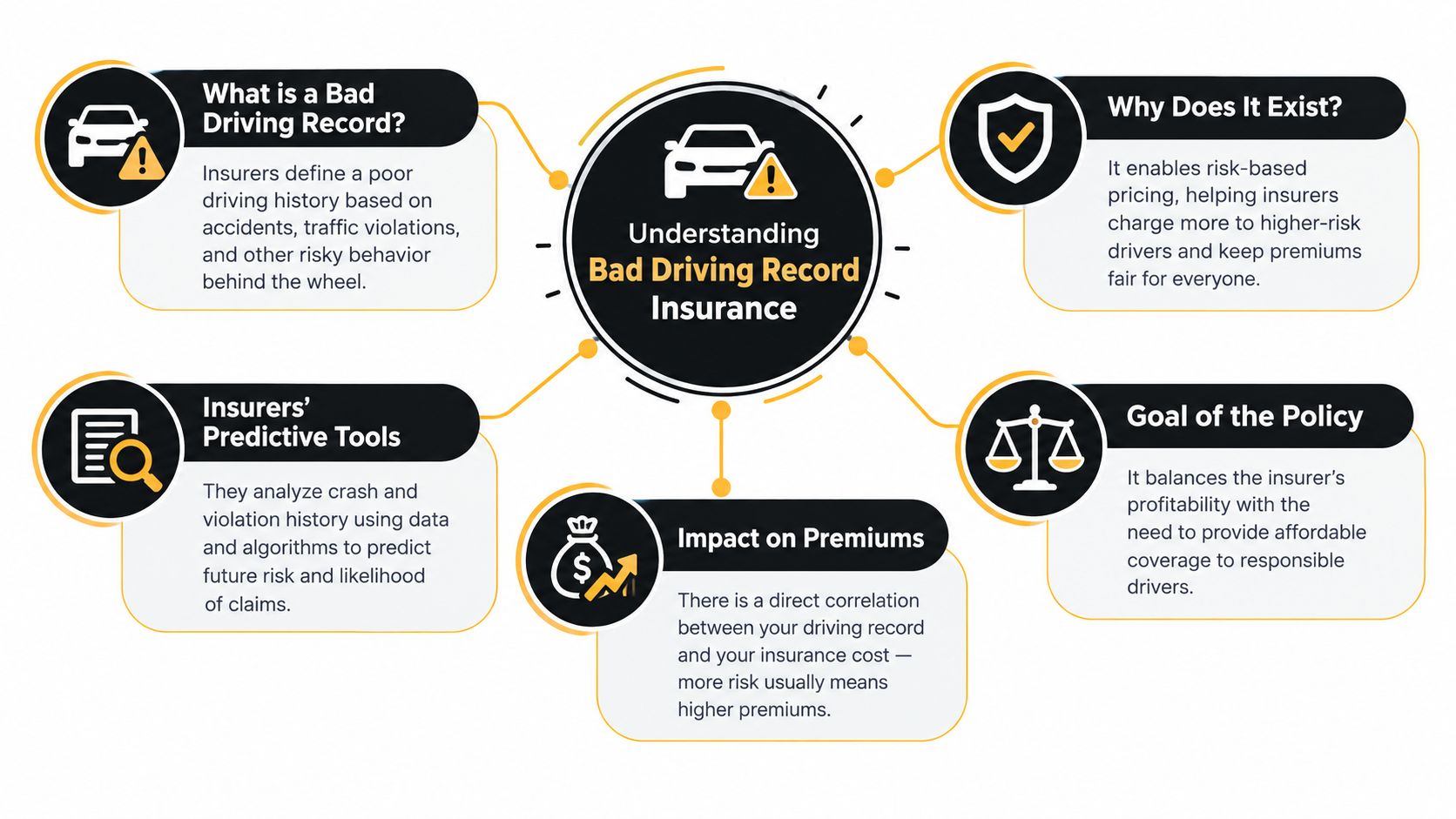
Insurers use driving history as a forecasting tool. A speeding ticket, an at-fault accident, and a DUI aren't treated as identical events because each can signal a different combination of driving frequency, claim likelihood, and potential claim severity. The insurer places those signals into a risk tier, then combines them with other underwriting information such as the vehicle, location, coverage choices, and insurance history.
You can think of the process as a sorting system:
- Speeding tickets can indicate a greater likelihood of future traffic incidents.
- At-fault accidents show that a previous loss involved the driver's responsibility.
- DUI convictions represent a more severe underwriting signal and commonly produce a sharper surcharge.
- Repeated violations suggest frequency, not merely an isolated mistake.
- Coverage lapses can create another concern because continuous insurance history helps an insurer assess reliability.
Contemporary rate research shows a single speeding ticket can add about 15% to 25% to premiums for three years, while higher-severity violations produce much larger jumps, including 59% for DUIs and 31% for at-fault accidents, according to rate research on bad driving records.
Severity and recency work together
The age of an incident matters because insurers generally care more about recent conduct than an older, isolated event. Severity matters separately. A minor ticket and a serious alcohol-related offense can both appear on a motor vehicle record, but the underwriting consequences won't usually be comparable.
That explains why two neighbors with similar cars can receive very different quotes. One may have a clean record and qualify for preferred pricing. The other may have a recent accident or DUI and enter a higher-cost pool, even if both drivers request the same deductible and liability limits. For a broader California auto insurance comparison, review California auto insurance coverage guidance.
Impact of Traffic Violations and At Fault Accidents on Rates
A California driver can see a higher renewal premium after a speeding ticket, an at-fault accident, or a DUI. The increase depends on two rating signals: frequency, meaning how often incidents appear, and severity, meaning how serious each event is. One analysis found average increases of about 38% for a speeding ticket, 60% for an at-fault accident, and 92% for a DUI, according to traffic-violation insurance rate analysis.
A separate market comparison found that high-risk drivers paid about 62% more on average than clean-record drivers. It reported average annual premiums of $3,063 for high-risk drivers and $1,895 for safer drivers, as detailed in high-risk driver premium data.
| Violation | Premium Increase |
|---|---|
| Speeding ticket | About 38% on average |
| At-fault accident | About 60% on average |
| DUI | About 92% on average |
These figures are reference points, not a quote for your policy. Insurers may apply different base premiums, violation definitions, claims histories, territories, vehicle ratings, and eligibility rules. Use the table to compare relative severity rather than predict a renewal bill.
Why repeated incidents hurt more
One incident can move a driver into a less favorable rating tier. Several incidents can indicate a continuing pattern, much like repeated warning lights suggest a recurring problem rather than one isolated fault. One dataset found that drivers with one violation paid about 27% more annually than clean-record drivers. The penalty rose to 36% for two violations and 54% for three or more, according to violation surcharge research.
Another market analysis reported that one DUI could raise average annual premiums to roughly $4,959. In one comparison, bad-record drivers averaged $2,844, compared with a general average of $1,150, as summarized in high-risk auto insurance market analysis. These datasets use different methods, so the amounts should not be combined into a personal estimate.
California's uninsured motorist risk can also affect how an insurer evaluates the policy, especially when an at-fault claim exposes gaps in financial protection.
Important: Compare the full premium, liability limits, deductibles, exclusions, and uninsured motorist protection, not only the surcharge.
California Insurance Requirements and SR 22 Filings
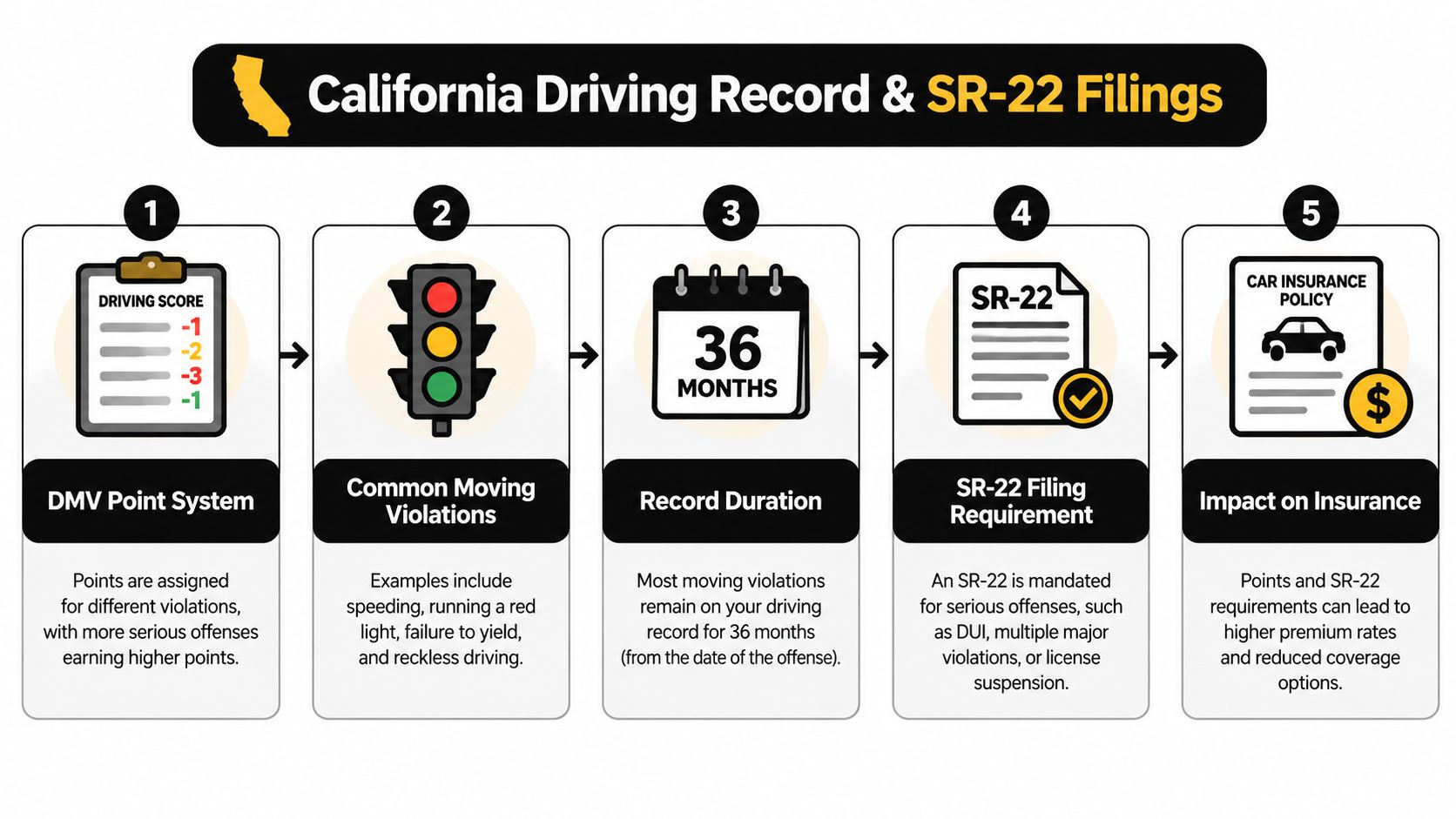
California treats the driving record and the insurance filing as related but separate issues. The DMV records qualifying violations and points, while an insurer evaluates that history during underwriting. An SR-22 is generally a certificate filed by an insurance company to demonstrate that the driver carries required financial responsibility after certain serious violations or license-related events.
Most one-point moving violations remain on a California driving record for 36 months, while DUI-related violations can remain for seven years or longer, depending on the violation type, according to California DMV point-duration guidance.
A practical SR-22 process
- Confirm the court or DMV requirement. Ask which filing is required and whether you must maintain it for a specified period.
- Disclose the violation accurately. An insurer needs the correct conviction and license information to quote and file properly.
- Choose a carrier that files SR-22 forms. Not every standard insurer handles every high-risk situation.
- Ask the carrier to submit the certificate. The filing supports proof of financial responsibility, but it doesn't function as extra coverage by itself.
- Keep the policy active. A cancellation or lapse can lead the insurer to notify the state, potentially affecting your driving status.
- Confirm reinstatement requirements. Pay any required fees and verify that the DMV has accepted the filing before driving.
A DUI arrest can create urgent legal and transportation decisions that insurance advice alone can't answer. For general guidance about immediate post-arrest considerations, consult Bada Bing Bail Bonds' DUI advice, then rely on your attorney, court, DMV, and licensed insurance professional for case-specific instructions.
California's good-driver framework can also be lost after a moving violation. One source notes that maintaining a valid license for the prior three years and having no more than one DMV point are conditions for keeping that discount, so a conviction may affect pricing before an insurer places you in a specialized high-risk market. You can find additional California policy resources in the California insurance guides.
Insurance Options for High Risk Drivers
High-risk drivers usually have three broad paths. The best choice depends on the seriousness and age of the violation, whether an SR-22 is required, the driver's budget, and the protection needed after a crash.
Nonstandard insurers specialize in applicants who may not qualify for preferred pricing. They can be useful when a standard carrier declines the application or applies a surcharge that makes renewal unaffordable. Read the policy carefully, because a lower quote may come with narrower optional coverage, different deductibles, or fewer available discounts.
A state-assigned risk option may help when private insurers won't provide the required liability coverage. It can preserve legal access to insurance, but it shouldn't automatically be treated as the most affordable or complete choice. Ask whether other carriers can offer a better combination of price and protection before accepting an assigned placement.
Minimalist liability coverage can reduce the immediate premium, but it may leave your vehicle and finances exposed. If you finance or lease a car, the lender may require collision and other physical damage coverage. Even when the law permits less, the financially sensible limit may be higher than the minimum.
Don't overlook uninsured motorists
The Insurance Research Council estimated that 33.4% of motorists were uninsured or underinsured in 2023, which increases the importance of uninsured and underinsured motorist protection, according to UM and UIM coverage guidance. This coverage can help protect you when another driver causes a covered injury or damage but lacks enough insurance, subject to the policy terms.
A bad record already makes your own coverage expensive. That makes it tempting to reduce limits everywhere, but removing UM/UIM protection can shift the financial risk to you. Compare the cost of stronger protection against the potential consequences of an uninsured driver's mistake.
How to Obtain Coverage and Lower Your Premiums
Start with accurate information. Gather your driver's license details, vehicle identification information, current declarations page, violation dates, accident details, and any SR-22 instructions. Insurers can price the application more reliably when the record is complete, and accurate disclosure helps prevent problems after purchase.
Traffic tickets can raise rates for three to five years, with first-year premium increases commonly ranging from $320 to $385, depending on the violation and insurer, according to ticket surcharge duration research.
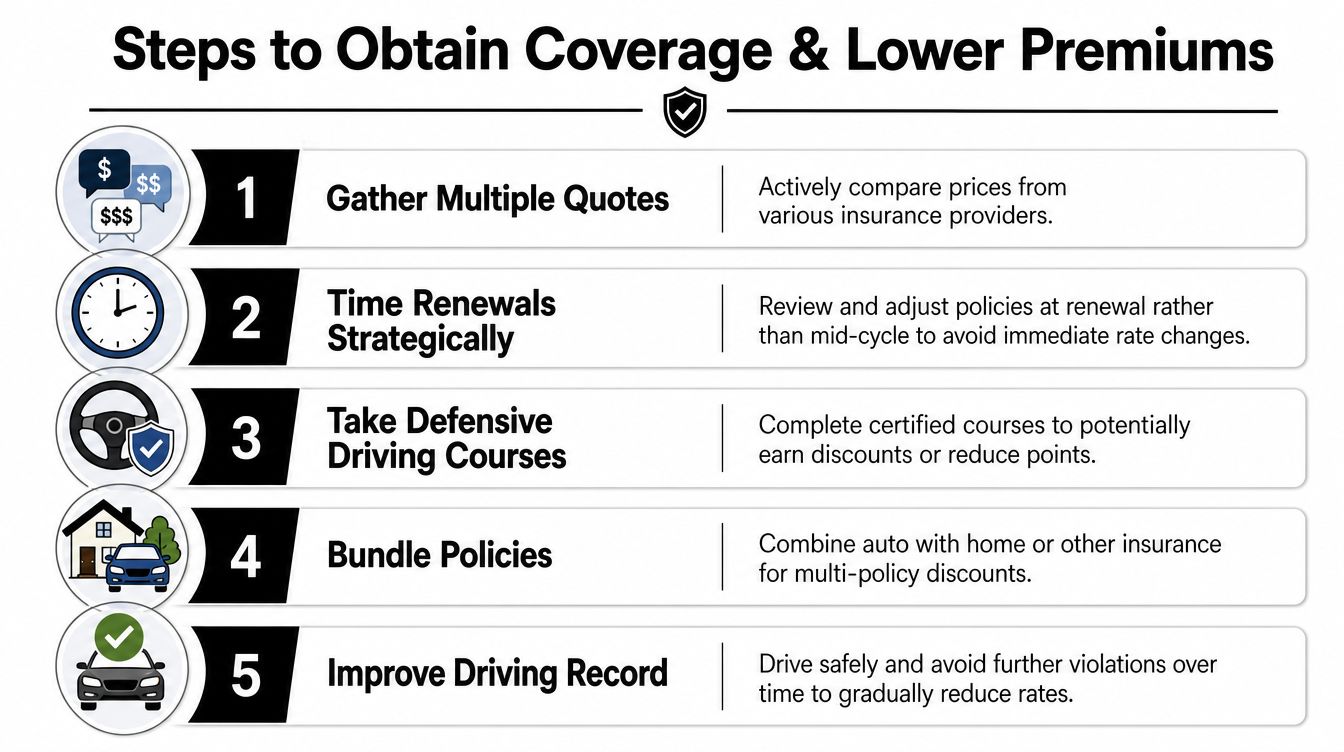
Five actions that can improve your choices
- Gather multiple quotes: Ask several carriers to price the same liability limits, deductibles, vehicle usage, and optional protections. Otherwise, you're comparing different policies rather than different prices.
- Review at renewal: A renewal is a useful point to recheck the market and your coverage. Ask whether a new violation, record update, or carrier rule changed the premium.
- Take a certified defensive driving course: Completion may support a discount or help with an eligible record-related requirement, but confirm the course and discount with the insurer before paying.
- Bundle thoughtfully: Combining auto with home insurance or renters insurance may create a multi-policy opportunity. Don't accept a bundle automatically. Compare the combined price and coverage with separate policies.
- Protect the record going forward: The most dependable long-term strategy is avoiding another violation during the same underwriting window. A clean stretch gives older incidents time to matter less under carrier rules.
If you manage business vehicles, personal auto tactics don't cover every pricing issue. Fleet operators can review strategies for cutting fleet insurance for ideas that apply to driver selection, safety practices, and fleet risk management. For personal policy questions, consult the California insurance FAQ.
Next Steps with Mai Associates
A bad driving record doesn't require you to guess at coverage or accept the first price you see. Mai & Associates helps California drivers compare carriers, request same-day quotes, and speak with licensed agents who can explain SR-22 needs, liability limits, UM/UIM protection, and available policy combinations.
The agency supports auto, home, renters, and life insurance, with multilingual assistance in English, Spanish, Armenian, Russian, and Vietnamese. Drivers can begin through the California insurance quote request and provide their license information, vehicle details, current policy, and violation or filing documents so an agent can evaluate the situation accurately.
Mai & Associates can compare California auto insurance options for drivers with tickets, accidents, DUI-related requirements, or lapses, while also reviewing home, renters, and life insurance needs. Visit Mai & Associates today to request a no-obligation quote and start comparing coverage that protects more than just your ability to drive.