What Is the Average Renters Insurance California Cost?
So, what does it actually cost to protect your stuff as a renter in California? The short answer is, probably less than you think. On average, you're looking at about $15 per month, which comes out to roughly $182 for the entire year.
That small monthly payment is your safety net. It protects your personal belongings if they're stolen or damaged and shields you from liability if someone gets hurt in your apartment. It's a surprisingly affordable way to gain major financial security—often for less than what a couple of weekly coffee runs would set you back. Navigating California insurance can be complex, but renters coverage is one of the simplest and most valuable policies you can own.
Your Guide to the Average Cost of Renters Insurance in California
Diving into the world of insurance can feel a bit overwhelming, but getting a handle on renters insurance costs is a great place to start. Think of it as a small, predictable expense that stands in the way of a huge, unexpected one. For what you might spend on a streaming subscription, you can safeguard everything you own, from your laptop and TV to your couch and clothes.
Here in California, the price for that peace of mind is a little higher than in other parts of the country. The state average for renters insurance is $182 per year, which is a step up from the national average of $148 annually. Why the difference? It boils down to California's higher cost of living and a unique mix of risks, from urban theft in dense cities to the ever-present threat of wildfires.
California vs The National Average
This chart really puts the numbers into perspective, showing a side-by-side look at how California's average renters insurance rates stack up against the rest of the U.S.
As you can see, Californians pay about 23% more for their renters policies. This is a direct reflection of the state's distinct economic and environmental landscape, and it really drives home the importance of finding a policy that gives you the right amount of protection without breaking the bank.
Think of your renters policy as a financial buffer. It ensures that one bad day—like a kitchen fire or a break-in—doesn't wipe out your savings by forcing you to replace everything you own out of pocket.
Getting a grip on these costs is the first step toward making a smart decision about your coverage. Whether you're in the market for renters insurance, home insurance, or auto insurance, knowing the basics makes all the difference. To learn more, check out our other California insurance guides to build up your knowledge.
What Your Renters Insurance Policy Actually Protects

It’s one of the biggest misconceptions we see: renters thinking their landlord's insurance has them covered. In reality, the landlord's policy only protects the building itself—the walls, roof, and floors. Your life and everything you own inside those walls? That's on you.
This is exactly where your renters insurance policy steps in. Think of it as a financial safety net built on three core pillars, each designed to catch you when a different kind of disaster strikes. Once you see how they work together, you'll understand the real value packed into that small monthly premium.
Personal Property Coverage
This is the heart and soul of any renters policy. It’s all about protecting your stuff—your furniture, laptop, clothes, kitchen gear, you name it—from unexpected events like fire, theft, or a burst pipe from the apartment above. This is the coverage that helps you rebuild your life without having to liquidate your savings.
Let's say you come home from work to find your door kicked in. Your $1,500 laptop is gone, along with your new $800 TV. You're looking at a $2,300 replacement bill out of nowhere. With renters insurance, you just file a claim, pay your small deductible, and the policy kicks in to cover the rest. It’s that simple. And here’s a great bonus: this coverage often follows you, protecting your belongings even if they’re stolen from your car or while you're on vacation.
Liability Protection
Liability coverage is your financial bodyguard. It protects you from lawsuits if someone is accidentally injured in your apartment and you’re held responsible. Honestly, this might be the single most important part of your policy.
Imagine a friend comes over, slips on a freshly mopped kitchen floor, and breaks their wrist. The medical bills alone could easily run into the thousands. If they decide to sue, you could be on the hook for a lot more. Your liability protection handles those legal fees and medical payments up to your policy limit. This is precisely why most landlords now require tenants to carry at least $100,000 in liability coverage. It’s a non-negotiable for homeowners, too, as we explain in our guide to home insurance in California.
A renters policy does more than just replace things; it protects your financial future. Liability coverage is the part of your policy that prevents a single accident from jeopardizing your savings and assets for years to come. This is a core principle across many types of California insurance, from car insurance to home insurance.
Additional Living Expenses
This part of your policy answers the question, "Where do I go if I can't live in my apartment?" If a fire or major water damage makes your place uninhabitable, Additional Living Expenses (ALE) coverage—sometimes called "loss of use"—pays for you to live somewhere else while repairs are made.
It’s an absolute lifesaver. This coverage helps with the extra costs you're forced to take on, such as:
- Hotel bills or a short-term rental
- The cost of restaurant meals if your kitchen is out of commission
- Laundry services, pet boarding, and other essentials
ALE coverage ensures a disaster doesn't leave you scrambling for a place to stay or burning through your cash just to maintain a normal routine. It provides stability when you need it most.
What Goes Into Your California Renters Insurance Rate?
Ever wonder why your friend across town pays a different price for renters insurance? It’s not just random. Insurers don't simply pull a number out of a hat; they're more like risk detectives, piecing together clues about your specific situation to figure out a fair price. That's why the average renters insurance California cost is really just a benchmark.
Your final premium is a unique recipe made up of several ingredients—some you can control, and some you can't. Getting a handle on these factors helps you understand where your money is going and, more importantly, shows you where you might be able to find some savings. Let's break down what really matters.
Where You Live (And the Risks That Come With It)
In the insurance world, your address tells a story. Insurers look at your zip code to get a sense of the potential for claims in your specific area. This isn't about judging a neighborhood; it's a process driven entirely by data.
They look at local statistics for things like:
- Crime Rates: If an area has a higher-than-average rate of burglaries or vandalism, there’s a greater chance of a theft claim. That increased risk is often reflected in the premium.
- Proximity to Natural Disasters: This is a huge one in California. If you're renting in a place officially designated as a high-risk wildfire zone or an area known for seismic activity, that will almost certainly influence your rate.
- Weather Patterns: Even the likelihood of severe storms or regional flooding gets factored in, as those events can lead to widespread water damage claims.
The Coverage You Choose and Your Deductible
While you can’t exactly pick up your apartment and move it to a lower-risk zone, you do have total control over how much coverage you buy. This is where you can really tailor your policy to fit both your needs and your budget. The two main levers you can pull are your personal property limit and your deductible.
It’s pretty simple: the more financial risk the insurance company takes on for you, the more you'll pay in premiums. A policy that covers $50,000 worth of your stuff will naturally cost more than one that only covers $20,000. The same principle works for your deductible, which is the amount you pay yourself before your insurance coverage starts.
How Your Deductible Changes Things: Choosing a higher deductible means you're agreeing to cover more of the initial cost of a claim. In return, the insurance company gives you a lower premium. A lower deductible means you'll pay less out-of-pocket, but your monthly bill will be a bit higher.
For example, bumping your deductible from $500 to $1,000 can often create some real savings over the year. It’s all about finding that sweet spot between what you pay now and what you’d be comfortable paying later if you had to file a claim. By making smart choices here, you can build a solid California insurance policy for your home or car that gives you peace of mind without overpaying.
Dealing with California's Unique Insurance Challenges
Renting in the Golden State comes with a few extra things to think about, namely environmental risks you just don't see in most other parts of the country. Your standard renters policy is a great start, but it has some major blind spots when it comes to California’s two biggest threats: earthquakes and wildfires. Knowing what isn't covered is the first step to making sure you're actually protected.
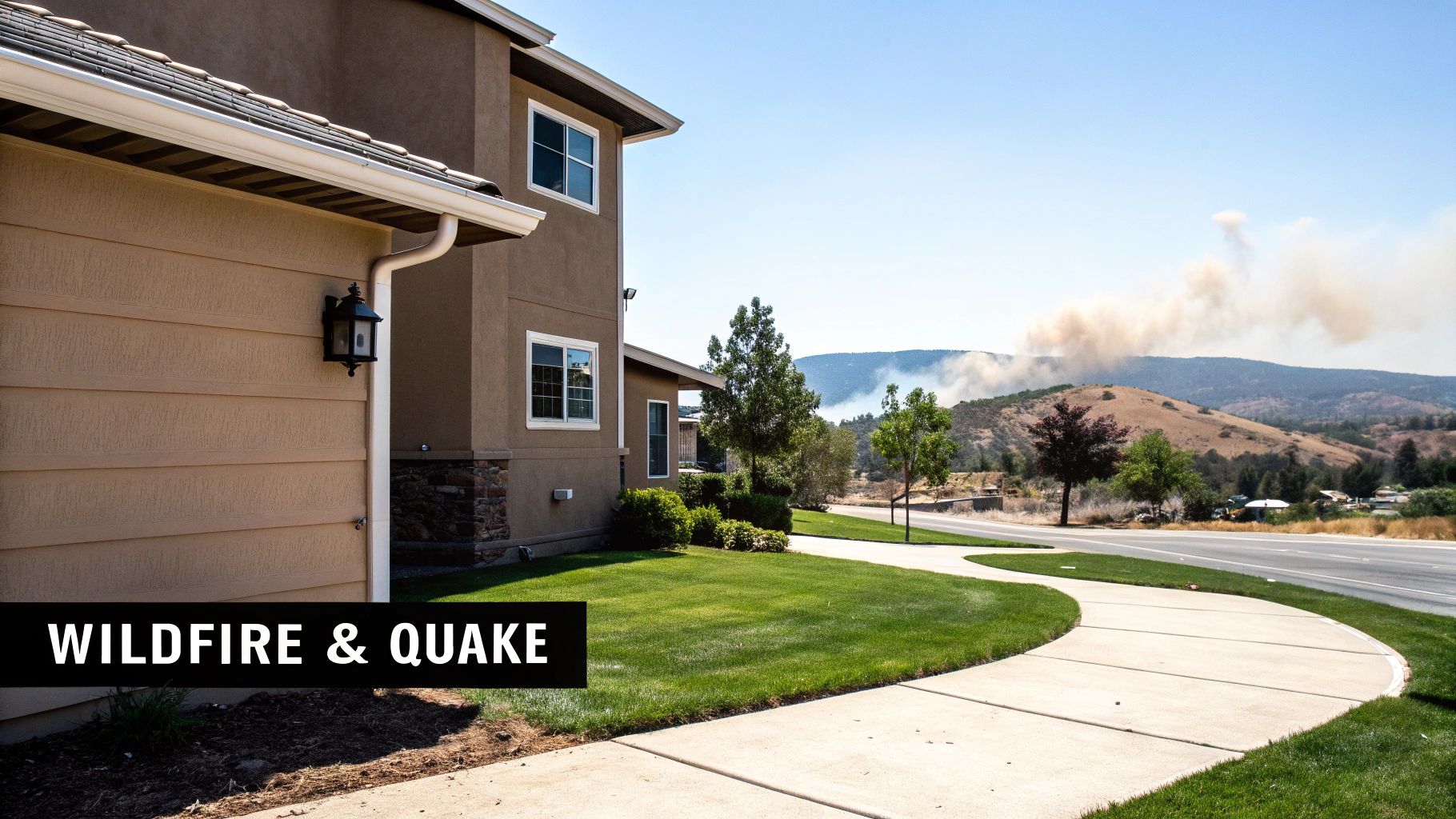
Here's a critical fact about insurance here: damage from an earthquake is almost never included in a base renters insurance or home insurance policy. This isn't just some fine print; it's a huge gap in your financial safety net that you have to fix yourself.
The Earthquake Coverage Gap
Imagine a quake hits. Your apartment is trashed, your furniture is destroyed, and the building is too dangerous to live in. Without specific earthquake coverage, your standard renters policy won't pay a dime for your ruined belongings or for a hotel while you're displaced. It’s a standard exclusion across the board because the potential for massive, widespread damage from a single event is just too big for a normal policy to handle.
So, what do you do? You need to buy a separate earthquake insurance policy or add an endorsement to your existing one. For most renters, the best bet is the California Earthquake Authority (CEA). They offer policies designed just for renters, covering your personal property and loss of use. We're often talking about just a few extra dollars a month to close this gap—a small price for ensuring you aren't left starting from scratch after a quake.
A lot of people figure their policy has them covered for any kind of disaster, but that’s a dangerous assumption with earthquakes. You have zero coverage unless you specifically buy it. In a state with as much seismic activity as California, that's a gamble you really can't afford to take.
Wildfire Risks and Your Policy
Now, for some better news. Unlike earthquakes, damage from fires—including wildfires—is a standard covered event in renters insurance. The problem in California isn't whether it's covered, but whether you can get a policy in the first place. With wildfire risk on the rise, many insurance companies have become hesitant to offer new policies in areas they've labeled as Very-High Fire Hazard Severity Zones.
This can make it incredibly frustrating to find coverage if you live in one of these beautiful, but at-risk, areas. If you find yourself turned away by private insurers, you're not out of options.
- The California FAIR Plan: Think of this as the state's insurer of last resort. It provides basic fire insurance when no one else will. A FAIR Plan policy for a renter will cover damage from fire, lightning, and smoke. It’s not a bells-and-whistles policy, but it’s an essential lifeline.
You can then pair that FAIR Plan policy with another policy that covers things like liability and theft to get comprehensive protection. It takes an extra step, but it’s the smart way to get the peace of mind you need when renting in many of California's most scenic communities.
Proven Strategies to Lower Your Renters Insurance Cost
Finding an affordable policy shouldn't mean you have to skimp on protection. With a few savvy moves, you can knock a surprising amount off your renters insurance bill while keeping the quality coverage you need. These are the tried-and-true strategies that help you find savings without sacrificing your peace of mind.
The biggest win, right out of the gate, is almost always bundling your policies. If you already have car insurance, combining it with a renters policy from the same company can unlock a multi-policy discount. We regularly see this save clients 10% to 20% on both premiums. Think of it as a loyalty bonus for keeping your business all in one place.
Smart Adjustments and Simple Upgrades
Beyond bundling, you have more control over your rate than you might think. A few small tweaks to your policy and some simple additions to your apartment can add up to real savings over time, driving that already low average renters insurance California cost even lower.
One of the most direct tactics is to raise your deductible. The deductible is simply the amount you agree to pay out-of-pocket on a claim before your insurance kicks in. By increasing it from, say, $500 to $1,000, you’re telling the insurer you'll handle the smaller stuff yourself. They’ll reward that shared risk with a lower monthly payment.
Insurers also love to see that you’re being proactive about safety. Installing a few protective devices is a fantastic and easy way to earn discounts.
- Smoke Detectors: Just having working smoke alarms is a simple step that many carriers reward.
- Fire Extinguishers: Keeping a fire extinguisher handy in the kitchen can also net you a small discount.
- Security Systems: A monitored burglar alarm, or even just solid deadbolt locks, signals to insurers that your home is a lower risk for theft, which can definitely translate into savings.
The Power of Comparison and Good Credit
Believe it or not, your financial habits can also play a part. In California, many insurance companies look at a credit-based insurance score to help set your premiums. Maintaining a good credit history shows you're financially responsible, and that can lead to a much better rate.
Your most powerful tool for saving money is comparison shopping. Never, ever assume the first quote you get is the best deal. Prices for the exact same coverage can vary wildly from one insurance carrier to the next.
Here's an interesting tidbit: while many costs in California seem to only go up, the renters insurance market has actually gotten more competitive. Nationally, from 2012 to 2021, average renters insurance premiums actually dropped from $187 to $170 per year. That's a 9% reduction, driven by fierce competition among insurers—which is fantastic news for anyone looking for a good deal. You can dig into more renters insurance statistics and see just how the market has shifted.
When you put all these strategies together—bundling, adjusting your deductible, adding safety devices, and most importantly, comparing quotes—you put yourself in the driver's seat. It's all about being an informed consumer and making your policy fit your budget, not the other way around.
Finding Your Best California Insurance Rate with an Expert
Let's be honest: trying to find the best deal on renters insurance can feel like a chore. You could spend hours plugging your information into a dozen different websites, only to end up with a confusing stack of quotes that are impossible to compare.
This is where working with a local, independent insurance expert like Mai & Associates makes all the difference. Think of us as your personal insurance shopper.
Instead of you doing all the legwork, we do the heavy lifting for you. Because we're an independent agency, our loyalty is to you, not a single insurance company. Our mission is simple: we search the entire market, comparing policies from a huge network of trusted carriers to find the one that truly fits your life and your budget.
Your Advantage with an Independent Agent
Having a licensed agent in your corner brings much-needed clarity to the process. We know the right questions to ask and can spot potential coverage gaps a generic online form might completely overlook, like crucial endorsements for earthquakes.
We also know where all the hidden discounts are. You might be missing out on significant savings by not bundling your renters insurance with your car insurance, and we can make sure that doesn't happen. From auto insurance to home insurance and even life insurance, we help you find comprehensive protection at the best price.
An independent agent is your advocate. We cut through the jargon, explain what your policy actually covers in plain English, and make sure you're getting the protection you genuinely need—without overpaying for extras you don't.
Ready to see just how easy and affordable the right coverage can be? You can get started right now. Request a no-obligation California insurance quote from our team today, and let us handle the rest.
Got Questions? We’ve Got Answers.
Even after you've got the basics down, a few questions always seem to pop up when you're on the hunt for the right renters insurance policy. Getting a straight answer can be the last piece of the puzzle, giving you the confidence to lock in the right coverage.
Here’s what California renters ask us most.
Is Renters Insurance a Legal Requirement in California?
Nope. There’s no state law in California that says you absolutely have to get renters insurance.
But here’s the catch: your landlord can require it. In fact, most landlords and property management companies now write it directly into the lease agreement. It’s a standard practice that helps protect their investment and limit their own liability.
How Much Personal Property Coverage Do I Really Need?
The best way to figure this out is to do a quick home inventory. It sounds more complicated than it is.
Just walk through your place, room by room, and make a list of your big-ticket items—think furniture, electronics, clothes, and anything valuable. Then, put a rough estimate on what it would cost to replace everything today. Most people are shocked when they see the final number. It adds up fast.
Taking an inventory is a game-changer. It not only helps you buy the right amount of coverage, but it also becomes your best friend if you ever have to file a claim after a disaster like a fire or theft.
Wait, Doesn't My Landlord's Insurance Cover My Belongings?
This is a huge misconception, and the answer is a hard no. Your landlord's insurance policy is there to protect the building itself—the walls, the roof, the foundation.
It does absolutely nothing for your personal belongings inside your apartment. It also won't cover you if someone gets hurt in your unit and decides to sue. That's the exact gap your own renters insurance policy is built to fill.
For more answers on everything from California insurance to auto and life policies, feel free to check out our complete FAQ page.
Ready to see just how affordable it is to protect your stuff? The team here at Mai & Associates can pull quotes from multiple top-rated carriers in minutes. We'll find that sweet spot between great coverage and a great price. Stop by our site to get started: https://cahomeauto.com.