Average Cost for Home Insurance in California Explained
Let's get one thing straight: national averages for home insurance costs are a decent starting point, but they're just that—a starting point. For a home with $350,000 in dwelling coverage, the current U.S. average hovers around $2,927 per year. But if you live in California, that number doesn't tell you much about your actual insurance needs, whether it's for your home, car, or life.
Understanding Home Insurance Costs: National vs. California
Think of the national average like the average temperature for the entire country on a given day. It’s a real number, but it won’t help you decide whether to grab a jacket in San Diego or a parka in Tahoe. The same goes for any type of California insurance, from home insurance to auto insurance.
The hard truth is that insurance costs are on the rise everywhere. Data from the last few years shows a sharp increase, with homeowners across the U.S. paying an average of 24% more between 2021 and 2024. Some states got hit even harder, which points to a nationwide trend of growing risks and skyrocketing repair costs. You can dig into these national insurance statistics to see just how widespread the hikes have become.
But this is where we have to zoom in on California. The Golden State is a world of its own, with a unique cocktail of risks—wildfires, earthquakes, and sky-high property values—that you just don't see in places like Ohio or Iowa. These local factors completely change the insurance equation, which is why comparing a California policy to the national average can be so misleading.
Why California Averages Are in a League of Their Own
So, what makes California so different? It boils down to a few key things:
- High Property Values: It's no secret that California real estate costs more. Since your policy's dwelling coverage needs to be enough to completely rebuild your home, higher home values mean you need more coverage, which naturally leads to a higher premium.
- Natural Disaster Risk: Wildfires and earthquakes are the two biggest elephants in the room for California insurers. If your home is in an area prone to either, you can expect to pay significantly more. In some high-risk zones, finding a standard policy can be a real challenge.
- Cost of Living: Everything costs more here, including the labor and materials needed to fix or rebuild a home. Insurers have to bake those higher costs into your premium to make sure your coverage is actually enough to do the job if disaster strikes.
The biggest mistake you can make as a California homeowner is using a national average to budget for your insurance. Your premium is a direct reflection of your home's specific address, its rebuild value, and its exposure to local risks.
To give you a much clearer picture of what this looks like in practice, let's compare the numbers side-by-side. The table below breaks down the national average home insurance cost against estimated California averages for different levels of coverage. It really highlights the "California premium" and shows why a local perspective is the only one that matters.
Average Home Insurance Costs: California vs. National
Here’s a look at how typical annual premiums stack up for different dwelling coverage amounts. Notice how the gap widens as home values increase.
| Dwelling Coverage Amount | Average Annual Premium (National) | Estimated Average Annual Premium (California) |
|---|---|---|
| $250,000 | $2,155 | $1,510 |
| $350,000 | $2,927 | $2,050 |
| $450,000 | $3,680 | $2,580 |
| $750,000 | $5,788 | $4,055 |
| $1,000,000 | $7,485 | $5,245 |
Estimates are based on industry data and can vary significantly based on your specific location, home characteristics, and chosen carrier.
As you can see, for lower-value homes, California can surprisingly be more affordable than the national average, largely because we don't face the same severe weather risks as states in Hurricane Alley or Tornado Alley. However, as property values climb and wildfire risk becomes a more dominant factor, the costs can quickly outpace the U.S. average. This is why getting a quote based on your home is the only way to know for sure.
What Really Goes Into Your Home Insurance Rate?
Ever wondered how an insurance company lands on a specific number for your premium? It’s not just pulled out of thin air. Think of it as a complex puzzle where every piece—from your roof's age to your neighborhood's crime rate—helps form the final picture of your unique risk profile.
At its core, an insurer’s job is to predict the likelihood you’ll need to file a claim. The more risk they see, the higher your premium will be. This isn't just about the big things; it's a granular assessment of dozens of data points.
This infographic breaks down how massive, national trends get narrowed down to state-level realities and, finally, to the specific rate you're quoted for your own home.
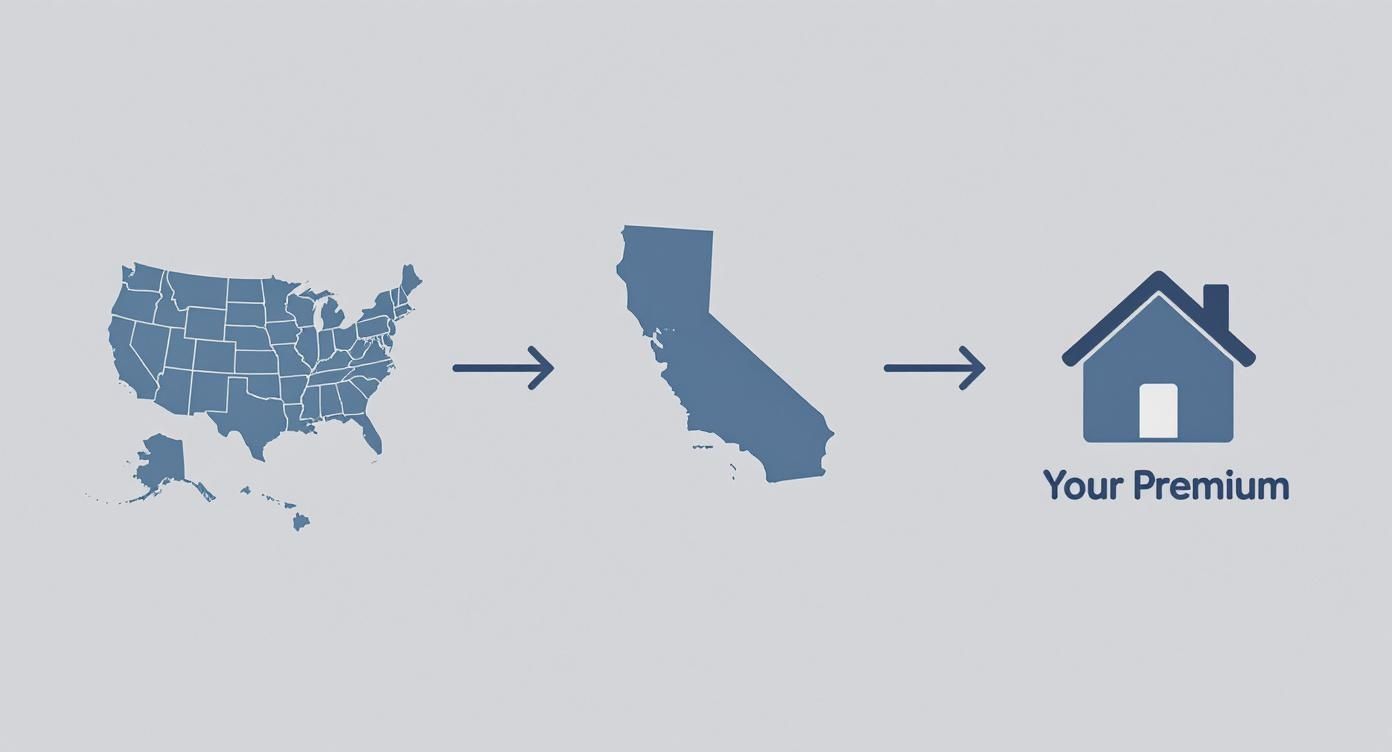
As you can see, the big picture provides context, but the number that matters to you is a deeply personal and local calculation. Let's peel back the layers.
Your Home's Unique Fingerprint
The most immediate factors shaping your premium are tied to your house itself. An insurer needs to know exactly what they’re protecting and, more importantly, what it would cost them to rebuild it from the ground up.
Here’s what they’re looking at:
- Age and Construction: An older home with original knob-and-tube wiring or galvanized plumbing is a very different risk than a modern build. The same goes for construction materials—a classic wood-frame house in a high fire-risk area is going to be viewed differently than a brick or stucco home.
- Roof Condition: Your roof is your home’s first line of defense. A 20-year-old roof with curling shingles is a water damage claim waiting to happen. On the flip side, a brand-new, impact-resistant roof can often score you a nice discount.
- Rebuild Cost: This is a crucial one. It’s not your home's market value. Instead, it's the calculated cost of labor and materials needed to reconstruct your home if it were completely destroyed. This figure becomes the basis for your dwelling coverage limit.
- "Attractive Nuisances": That's the industry term for things that are fun but increase your liability risk. A swimming pool, a trampoline, or even certain dog breeds can raise the odds of someone getting injured on your property, which nudges your liability premium upward.
Location, Location, Location: The Power of a ZIP Code
Where your home is located might just be the single most powerful factor driving your insurance costs. Seriously, moving just a few miles down the road can sometimes change your premium dramatically because risk is often highly concentrated.
Your ZIP code is shorthand for a ton of data, telling an insurer about:
- Fire Protection: How close is the nearest fire station? Are there fire hydrants on your street? The faster firefighters can get to you, the less damage a fire is likely to cause. Living in a rural area far from these services almost always means a higher premium.
- Local Crime Rates: If your neighborhood has a history of break-ins and vandalism, the risk of a theft claim goes up, and your rate will reflect that. This factor is also relevant for renters insurance.
- California-Specific Hazards: In the Golden State, this is a huge deal. Your proximity to a designated high-risk wildfire zone or an active earthquake fault line will have a massive impact on the cost—and even the availability—of your home insurance.
Your address is more than just a mailing label; it's a data point that helps insurers quantify the environmental and community risks your property faces. This is exactly why the average cost for home insurance can be so different from one California city to the next.
Your Personal Insurance Footprint
Finally, carriers look at you. Your personal history gives them a clue about your future behavior, which is why your past claims are so important.
A homeowner who has filed several claims in the last five years—especially for the same type of issue, like recurring water leaks—is flagged as a higher risk than someone with a clean slate. This isn't just for home insurance; it often carries over from other policies like your car insurance, too. A pattern of frequent claims signals a higher probability of future ones.
The good news is that you can actively lower your risk profile. Installing protective devices like a monitored alarm system, smart smoke detectors, or an automatic water shut-off valve shows you're proactive. Insurers love to see this and often reward it with significant discounts because these gadgets can stop a small problem from turning into a six-figure catastrophe.
Why California Home Insurance Is So Complex
Welcome to the Golden State. We've got sunshine, beautiful coastlines, and an insurance market that's unlike anywhere else in the country. We've already touched on how location affects your premium, but in California, that factor gets turned up to eleven. The state’s unique cocktail of environmental risks and a tough regulatory climate creates a market that often leaves homeowners feeling confused and sticker-shocked.
To understand why your policy might cost a whole lot more than your cousin's in another state, you have to look past the usual stuff. It’s really about grasping the very real—and very expensive—threat of natural disasters that are a part of life here.
The Ever-Present Threat of Wildfires
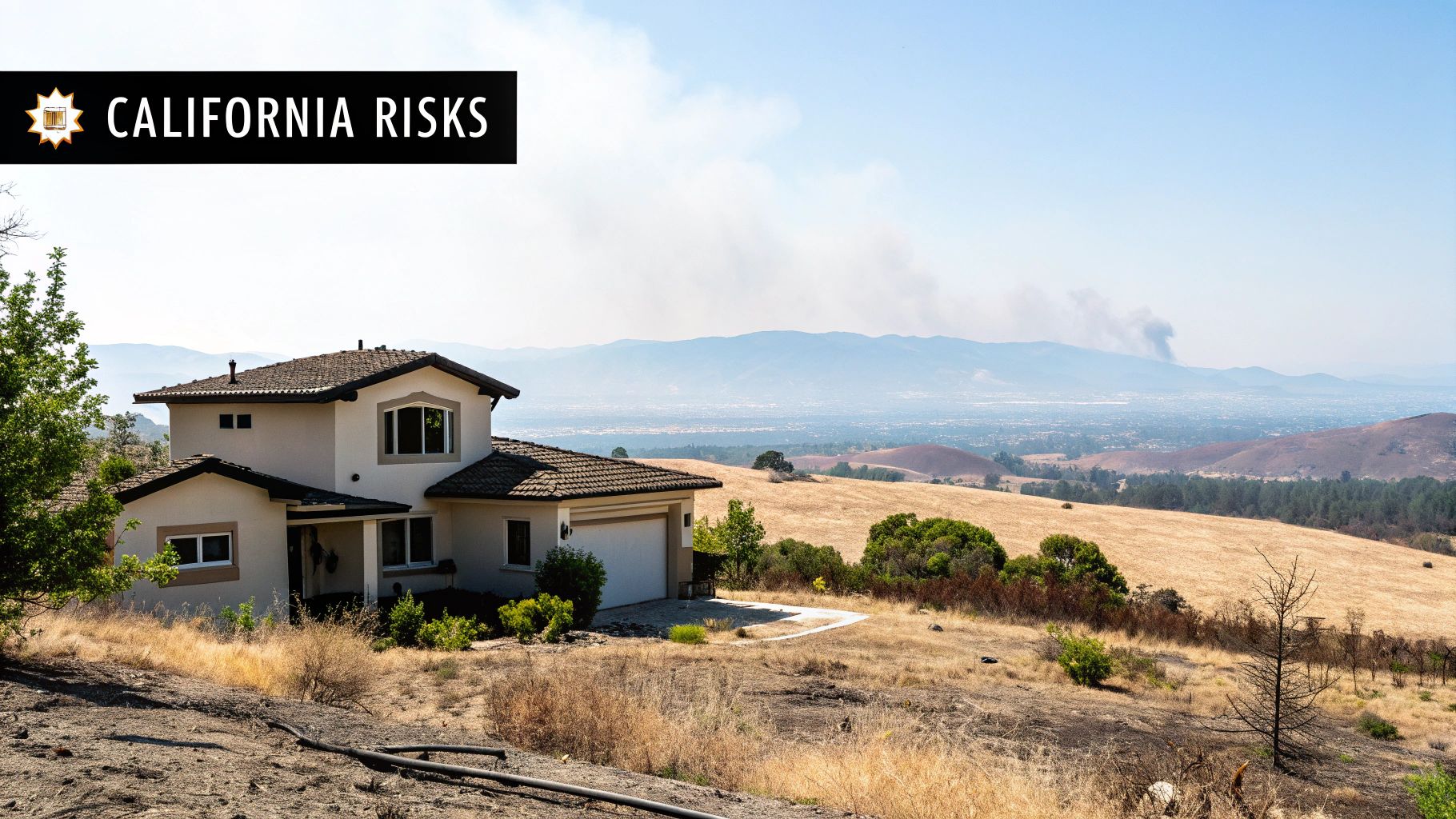
More than anything else, the risk of wildfires defines modern home insurance in California. What used to be a seasonal concern is now a year-round reality, causing billions in damages and forcing insurers to get incredibly precise with how they calculate risk.
They’re no longer just looking at your ZIP code. Instead, they use sophisticated models to zoom in on your exact property, analyzing things like:
- Proximity to wildlands: How close is your home to a canyon full of dry brush or a dense forest?
- Local topography: Is your house perched on a steep hill where fire can race uphill in seconds?
- Fire history: Has this specific area burned before?
This microscopic level of detail means two homes just down the street from each other can have completely different risk profiles—and wildly different premiums. In the highest-risk areas, many well-known insurance companies have simply stopped offering new policies, creating a real coverage crisis for homeowners.
Earthquakes and Other Natural Disasters
On top of the fire risk, California sits on some of the world's most active fault lines. This makes earthquakes a constant, if unpredictable, danger. Here’s a critical detail many homeowners miss: your standard home insurance policy does not cover earthquake damage. Protecting your home from a seismic event requires buying a completely separate policy or endorsement, adding another layer of cost and complexity.
But it doesn't stop there. The aftermath of a wildfire often sets the stage for the next disaster: mudslides. When heavy rains hit hillsides where all the vegetation has been burned away, the soil can give way with catastrophic results. Just like earthquakes, damage from mudslides and floods is almost always excluded from a standard policy. This means homeowners in vulnerable areas need to purchase even more specialized coverage.
Think of your California coverage in layers. A standard policy is just the foundation. True peace of mind often means adding specific policies for the unique risks your property faces, whether that's earthquakes, floods, or both.
The financial impact of all this is huge. As climate-related disasters become more frequent, the insurance cost gap between low-risk and high-risk areas keeps growing. A recent report from the U.S. Department of the Treasury found that homeowners in the top 20% of ZIP codes with the highest climate risk paid an average of $2,321 for their premiums. That’s a staggering 82% more than what homeowners in the safest areas paid.
When You Can't Find Coverage: The FAIR Plan
So, what do you do when every private insurance company tells you your home is too risky to cover? For thousands of Californians, the answer is the California FAIR Plan. This isn't a typical insurance company; it's a state-mandated program that serves as the insurer of last resort.
The FAIR Plan provides a basic fire insurance policy when you've been denied everywhere else. It’s a lifeline, but it's essential to know what you’re getting. A FAIR Plan policy is a bare-bones solution. It covers damage from fire, smoke, and lightning, but that’s it. It leaves you exposed to everything else—liability claims, water damage, and theft.
To get protection that even comes close to a standard policy, you have to buy a second policy called a "difference in conditions" (DIC) policy to wrap around the FAIR Plan. This two-policy setup is almost always more expensive and a lot more complicated to manage. For many in high-risk zones, though, it’s the only way to get any coverage at all.
Putting It All Together: Real California Scenarios
Okay, we've talked about averages and risk factors, but what does this all actually look like for a real California homeowner? The best way to understand how all these pieces fit together is to walk through a few examples.
Let’s look at three very different households across the state. Seeing how their unique situations shape their insurance costs will help you connect the dots between your own home and what you can expect to pay for protection.
Scenario 1: The Orange County Suburban Family
First up, meet the Wilsons. They own a lovely two-story home in a planned community in Irvine. It's a newer build, well-maintained, and in a neighborhood with a low crime rate and a fire station just down the road.
Their biggest concern is liability—that swimming pool in the backyard is a magnet for neighborhood kids. While wildfire is always a background thought in California, their specific area is considered very low-risk, and they aren't near a major fault line.
Here’s a quick look at their policy profile:
- Location: Irvine, a low-risk suburban area.
- Home: 15-year-old, 2,500 sq. ft. house with a durable tile roof and a monitored alarm.
- Primary Risks: Liability from the pool and common household issues like theft or a burst pipe.
- Coverage Choices: They opted for $750,000 in dwelling coverage, a solid $500,000 in liability, and chose a $2,500 deductible to keep their annual premium manageable.
Because of their home's features and location, the Wilsons are an ideal customer for a standard insurance carrier and can get a great policy at a competitive price.
Scenario 2: The Sierra Foothills Retirees
Now let's head up to the mountains and meet the Garcias. This retired couple built their dream home near Grass Valley in the Sierra Nevada foothills. It's a beautiful, custom-built house, but it’s surrounded by dense forest, putting them right in the middle of a high-risk wildfire zone.
Last year, their long-time insurer dropped them due to the fire risk, so finding coverage became their number one priority. They’ve done everything right—installing a metal roof, clearing defensible space around the property, and following all home-hardening guidelines. Still, it was a challenge.
The Garcias' insurance breakdown:
- Location: Grass Valley, a designated high-risk wildfire area.
- Home: 10-year-old, 2,000 sq. ft. home with fire-resistant siding and other safety features.
- Primary Risks: Catastrophic wildfire. It’s their single biggest worry.
- Coverage Choices: Their custom home requires $800,000 in dwelling coverage. After being turned down by multiple companies, their only option was a California FAIR Plan policy for fire protection, bundled with a separate "difference in conditions" policy to cover everything else, like liability and theft.
This two-policy solution is expensive, but it’s the reality for many homeowners in high-risk areas. It's the only way they can get the comprehensive protection they need.
Scenario 3: The Los Angeles Urban Professional
Finally, let's go to the city. Ms. Chen owns a beautifully restored 1940s Spanish-style home in a great Los Angeles neighborhood. Her area isn't a major wildfire threat, but her home's age and its proximity to a known earthquake fault line are what keep her up at night.
She’s also keenly aware of how expensive it would be to rebuild her historic home in L.A., factoring in today’s labor and material costs. You can learn more about the unique insurance landscape in our guide to home insurance in Los Angeles.
Ms. Chen’s policy needs:
- Location: Los Angeles, a dense urban area with significant earthquake risk.
- Home: An 80-year-old home. The electrical and plumbing are updated, but the core structure is original.
- Primary Risks: Earthquake damage and the potentially astronomical cost of rebuilding an older home to code.
- Coverage Choices: She has a standard HO-3 policy with $900,000 in dwelling coverage. More importantly, she purchased a separate earthquake policy from the California Earthquake Authority (CEA) with a 15% deductible.
That separate earthquake policy adds a significant amount to her overall insurance costs, but it's a non-negotiable for her. It’s the only thing that stands between a major quake and financial ruin.
Comparing California Home Insurance Cost Scenarios
These stories show there's no single "average" price for home insurance in California. The table below puts some real numbers to these scenarios, illustrating just how dramatically premiums can vary based on risk.
| Homeowner Profile | Location | Key Risk Factors | Dwelling Coverage | Estimated Annual Premium Range |
|---|---|---|---|---|
| The Wilsons | Irvine (Low-Risk Suburb) | Standard Liability, Pool | $750,000 | $1,800 - $2,500 |
| The Garcias | Grass Valley (High Wildfire Risk) | Wildfire, Rural Location | $800,000 | $6,500 - $9,000 (Combined FAIR Plan + DIC Policy) |
| Ms. Chen | Los Angeles (Urban, Earthquake Risk) | Earthquake, Home Age | $900,000 | $4,500 - $6,000 (Including separate earthquake policy) |
As you can see, the difference between a low-risk suburban home and one facing major wildfire or earthquake threats can be thousands of dollars per year. It all comes down to your specific location and the unique risks you need to protect against.
Actionable Strategies to Lower Your Home Insurance Costs
Feeling powerless as you watch your home insurance premium climb? It’s a common feeling, but you actually have more control than you might think. While it's true that California insurance costs are on the rise across the board, there are practical, effective steps you can take to lower your bill without sacrificing the protection your family needs.

This isn’t about finding loopholes or cutting corners. It’s about proactively managing your risk profile. By making a few smart adjustments and strategic upgrades, you can show insurers that your home is a safer bet, and that often translates directly into real savings.
Start with Simple Policy Adjustments
Some of the most powerful ways to save money don't require a single construction project. They’re simple tweaks to your policy that can have an immediate impact on what you pay.
One of the quickest ways to see a reduction is by raising your deductible. Think of the deductible as the amount you agree to pay out-of-pocket before your insurance kicks in. Simply increasing it from $1,000 to $2,500 can lower your annual premium by a noticeable amount. Just make sure it’s a number you could comfortably cover in an emergency.
Another fantastic strategy is to bundle your insurance policies. If you have your home and auto insurance with different companies, you're almost certainly leaving money on the table. Insurers offer significant "multi-policy" discounts when you combine your home insurance with your auto insurance or even life insurance. It’s often a simple phone call that could save you hundreds.
Invest in Home Safety and Security
Insurance companies love to see homeowners who take steps to minimize potential claims. Installing certain protective devices can not only make your home safer for your family but also unlock some valuable discounts on your policy.
Consider these upgrades:
- Monitored Security Systems: A system that automatically alerts the police or fire department in an emergency can seriously reduce the risk of theft and major fire damage.
- Smart Home Devices: Things like smart smoke detectors, automatic water shut-off valves, and temperature sensors can catch small issues before they snowball into catastrophic claims.
- Upgrading Utilities: If you live in an older home, modernizing the electrical, plumbing, and heating systems can lower your risk profile and, in turn, your premium.
Homeowners are facing a double challenge. It’s not just that premiums are rising; deductibles are also increasing. Making your home safer is one of the few direct actions you can take to fight back against both trends.
The Californian's Guide to Home Hardening
For anyone living in California, nothing impacts insurance availability and cost more than wildfire risk. Home hardening—the process of making your property more resistant to fire—is an absolutely critical strategy for securing coverage at a better rate.
This involves creating a defensible space around your home by clearing brush and removing flammable materials, but it also means using fire-resistant building materials whenever you do renovations.
Here’s a checklist to get you started:
- Create Defensible Space: Work on establishing a 30-foot "lean, clean, and green" zone around your home, with reduced vegetation extending out to 100 feet.
- Use Fire-Resistant Materials: When it’s time to replace your roof or siding, choose non-combustible materials like metal, tile, or fiber-cement.
- Protect Vents and Eaves: Cover all attic and foundation vents with a fine metal mesh (at least 1/8-inch) to block flying embers from getting inside.
This proactive approach is becoming non-negotiable as insurers scrutinize wildfire exposure. For more ideas on protecting your assets, check out our full collection of California insurance guides.
These steps don’t just protect your home; they make it a much more attractive risk for insurers. With costs rising nationwide—the average annual premium for new U.S. home policies recently hit $1,966, a 9.3% increase from the previous year, while the average deductible shot up by 24.5%—these measures are more important than ever. You can learn more about how these home insurance trends affect homeowners and see why taking proactive steps is so essential.
Finding the Right Coverage in a Tough Market
Trying to navigate the California insurance market all by yourself can feel like a maze with no exit. As we've seen, that "average cost for home insurance" isn't a simple number—it's more like a complex puzzle with a dozen moving pieces. While the national and state averages give you a ballpark idea, they can't tell you what your policy will actually cost.
The only number that truly matters is the one on a quote built specifically for your home, your risks, and your needs.
This is where having a pro in your corner changes the game. Instead of you spending hours filling out the same information on a dozen different websites, an independent agent does all that legwork for you. They can shop the entire market at once, comparing policies and prices from multiple top-rated carriers to find the right fit.
Stop Guessing and Start Saving
When you work with an independent agent, you get more than just a quote—you get an advocate. They have the experience to find the best possible protection for your most valuable assets, from the roof over your head to your family's financial security.
In a market as difficult as California's, having a dedicated expert is no longer a luxury; it's a necessity. An agent can spot critical gaps in your coverage you might have missed and uncover discounts that lead to real savings on your home, auto, and life insurance.
At Mai & Associates, our licensed agents live and breathe the California insurance market. We know its challenges inside and out. We're here to help you compare policies side-by-side, figure out if you need additional protection for earthquakes or wildfires, and bundle your policies to get the most significant discounts available.
It’s time to stop looking at averages and find out what your best rate really is. We provide fast, no-obligation quotes to help you lock in the right coverage at a competitive price. Don't leave your home's protection to chance. Let us help you build a policy that fits your life and your budget.
Common Questions About California Home Insurance
It's completely normal to have a few lingering questions when you're sorting out your home insurance. Let's tackle some of the most common ones we hear from California homeowners.
So, how often should you really be shopping around for new quotes? With how quickly things change in the California market, a good rule of thumb is to review your policy and compare rates every one to two years. It's also smart to do this after any big life event, like a major home renovation or a new baby. The best rate you found last year might not be the most competitive one today.
Will Filing a Small Claim Make My Rates Go Up?
That's a classic question, and the honest answer is: it probably will. Even a small claim goes on your record and can trigger a rate increase when your policy renews.
Before you file, do a little math. Compare the cost of the repair to your deductible. If the repair bill is just a bit higher than your deductible, it often makes more financial sense to pay for it yourself. This keeps your claims-free discount intact and could save you a lot more money in the long run.
Is Earthquake and Flood Damage Covered?
This is a big one, and it's where a lot of people get tripped up. Your standard homeowners insurance policy does not cover damage from earthquakes or floods. These are specific exclusions, and you absolutely need separate policies to be protected.
You’ll need to buy an earthquake policy for seismic events and a flood policy for damage caused by rising water or mudslides. This is where working with a single agent for your home, auto, and even life insurance can be a real advantage. They can give you a complete picture of your coverage and spot any dangerous gaps.
One of the costliest mistakes a California homeowner can make is assuming their basic policy covers every kind of natural disaster. Double-checking what you're actually covered for is the only way to get real peace of mind.
Have more questions? We’ve got a lot more answers on our detailed California insurance FAQ page.
At Mai & Associates, our agents live and breathe the California insurance market. We'll help you compare policies from different carriers, figure out the right extra coverages, and bundle your home and auto for the biggest discounts. Don't leave it to chance—visit https://cahomeauto.com to get a clear, fast, no-obligation quote today.