A Complete Guide to Auto Insurance Liability Coverage in California
When you're found at fault in a car accident, the financial fallout can be staggering. That’s where auto insurance liability comes in. It’s not coverage for your car or your injuries—it’s the financial shield that protects you from having to pay for the other party's damages out of your own pocket.
Think of it this way: this coverage is what stands between an expensive mistake on the road and your personal savings, your home, or even your future earnings. For anyone seeking comprehensive California insurance, understanding liability is the first critical step.
What Is Auto Insurance Liability and Why It Matters
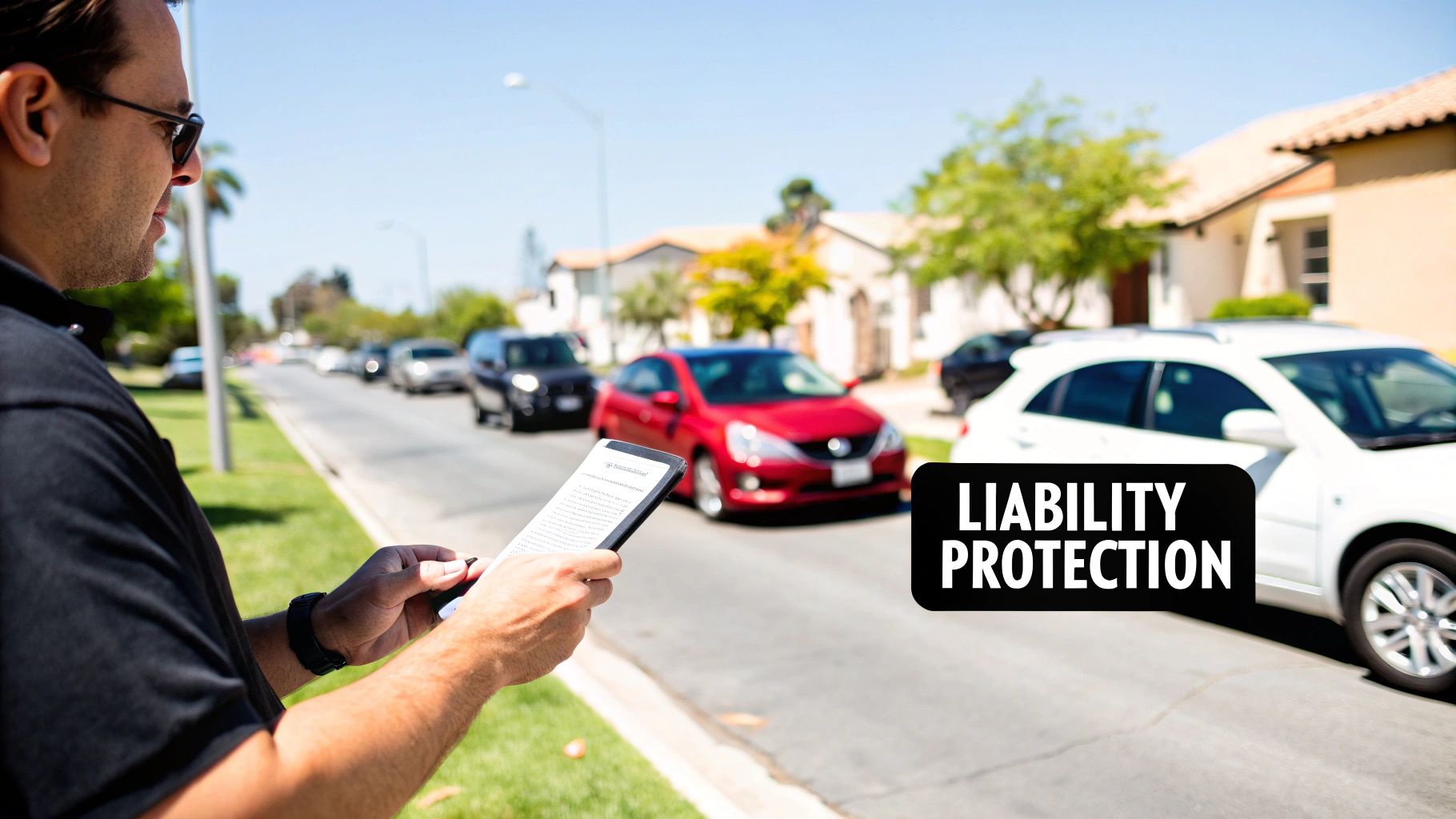
Imagine causing a fender bender on the I-5 during rush hour. Your car has a dent, but the other driver's car is heavily damaged, and they're complaining of neck pain. Without liability coverage, you'd be personally on the hook for their vehicle repairs, medical bills, and potentially lost wages. For California drivers, this isn't a far-fetched scenario; it's an everyday risk that makes proper car insurance essential.
This coverage isn't just a good idea—it's the law in California and almost every other state. The primary reason is to make sure innocent victims of an accident are compensated for their losses. But for you, the policyholder, its most crucial job is protecting your financial future from a lawsuit that could drain your resources.
The Two Pillars of Liability Coverage
Auto liability coverage is built on two core components. Getting a handle on how they work together is the first step to making sure you're properly protected with the right California insurance plan.
To make this easier to understand, let's break down the two main types of liability coverage.
Liability Coverage At a Glance
| Coverage Type | What It Covers | Example |
|---|---|---|
| Bodily Injury (BI) Liability | Covers costs for injuries to others when you're at fault. This includes their medical bills, lost income, and even pain and suffering. | You run a red light and hit another car. The other driver breaks their arm and requires surgery. Your BI coverage pays for their hospital bills. |
| Property Damage (PD) Liability | Covers costs to repair or replace someone else's property you damage. This is usually their car, but it can also be a fence, a storefront, or other structures. | You back out of a parking spot and hit a parked car, denting its door. Your PD coverage pays for the repairs to the other vehicle. |
These two coverages work in tandem to handle the financial consequences of an at-fault accident.
Sometimes, all the insurance lingo can feel a bit overwhelming. If you ever come across a term you don't recognize, our comprehensive insurance glossary is a great resource to help clear things up.
Here’s a little perspective on why this matters so much. The global liability insurance market is expected to grow by over 90% in the coming decade, largely because of increasing legal risks. Closer to home, nearly half of all U.S. liability insurance payouts are from motor vehicle accidents. It's a clear sign of just how essential this protection really is for drivers.
Understanding Coverage Limits
When you look at a car insurance policy in California, you’ll see liability coverage expressed as a series of three numbers, like 15/30/5. This is California's legal minimum, and each number stands for a maximum payout amount (in thousands of dollars).
Here's how it breaks down:
- $15,000 for bodily injury to a single person.
- $30,000 total for bodily injuries for the entire accident if multiple people are hurt.
- $5,000 for property damage per accident.
These numbers represent the absolute most your insurance company will pay for a claim you cause. Deciding on your limits is one of the most critical choices you'll make when buying a policy. As we'll get into later, sticking with the state minimums can leave you dangerously exposed.
Bodily Injury vs. Property Damage: The Two Sides of Your Liability Shield
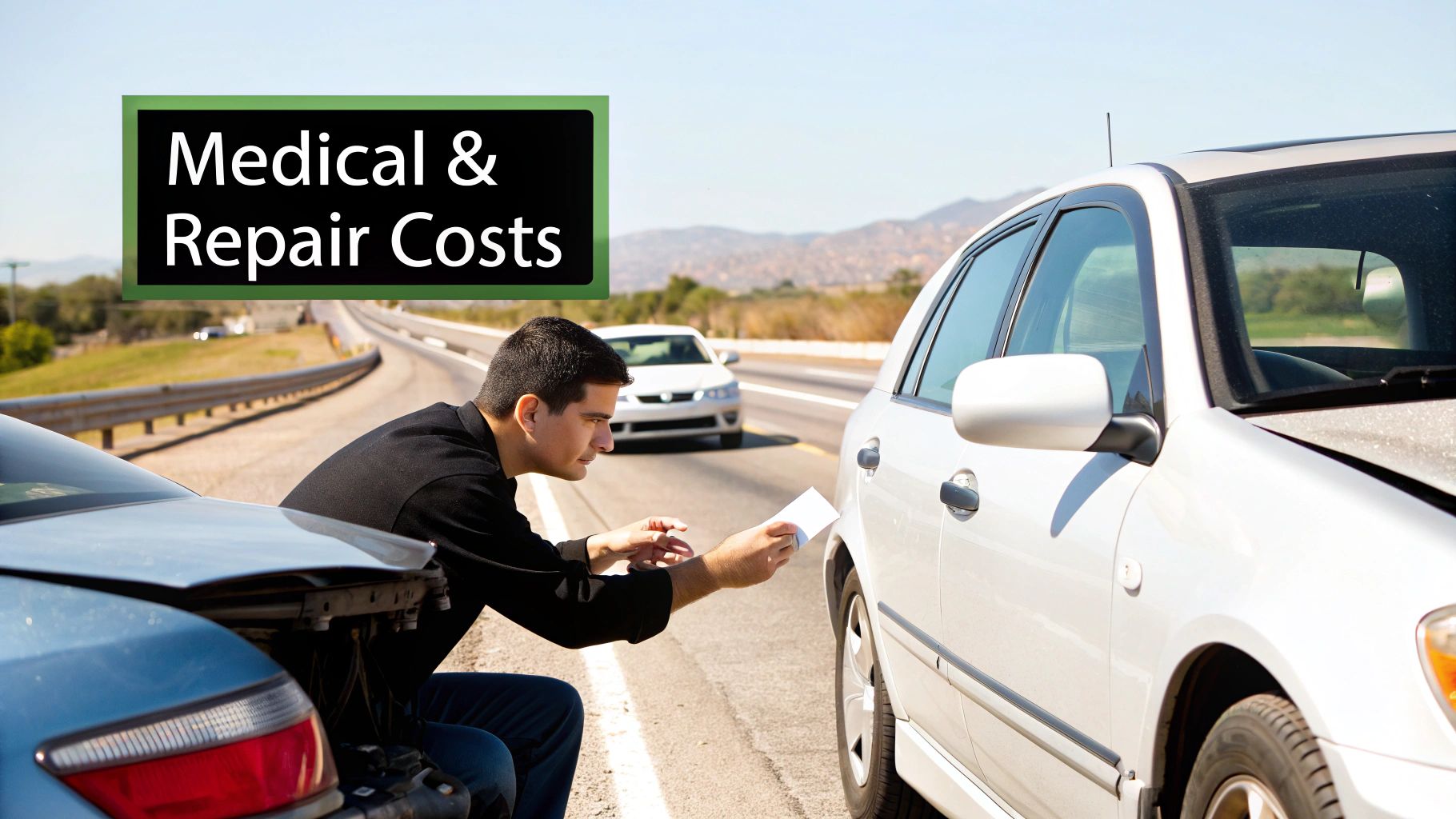
When we talk about auto insurance liability, we're not talking about one single protection. Think of it as a two-part shield designed to protect you financially if you're at fault in an accident. These two crucial components are Bodily Injury (BI) Liability and Property Damage (PD) Liability.
Each one has a very specific job. One side of the shield protects you from the costs of injuring people, while the other side handles the costs of damaging their things. Both work together to keep your personal assets safe when someone else files a claim against you.
What Bodily Injury Liability Actually Covers
Bodily Injury (BI) liability is all about the human side of an accident. If you cause a crash that hurts someone—another driver, their passengers, or even a pedestrian—this is the coverage that kicks in. Its main purpose is to pay for their medical bills. We’re talking everything from the ambulance ride and ER visit to surgery and long-term physical therapy.
But the financial fallout from an injury often goes beyond medical treatment. BI liability is designed to cover these other major costs, too.
Here's what it typically helps pay for:
- Lost Wages: If someone's injuries keep them from working, your BI coverage can help replace the income they lose while they recover.
- Legal Fees: If the injured person sues you, this part of your policy helps cover your legal defense, including lawyer's fees and court costs.
- Pain and Suffering: It can also provide compensation for the physical pain and emotional distress caused by the accident.
Just picture a chain-reaction collision on a busy freeway like the 405. The medical expenses for multiple people can easily skyrocket past $100,000. Without enough BI coverage, you'd be on the hook for that bill yourself, a situation that could be financially devastating.
What Property Damage Liability Protects
While BI handles injuries to people, Property Damage (PD) liability takes care of their stuff. This is the part of your policy that pays to fix or replace someone else's property when you’re at fault.
The most obvious example is the other person's car. Whether it's a small dent from a parking lot mishap or major damage from a collision, your PD coverage pays the body shop. But it covers a lot more than just other vehicles.
Property Damage liability also covers damage to stationary objects. This could be anything from a mailbox you clip to a fence, a storefront, or even city property like a guardrail or traffic sign.
This coverage is more important than ever. Modern cars are loaded with expensive tech—sensors, cameras, and complex computer systems. A seemingly minor fender-bender with a new luxury sedan or EV can lead to repair costs of $20,000 or more, which can quickly blow past the state's minimum coverage requirements.
Together, BI and PD liability create the financial safety net that every driver needs. Getting the right auto insurance in California means understanding what these coverages do, ensuring that one mistake on the road doesn’t end up costing you everything you've worked for.
The Big Gamble: Why California's Minimum Liability Limits Are a Trap
Every driver in California is legally required to carry auto insurance liability. It's the law. But here’s a hard truth most people don’t realize until it's too late: the state-mandated minimums are so low they offer a false sense of security. Relying on them is one of the biggest financial risks you can take.
You'll often hear the legal minimum in California referred to as 15/30/5. It’s a bit of insurance shorthand, but those numbers represent the absolute maximum your insurance company will pay if you’re at fault in an accident. Let's break down what that really means for you.
What Does 15/30/5 Actually Cover?
On paper, these numbers might not seem so bad. But when you’re standing on the side of the road after a crash, they become terrifyingly small. Here's a simple translation:
- $15,000 for Bodily Injury per Person: This is the most your policy will pay for any single person's medical bills and related costs if you injure them.
- $30,000 for Bodily Injury per Accident: If you injure two or more people, this is the total amount your policy will pay for all of their injuries combined.
- $5,000 for Property Damage per Accident: This is the absolute max your insurance will pay to fix or replace whatever property you damaged—usually, the other person's car.
These limits were established decades ago and have not been updated to reflect today's reality. A trip to the ER, modern car repair costs—they’ve all skyrocketed, while these numbers have stayed stuck in the past.
A Reality Check on Accident Costs
Let's put this into perspective. A single visit to the emergency room after an accident can easily blow past $15,000, especially if an MRI or CT scan is involved. If that person needs surgery or months of physical therapy, the costs can spiral into six figures. You'd be on the hook for every dollar over that initial $15,000.
And what about the $5,000 for property damage? The average price of a new car in the U.S. is now hovering around $50,000. That minimum coverage wouldn't even pay for a tenth of a replacement. Even fixing a modern car with its complex sensors and computers can easily top $10,000 for a moderate fender-bender.
When your auto insurance liability limits run out, the bills don't just disappear. The other driver can—and will—sue you personally for the rest. This puts everything you own on the line.
The Real Consequences of Being Underinsured
Carrying only the state minimum isn't just a bad idea; it's a gamble with your entire financial future. If you cause an accident with damages that exceed your limits, you are personally and legally responsible for paying the difference.
The fallout can be devastating and last for years:
- Your Assets Can Be Seized: Savings accounts, investments, and even the equity in your home can be taken to pay the judgment.
- Your Wages Can Be Garnished: A court can order your employer to take a chunk of your paycheck every single pay period and send it to the person you owe until the debt is settled.
- Your License Can Be Suspended: If you can't pay for the damages you caused, California can suspend your driver's license, making it impossible to get to work and live your life.
When you stick with minimum coverage, you're essentially self-insuring for any amount above those tiny limits. For most of us, that's a risk that could lead to complete financial ruin. Your car insurance isn't just about protecting your vehicle; it's about safeguarding your entire financial life—your home insurance, your renters insurance, and your family's security. A single bad day on the road shouldn't be allowed to destroy everything you’ve worked so hard to build.
How to Choose Liability Limits to Protect Your Assets
Picking the right liability limits for your car insurance goes way beyond just satisfying California's legal minimums. Frankly, those minimums are dangerously low. The real goal is to protect everything you've worked so hard for. Choosing the right coverage is a personal decision, and it all boils down to your unique financial situation.
Think of your liability coverage as a financial shield. If you cause a serious accident, this is what stands between a lawsuit and your personal assets—your savings, your home, your future income. You want a shield strong enough to cover the potential damage, so you don't have to pay out of your own pocket.
This flowchart shows just how quickly things can go wrong if you’re only carrying the state minimum coverage.
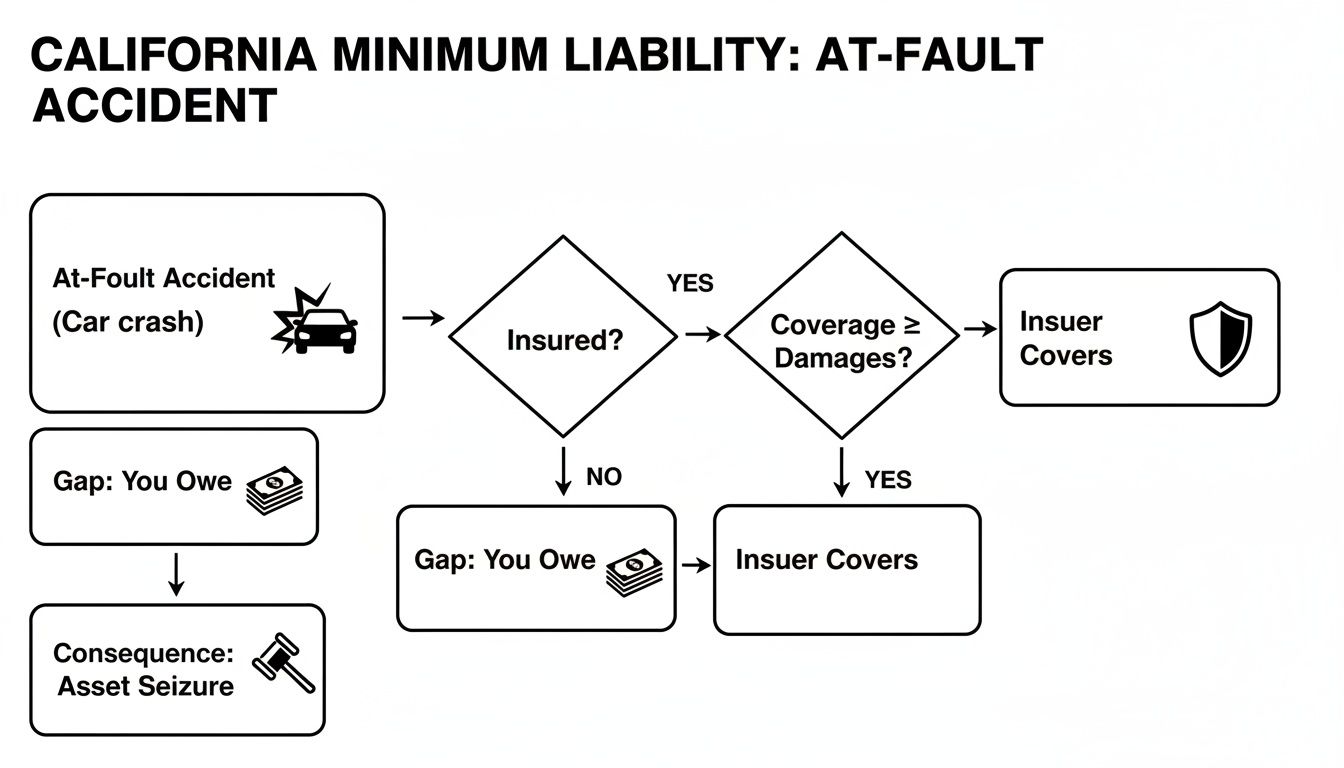
As you can see, relying on minimums is a risky bet. One bad accident could leave you with a massive debt that follows you for years, potentially leading to asset seizure.
A Quick Tally of Your Assets
So, how much coverage do you actually need? To figure that out, you need a clear picture of what you're protecting. Don't worry, this isn't a deep dive into financial planning—just a quick inventory.
Take a few minutes and jot down the approximate value of:
- Savings and Investments: This is everything in your checking and savings accounts, stocks, bonds, 401(k)s, and IRAs.
- Home Equity: What's your home worth on the market today? Subtract what you still owe on your mortgage to get your equity.
- Other Valuables: Think about any other big-ticket items, like rental properties, cars you own free and clear, or expensive personal belongings.
- Future Earnings: Yes, your income is an asset. In a lawsuit, your future wages can be garnished, so it's a critical piece of the puzzle, especially if you're a high-earner.
Add it all up. That final number is your target. As a rule of thumb, your auto insurance liability limits should, at the very least, match your net worth. If your assets total $250,000, your liability coverage needs to be at least that high to keep you properly protected.
Common Coverage Levels Explained
Insurance companies offer coverage in tiers. While California's minimum is a meager 15/30/5, a much more sensible starting point for most drivers is 100/300/100.
Here’s what those numbers mean in plain English:
- $100,000 for bodily injury liability per person.
- $300,000 for total bodily injury liability for the entire accident.
- $100,000 for property damage liability per accident.
This level provides a far more realistic safety net that can handle the costs of most common accidents. But if you own a home or have built up a decent nest egg, even that might not be enough. Many homeowners and professionals opt for higher limits, like 250/500/100, for greater peace of mind.
The Ultimate Safety Net: An Umbrella Policy
What if your net worth is $1 million or more? Trying to get an auto policy with limits that high can be really expensive. This is exactly where an umbrella policy shines.
An umbrella policy is a type of excess liability insurance. It kicks in when the liability limits on your existing auto insurance or home insurance are exhausted, giving you an extra layer of protection. It’s a surprisingly affordable way to add $1 million or more in coverage.
Let’s say you have a 250/500/100 auto policy and you cause an accident that results in $750,000 in medical bills for the other driver. Your auto policy would pay out its $250,000 limit. What about the other $500,000? That's where the umbrella policy steps in to cover the rest.
Without it, you’d be on the hook for that half-million-dollar gap personally. For just a few hundred dollars a year, an umbrella policy acts as a powerful financial backstop, ensuring that one catastrophic event doesn’t erase a lifetime of savings and planning. It’s an essential part of a solid financial plan, protecting not just your assets but your family’s entire future, including your life insurance strategy.
Recommended Liability Limits Based on Driver Profile
Choosing the right limits can feel daunting, but it helps to see what makes sense for different life stages and financial situations. The table below offers some practical recommendations to guide California drivers.
| Driver Profile | Assets to Protect | Recommended Liability Limits | Consider an Umbrella Policy? |
|---|---|---|---|
| New Driver / Renter | Minimal savings, rented housing, older vehicle. | 50/100/50 | Not yet, but revisit as assets grow. |
| Young Professional | Growing savings/investments, may own a condo. | 100/300/100 | Yes, if net worth exceeds $300,000. |
| Homeowner | Significant home equity, retirement savings, multiple vehicles. | 250/500/100 | Highly Recommended. A $1M policy is a smart move. |
| High-Net-Worth Individual | Substantial investments, multiple properties, high income. | 250/500/100 or 500/500/100 (as the base) | Essential. A policy of $2M to $5M+ is standard. |
This table serves as a great starting point for a conversation about your needs. The key takeaway is to align your coverage with the value of what you need to protect. As your life changes, your California insurance needs should, too.
What Really Drives the Cost of Your Liability Insurance?
Ever look at your auto insurance bill and wonder where that number comes from? It's not just pulled out of a hat. Insurance companies in California look at a handful of key factors to figure out how likely you are to be in an accident, and that risk calculation is what sets your premium for auto insurance liability and everything else.
Think of it as them trying to build a picture of you as a driver. Your driving history, your car, and even your zip code are all pieces of that puzzle. Once you understand the pieces, you can start to see where you have some control over the final cost.
Your Driving Record and Experience
No surprise here—this is the big one. Your history behind the wheel is the best predictor of your future risk. If you have a history of accidents or a collection of speeding tickets, an insurer is going to see you as more likely to file a claim down the road. It's a simple numbers game for them.
The same goes for your time on the road. A 17-year-old who just got their license is a much bigger unknown than a 45-year-old who's been commuting for decades. More years of clean driving prove you know how to handle tricky situations.
Where You Live and Park Your Car
Your address has a bigger impact than most people think. A driver in a dense city like Los Angeles is surrounded by heavy traffic, has a higher chance of their car being stolen or vandalized, and simply faces more potential for a fender bender every single day.
Compare that to someone living in a sleepy, rural town in Northern California. The daily risks are just lower, and the insurance premiums reflect that. Even something as simple as parking in a locked garage versus on the street can nudge your rate up or down.
The Car You Drive and Its Tech
The make and model of your car matter quite a bit, especially for the property damage side of your liability coverage. Insurers are looking at safety ratings, how often that model is stolen, and—more than ever—how much it costs to fix.
Today's cars are loaded with incredible technology, from lane-assist cameras to bumper sensors. These features are fantastic for safety, but they can be shockingly expensive to repair or replace after a collision. If you hit someone, the potential repair bill for their high-tech car is a lot higher than it used to be, and your liability premium will account for that possibility.
The auto insurance world has been on a rollercoaster lately. After losing billions, U.S. insurers finally saw major profits in 2024, mostly because of some steep rate hikes. But the cost to close out a claim keeps climbing, thanks to complex vehicle repairs and lawsuits. This is especially true here in California, where "social inflation" can sometimes lead to much larger jury verdicts. Read the full report on recent auto insurance trends.
This is why it's so critical for drivers in places like Glendale or Escondido to be smart shoppers and make sure they're not overpaying for their California insurance.
How (and How Much) You Use Your Car
It makes sense that the more you're on the road, the higher your chances of getting into an accident. That’s why insurers ask about your annual mileage. A long daily commute puts more wear and tear on your car and increases your exposure to risk.
What you're doing with the car matters, too. Using your vehicle for personal errands and weekend trips is a different risk profile than using it for ridesharing or making deliveries for a side hustle.
Practical Steps to Lower Your Premium
While you can't change your age or move to a new town just to save on insurance, you have more power here than you might realize. Here are a few tried-and-true ways to bring your costs down:
- Keep Your Record Clean: This is, without a doubt, the #1 way to get the best rates. Driving safely and avoiding tickets and at-fault accidents pays off year after year.
- Hunt for Discounts: Don't be shy about asking what's available. You can often get a discount for bundling your auto insurance with home insurance or renters insurance.
- Take a Defensive Driving Course: Many insurance companies will give you a nice little rate reduction for completing an approved defensive driving class. It shows them you're serious about safety.
- Shop Around: Never just automatically renew without checking your options. Rates can change, and new discounts become available. Working with an independent agency lets you compare quotes for California insurance from several top carriers at once, so you can be confident you’re getting the best deal.
Get Your California Liability Insurance Quote
Finding the right liability coverage for your car shouldn't be a chore. Here at Mai & Associates, our whole approach is built on making it simple. We see ourselves as your partner, helping you protect what you've worked so hard for, right here in California. We'll help you cut through the jargon and find a policy that actually fits your life.
Forget about spending your weekend calling one insurance company after another. That's our job. Our team compares rates for all types of California insurance from a whole network of top-rated carriers, saving you the headache and making sure you get a great deal. You end up with solid protection at a price that makes sense.
Fast, Reliable, and Ready to Help
We know you're busy. That's why we're committed to providing same-day quotes and having a licensed agent get back to you within 24 hours. No waiting around for days to get the answers you need.
California is a vibrant, diverse state, and we believe your insurance agent should reflect that. To make sure you feel completely comfortable and understood, our team can help you in several languages:
- English
- Spanish
- Armenian
- Russian
- Vietnamese
This way, nothing gets lost in translation when we’re talking about something as important as your liability coverage.
Think of your financial protection like a web. Strong auto insurance is a critical thread that connects to your home insurance, renters insurance, and even life insurance policies. Together, they create a comprehensive safety net for your family and your assets.
Get Your Free, No-Obligation Quote Today
We don't just look at one piece of the puzzle. By taking a moment to understand your entire situation—your car, your home, your family's needs—we can help you build a smarter, more complete defense against financial surprises. It all starts with a quick chat.
Ready to see how affordable the right auto insurance liability coverage can be? Take the next step and request your free California insurance quote online or give us a call. Let's get you the peace of mind that comes from knowing you're properly covered.
Frequently Asked Questions
Auto insurance liability can feel like a maze of rules and jargon. It's totally normal to have questions. To make things clearer, we've broken down some of the most common things California drivers ask us about their car insurance.
Does Liability Insurance Cover My Car or My Injuries?
This is probably the biggest point of confusion, and the answer is no. Think of auto liability insurance as your financial shield. It's there to pay for the injuries and property damage you cause to other people in an accident you're responsible for. It’s what protects you from being sued into bankruptcy.
To get your own car fixed after an accident, you’ll need Collision coverage. For things like theft, falling trees, or vandalism, that’s where Comprehensive coverage comes in. And for your own medical bills, you'd look to Medical Payments (MedPay) coverage or your health insurance.
What Happens if Damages Exceed My Liability Limits?
This is where things can get scary, and it's precisely why picking the right limits is so crucial. If you cause an accident and the costs are higher than your coverage limits, you are on the hook for every penny of the difference.
The other party's attorney won't just let it go; they can sue you personally to collect the remaining amount. This could lead to devastating financial outcomes, like:
- Seizure of your assets, including your savings accounts, investments, and even your home.
- Garnishment of your future wages until the entire debt is settled.
Suddenly, those rock-bottom state minimums don't seem like such a good deal, do they?
How Can I Lower My Auto Liability Insurance Costs?
While a lot of factors go into your premium, you have more power here than you might realize. The number one way to keep your rates down is simple: maintain a clean driving record. No accidents, no tickets.
A fantastic and easy strategy is to bundle your policies. Most insurers offer deep discounts when you combine your auto insurance with your home insurance, renters insurance, or life insurance. It’s one of the biggest money-savers out there.
Beyond that, always ask about other discounts. Good student grades, completing a defensive driving course, or having anti-theft devices on your car can all help. Working with an independent agency like ours lets you compare rates from multiple carriers at once, so you know you’re getting the best deal on your California insurance. For more answers, check out our full California insurance FAQ page.
Ready to feel confident you have the right protection at the right price? The team at Mai & Associates is here to give you a free, no-pressure quote and help you find the auto liability coverage that truly fits your life.