Your Guide to Auto Insurance in California for 2026
Let's be honest: finding affordable auto insurance in California can feel like you're navigating a maze. As one of the most expensive states for car insurance, it's easy to feel overwhelmed. The short answer is you need at least 15/30/5 liability coverage to be legal, but here's the reality—that's rarely enough to protect you financially if a real accident happens.
The secret to not overpaying isn't just finding the cheapest plan; it's about finding the right plan at the best price. And that always starts with comparing quotes from several different carriers for all your California insurance needs.
Your Guide to California Auto Insurance in 2026
Getting a handle on car insurance in the Golden State is less about memorizing rules and more about knowing how to protect yourself. From decoding state laws to choosing policy options that actually make sense for your life, making informed decisions can save you thousands and safeguard your assets. This guide is your roadmap to becoming a much smarter insurance shopper.
The numbers don't lie. California car insurance rates are consistently among the highest in the country, a fact that puts a strain on drivers from San Diego to Sacramento. In 2026, the average cost for a typical policy is pegged at $2,109 a year, which breaks down to about $176 per month.
Some analyses, like a recent report from Experian.com, place the average for full coverage even higher at $3,119 annually—that's a full 16% above the national average. Meanwhile, state minimum coverage hovers around $916 per year.
Let's break down the most important numbers you need to know right from the start.
California Auto Insurance at a Glance
This table gives you a quick snapshot of the key requirements and typical costs you can expect to see in California.
| Requirement/Coverage | Details | Average Annual Cost (2026) |
|---|---|---|
| State Minimum Liability | 15/30/5: $15k for injury/death to 1 person, $30k per accident, $5k for property damage. | $916 |
| "Good Driver" Policy | A policy for drivers with a clean record, often with slightly higher liability limits. | $1,687 |
| Full Coverage Policy | Includes liability, plus Collision and Comprehensive to protect your own car. | $3,119 |
As you can see, the price you pay is directly tied to the level of protection you choose.
Why You Need More Than a Basic Policy
Understanding your insurance isn't just about ticking a box to drive legally; it’s about managing real-world risk. A seemingly minor fender-bender can easily result in repair and medical bills that blow past the state's bare-bones minimums. When that happens, you're on the hook for the rest.
This is exactly why a one-size-fits-all policy is a bad idea. This guide is built to give you a clearer picture of how insurance products work together to protect not just your car, but your entire financial well-being.
Here’s a glimpse of what we'll cover:
- California's Legal Minimums: We’ll explain the "15/30/5" rule and show you why it’s often dangerously inadequate.
- Key Coverage Types: You'll learn the practical difference between liability, collision, and comprehensive insurance.
- Real Cost-Saving Strategies: We'll share proven tips for lowering your monthly premiums without sacrificing protection.
- The Power of Bundling: Discover how combining your auto insurance, home insurance, and even life insurance policies can unlock major discounts.
Protecting your assets is about more than just your car. A smart insurance strategy looks at your whole life—your home, your savings, and your family's future. Working with an independent agent is the best way to build that complete safety net.
Ultimately, our goal is to show you how to get the right protection for your life and your budget. Whether you're a new driver getting your first policy or a homeowner looking to optimize your coverage, having the right information is everything.
For more deep dives into building a financial safety net, be sure to explore our other guides on comprehensive insurance strategies.
Understanding California's Minimum Insurance Laws
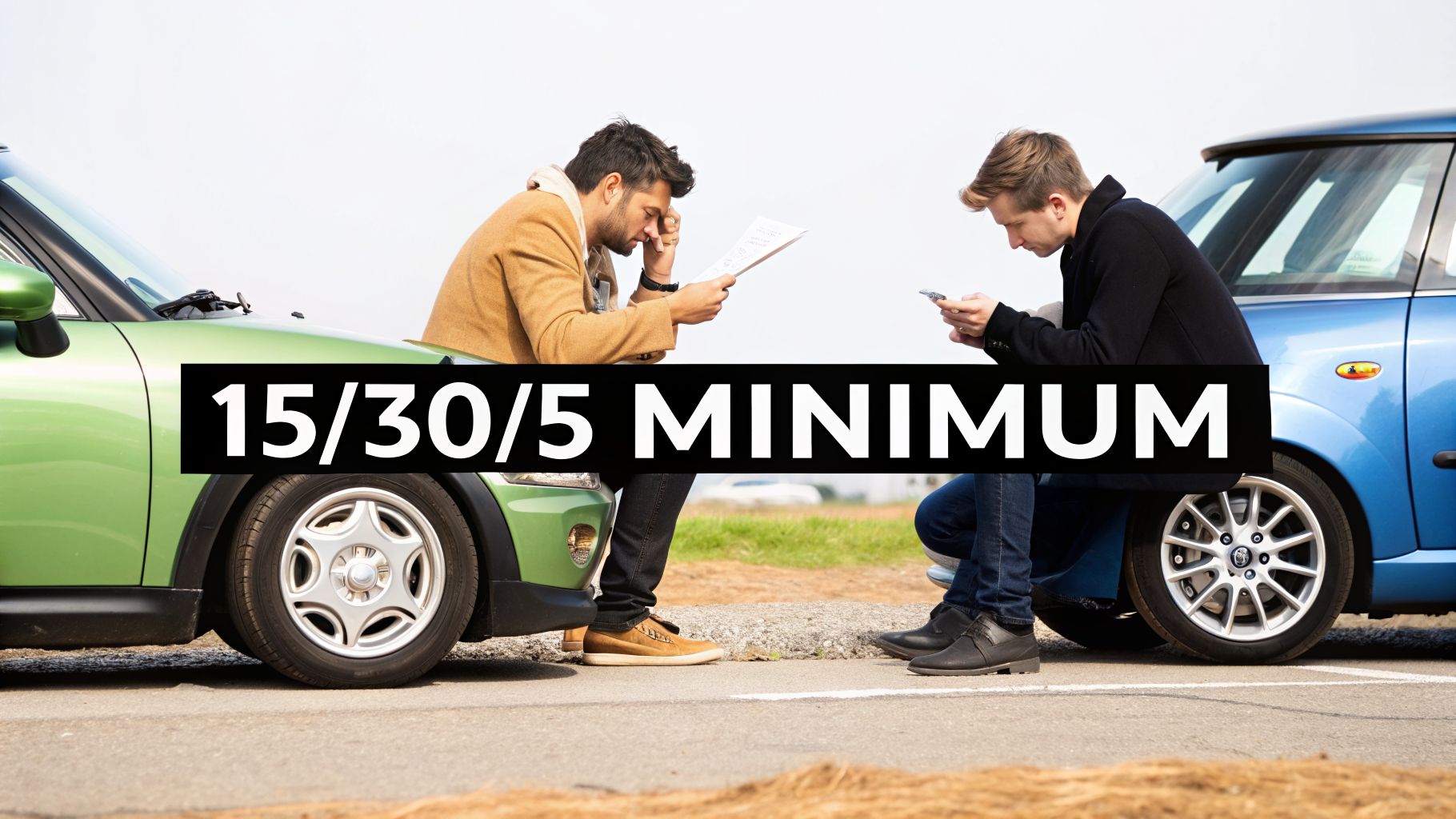
In the Golden State, every single driver is legally required to carry car insurance. You can think of this as the absolute bare minimum for financial responsibility on the road. For decades, California has used a liability system known as the “15/30/5” rule.
Getting a handle on this rule is the first real step to understanding how auto insurance in California works. It’s a simple formula that sets the lowest amount your policy must cover if you’re found at fault in an accident.
Decoding The 15/30/5 Rule
So, what do those numbers actually mean? Each one represents a different coverage limit, which is the maximum your insurance company will pay out in a given situation. Let's break it down:
- $15,000 for Bodily Injury Liability (per person): This is the most your insurer will pay for a single person's medical expenses if you cause an accident that injures them.
- $30,000 for Bodily Injury Liability (per accident): No matter how many people are hurt in an accident you cause, this is the total cap your policy will pay out for everyone’s combined injuries.
- $5,000 for Property Damage Liability (per accident): This is the maximum your insurance will pay to fix or replace the other person's car or any other property you damage.
To drive legally, everyone must follow these financial responsibility laws. You can dive deeper into the specifics by reviewing the official minimum insurance requirements in California. But what’s more important is understanding how these limits actually perform in the real world.
Why The Minimum Is Often Not Enough
Here’s the thing about those minimums: they are dangerously low in today's world. Let's walk through a scenario we see all too often. You're in a multi-car pile-up on a busy freeway. The car you hit is a fairly new SUV, and both the driver and their passenger need medical care.
Just the repair bill for that SUV could easily run over $10,000. Now, add an emergency room visit for two people, plus follow-up appointments and physical therapy. Their medical bills could quickly climb past $20,000.
With only the state minimum 15/30/5 coverage, here’s how that plays out:
- Your $5,000 property damage limit is exhausted immediately. You are now personally on the hook for the remaining $5,000 (or more) to fix their vehicle.
- Your $15,000 per-person bodily injury limit might not even cover one person’s bills. You'd have to pay the difference out of your own pocket.
- Your $30,000 total bodily injury limit is the combined max for everyone. If their total medical costs exceed this, you are responsible for paying the rest.
In this very realistic situation, a driver with minimum coverage could be looking at tens of thousands of dollars in personal debt. This is precisely why just meeting the legal requirement is a huge financial gamble.
Of course, the penalties for driving with no insurance at all are far worse, including massive fines, having your car impounded, and losing your license. Choosing a policy that truly protects your assets isn't just a good idea—it's essential for your financial well-being. A solid policy with higher liability limits, which complements other protections like your home insurance or renters insurance, provides a much more secure safety net.
Cracking Open Your California Car Insurance Policy
Let's be honest: an auto insurance policy can look like it's written in another language. But it's not as complicated as it seems. The best way to think about it is as a bundle of different shields, each designed to protect you from a specific type of financial disaster. Getting the right auto insurance in California is all about understanding what each shield does so you can build the right wall of protection for your life.
While the law only requires one part of this bundle—liability—a solid policy goes much further. Let's break down the jargon and see what these coverages actually do for you in the real world.
Liability Coverage: Your Financial First Defense
Think of liability coverage as your "I'm sorry" fund. If you're at fault in an accident, this is the part of your policy that pays for the damage you cause to other people and their property. It’s important to remember that it does nothing for your own car or your own injuries. Its entire job is to stand between you and a potentially devastating lawsuit.
This coverage is always presented in two parts:
- Bodily Injury Liability: This handles the costs if people are hurt in an accident you cause. It covers their medical bills, lost income if they can't work, and even settlements for pain and suffering.
- Property Damage Liability: This pays to fix or replace whatever you hit, whether it's someone else's car, a storefront, or a backyard fence.
Simply carrying California's minimum liability limits is a huge gamble. A single serious accident can easily blow past those low numbers, and when that happens, you're on the hook for every dollar beyond what your insurance pays.
Protecting Your Own Car
Liability takes care of others, but what about your own vehicle? That's where Collision and Comprehensive coverage come in. They are two sides of the same coin, working together to repair or replace your car after almost any kind of physical damage.
Collision Coverage: This is for when your car, well, collides with something. It pays for repairs when you hit another vehicle, a pole, a guardrail, or even if you back into a post in a tight parking garage. It applies no matter who was at fault.
Comprehensive Coverage: This is for all the other chaos life throws at your car. It handles damage from non-crash events that are typically out of your control. It’s your protection against the unexpected.
Comprehensive is your go-to coverage for incidents like:
- Theft or vandalism
- Fire
- Falling objects (like that rogue tree branch)
- Hitting a deer or other animal
- Floods, hail, and other natural events
When you hear a broker or dealer talk about "full coverage," they're almost always referring to a policy that includes both Collision and Comprehensive. If you have a car loan or lease, your lender will require you to carry both to protect their asset—your car.
Rounding Out Your Protection with Key Add-Ons
Beyond the big three, a couple of optional coverages provide a layer of security that has become more critical than ever. We're in a tough market right now. With premiums for some of California's biggest insurers jumping by over a third between 2023 and 2025, many drivers feel the pinch. The top 10 carriers, who write 85% of all policies in the state, hiked rates an average of 13% in 2023 and are on track for another 15.4% in 2024. In this climate, it's tempting to cut coverage, which makes having these protections even more vital.
Here are two of the most important options to consider:
- Uninsured/Underinsured Motorist (UM/UIM): What happens when the person who hits you has no insurance, or not enough to cover your hospital bills? This is your safety net. Your own UM/UIM coverage steps in to pay for your medical expenses and lost wages so you aren't left with the bill for someone else's mistake.
- Medical Payments (MedPay): This is straightforward, no-fault coverage for medical bills. After an accident, MedPay can immediately help pay for health insurance deductibles, ambulance rides, or other urgent costs for you and your passengers, regardless of who caused the crash.
Getting a handle on these policy elements is the first step to building a plan that actually protects you. If you want to get deeper into the terminology, our glossary of insurance concepts is a great resource. A smart strategy often involves bundling your auto insurance with home insurance or renters insurance—and sometimes even life insurance—to get the best possible protection and pricing.
Why Is California Auto Insurance So Expensive?
If you're a driver in the Golden State, you’ve probably felt the sting of high auto insurance costs. It’s a common complaint, and for good reason—premiums here are consistently some of the most expensive in the country. It’s not your imagination, and it’s not personal. The reality is that California is just an incredibly expensive state for an insurer to do business in.
At its core, an insurance premium is just a reflection of risk. When an insurer calculates your rate, they're predicting the likelihood and cost of you filing a claim. In California, that risk is off the charts due to a handful of key factors that create a high-cost environment for everyone.
The High Cost of Crowded Roads
First and foremost, California has more cars and drivers than any other state. Our major cities, especially Los Angeles and the Bay Area, are notorious for traffic congestion. All that gridlock isn’t just frustrating; it leads directly to more accidents. More fender-benders and collisions mean more claims are filed, forcing insurers to charge more to cover the massive payouts.
It’s not just the sheer number of accidents, either—it's the staggering cost associated with them. California's auto insurance market is the largest in the U.S., but it's also one of the most strained. In 2020, insurers paid out a jaw-dropping $646,023,640 in losses, resulting in a loss ratio of 126.66%. That means for every dollar they collected in premiums, they paid out over $1.26 in claims. More recently, the total written premiums climbed to $18,493,931,514, a figure that shows just how massive this market has become. You can dig deeper into the numbers yourself by checking out this market data report from the California Department of Insurance.
This trend of rising costs has led to significant rate hikes over the past few years.
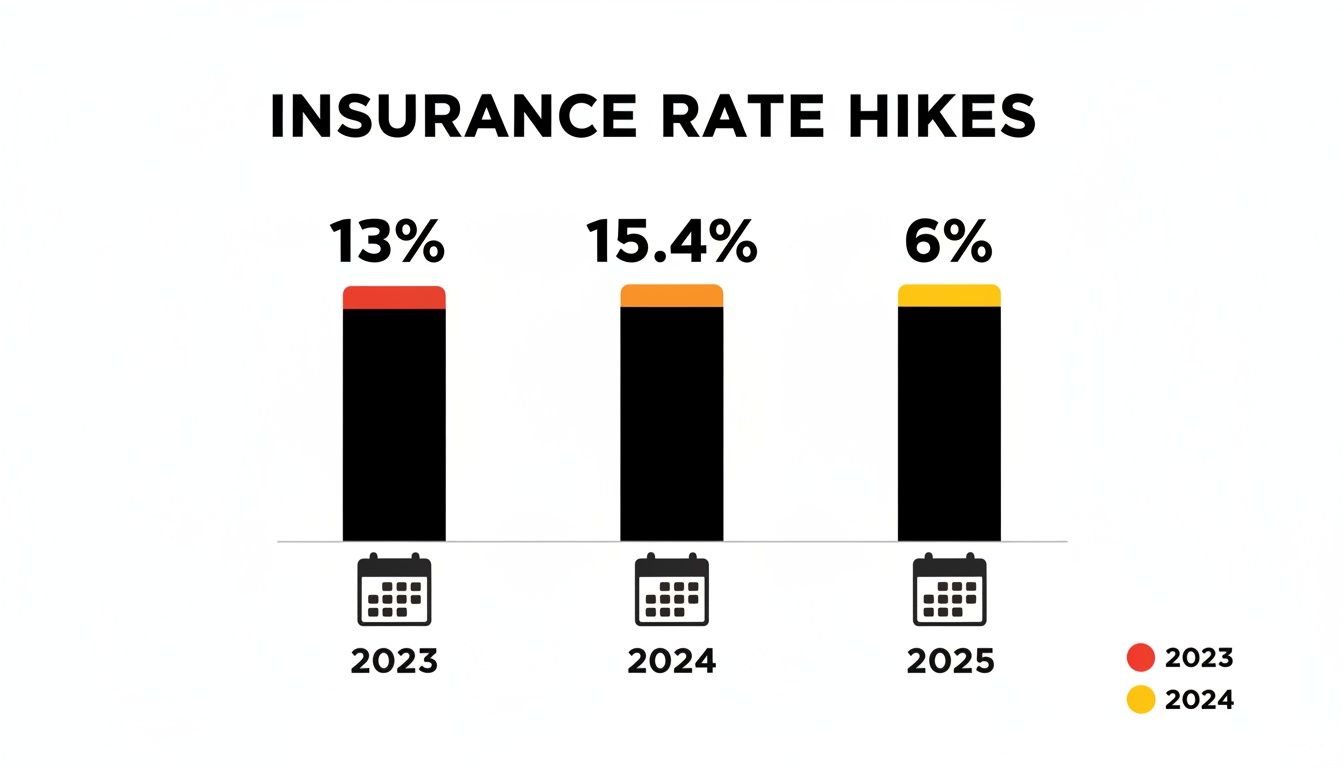
As you can see, these aren't small adjustments. Insurers are trying to catch up with the rising tide of claims, and drivers are feeling it directly in their wallets.
Where You Live Matters More Than You Think
Of all the factors that influence your premium, your zip code is one of the most powerful. It's a simple game of statistics. Densely populated urban areas with high rates of traffic, theft, and vandalism will always have more expensive car insurance than quiet, rural towns.
On top of that, California has unique environmental risks that get baked into your rates. Wildfires, floods, and even earthquakes add another layer of risk. Comprehensive coverage, which handles these non-accident-related claims, costs more here because the chances of needing it are genuinely higher. It’s the same principle that drives up home insurance costs in high-risk fire zones.
Your ZIP Code's Impact: A driver in a quiet, rural town might pay significantly less than someone with the exact same driving record living in downtown Los Angeles. This isn't personal—it's a calculation based on the collective risk of your neighborhood.
Finally, the cost of everything is just higher in California. From labor rates at the auto body shop to the specialized expertise needed to repair modern cars loaded with sensors, the average repair bill is inflated. When repair costs go up, insurance premiums follow. It all adds up, explaining why California insurance—whether for your car, home, or apartment—is a direct reflection of the state's high-cost, high-risk reality.
The table below shows just how much rates can vary from one city to another, even within the same state.
Average Full Coverage Auto Insurance Rates by California City (2026)
| City | Average Annual Premium | Average Monthly Premium |
|---|---|---|
| Los Angeles | $3,150 | $263 |
| San Diego | $2,480 | $207 |
| San Jose | $2,350 | $196 |
| San Francisco | $2,790 | $233 |
| Fresno | $2,250 | $188 |
| Sacramento | $2,420 | $202 |
| Long Beach | $2,980 | $248 |
| Oakland | $2,850 | $238 |
| Bakersfield | $2,190 | $183 |
| Anaheim | $2,720 | $227 |
As you can see, a driver in Bakersfield might pay nearly $1,000 less per year than someone in Los Angeles for the exact same coverage. This highlights just how critical your location is in determining your final premium.
Proven Strategies to Lower Your Insurance Costs

So, you know why auto insurance in California can be so expensive. Now for the good part: what you can actually do about it. While you can't change statewide accident rates or the price of car parts, you have more control over your premium than you might think.
This isn't about some secret trick. It's about being a savvy consumer and using a few proven, practical methods to get the best possible rate. Let's walk through the most effective ways to cut your car insurance bill, starting with the one that makes the biggest difference.
Embrace the Power of Comparison Shopping
By far, the single most effective way to lower your insurance cost is to shop around. No two insurance companies will quote you the same price for the exact same coverage. Why? Because each one uses its own unique (and secret) formula to weigh your risk.
That means the price for an identical policy can vary by hundreds, sometimes even thousands, of dollars between carriers. Accepting the first quote you get is a surefire way to leave money on the table.
This is where working with an independent insurance agent becomes a game-changer. Instead of spending hours on the phone with ten different companies, an agent does all that legwork for you. They can instantly check rates from dozens of carriers to find the one that gives you the best value for your specific situation.
Unlock Discounts You Might Be Missing
Insurance companies have a whole menu of discounts available, but they don't always put them front and center. You often have to ask. Make sure you’re not missing out on these common savings opportunities:
- Multi-Policy Discount: This is the heavyweight champion of discounts. Bundling your auto insurance with your homeowners or renters policy can easily save you 10% to 25%. Some carriers will even throw in a discount for adding a life insurance policy.
- Good Driver Discount: A clean record is your best asset. If you’ve gone three to five years without any at-fault accidents or major tickets, you absolutely deserve a lower rate.
- Good Student Discount: Have a young driver on your policy? If they're a full-time student and maintain at least a "B" average, it can make a real dent in their part of the premium.
- Defensive Driving Course: Completing an approved defensive driving class can often knock a few more percentage points off your bill. Every little bit helps.
Adjust Your Policy with Care
Beyond discounts, a few strategic tweaks to your policy itself can lead to immediate savings. The most common move is to raise your deductible—the amount you agree to pay out-of-pocket for a collision or comprehensive claim before your insurance pays the rest.
Think of it as a balance. A higher deductible, say moving from $500 to $1,000, will lower your monthly premium. The key is to only choose a deductible you can comfortably pay on a moment's notice. If you have that amount set aside in an emergency fund, this is a smart trade-off.
It's also worth re-evaluating your coverage on older cars. If your vehicle is paid off and its market value has dropped significantly, paying for full collision and comprehensive might not make financial sense anymore. You could end up paying more in premiums over a year than the car is actually worth.
Ultimately, taking control of your California insurance premium is an active process. By combining aggressive comparison shopping with a hunt for every available discount and a few smart policy adjustments, you can ensure you're getting the protection you need without overpaying. To see exactly how these strategies can work for you, our team can help you get an insurance quote and compare top-rated carriers in minutes.
Finding Coverage for Special Situations
Let's face it, not every driver's history is a perfect straight line. Life happens, and sometimes that can throw a wrench into your insurance needs. Whether you’ve had a few bumps in the road or you don't even own a car, getting the right auto insurance in California is absolutely achievable. It just means taking a slightly different path.
A knowledgeable agent knows there’s a solution for every driver, no matter the circumstances. Let’s clear up the confusion around some of these unique scenarios.
What Is an SR-22 and Why Might You Need One?
First off, an SR-22 isn't insurance. It’s a certificate, a piece of paper your insurance provider files with the California DMV to prove you're carrying the state-required liability coverage. Think of it as a "proof of responsibility" form that the state demands for a period of time.
You'll typically be required to file an SR-22 after a serious driving violation, such as:
- A DUI conviction
- Getting caught driving without any insurance
- Causing a major accident while uninsured
- Having your license suspended due to too many points
If the DMV puts you on an SR-22 requirement, you must keep it active, usually for three years. Any gap in your insurance gets reported straight to the DMV, and they can suspend your license all over again. Finding an insurance company willing to file an SR-22 can feel like a hurdle, but it's far from impossible.
High-Risk Drivers and Finding Affordable Coverage
The term "high-risk driver" can sound pretty harsh. In reality, it’s just the industry's label for anyone they believe has a higher-than-average chance of filing a claim. This could be because of multiple accidents, a string of speeding tickets, a DUI, or even just being a brand-new driver with zero experience.
Being classified as high-risk almost always means paying higher premiums. But you aren't stuck. The key is to work with an independent agent who partners with carriers that specialize in these kinds of policies. Over time, as violations age and fall off your record, your rates will come back down. To see how your location impacts this, our guide on auto insurance in Los Angeles breaks down local factors in more detail.
Pro Tip: Even if you're considered high-risk, you can still chip away at your costs. Always ask about discounts for taking a defensive driving course or bundling your auto policy with renters insurance.
Non-Owner Car Insurance Explained
What happens if you drive often but don't actually own a car? Maybe you regularly borrow a friend's SUV, use car-sharing apps, or rent vehicles for work trips. This is precisely where a non-owner car insurance policy comes in.
This policy gives you personal liability coverage whenever you're driving a car you don't own. It’s your own financial safety net, protecting you and your assets if you're found at fault in an accident. It’s an incredibly smart and affordable way to stay covered without the expense of a traditional auto policy tied to a specific vehicle—a great addition to your overall protection plan, right alongside home insurance or life insurance.
Frequently Asked Questions About California Auto Insurance
It's only natural to have questions when you're sorting out car insurance. We get them all the time. Here are our straight-to-the-point answers to some of the most common things California drivers ask us about.
Does My Credit Score Affect My Auto Insurance Rate in California?
Yes, but probably not as much as you think. In California, insurance companies can look at your credit history when they calculate your premium, but it can't be the only reason they charge you more or turn you down.
Think of it this way: a good credit history suggests you're financially responsible, which can translate to a slightly lower rate. However, factors like your driving record, where you live, and the car you drive will always have a much bigger impact on your final price.
How Can I Get a Better Rate After an Accident?
An at-fault accident will almost certainly cause your premium to go up at renewal time. The key is to get ahead of it. First, see if you're eligible for traffic school. Completing it can often prevent points from hitting your license, which really helps soften the long-term financial blow.
Then, about 45 days before your current policy ends, you need to start shopping around. Different insurance carriers have different levels of forgiveness for a single accident. This is where working with an independent agent really pays off—we can quickly check rates across dozens of companies to find one that won't penalize you as heavily.
Is It Cheaper to Bundle My Auto, Home, and Life Insurance?
Absolutely. In fact, bundling is one of the easiest and most powerful ways to lower your insurance costs across the board. When you buy multiple policies—like auto insurance, home insurance, renters insurance, or life insurance—from the same carrier, they reward you with a multi-policy discount.
These discounts are significant, often saving you 10% to 25% on your total bill. Beyond the savings, it just makes life simpler. You have one point of contact for all your policies. We're experts at finding the perfect bundle that maximizes your savings without leaving any gaps in your protection.
Bundling is a true win-win. Insurers get more of your business, and you get a loyal customer discount, simpler billing, and a much lower overall cost. It's the smartest way to stretch your insurance dollars.
What Is the California Low Cost Auto Insurance Program?
This is a fantastic, state-sponsored plan called the California Low Cost Auto (CLCA) program. It was created to provide affordable liability car insurance for drivers who meet specific income requirements. It’s a vital safety net that helps people stay legally insured when they might otherwise not be able to.
To qualify, you'll need to meet income eligibility guidelines, have a good driving record, and own a car valued under a certain amount. If you think you might be eligible, we can help you review the criteria and guide you through the application to see if it’s the right choice for your situation.
Ready to see what your savings could look like? The expert agents at Mai & Associates can pull real-time quotes for your auto, home, and life insurance from California's top carriers in just a few minutes. Visit us to get your free, no-obligation quote and start protecting what matters most: https://cahomeauto.com