Auto Insurance for Young Drivers in California
You're at the kitchen table in Glendale or Costa Mesa, staring at a quote that makes no sense. Your 17-year-old just got licensed, you did the responsible thing, and now the family premium looks like it got hit with a wrecking ball. That reaction is normal. Auto insurance for young drivers is priced off real risk, not parental feelings, and California families need a clean way to judge the quote, not panic over it.
The right move is not to chase the cheapest number on one screen. The right move is to understand why the price jumped, what California requires, and which switches you can flip today to bring the bill back into the realm of reason. A good policy for a teen driver is about more than the sticker price, it's about coverage that still works after a mistake.
Why Auto Insurance for Young Drivers Costs So Much
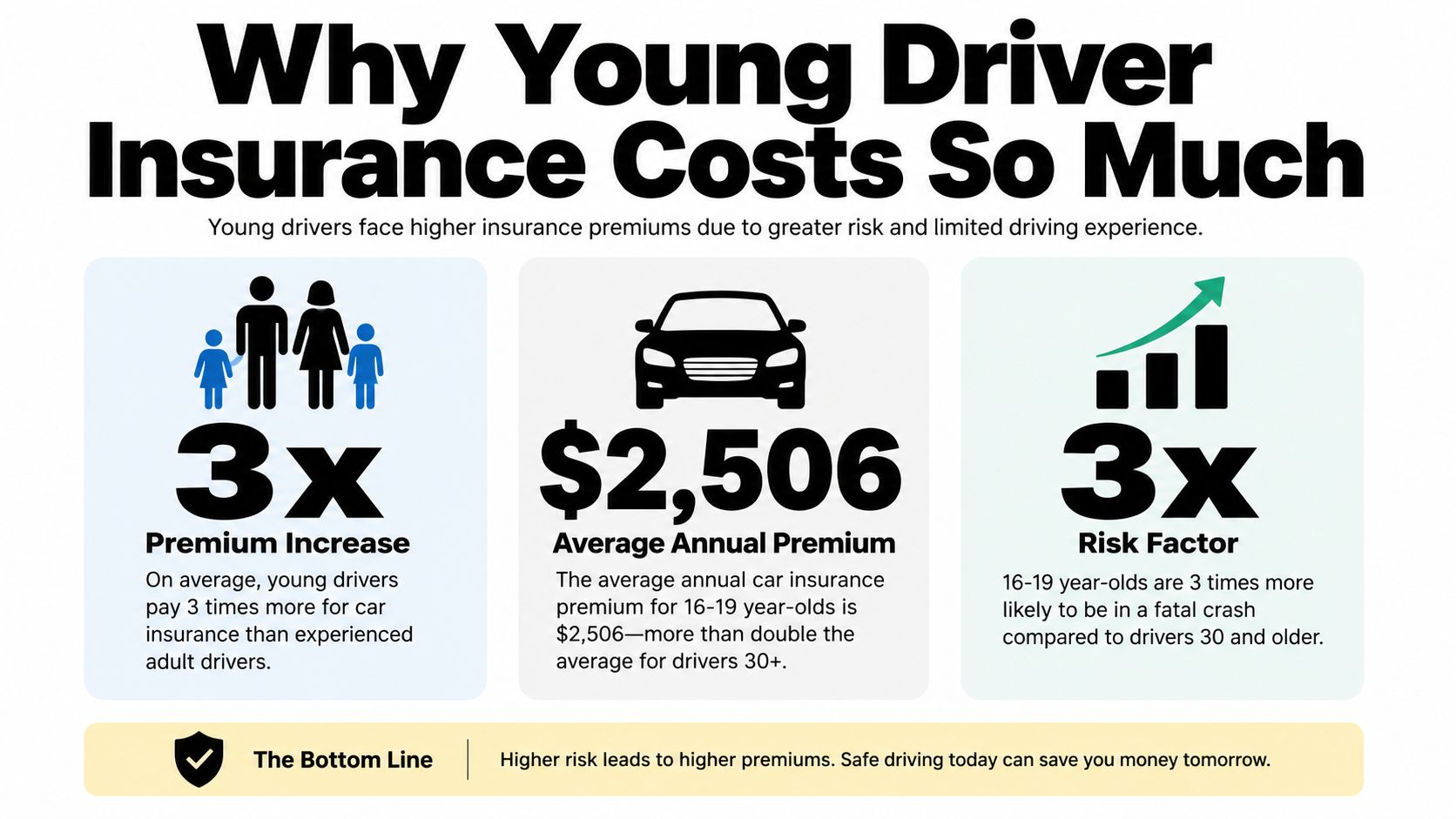
A Glendale parent opens a quote for the family's 17-year-old and the premium jumps hard. That is not random, and it is not a computer mistake. Carriers are reacting to the same loss pattern every underwriter sees, young drivers crash more often and with worse outcomes than older adults, so the price tracks the risk.
The primary price driver is the risk gap
NHTSA reported that in 2021, drivers ages 20 and under were just 5.1% of licensed drivers, but they accounted for 8.5% of drivers in fatal crashes and 12.6% of drivers in all crashes. For drivers ages 16 to 19, the fatal-crash rate was 4.8 per 100 million travel miles, compared with 1.4 for drivers in their 30s and 40s, according to the same young-driver data. NHTSA also reported 2,116 young drivers killed and 203,256 injured in traffic crashes in 2021. NHTSA young driver data
That gap is why insurers do not treat a teen like a slightly pricier adult. They see a much higher chance of a claim, and in insurance, chance matters as much as the car itself. When the loss pattern is this clear, the premium does not inch up. It jumps.
Practical rule: if a teenager's quote looks painful, that usually means the carrier is pricing the exposure correctly, not punishing the family.
Age is the largest single rating factor
Market pricing says the same thing in plain terms. The Zebra reported that 16-year-old drivers pay an average of $7,658 per year, which is 254% more than the national average for a 30-year-old driver at $2,189 per year. Other market snapshots show the same steep curve, with teen pricing far above what older drivers pay. The Zebra teen driving report
That is why a young-driver quote can feel like a family-policy shock. The policy did not get worse because the agent got greedy. It got worse because the insurer is loading the premium where the loss risk lives, and the youngest licensed drivers sit at the top of that risk stack.
A good policy for a teen driver is about more than the sticker price, it is about coverage that still works after a mistake. For California families, that starts with understanding California's auto insurance requirements before you compare premiums.
The short version is simple. Teen premiums are high because teen crash risk is high. Once you accept that, you can make better decisions instead of arguing with the quote.
California Minimum Coverages and GDL Rules
A teen can have a clean driving record and still create a mess for the family if the policy, the vehicle assignment, and the license status do not line up. California families need to start with the legal floor, then make sure the household setup matches it. If those pieces conflict, the policy can look fine until a claim, a stop, or a renewal exposes the problem.
What the state requires
California's minimum liability limits are only the starting point. They do not make a policy strong, and they do not protect a family from the cost of a serious crash. Drivers also need to carry proof of insurance, because a policy number does nothing if the driver cannot show coverage during a stop or after an accident.
The provisional-license rules matter just as much. Under California's graduated licensing rules, new drivers under 18 face passenger and nighttime restrictions during the first stage of licensing, and parents need to enforce those limits at home. A teen who drives outside those rules can turn a license violation into a coverage problem later, especially if the household has been loose about who is allowed to drive what car.
Keep the license status, the car assignment, and the household policy in sync. That is where families stay out of trouble.
SR-22 is a filing problem, not a coverage upgrade
An SR-22 is not a better policy. It is a filing attached to driving trouble or licensing trouble, and young drivers can need it after serious violations such as a DUI, an at-fault crash without insurance, or driving without a license. If the state requires one, the family has to treat it as a compliance requirement that stays active for the required period, not as a form to file once and forget.
California parents should take every citation and every lapse seriously. One bad event can raise the next premium and complicate the teen's record, which is why the state draws such a hard line around compliance. If you want a plain-English check of whether your teen's setup is legal and complete, start with the answers agents give every day in the California auto insurance FAQ. Families save time and avoid mistakes when they verify the license rules first, then shop the policy.
How Insurers Price a Young Driver
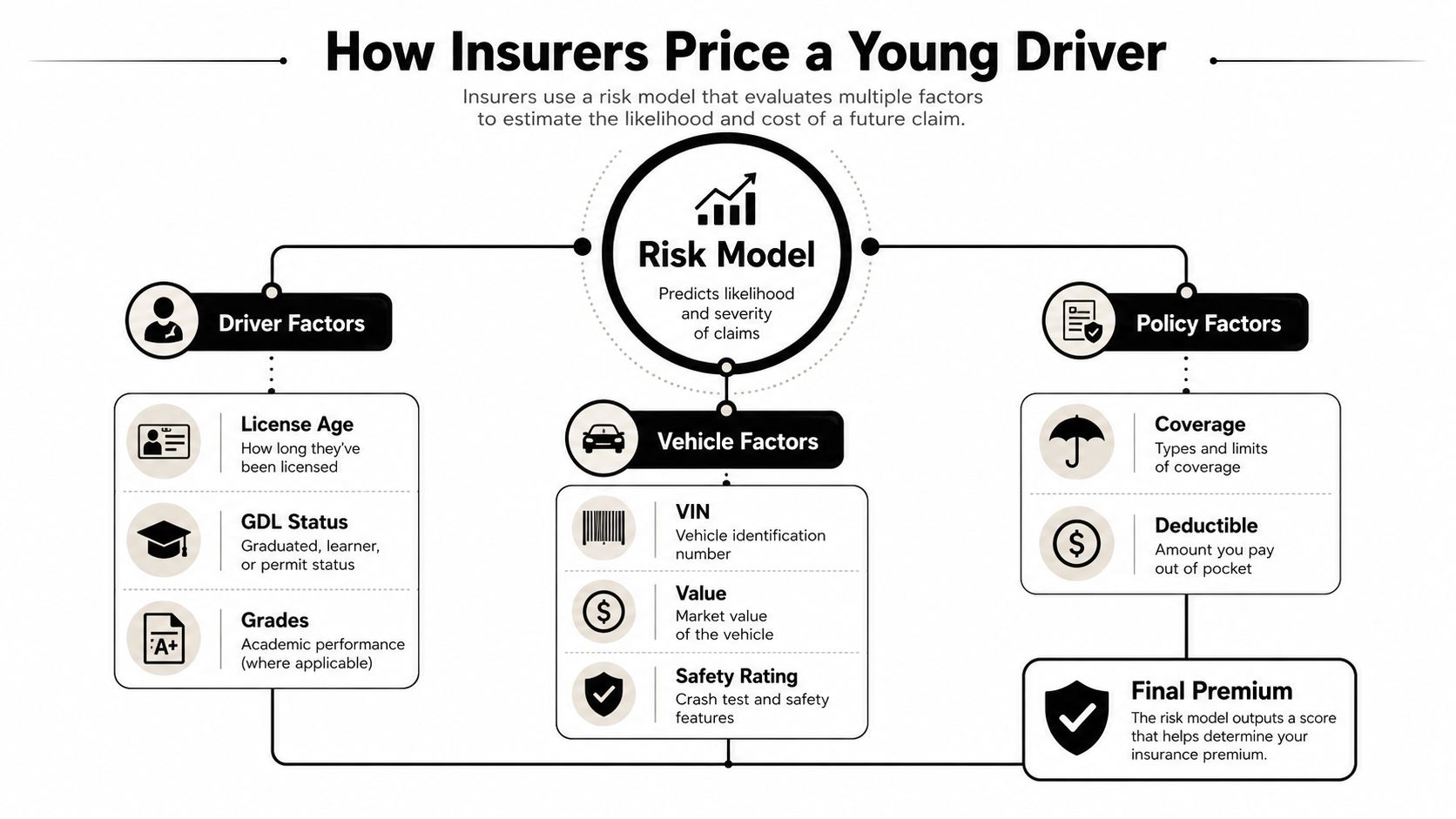
Carriers do not set a teen rate from age alone, even though age is the loudest signal in the file. They use a multi-factor risk model to separate the careful 19-year-old from the 19-year-old who speeds, drives late, and generates claims. That is why two teens in the same city can get very different quotes.
The variables carriers score
A practical underwriting workflow scores the applicant using date of birth, license issue date, GDL stage, vehicle VIN-based safety and theft class, household claims history, and telematics inputs like hard braking, speeding, night driving, and distraction. That is the full picture behind a quote. The insurer is pricing both the chance of a claim and how expensive that claim is likely to be.
The vehicle matters because some cars cost more to repair or replace. The garaging address matters because risk is not identical in every neighborhood. The household claims record matters because the policy sits inside a broader family risk pattern, not in a vacuum. California families who want to see how those factors are usually organized can compare notes with the California auto insurance FAQ and then shop from there.
Experience changes the number quickly
The premium curve is steep, but it does not stay steep forever. Car and Driver, citing CarInsurance.com data, showed averages dropping from $7,203 at age 16 to $2,010 by age 25. That is the pattern families feel in real life, the first years are brutal, then the quote usually eases as driving history replaces guesswork. The Zebra teen driving report
Bottom line: insurers are charging for uncertainty, and uncertainty fades as the driver builds a clean record.
California families get the best results when they stop fighting the premium and start managing the inputs. Keep the teen on the right policy, keep the car choice sensible, and keep the record clean. That is what moves the number.
A Prioritized Checklist to Lower Your Premium
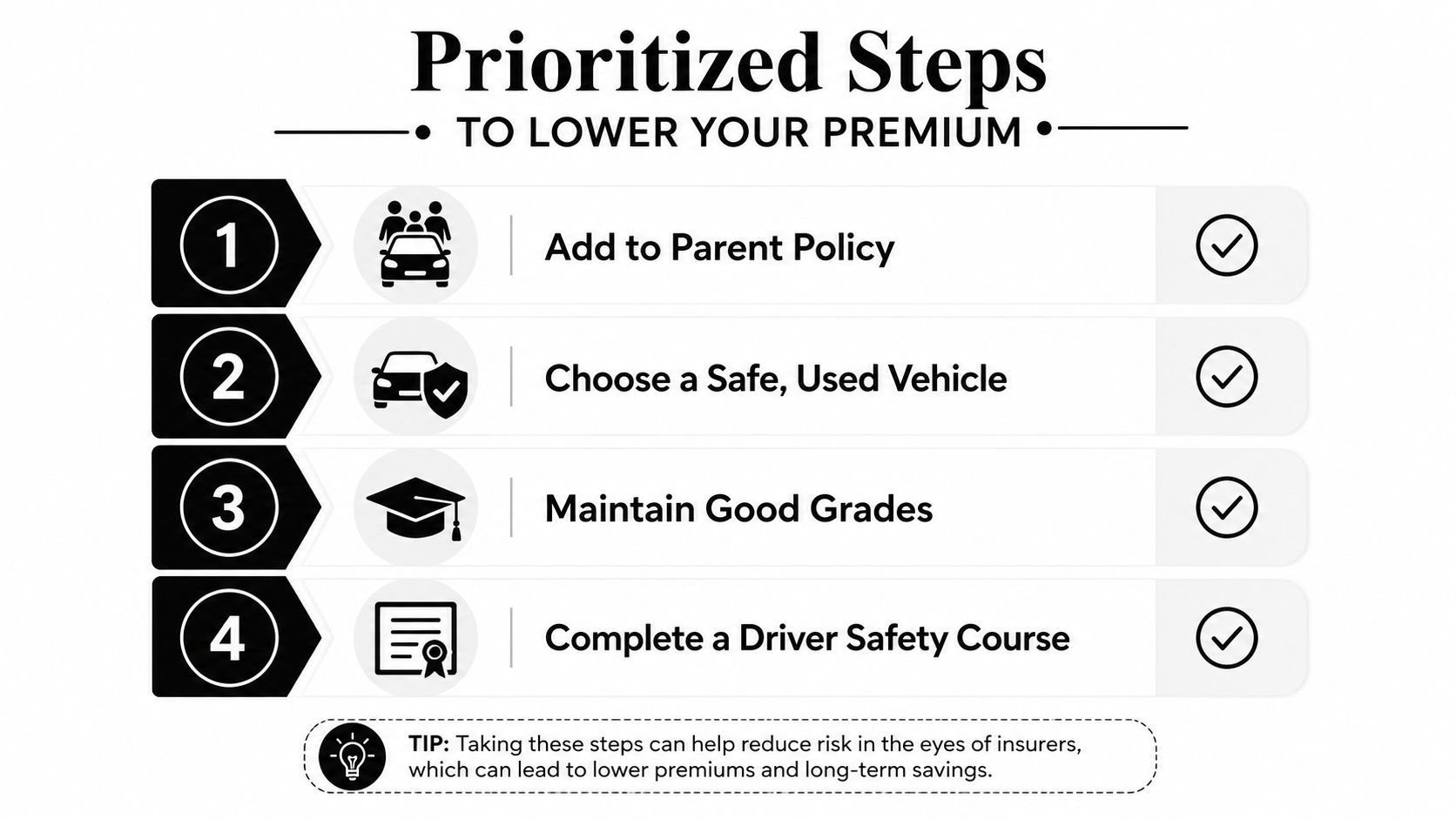
A family with a new teen driver should start with the decisions that change the quote fastest. Families waste money chasing small discounts first, then wonder why the bill barely moves. Savings come from the policy setup, the car, and the driver's day-to-day behavior.
Start with the policy, then the car
Put the teen on the family policy first unless there is a clear reason not to. That is usually the cleaner and cheaper setup, and it keeps the household coverage aligned. If the young driver is living elsewhere or owns the car outright, then a separate policy may make sense.
Then choose the vehicle with your eyes open. A modest, lower-performance car with a better repair and theft profile is usually easier to insure than a newer or sportier model. California families who want to compare how carriers and policy structures are typically discussed can start with the California insurance guides and use that to frame the conversation.
After that, check the policy terms line by line. Compare quotes on the same liability limits, the same deductibles, and the same optional coverages, or the price comparison is meaningless. A low quote that only looks cheap because the limits are thin is the wrong move for a teen driver.
Use discounts that reward habits, not luck
Ask for discounts tied to things you can control. Good-student discounts and driver-training discounts belong at the top of the list because they reflect effort, not chance. A defensive-driving discount can help too, and the logic is the same as the defensive driving discount Georgia programs carriers already use. The point is not Georgia law, it is the pricing principle, and California carriers should answer the same question clearly.
Telematics and usage-based programs deserve attention, especially for a teen who drives less and drives calmly. They give the insurer a real driving record instead of a guess based on age alone. They also come with tradeoffs, because hard stops, night driving, or inconsistent habits can push the price around. Families should read the privacy terms before enrolling.
Do not ignore mileage, deductibles, and bundling
Mileage estimates matter more than families expect. If the car is driven only for school, work, or limited errands, the estimate should reflect that reality and be kept current. Inflate the mileage and you pay for risk you do not have. Understate it and you create problems later.
Raise the deductible only if the household can cover it without strain. A higher deductible can lower the premium, but only if there is cash set aside for repairs or a claim. Bundling can help as well, especially when the auto policy sits with renters or home coverage in the same household. The right carrier should review the full picture, not just quote one auto number and stop there.
A direct shopping checklist for California families is available through California insurance guides if you want to compare the household setup before binding coverage. That is the practical way to shop, especially when you are pricing a first teen policy in California and want the same-day quote conversation to be clear in English or Spanish.
Westlake Village families can often save by combining a sensible used car, a household policy, a good-student discount, and a defensive-driving course. That is not a trick. It is disciplined buying, and it works.
Family Policy vs Separate Policy for Young Drivers
Most families should start by pricing the teen on the parent policy. That's usually the cleaner and cheaper setup, and it keeps the household coverage consistent. The separate-policy option only starts making sense when the teen's living situation, car ownership, or coverage needs pull them away from the family household.
Where the math usually lands
Recent pricing snapshots show how wide the spread can be. NerdWallet reports an average of $479 per month to insure a teen plus two parents sharing one vehicle, while Insurify reports $182 per month on average for a teenage driver on their own liability-only policy. Policygenius notes the national average for young adults ages 20 to 21 is $3,268 per year. Those figures are not apples-to-apples on every detail, but they do show why families need to check both structures instead of assuming one answer fits everyone. NerdWallet young driver coverage
| Family Policy vs Separate Policy Cost Comparison | Policy Structure | Average Monthly Cost | Average Annual Cost | Best Fit Scenario |
|---|---|---|---|---|
| Household policy | Add teen to parent policy | Often cheaper in most families | Varies by vehicle and coverage | Teen lives at home, shares household cars, needs full family protection |
| Separate policy | Teen buys own liability-only policy | $182 average | Varies by limits and vehicle use | Teen lives away, owns their own car, or needs independent coverage |
| Shared household scenario | Teen plus two parents sharing one vehicle | $479 average | $5,748 annualized | Useful as a reality check when comparing family-policy quotes |
When a separate policy can win
A separate policy starts to make more sense when the teen lives away at college, owns a vehicle titled in their own name, or needs coverage that doesn't fit inside the family policy. That's the part most consumer articles skip, and it's the part that matters when the vehicle is no longer really a household asset.
An Escondido family with a teen who still drives the family SUV should usually stay on one policy. A Costa Mesa 20-year-old with their own car and a clean, limited driving pattern may need a separate policy if the household setup no longer matches the car's real use. The answer comes from the household facts, not from a blanket rule.
If the young driver is still using the family cars, the parent policy usually wins. If the young driver has become a separate household risk, price it separately and compare.
The decision is mostly about ownership, residence, and usage. Get those three right, and the rest of the math becomes a lot easier.
How to Shop, Compare Quotes, and Handle SR-22s
Start with clean inputs. A young-driver quote only helps when every carrier gets the same facts and the same coverage targets. If one company quotes a family policy with solid limits and another quotes a stripped-down version, the lower number is just the easier mistake.
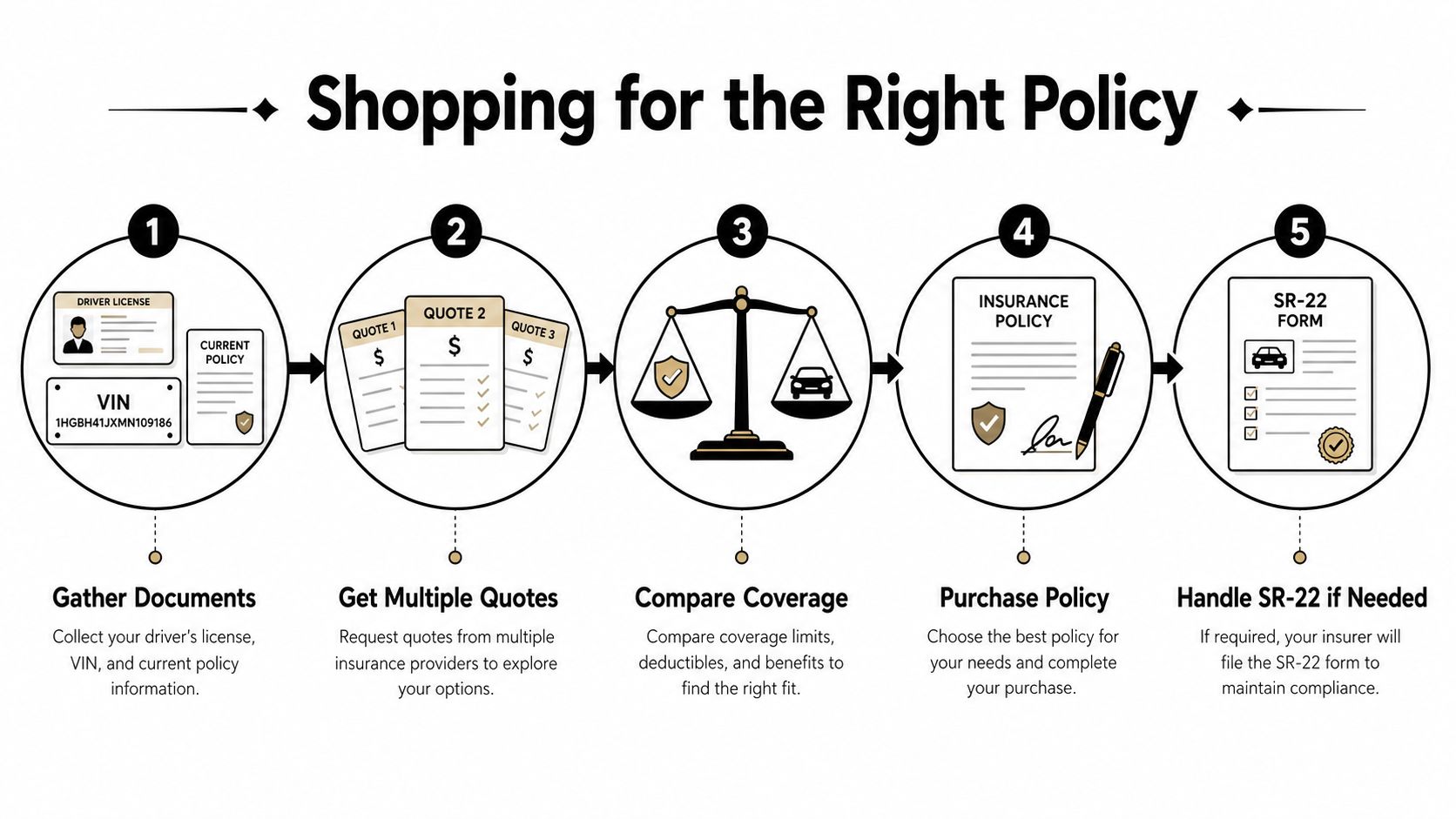
Bring the right paperwork first
Have the driver license number, VIN, current declarations page, and proof of any good-student or driver-training completion ready before you request quotes. If an SR-22 is required, say so up front. The carrier cannot file what it does not know it needs to file. If the teen has a suspended license or a serious violation on record, disclose it now. Cleaning it up later wastes time and usually costs more.
Match the liability limits, deductibles, and uninsured motorist coverage before you compare price. A low quote that omits important protection is not a deal. It is a gap. The right way to shop is to compare the same policy structure from two or three carriers, then ask which one gives the best price for the same protection. If you want to request a same-day review, compare quotes from top carriers and make the carriers work from the same details.
Know what SR-22 really means
If SR-22 filing is required, expect a filing fee and a compliance tail after a serious violation. California families should treat that filing as part of the recovery plan, not a footnote. For a young driver trying to get back on the road after suspension, the next move is to keep the policy active, keep the filings current, and stop letting lapses create a new problem.
Working rule: if the quote looks suspiciously low, check the coverage first. In auto insurance, the missing protection is usually why it looks cheap.
A smart shop moves quickly, but it stays disciplined. Bring the documents, match the coverage, and make the carrier explain any gap before you bind the policy.
Working With a Licensed California Agent
A good California agent saves families time because the agent knows where the quote gets distorted. That matters even more when the driver is new, the household has more than one car, or the family also needs help with home, renters, or life insurance. Same-day quotes from multiple carriers beat waiting on one website and hoping it guessed right.
Mai & Associates gives families a practical advantage here, with same-day quotes, a 24-hour response promise, and support in English, Spanish, Armenian, Russian, and Vietnamese. The team has offices in Glendale, Westlake Village, Escondido, and Costa Mesa, which is useful when a parent wants a real conversation instead of a chatbot. That human review matters because young-driver quotes often hinge on details like household drivers, vehicle use, and coverage gaps that online forms miss.
A first call should be simple. A good agent asks who drives which car, where the vehicle is garaged, what coverages are already in force, and whether the family also wants to review home, renters, or life insurance for bundling opportunities. That's the level of care families need when a teen is moving onto the road for the first time.
If you want a straight answer on your teen's policy, talk to Mai & Associates. They compare carriers, explain the tradeoffs in plain English, and help California families find coverage that fits the driver, the car, and the household without wasting a day chasing bad quotes.