Auto Insurance Deductible: How to Choose the Right Amount for California Drivers
An auto insurance deductible is the amount of money you agree to pay out of your own pocket before your insurance company steps in to cover the rest. Think of it as your share of the repair costs after an accident. Getting this number right is one of the biggest levers you can pull to manage how much you pay for car insurance in California.
What an Auto Insurance Deductible Means for You

At its heart, your deductible is a simple agreement with your insurer. When you set up your policy, you're essentially saying, "If something happens to my car, I'll handle the first chunk of the bill up to this amount." This single decision has a huge impact on your premium.
The relationship is a classic trade-off. If you choose a higher deductible, you're telling the insurance company you're willing to take on more financial risk. They see this as a good thing and reward you with a lower premium. On the flip side, a lower deductible means they're on the hook for more, so your premium will be higher.
The Basic Trade-Off Explained
Picking your deductible is a balancing act between what you can afford monthly and what you could handle in an emergency. There's no magic number here, especially for drivers in California's often-pricey insurance market. It really comes down to your personal finances.
Let's break it down into two simple scenarios:
- Higher Deductible: You'll enjoy smaller monthly payments, but you must have enough cash stashed away to cover that larger out-of-pocket expense if you need to file a claim.
- Lower Deductible: Your monthly bill will be higher, but if you get into a fender bender, your immediate financial hit will be much easier to swallow.
This isn't a small decision. The National Association of Insurance Commissioners (NAIC) noted that the average U.S. auto insurance spend hit $1,127 in 2022, and the deductible you choose plays a big part in that figure. A $500 deductible remains the most popular choice for both collision and comprehensive coverage, which 80% of insured American drivers have. You can dig into more national auto insurance trends and statistics from the Triple-I.
Getting comfortable with the key terms is the first step to making a smart choice. For straightforward definitions of this and other insurance lingo, feel free to browse our complete insurance glossary.
The ultimate goal is to land on an amount you could pay tomorrow without derailing your budget. At Mai & Associates, we work with California drivers from Glendale to Costa Mesa every day to find that sweet spot, making sure their auto insurance, home insurance, and renters insurance policies truly fit their needs. This guide will give you the clarity you need to choose wisely.
Collision vs. Comprehensive Deductibles Explained
When you pull up your car insurance policy, you’ll see it’s not just one blanket deductible. Your policy actually has two main players when it comes to covering damage to your car: the collision deductible and the comprehensive deductible. Getting the hang of how these two work is the key to understanding what your California insurance will actually pay for when something goes wrong.
Think of them as two different kinds of protection for two different kinds of trouble. Each has its own deductible, and the cool part is, you can often set different dollar amounts for each one. This gives you a way to customize your policy to fit what you're most worried about and what your wallet can handle.
What is a Collision Deductible?
The collision deductible is pretty straightforward. It’s the amount you pay out-of-pocket when your car gets damaged in a crash—whether it’s with another car or an object, like a pole or a guardrail. It doesn't matter who was at fault; if your car collides with something, this is the coverage that kicks in.
For a driver in California, this could look like:
- A classic fender-bender during rush hour traffic on a Glendale freeway.
- Accidentally backing into a concrete pillar in a tight Costa Mesa parking garage.
- Losing traction on a wet, winding canyon road and hitting the guardrail.
In any of these situations, you’d pay your collision deductible first. After that, your insurance company picks up the rest of the repair bill, all the way up to your policy's limit. It’s all about damage from impacts.
What is a Comprehensive Deductible?
Your comprehensive deductible, on the other hand, is for almost everything else. Think of it as the "life happens" coverage. It’s for damage that isn't caused by a direct collision, which is why some insurers call it "other than collision" coverage.
Comprehensive is your financial shield against the unpredictable. It covers the kind of damage that can happen when your car is just parked, or from surprise events on the road that have nothing to do with a crash.
This is a huge deal for California residents, who deal with a unique set of risks. Here are a few real-world examples where comprehensive coverage saves the day:
- Theft & Vandalism: Your car gets stolen from your driveway in Westlake Village, or someone decides to key it overnight.
- Weather Damage: A freak hailstorm in Escondido leaves your roof looking like a golf ball, or a heavy branch snaps off a tree during a storm and smashes your windshield.
- Animal Collisions: Hitting a deer on a rural road just outside city limits. (Yes, hitting an animal is considered comprehensive, not collision!)
- Road Debris: A rock gets kicked up by a truck on I-5 and leaves a nasty chip in your windshield.
For any of these headaches, you’d pay your comprehensive deductible, and your insurance would take care of the rest. Since these things are completely out of your control, this coverage offers some serious peace of mind.
Setting Different Deductible Amounts
Here’s where you get some strategic control. You don't have to set the same deductible for both collision and comprehensive coverage. You can mix and match. For example, you might opt for a $500 collision deductible but feel comfortable with a $1,000 comprehensive deductible.
Why would you do that? Maybe you figure you're more likely to get into a minor accident than to have your car stolen. By raising the deductible for comprehensive—the less likely event, in your view—you can lower your overall insurance premium. At the same time, you keep a more manageable out-of-pocket cost for a collision, which you might see as a more common risk. This kind of flexibility is crucial for balancing great protection with a price you can afford, a smart strategy that applies to other policies too, like home and renters insurance.
How Your Deductible Directly Impacts Your Premium
Think of your auto insurance deductible and your premium as two ends of a seesaw. When one goes up, the other comes down. It's a simple but powerful relationship: the more financial risk you're willing to take on upfront after an accident, the less your insurance company will charge you each month.
By choosing a higher deductible, you're essentially telling your insurer, "I'll cover the small stuff, you cover the big stuff." They reward that shared risk with a lower premium. For drivers in California, from Costa Mesa to Westlake Village, this isn't just a minor tweak—it's one of the most effective ways to manage your California insurance budget.
The chart below gives you a clear visual of how this works. Notice the direct link between higher deductibles for collision and comprehensive coverage and the corresponding drop in premium costs.
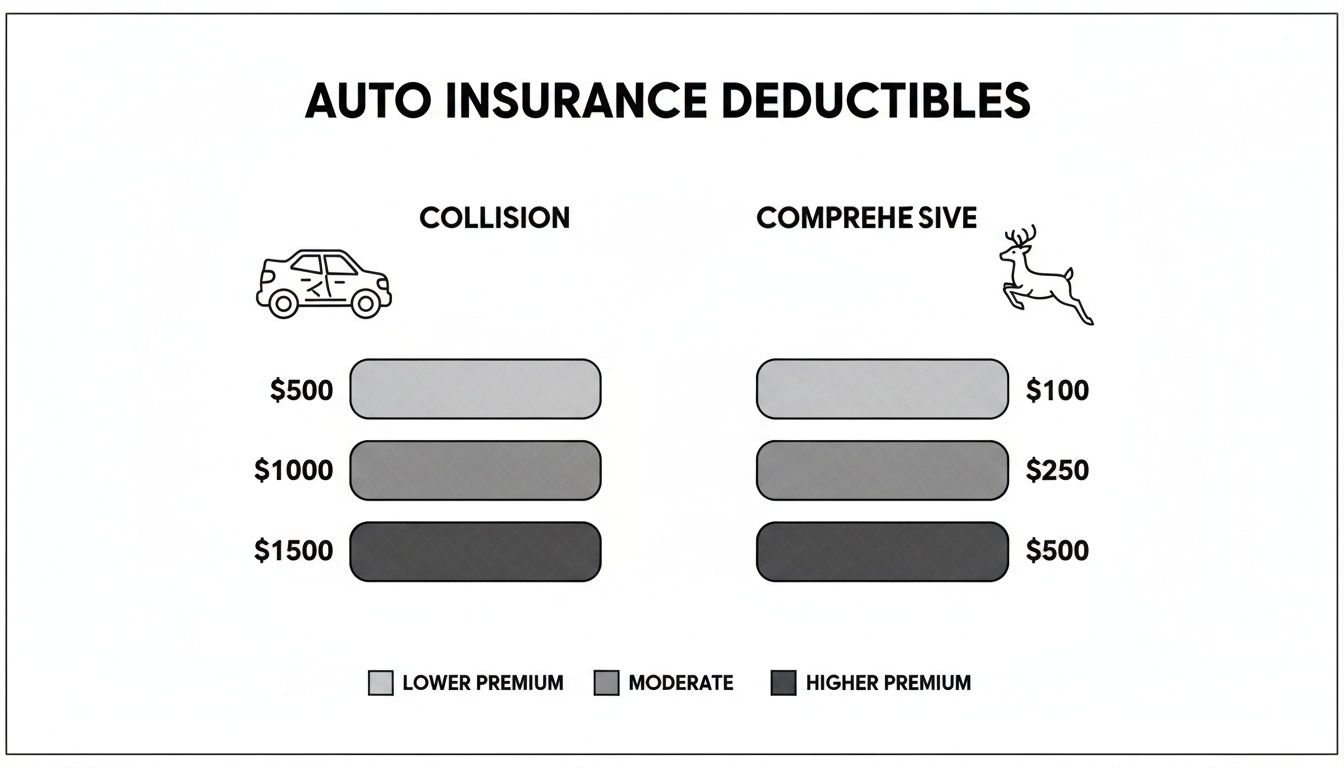
As you can see, the higher you set your deductible, the lower your premium can go. It’s a classic trade-off between what you pay now versus what you might have to pay later.
The Numbers Behind the Savings
So, what does this look like in real dollars? The impact is bigger than you might think. Just by increasing your deductible from $500 to $1,000, many drivers can see their collision and comprehensive premiums drop by 15% to 30%. If your annual policy is $2,000, that’s a real savings of $300 to $600 every year.
This strategy has become even more important lately. With motor vehicle insurance costs jumping a staggering 17.8% in 2024, drivers are feeling the pinch. Finding smart ways to lower your bill is no longer a luxury—it’s a necessity.
Choosing a higher auto insurance deductible is a calculated risk. You bet on your safe driving record to save money every month, while accepting you'll pay more upfront if a claim becomes necessary.
Ultimately, it comes down to your financial comfort zone. You have to weigh the guaranteed, immediate savings of a lower monthly bill against the potential for a larger one-time expense down the road. There’s no single right answer; it’s all about what works for your personal budget and peace of mind.
Deductible Level vs. Estimated Annual Premium Savings
To illustrate this trade-off, here’s a look at how different deductible levels might affect a standard California auto insurance policy. Keep in mind, these numbers are illustrative—your actual savings will vary based on your car, driving history, and insurance provider.
| Deductible Amount | Potential Premium Reduction | Example Annual Premium | Your Out-of-Pocket Risk |
|---|---|---|---|
| $250 | Baseline | $2,200 | Very Low |
| $500 | 5-15% | $1,980 | Low |
| $1,000 | 15-30% | $1,650 | Moderate |
| $2,500 | 30-40%+ | $1,320 | High |
As the table shows, the jump from a $500 to a $1,000 deductible often delivers the most significant premium reduction for the amount of risk you take on. For many California drivers, this is the "sweet spot" that balances immediate savings with a manageable out-of-pocket cost if they need to file a claim.
Beyond the Deductible: Other Ways to Save
While your deductible is a major lever for controlling costs, it’s not the only one. Your insurer looks at a whole host of factors, and you can influence some of them.
For example, making your car a less attractive target for thieves can also chip away at your premium. Insurers love features that reduce their risk. Taking steps to save on premiums with anti-theft devices is a proactive way to earn discounts. By combining an optimized deductible with other smart strategies, you can take maximum control of your auto insurance expenses.
How to Choose the Right Auto Insurance Deductible
Alright, let's turn all this theory into a practical decision. You now know what a deductible is and how it works, so it's time to figure out the right number for you. This isn't about a magic formula; it's about taking a clear-eyed look at your finances and what you're comfortable with.
The goal is to find that perfect sweet spot—a monthly premium that fits your budget and an out-of-pocket cost you could actually handle if something happened. To nail that down, you need to get honest about three things.
Assess Your Emergency Fund
First, and most importantly, what does your savings account look like? Your emergency fund is the single biggest factor here. This is the cash you’ve stashed away for life’s curveballs, and a car accident is definitely a curveball.
Here’s a simple rule of thumb: never set your deductible higher than what you have in your emergency fund. If you pick a $1,000 deductible to get a lower premium but you've only got $500 saved up, you’re playing with fire. One fender-bender could force you into debt just to get your car running again.
- Strong Emergency Fund: If you've got a healthy savings cushion, you can confidently look at a higher deductible like $1,000 or more. This will unlock the biggest savings on your premium.
- Limited Savings: If your savings are on the leaner side, a lower deductible of $500 or even $250 is the smarter, safer bet. It might mean a higher monthly bill, but it protects you from a crippling out-of-pocket expense.
Think of your savings as your financial safety net. A higher deductible demands a stronger net.
Consider Your Vehicle's Value
Next up, what's your car actually worth? Are we talking about a new ride fresh off the lot, or an older, trusty vehicle that’s seen better days? Your car's value is a huge piece of the puzzle, especially for collision and comprehensive coverage.
An insurance company will never pay more to fix a car than its market value. If your car is only worth, say, $2,500, it doesn’t make much sense to carry a $1,000 deductible. After you pay your part, the most the insurance company would pay out is $1,500, and you've been paying for that coverage all along.
For older cars with lower values, a higher deductible often makes a lot of sense. You might even think about dropping collision coverage altogether if the car's value is barely more than your deductible and the cost of coverage.
On the flip side, if you have a newer or more valuable car, you want to protect that investment with good coverage and a deductible you can easily manage. A good agent can help you figure out your car's current value to see if your coverage still makes financial sense.
Evaluate Your Personal Risk Tolerance
Finally, you need to be real with yourself about your comfort level with risk. This isn't about crunching numbers; it's about your peace of mind. Some people are perfectly fine with the idea of a potential big expense down the road in exchange for saving money every month. Others would much rather pay a bit more in premiums to avoid the shock of a sudden, large bill.
Ask yourself these questions:
- How would a surprise $1,000 expense hit my budget? Would it just be an inconvenience, or would it be a genuine crisis?
- Am I a cautious driver with a spotless record, or do I navigate a chaotic commute every day where accidents are more likely?
- Am I the type to handle minor fixes myself to avoid the hassle of a claim?
For example, your comfort with minor fixes can make a difference. Knowing some DIY car scratch repair techniques might make you more willing to handle small dings yourself, which could support the decision to choose a higher deductible and save on your premium.
There is no single "right" answer here. Whether you’re a new driver on a strict budget or a family juggling multiple policies for auto insurance, home insurance, or life insurance, the best choice is deeply personal. This is where getting help from an expert at Mai & Associates really pays off. We can run the numbers and show you exactly how different deductibles affect your rates, helping you find that perfect balance between protection and affordability.
Special Deductible Considerations for California Drivers
Driving in California isn't like driving anywhere else, and the same goes for your insurance. We have our own unique challenges, from wildfire threats to crowded freeways, and these local realities play a big role in choosing the right auto insurance deductible. It's not just about your car; it’s about making sure your policy is built for life in the Golden State.
Things like where you live can directly impact how you should set up your comprehensive coverage. This is exactly where a local expert who gets the full picture—how auto insurance, home insurance, and renters insurance all connect—can be a huge help.
Wildfire Risk and Your Comprehensive Deductible
For anyone living near California's high-risk fire zones, the thought of wildfire is never far away. This isn't just a homeowner's problem; it's a major risk for your vehicle, too. If a wildfire damages or totals your car, that claim goes through your comprehensive coverage.
This is where you need to be smart about your deductible. If you're in a high-risk area, it might make sense to choose a lower comprehensive deductible, even if it nudges your premium up a bit. The trade-off is simple: you pay a little more now for the peace of mind that a catastrophic fire won't leave you with a massive out-of-pocket expense to replace your car.
If you're a homeowner with a California Fair Plan policy, it's even more important to align your auto comprehensive deductible with your broader financial plan. An expert can show you how all the pieces of your California insurance portfolio fit together for maximum protection.
Uninsured Motorist Property Damage (UMPD)
Here’s another detail specific to our state: the deductible for Uninsured Motorist Property Damage (UMPD). This is the coverage that kicks in to fix your car when an uninsured, at-fault driver hits you.
In California, there's a standard deductible if you use your UMPD coverage. It's important to know that this is separate from your collision deductible and usually applies in specific situations, like a hit-and-run where you can't identify the other driver. Getting the details right on UMPD is a crucial part of being protected on California's busy roads. For a deeper dive, take a look at our complete guide on auto insurance in California.
Lender Requirements for Leased and Financed Vehicles
Financing or leasing your car? Then you’re not the only one with a stake in it. Your lender or leasing company is a part-owner, and they want to make sure their investment is protected.
Because of this, nearly every auto loan and lease contract spells out specific insurance rules. They’ll almost always require you to carry both collision and comprehensive coverage and will often limit how high your deductible can be—typically capping it at $500 or $1,000. So, before you decide to raise your deductible to get a lower premium, pull out that financing agreement and double-check the fine print.
Choosing a higher deductible is one of the best tools you have to manage rising insurance costs. With the global auto insurance market hitting $735.39 billion in 2023, every dollar counts. For drivers right here in places like Costa Mesa, simply raising a deductible from $500 to $1,000 can slash premiums by as much as 25%. That's real money back in your pocket and a smart way to fight back against the premium hikes we’ve been seeing across the Southwest.
Finding Your Ideal Deductible with a Personalized Quote

You’ve made it this far, so now you have a solid grasp of what an auto insurance deductible really is. You know how it affects your premium, how collision and comprehensive deductibles work independently, and why you need to take a hard look at your own finances.
The only thing left to do is put that knowledge into action and see what it means for your wallet.
This is where the rubber meets the road—and it's exactly where our team at Mai & Associates comes in. Forget about generic estimates. A personalized quote lays out the exact numbers, showing you precisely how adjusting your deductible up or down will change your premium. It takes all the guesswork out of the equation.
Your Partners in California Insurance
We live and work here, so we get the unique challenges Californians face, from specific lender rules to local risks that change from one county to the next. With offices in Glendale, Westlake Village, Escondido, and Costa Mesa, our licensed agents know the state's insurance landscape inside and out. Our job isn't just to sell you a policy; it's to help you build a real plan that protects what matters most.
That means looking at the big picture:
- Auto Insurance: Pinpointing that sweet spot for your deductible to lower your monthly bill.
- Home Insurance: Making sure your policy is ready for regional realities like wildfire and earthquake risks.
- Renters Insurance: Covering your personal property without breaking the bank.
- Life Insurance: Protecting your family’s financial future, no matter what.
A smart insurance strategy is about more than a single policy. It’s about understanding how your auto, home, and renters insurance can work together to create a solid financial safety net. Getting a personalized quote is the first step toward building that strategy.
Our agents can pull instant quotes from several top-rated insurance carriers, making sure you get the best possible value. We also offer multilingual support because you deserve to understand your options with total confidence.
It's time to see how the right deductible can make a real difference. You can easily get a no-obligation insurance quote from our team today and find out just how much you could be saving.
Frequently Asked Questions About Deductibles
Even after you think you've got your policy all figured out, a few specific questions about your auto insurance deductible always seem to pop up. Knowing how it all works when you actually need to use it is the key to feeling confident in your coverage. Let's walk through some of the most common questions we hear from drivers here in California.
These situations can feel a little complicated, but understanding the rules ahead of time makes everything less stressful if you ever have to file a claim. You’ll know exactly when you're on the hook to pay and when you're not.
Do I Pay a Deductible if an Accident Is Not My Fault?
Usually, no. If the other driver is clearly 100% at fault and they have insurance, their liability coverage is supposed to pay for your repairs. In that straightforward scenario, your deductible doesn't even come into play because you aren’t using your own collision coverage.
But let's be realistic—dealing with someone else's insurance company can be a slow, frustrating process. If you want your car fixed now, you can choose to file the claim under your own collision policy. You’ll pay your deductible upfront to get the repairs started right away.
Then, your insurance company goes to bat for you. They’ll pursue the at-fault driver's insurer to recover all the money they paid out, including your deductible. This process is called subrogation, and once they get the money back, you get your deductible refunded in full.
Can I Change My Auto Insurance Deductible at Any Time?
Yes, absolutely. You can almost always adjust your deductible in the middle of your policy term—you don't have to wait for renewal time. All it takes is a quick call to your insurance agent to request the change.
Just remember the direct trade-off:
- Raising your deductible will lower your premium payments immediately.
- Lowering your deductible will raise your premium payments.
It’s a good habit to review your deductible at least once a year, or whenever you have a major life change like getting a new job or building up your savings. This makes sure your policy still makes sense for your current financial picture. For more answers to common insurance questions, check out our comprehensive FAQ page.
What Is a Disappearing Deductible?
A disappearing deductible (sometimes called a vanishing deductible) is an optional feature some insurance companies offer as a perk for safe drivers. The idea is pretty simple: for every year you go without filing a claim, your deductible gets smaller by a certain amount.
For instance, a $500 deductible might shrink by $100 for every claim-free year. After five years of safe driving, your deductible could drop all the way to $0 for a covered accident.
This kind of add-on usually costs a little extra on your premium. You'll have to decide if the extra cost is worth the potential reward of having a much smaller—or even zero—deductible when you need it most.
Should I Choose a $500 or $1000 Deductible?
This is the classic question, and the honest answer is that it completely depends on your personal finances. There's no single right choice for everyone.
A $1,000 deductible is a great option if your main goal is to save money on your monthly premium and you have at least that much sitting in an emergency fund. You're taking on more of the initial risk yourself in exchange for lower regular payments.
On the other hand, a $500 deductible is the safer play if having to come up with $1,000 on short notice would be a real financial hardship. Your premium will be higher, but your out-of-pocket hit after an accident is much more manageable. The best way to decide is to look at the annual savings and be honest with yourself about your comfort level with risk.
Navigating the details of your insurance policy can seem complex, but you don't have to do it alone. The licensed agents at Mai & Associates are here to provide clear, personalized guidance on your auto insurance, home insurance, renters insurance, and life insurance needs. Let us help you find the perfect balance of coverage and cost. Visit us at https://cahomeauto.com to compare quotes and build a smarter California insurance plan today.