Auto Insurance Coverage Limits Explained
You're merging onto Highway 101, checking the traffic, and thinking about getting to work on time. Then the car ahead stops suddenly. One moment later, your bumper is against another vehicle, passengers are calling for medical help, and you're trying to remember what the three numbers on your insurance card mean.
That's where auto insurance coverage limits become important. Your policy doesn't promise to pay every dollar connected to a crash. It pays up to specific caps. Those caps determine when your insurer pays, when the other people involved may pursue additional money, and when your savings or future income could be exposed.
What Coverage Limits Really Decide After a Crash
Consider Maria, a Bay Area commuter who rear-ends a minivan on Highway 101 at about 35 mph. The collision totals two vehicles, and three passengers go to the hospital with whiplash and a broken wrist. Maria didn't intend to cause serious harm, but her liability coverage still has to address the losses she caused.
Her bodily injury liability coverage may pay the injured passengers' medical bills, lost wages, and other covered damages, subject to the policy's per-person and per-accident limits. Her property damage liability coverage may pay for the minivan and other damaged property, also subject to its own cap. The insurer's checkbook stops at those selected limits.
If the injured people's claims exceed the available coverage, the remaining amount doesn't disappear. Maria could face demands for payment, a lawsuit judgment, or pressure on her savings and future paychecks. The exact result depends on the facts, applicable law, available assets, and the claims process, but the financial boundary is clear: liability limits separate the insurer's obligation from the driver's personal exposure.
Practical rule: Legal compliance answers whether you can drive. Adequate limits answer how much of your financial life remains protected after a serious mistake.
A California driver reviewing a repair estimate may also benefit from a practical guide to auto body repair in Antioch, especially when learning why modern vehicle damage can involve more than visible dents. For definitions of common insurance terms, keep a California insurance glossary available while reviewing your declarations page.
The rest of the decision comes down to four questions. What do the three numbers mean? How did California change them in 2025? How can one accident consume the limits quickly? And which limits fit your vehicle, household, income, and assets?
The Three Buckets Behind Every Limit Number
Think of liability coverage as three separate buckets. Each bucket has a different job, and money in one bucket generally doesn't expand the capacity of another.
Bucket one covers one injured person
The first number is bodily injury per person. It sets the maximum your insurer will pay for injuries to one individual in an accident you caused. Medical treatment, lost wages, and other damages may be part of the claim, depending on the circumstances and applicable coverage terms.
If your policy shows 30/60/15, the first 30 means up to $30,000 for bodily injury or death to one person under California's current private-passenger minimums. California DMV requirements identify this as part of the state's legal minimum liability structure.
Bucket two covers everyone injured together
The second number is bodily injury per accident. It limits the total paid for all injured people in one crash. The 60 in 30/60/15 means the insurer can pay up to $60,000 for bodily injury or death to multiple people in one accident, even if several individuals have valid claims.
That creates an important distinction. Two injured people might each have claims that could reach the per-person limit, but the combined payments still can't exceed the per-accident ceiling.
Bucket three covers damaged property
The final number is property damage liability. The 15 means up to $15,000 for damage to another person's vehicle or property. That can include a car, fence, mailbox, building, or other property you damage, subject to policy terms.
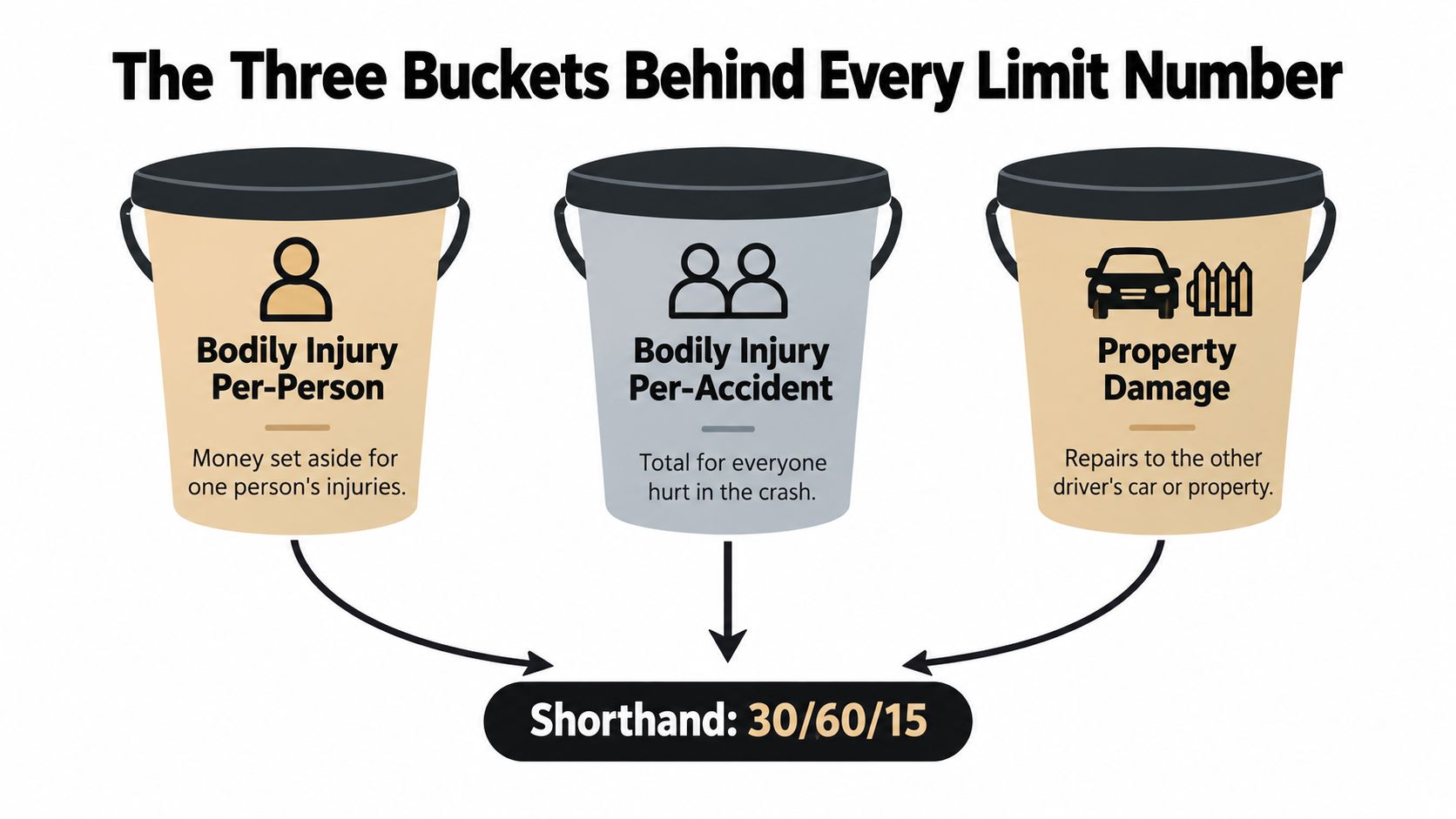
The shorthand places those buckets in order.
- 30/60/15: $30,000 per injured person, $60,000 for all injured people, and $15,000 for property damage.
- 100/300/100: $100,000 per injured person, $300,000 for all injured people, and $100,000 for property damage.
The property damage figure is separate from both injury limits. A crash can use the property bucket quickly without touching the bodily injury buckets, or it can exhaust the injury limits while the vehicle damage remains within its cap.
California Minimums and the 2025 Law Change
California's auto insurance minimums changed on January 1, 2025. The state moved from 15/30/5 to 30/60/15, meaning the legal floor became $30,000 per person, $60,000 per accident, and $15,000 for property damage. California consumer guidance lists the current requirements and helps distinguish a legal minimum from broader financial protection.
The prior limits had been frozen since 1967, so they remained unchanged while medical expenses, vehicle technology, repair complexity, and household finances evolved. That history matters because a minimum limit isn't a prediction of what a serious crash will cost. It's a legal threshold that can remain behind real-world expenses for decades.
California's change doubled the bodily injury amounts and tripled the property damage amount. The state is also scheduled to raise the minimums again in 2035, to $50,000 per person, $100,000 per accident, and $25,000 for property damage, according to analysis of California's insurance limit change.
| Effective Date | Bodily Injury Per Person | Bodily Injury Per Accident | Property Damage |
|---|---|---|---|
| 1967 through 2024 | $15,000 | $30,000 | $5,000 |
| January 1, 2025 | $30,000 | $60,000 | $15,000 |
| Scheduled for 2035 | $50,000 | $100,000 | $25,000 |
The scheduled 2035 increase is a projection based on the law's planned structure, not the current California requirement. Drivers should check their policy and current state guidance rather than assuming the future limits already apply.
For a broader explanation of auto insurance in California, remember the central distinction: minimum coverage lets you meet the law, while higher limits help protect your assets when a claim grows beyond the legal floor.
How Minimum Limits Get Used Up in Real Accidents
The easiest way to understand 30/60/15 is to watch each bucket run out. The examples below use hypothetical claim amounts to illustrate the mechanics, not to predict what any particular crash will cost.
A crash with two injured passengers
Suppose a rear-end collision injures two passengers and totals a Tesla. The combined bodily injury claims reach $80,000, while the damaged vehicle and related property claim reaches $25,000. Under 30/60/15, the policy can pay no more than $60,000 for all bodily injury claims and $15,000 for property damage.
The illustrative gaps are $20,000 for bodily injury and $10,000 for property damage, subject to claim resolution and applicable law.
One serious injury
Now consider one injured person with $80,000 in medical bills. The per-person limit pays up to $30,000, leaving $50,000 outside that limit before considering lost wages, future care, or other damages.
A single claimant can therefore exhaust the first bucket without needing a multi-person crash.
A freeway pileup
In a pileup involving four injured people, the $60,000 per-accident limit applies across the group. If their combined claims total $140,000, the illustrative gap is $80,000, even though each person may have a separate claim. The insurer can't turn the $60,000 aggregate into four separate $60,000 payments.
| Scenario | Injuries | Total Claim Cost | Limit Pays | Your Out-of-Pocket Gap |
|---|---|---|---|---|
| Two passengers and a totaled vehicle | $80,000 bodily injury, $25,000 property damage | $105,000 combined | $60,000 bodily injury, $15,000 property damage | $20,000 bodily injury, $10,000 property damage |
| One serious injury | $80,000 bodily injury | $80,000 | $30,000 bodily injury | $50,000 before other damages |
| Four-person pileup | $140,000 bodily injury | $140,000 | $60,000 bodily injury | $80,000 |
If another driver has too little insurance, understanding your options if the at-fault driver has low coverage can help clarify why your own uninsured or underinsured motorist protection matters. The key principle is simple: the policy cap doesn't rise because the claim is larger.
Picking Limit Levels That Fit Your Driving Life
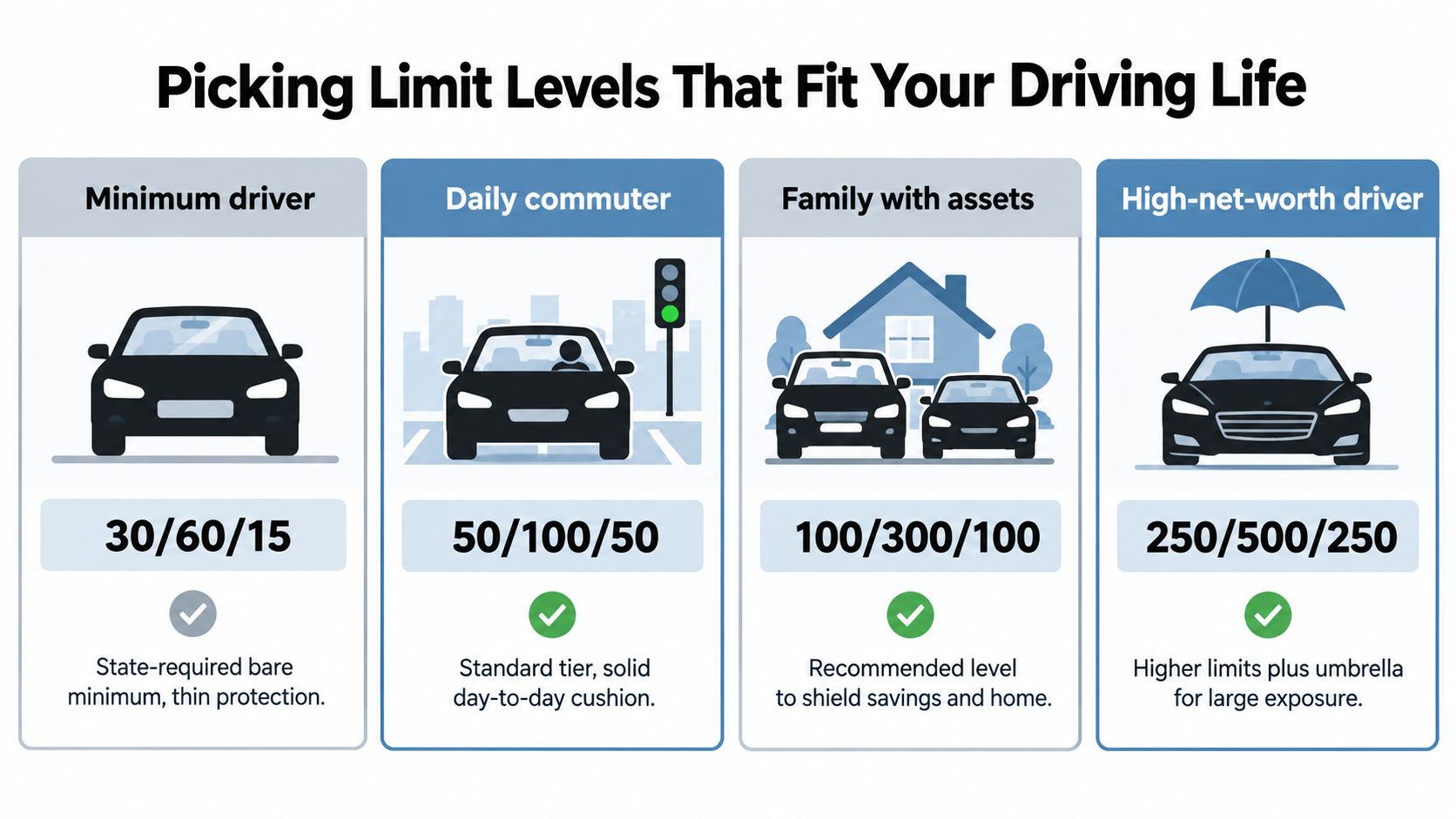
There isn't one correct limit for every California household. A useful starting point is to compare the legal minimum with higher tiers, then ask what you could lose if a claim exceeded the policy.
| Coverage tier | Bodily injury per person | Bodily injury per accident | Property damage | General role |
|---|---|---|---|---|
| Minimum | $30,000 | $60,000 | $15,000 | Meets California's current legal floor |
| Standard | $50,000 | $100,000 | $50,000 | Adds a broader day-to-day cushion |
| Higher protection | $100,000 | $300,000 | $100,000 | Better aligned with meaningful savings, income, or assets |
The 50/100/50 tier increases each bucket compared with 30/60/15. The 100/300/100 tier creates substantially more room before personal finances become the next source of payment. Major carriers commonly use higher-limit structures such as 100/300/100 as a practical benchmark, as discussed in California automobile insurance guidance.
Four household starting points
- A new teen driver: A teen on a parent's policy may begin with more than the bare minimum, along with uninsured and underinsured motorist coverage. The goal is to avoid a small legal limit creating a large family liability problem.
- A long-distance Bay Area commuter: Someone driving daily with a financed vehicle may consider 100/300/100 liability, plus collision and full coverage for the vehicle. A lender may also have coverage requirements under the loan or lease.
- A Sacramento family with two teen drivers: Multiple drivers create more opportunities for a claim. Reviewing limits across every vehicle and coordinating uninsured or underinsured motorist protection can prevent one accident from consuming the household's only thin layer of protection.
- A high-net-worth Los Angeles household: Higher auto limits may be paired with an umbrella policy above the auto liability limits. That combination is designed to place an additional liability layer between a serious judgment and the household's broader estate.
Your income, savings, home ownership, driving distance, vehicle value, and household drivers should shape the selection. A driver with few assets still needs protection from future wages and legal costs, while an asset-rich household has more to shield.
Balancing Premium Cost Against Real Protection
Insurance pricing doesn't rise in a perfectly straight line with the amount of protection. Moving above California's minimums can add meaningful liability capacity without automatically making the entire policy unaffordable, but the exact premium depends on the insurer, driver, vehicle, location, claims history, deductibles, and selected coverages.
The most useful comparison is to request identical quotes at several liability tiers. Keep the drivers, vehicles, deductibles, and optional coverages consistent, then compare what each added limit buys. A quote that changes several variables at once won't show whether the liability increase or another coverage change caused the premium difference.
Where premiums commonly move
Adding collision and other-than-collision coverage to a financed vehicle can change the premium more noticeably because the policy now protects the insured vehicle against collision and non-collision losses. Lowering a deductible from $1,000 to $250 can also affect price, but the exact change depends on the carrier and vehicle.
Uninsured and underinsured motorist coverage deserves separate attention. It protects you when another driver has no insurance or insufficient limits, so reducing liability protection to preserve vehicle coverage may leave the person, rather than the car, underinsured.
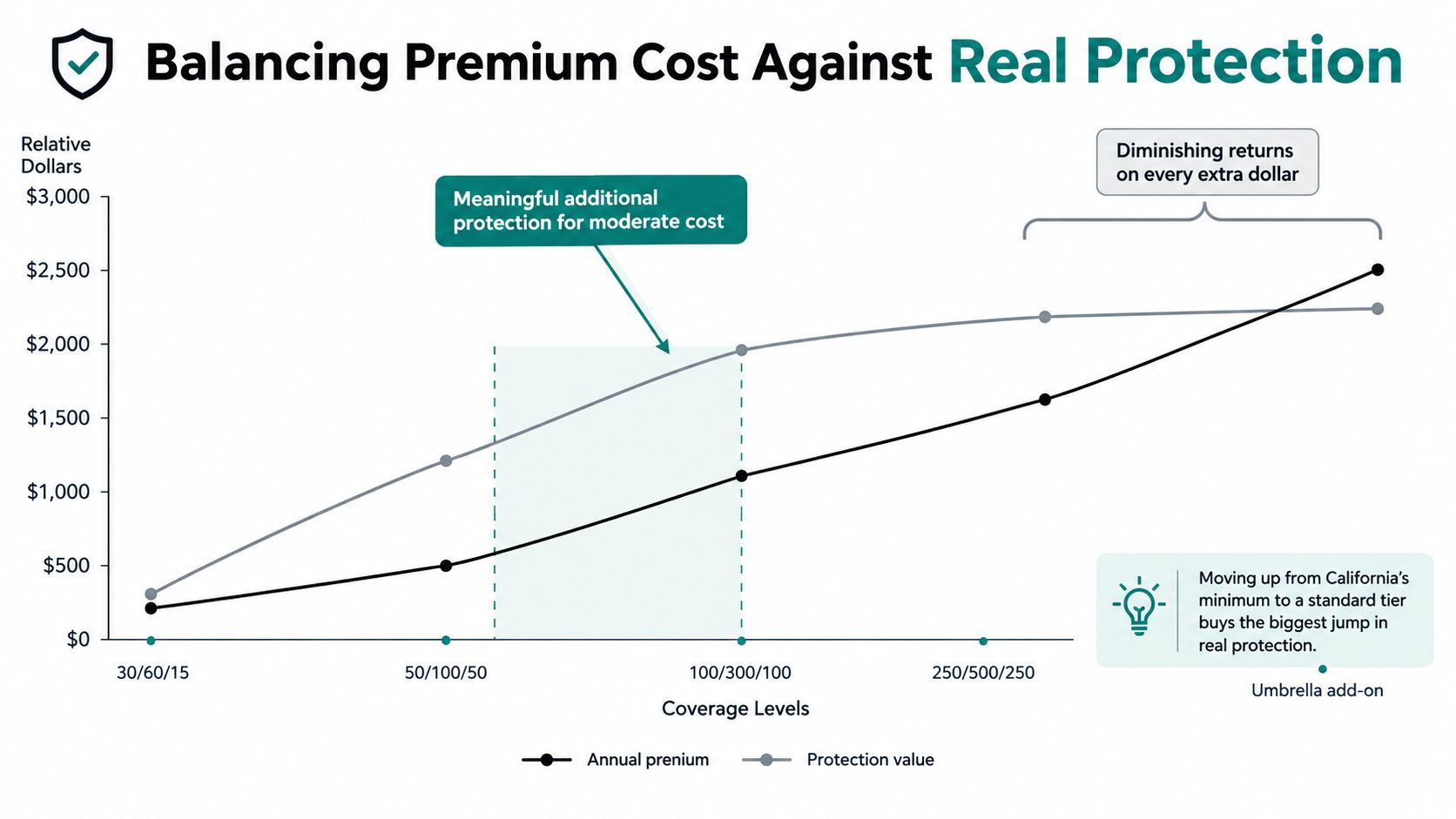
Budgeting insight: Liability coverage protects your savings, future income, and property. Collision and comprehensive coverage protect the vehicle. A sound policy considers both layers instead of treating full coverage on the car as a substitute for strong liability limits.
If you must prioritize, compare the cost of stronger liability limits with the financial impact of paying for an uncovered claim. A licensed agent can quote the tiers side by side, explain deductibles, and show whether changing one part of the policy creates a dangerous gap elsewhere.
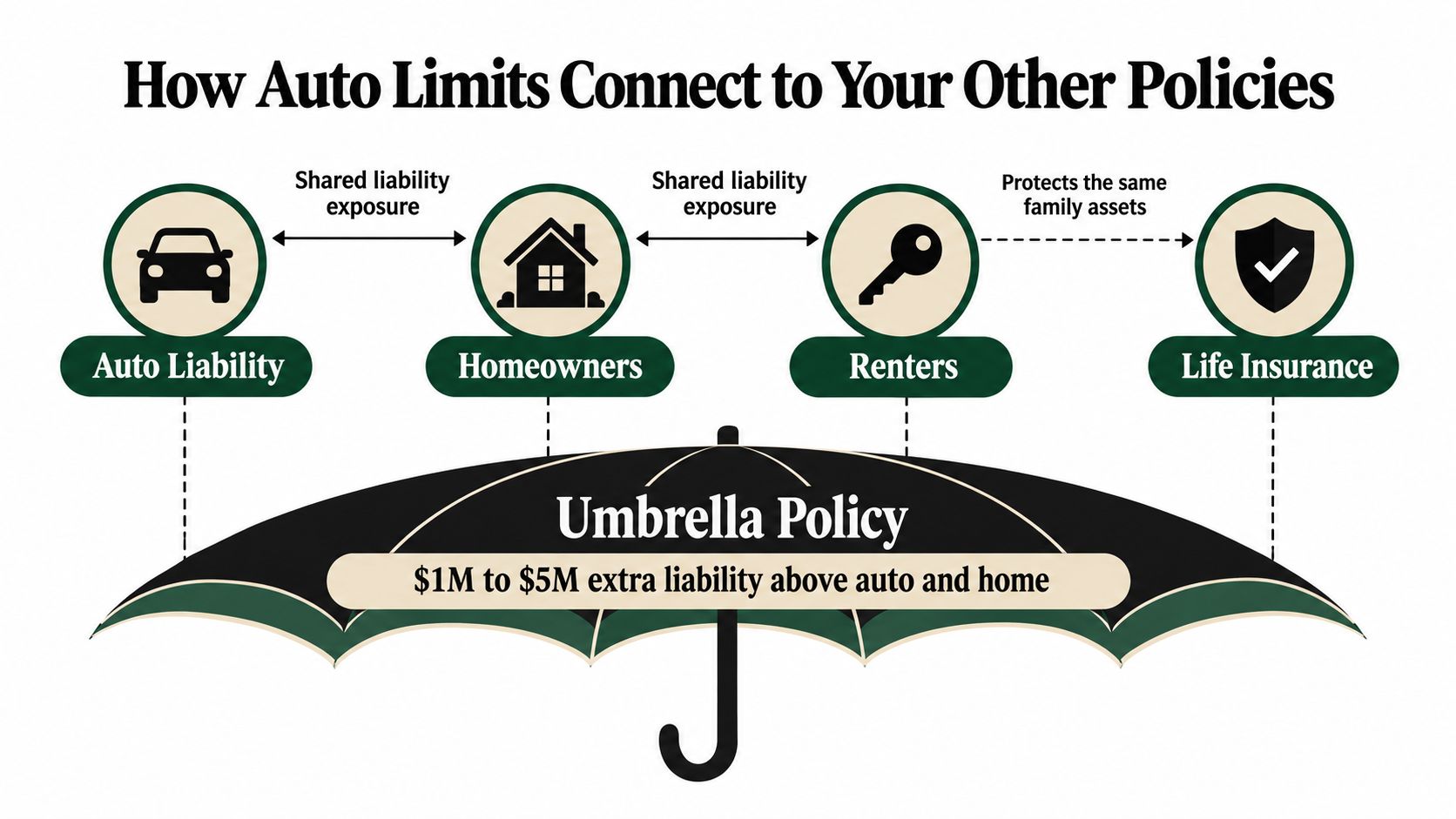
How Auto Limits Connect to Your Other Policies
A crash can create more than an auto claim. If your liability limit pays the injured driver's medical bills and damages only up to its stated amount, the remaining exposure may reach your savings or future income. Home, renters, umbrella, and life insurance address different parts of that household risk.
For homeowners, California home insurance coverage can include liability for injuries or accidents connected with the residence. California residential guidance states that personal property coverage is normally 50% of dwelling coverage, loss of use is 20% of the personal property limit, and personal liability generally has a minimum of $100,000, according to the California residential insurance guide. Renters can purchase up to $100,000 of personal property coverage, depending on the policy and need. That protects belongings, while renters liability coverage addresses covered claims tied to the rented home.
The umbrella layer
An umbrella policy adds liability protection above underlying auto and home policies. For example, if a covered lawsuit exceeds the auto policy's limit, the umbrella may respond after the primary coverage is used, subject to its terms and required underlying limits. It does not replace adequate auto liability limits.
California homeowners in high-risk wildfire areas may encounter the California FAIR Plan. Its residential dwelling coverage has a published maximum of $3 million per dwelling policy, and personal property coverage is typically available up to 75% of the dwelling limit when included, as described by California FAIR Plan coverage information. FAIR Plan dwelling coverage is not the same as a complete homeowners policy, so other protection may be needed.
Life insurance serves a separate purpose. Term life covers a defined period without cash value. Whole life is designed to build cash value and usually costs more because its premium supports both the death benefit and cash-value component, distinctions summarized in this California life insurance overview.
Getting Tailored Quotes From Mai and Associates
A useful quote review starts with accurate household information. Before contacting an agency, gather:
- Your declarations page: It shows current limits, deductibles, vehicles, drivers, and selected options.
- Driver details: Have the license numbers for everyone who regularly drives a household vehicle.
- Vehicle information: Collect the VIN for each car, along with financing or leasing details.
- Driving patterns: Estimate average annual mileage and identify regular commuting, business, or student use.
- Recent history: Prepare a list of recent tickets, claims, or policy changes so the quote reflects the actual risk profile.
Ask for side-by-side options rather than one unexplained premium. A clear comparison should show what changes between 30/60/15, 50/100/50, and 100/300/100, whether collision and other perils are included, how deductibles affect the price, and whether uninsured or underinsured motorist coverage matches the bodily injury limits.
Mai & Associates provides California auto, home, renters, and life insurance services through offices in Glendale, Westlake Village, Escondido, and Costa Mesa. The agency supports customers in English, Mandarin, Cantonese, Vietnamese, Spanish, and Korean, and its licensed agents can compare carrier options and discuss coverage tradeoffs. Drivers can begin with an online insurance quote request and bring the resulting questions to an agent.
A yearly limit review is also practical after a raise, home purchase, marriage, divorce, new teen driver, vehicle change, or major shift in savings. Your limits should reflect the life you're protecting, not just the car you're driving.
Mai & Associates can compare California auto, home, renters, and life insurance options while explaining how liability limits fit together. Visit Mai & Associates to request guidance on the right coverage level and arrange a review of your current policy.