Auto Insurance After DUI: Your 2026 Guide to Affordable Coverage in California
Getting auto insurance after a DUI in California is a whole new ballgame. You can expect your premiums to jump, your current policy might get canceled, and you'll almost certainly have to file an SR-22. Once your insurer finds out, they'll label you a high-risk driver, which kicks off a series of financial and administrative challenges you'll need to navigate to keep your driving privileges.
What Happens to Your Car Insurance Right After a DUI?
A DUI arrest in California triggers a cascade of events that will hit your auto insurance hard. From the moment of the arrest, the clock starts ticking. While it's a stressful and confusing time, knowing what’s coming can help you get ahead of the problem.
Your insurance company won't get a notification the second you're arrested. But make no mistake, they will find out. Insurers pull your Motor Vehicle Record (MVR) pretty regularly, almost always before renewing your policy. When they do, that DUI conviction will be impossible to miss.
How Your Insurer Will Likely React
Once the DUI is on their radar, your insurance company will typically go one of two ways:
- Non-Renewal: This is the most common outcome. Many standard insurance companies simply don't want the liability that comes with a DUI. They see it as a sign of extreme risk and will mail you a non-renewal notice, essentially telling you they won't be offering you a new policy when your current one expires.
- Cancellation: It’s less common, but some insurers may cancel your policy mid-term. This is more likely if your policy has specific clauses about it or if the DUI was tied to an accident.
An insurance company isn't going to drop you just for an arrest. A conviction, however, gives them all the reason they need to either refuse to renew your policy or cancel it outright. This forces you into the high-risk insurance market.
This is where things get tricky. If you've bundled policies like your home insurance or renters insurance, you might think you have some leverage. Honestly, with something as serious as a DUI, that loyalty often doesn't count for much. To understand the coverages you'll be required to maintain, our guide on auto insurance in California is a great resource.
The SR-22: Your New Requirement
The biggest and most immediate change is the SR-22 certificate. It’s not insurance itself, but a form your insurance company files directly with the California DMV. Think of it as a guarantee that you're carrying at least the state-mandated minimum liability coverage for your car insurance.
After a DUI conviction, a judge or the DMV will require you to have an SR-22 to get your license back. You can't legally drive again without it. The first step is finding an insurance company that will not only cover a driver with a recent DUI but also file the SR-22 for you. This is the starting point for getting back on the road and also where you'll see your insurance costs begin to skyrocket, as any "Good Driver" discounts you had will be long gone.
For a complete rundown of what to expect from the legal side, this guide on the immediate steps and legal processes after a DUI arrest is incredibly helpful.
How to Navigate California's SR-22 Requirements
After a DUI conviction in California, getting your driving privileges back almost always comes down to a single document: the SR-22 certificate. It’s a mandatory step, but one that often causes a lot of confusion. Let's cut through the noise and talk about what an SR-22 actually is and what it means for your auto insurance after a DUI.
First off, an SR-22 is not an insurance policy. That’s a common misconception. Instead, it’s a form—a certificate of financial responsibility—that your insurance company files directly with the California DMV. Think of it as your insurer vouching for you. They’re essentially telling the DMV, "We're covering this driver with at least the state-required minimum liability insurance. If they stop paying or cancel their policy, we promise to notify you immediately."
This process kicks off right after the DUI arrest and is a non-negotiable part of staying compliant and getting back on the road.
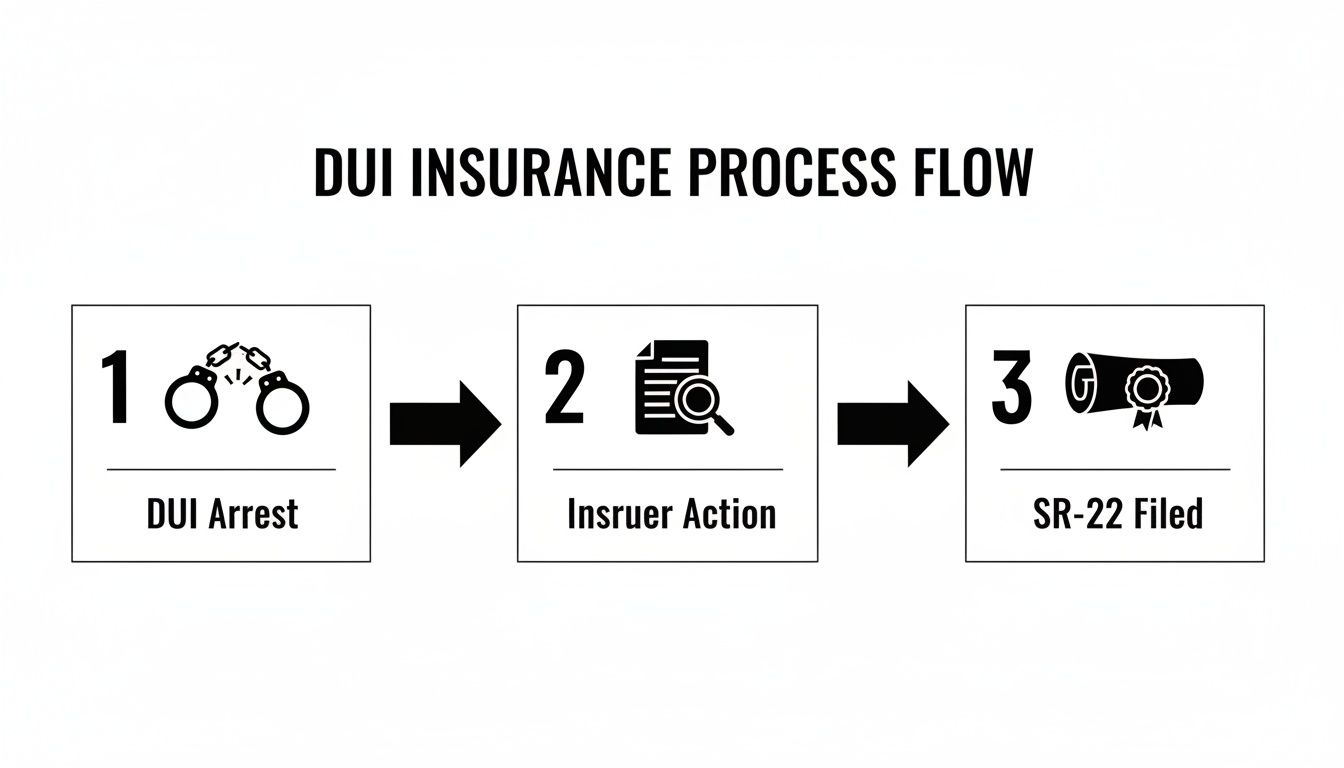
As the diagram shows, the SR-22 filing isn't an optional step; it's a direct consequence of the conviction and a requirement from the DMV.
Which Type of SR-22 Do You Need?
Getting an SR-22 from your insurer is usually pretty simple, but you have to ask for the right one. The correct type depends entirely on whether you own a car.
- Owner's Certificate: This is the most common type. It’s for drivers who own and operate their own registered vehicle.
- Operator's Certificate (Non-Owner): Don't own a car but still need to drive? Maybe you borrow a friend's car or use a company vehicle. You'll need a non-owner policy with an SR-22 attached. This covers your liability while driving a car you don't own.
- Owner-Operator's Certificate: This one is a hybrid. It provides coverage whether you’re driving your own car or a borrowed one, making it the most flexible option.
Getting this wrong can cause major headaches and delay your license reinstatement. Be crystal clear with your insurance agent about your exact situation.
Here's the most critical piece of advice: Do not let your policy lapse. If you miss a payment or cancel your coverage, your insurer is legally required to file an SR-26 form with the DMV. This form cancels your SR-22 and will result in the immediate re-suspension of your driver's license.
The Real Cost of an SR-22
The filing fee for the SR-22 certificate itself is minor, typically just $25 to $50. The real financial sting comes from the high-risk car insurance policy you now have to carry. After a DUI, insurance companies classify you as a high-risk driver, and your premiums will reflect that—often dramatically.
While some states have even tougher requirements like FR-44 forms (which mandate higher liability limits), California sticks to the SR-22. Even so, drivers here are already facing rising costs, with a projected statewide rate increase of 6.13% in 2026. For a driver with a fresh DUI, average monthly rates for auto insurance in California can easily jump from $190 to $246, and that's before factoring in broader market increases. You can see more data on how DUIs impact insurance costs by reviewing these drunk driving statistics on FinanceBuzz.com.
In California, you're required to maintain an SR-22 for a minimum of three years. This period can get extended if you have another serious violation or if you let your insurance lapse. It's a long-term commitment that requires careful management. If you're hoping to find savings by bundling policies like home insurance or renters insurance, you'll need an agency that knows how to navigate the complexities of high-risk profiles.
To learn more about other insurance topics, feel free to browse more articles in our guides section.
Why Your Car Insurance Rates Skyrocket After a DUI
There’s no way to sugarcoat it: the sticker shock from a post-DUI insurance quote is a gut punch. After dealing with the arrest and legal headaches, seeing your premium double or even triple can feel like the final straw. So, what’s really going on here? Let’s break down exactly why your auto insurance after a DUI becomes so incredibly expensive.

It all comes down to one word: risk. Insurance companies run their entire business by calculating the odds. They use complex models to look at everything about you—your age, car, and driving history—to predict how likely you are to file a claim. A clean record means you’re a low risk, and you get rewarded with better rates.
A DUI conviction completely flips that script. Instantly, you're re-categorized as a high-risk driver. To an insurer, that DUI is a massive red flag signaling a much higher chance of future accidents. Their response is purely financial—they hike your premium to protect themselves from the risk you now represent.
The Math Behind the Premium Hike
Companies like State Farm or USAA aren't just winging it when they calculate your new rate. The increase is backed by huge amounts of data that show a direct link between DUI convictions and more frequent, often severe, future claims.
To your insurer, a DUI isn't a moral judgment—it's a math problem. You've gone from being a low-risk, profitable customer to a high-risk, potentially costly one. The new premium is a direct reflection of that change.
The numbers are pretty staggering. A DUI can increase car insurance rates by 71.0% on average nationwide. For California drivers specifically, a conviction can cause rates to jump from an average of $190 to $246 per month—that's a 29% increase right off the bat. This long-term financial hit is what makes a DUI one of the most expensive mistakes you can make behind the wheel. You can dig deeper into these figures by checking out the latest drunk driving statistics on TheZebra.com.
But that initial rate hike is just the beginning. The total cost is often inflated by other factors you might not see coming.
The Hidden Costs Beyond the Base Rate
That shockingly high new premium isn't just about your base rate going up; it's also about the discounts you lose. A single DUI can wipe out valuable savings you may have spent years accumulating.
- Loss of "Good Driver" Discount: This is often the biggest discount drivers have. A DUI conviction means you’re no longer eligible, causing a huge jump in your premium all by itself.
- Loss of "Claims-Free" Discount: If your DUI involved an accident, you can kiss this discount goodbye, too, piling on to the cost.
- Forced into High-Risk Pools: Don’t be surprised if your current insurer drops you. Many standard carriers will simply issue a non-renewal, forcing you to find coverage from companies that specialize in high-risk policies. These insurers inherently charge more because their entire customer pool is considered a higher risk.
Here’s a real-world example of how this plays out. Imagine a driver with a perfect record pays $150/month for their policy, which includes a 20% Good Driver discount. After a DUI:
- Their base rate is recalculated for a high-risk profile, immediately jumping to $250.
- The 20% Good Driver discount is removed, adding another $50 back onto the bill.
- The new monthly premium is now $300—double what they were paying before.
This isn’t a short-term problem, either. In California, you can expect to pay these inflated rates for three to five years, sometimes even longer depending on the insurance company. Even if you bundle your home insurance or renters insurance, the massive surcharge from the DUI will likely cancel out any multi-policy savings. Understanding this long-term financial reality is the first step toward getting through it.
How to Lower Your Insurance Costs After a DUI
Seeing that first insurance quote after a DUI can be a real shock. But while higher rates are unavoidable for a while, you aren't powerless. You can take specific, concrete steps to bring that number down and find affordable auto insurance after a DUI without sacrificing the coverage you need to be legal in California.

The single most important thing you can do? Shop around aggressively. If you’ve been with the same insurer for years, that loyalty probably won’t help you now. After a DUI, every company views your risk profile differently. The carrier that was cheapest before might suddenly become one of the most expensive.
Compare Quotes from Multiple Carriers
Don't just take the first quote you get, especially if it's from your current company. Many standard insurers get nervous about high-risk drivers and price their policies accordingly. You need to cast a much wider net.
This is where working with an independent insurance agency really pays off. Unlike a captive agent who only represents one company (like State Farm or Allstate), an independent agent can pull quotes from dozens of carriers at once. They have relationships with specialty insurers that focus on high-risk policies—companies you can't even call directly. This is your fastest path to finding a more manageable rate for your car insurance.
Make Smart Adjustments to Your Policy and Vehicle
Beyond just shopping, a few practical tweaks to your coverage and even your car can lead to some serious savings.
- Raise Your Deductible: Your deductible is what you pay out-of-pocket on a claim. Simply raising it from $500 to $1,000 can make a noticeable dent in your premium. Just make sure you have that higher amount saved in case you ever need it.
- Rethink Your Coverage: Do you drive an older, paid-off car? It might be time to drop collision and comprehensive coverage. If your car is only worth a couple thousand dollars, paying a high premium to protect it might not make financial sense.
- Consider Your Car: A high-performance sports car or a big luxury SUV is expensive to insure at the best of times. After a DUI, the cost skyrockets. Switching to a safer, more modest car is one of the quickest ways to see a significant drop in your quote.
Hunt Down Every Available Discount
Your "Good Driver" discount is gone for now, but that doesn't mean all discounts are off the table. You just have to be a little more strategic.
The key to lowering your rates is to prove you are a responsible driver moving forward. Every positive action you take can help rebuild your risk profile in the eyes of an insurer and lead to lower premiums over time.
Bundling is your best friend here. If you have home insurance or renters insurance, moving it to the same company that handles your auto policy can trigger a multi-policy discount. This is often one of the biggest discounts you can get and can help offset a big chunk of the DUI surcharge. This is a smart way to manage your overall California insurance costs.
Completing a state-approved defensive driving course can also earn you a small discount while showing insurers you're committed to safe driving. By combining these tactics and exploring other 7 proven tips to save, you can take back control and make your post-DUI insurance journey much more affordable.
How a Specialized Agency Can Secure Your Insurance After a DUI
Trying to find affordable auto insurance after a DUI often feels hopeless. You make calls that go nowhere, fill out online forms only to get rejected, and the few quotes you do receive are astronomical. This is exactly where a specialized, independent insurance agency like Mai & Associates can make all the difference.
Instead of battling the system alone, you get an expert who knows the high-risk market inside and out. We become your personal advocate, navigating the complexities of California insurance to find carriers that are actually willing to work with your situation.
Your Advocate in the High-Risk Insurance Market
Most standard insurance carriers just aren't interested in a driver with a recent DUI. They see a major red flag, which usually leads to a non-renewal notice or a premium so high it’s designed to make you walk away. A specialized agency, however, works with a completely different playbook.
We have built strong relationships with dozens of specialty carriers—companies you won't see advertising during the Super Bowl because they don't typically sell directly to the public. These insurers specifically serve the high-risk market and have policies built for drivers who need to file an SR-22.
Our approach is straightforward and focused on getting you results fast:
- We start by listening to understand your specific circumstances and what you need.
- We then immediately shop your profile across our entire network of partner carriers.
- We come back to you with the best available options, often with same-day quotes.
This process saves you hours of frustrating phone calls and dead-end web forms. We do the legwork so you can concentrate on meeting your DMV requirements and getting your life back on track.
More Than Just a Policy—A Long-Term Strategy
Finding you a policy to get you back on the road is just the first step. Our real goal is to create a long-term plan to bring your rates back down over time. We don't just sell insurance; we look at your whole financial picture.
For example, we can show you how bundling your auto insurance with a home insurance or renters insurance policy can unlock major multi-policy discounts. These savings can go a long way in offsetting the DUI surcharge. We even help clients with life insurance, making sure all their needs are covered efficiently under one roof.
An independent agent works for you, not for a single insurance company. Our loyalty is to you, which means finding you the best possible outcome with clear explanations, transparent pricing, and a real strategy for lowering your premiums.
We won’t just hand you a policy; we’ll explain what it all means. Our agents will walk you through your coverage, make sure you understand California’s legal requirements, and help map out a path to eventually leave your high-risk status behind. Getting a fast, no-obligation insurance quote is your first step toward taking back control.
The insurance industry's reaction to DUIs makes sense when you look at the numbers. In 2022, 32% of all fatal crashes in the U.S. involved an alcohol-impaired driver. With DUI violations growing by 8% year-over-year, insurers see this as a huge, ongoing risk. The tragic reality is that every day, 37 people die in these crashes—that's one death every 39 minutes. These stark figures are why premiums spike and why you need an expert to navigate the market. You can explore more drunk driving statistics from Insurify.com to see the full picture.
Clear Communication When It Matters Most
Dealing with the legal and financial fallout from a DUI is stressful enough. The last thing you need is a communication barrier. At Mai & Associates, we’re committed to providing clear, understandable guidance to everyone. That’s why our team offers multilingual support in English, Spanish, Armenian, Russian, and Vietnamese.
This ensures you can discuss your situation in the language you're most comfortable with. You'll fully understand your car insurance policy, the SR-22 filing process, and the long-term plan to save you money. No confusion, no second-guessing—just clear, professional advice you can trust.
Common Questions About California DUI Insurance
After a DUI in California, the road ahead can feel overwhelming, especially when it comes to insurance. It’s natural to have a lot of questions. Getting the right answers is the first step toward putting this behind you.
The good news? While this is a serious situation, it’s not a permanent one. Let's walk through some of the most common concerns we hear from drivers every day.
How Long Will a DUI Affect My Insurance Rates in California?
This is usually the first question on everyone's mind. A DUI conviction will stay on your DMV record for 10 years, but the impact on your insurance premiums is typically shorter.
Most insurance companies will keep the high-risk surcharge on your policy for three to five years following the conviction date. A few might even rate for it for up to seven years. The best thing you can do to speed up this process is simple: keep your driving record spotless from this point forward.
Can I Get Car Insurance if My License Is Suspended?
Not only can you, but you must. In California, securing auto insurance isn't something you do after your suspension ends; it's a mandatory first step to getting your license back.
The DMV will not even consider reinstating your driving privileges until they receive proof of financial responsibility. This comes in the form of an SR-22 certificate filed by your insurer. If you don't own a car, we can help you with a non-owner policy, which still satisfies the state’s requirement and gets you moving in the right direction.
You cannot wait out the suspension period and then buy insurance. Getting a policy with an SR-22 filing is one of the very first things you have to do to get back on the road.
Will My Insurance Company Find Out About My DUI?
Yes, they will. It’s just a matter of when. Insurance carriers regularly pull their customers' Motor Vehicle Records (MVRs), and they almost always do it just before your policy is up for renewal.
When they run your record and see the DUI, they will reassess your risk. This usually results in a non-renewal notice, forcing you to find a new high-risk policy, or a massive spike in your premium. Trying to conceal it simply doesn’t work.
What Is the Difference Between SR-22 Insurance and Regular Insurance?
This is a huge point of confusion for many drivers. An SR-22 isn't actually insurance at all. It's a certificate, a form that your insurance company files electronically with the California DMV to prove you have the state's minimum required liability coverage.
The policy itself is just a standard auto policy for a driver the state has classified as high-risk. The real difference is the reporting requirement. If you cancel your policy or let it lapse, your insurer is legally obligated to immediately notify the DMV. This triggers an automatic re-suspension of your license and can set you back significantly.
For more answers on a wide range of topics, you can explore our FAQ page for other common questions about California insurance. Even with a DUI on your record, you might still find savings by bundling your auto insurance with home insurance or renters insurance.
At Mai & Associates, we specialize in helping California drivers navigate these tough situations. We can find you affordable coverage after a DUI, often with same-day quotes, to help you get back behind the wheel legally and without breaking the bank. Get your peace of mind back by visiting us at https://cahomeauto.com today.