California Auto Claim Adjuster: Your 2026 Guide
You're probably dealing with two things at once right now. First, the disruption of the accident itself. Second, the flood of insurance questions that starts almost immediately, often before you've even had time to calm down, arrange a tow, or figure out how you're getting to work tomorrow.
That's where the auto claim adjuster enters the picture. For many California drivers, this is the first time they've had to deal directly with the claims side of car insurance, and it can feel uneven from the start. The adjuster sounds confident. You're stressed. They ask questions quickly. You're still trying to remember exactly what happened.
If you carry California auto insurance coverage, or you're comparing California insurance options across auto insurance, home insurance, renters insurance, car insurance, and life insurance, understanding how the claims process works matters just as much as understanding the premium. A policy only proves its value when there's a claim.
The Role of the Auto Claim Adjuster After an Accident
A common scene goes like this. Your car has been hit. The photos are taken, the exchange of information is done, and then the phone rings. The person on the line introduces themselves as the adjuster. They ask where the vehicle is, whether anyone was hurt, whether the car is drivable, and what you remember about the crash.
That conversation can feel casual. It isn't casual.
The auto claim adjuster is the person assigned to investigate the claim and move it toward a financial outcome. That means reviewing facts, checking coverage, evaluating damage, and deciding what the insurer believes it owes under the policy or liability rules. In practical terms, the adjuster becomes the traffic controller for the whole file.
What the adjuster is actually doing
The adjuster is not just “getting your side.” They're building a claim record. That record may include:
- Accident facts such as time, location, road conditions, and vehicle positions
- Damage documentation including photos, shop estimates, and inspection notes
- Liability analysis about who caused the crash
- Coverage review to confirm what the policy does and doesn't pay
- Settlement handling for repairs, total loss valuation, rental issues, and other covered items
There's nothing unusual about this. It's how the system works at scale. There are over 77,024 auto claims adjusters currently employed in the United States, and the broader claims profession adjusts an industry-wide value between $450 to $500 billion annually, which shows how large and standardized this process has become (Zippia adjuster demographics and industry scale).
The tension drivers feel is real
Most adjusters are doing a demanding job inside a structured process. But it's also true that their role is tied to the insurance company's claim handling goals. Your goal is a fair result. The insurer's goal includes accuracy, consistency, and cost control. Those goals overlap sometimes, and sometimes they don't.
Practical rule: Treat every early conversation as part of the claim record, not as an informal chat.
That doesn't mean you should be hostile. It means you should be careful, organized, and specific. Drivers usually get into trouble in one of two ways. They either say too much too early, or they accept a number before they understand how it was reached.
Staff Independent and Public Adjusters Explained
Not every adjuster plays the same role. This is one of the biggest sources of confusion after a collision. If you don't know who the adjuster works for, it's easy to misread what they can do, what they want, and how much weight to give their statements.
The easiest way to sort it out is simple. Ask yourself one question: Who hired this person?
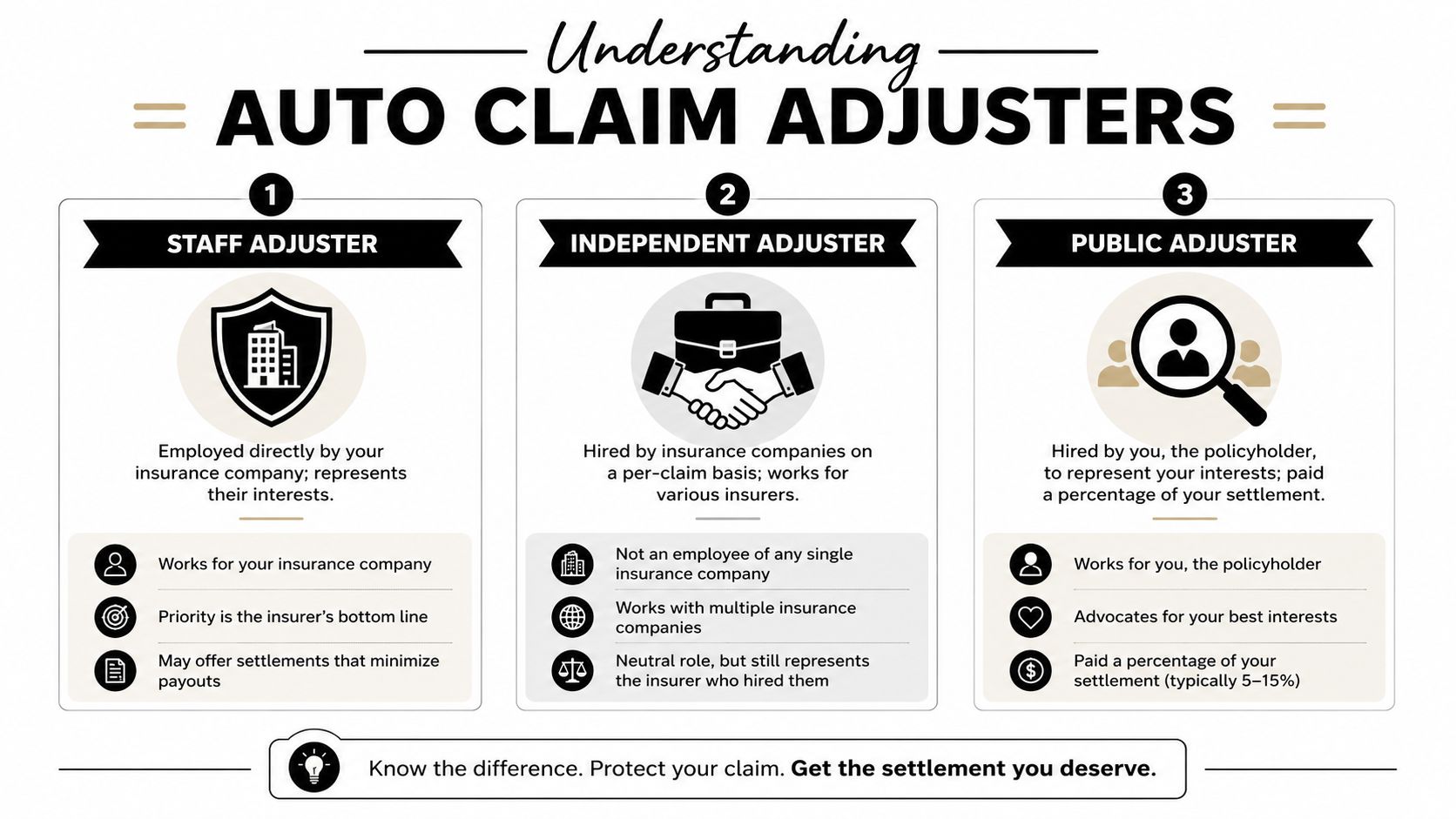
The three adjuster types
A staff adjuster is employed directly by an insurance company. If your insurer assigns someone from inside its own claims department, that's usually a staff adjuster. Their job is to handle the file according to company procedures and claim standards.
An independent adjuster is not your representative, even though the word “independent” makes many people think otherwise. This person is typically a contractor hired by insurance companies on a per-claim or overflow basis. During busy periods, insurers often rely on independents to handle volume.
A public adjuster works for the policyholder, not the insurance company. That changes the relationship entirely. A public adjuster's role is to advocate for the insured's side of the claim.
Types of Auto Claim Adjusters at a Glance
| Adjuster Type | Who They Work For | Primary Goal |
|---|---|---|
| Staff Adjuster | Insurance company | Handle and resolve claims for the carrier |
| Independent Adjuster | Insurance companies that hire them | Investigate and process claims for the hiring insurer |
| Public Adjuster | Policyholder | Advocate for the insured's claim position |
What this means in real life
If you're speaking with a staff or independent adjuster, you should assume the person is operating for the insurer's file, timeline, and settlement framework. That doesn't mean the process will be unfair. It means you should stay aware of where their loyalty sits.
A public adjuster changes that dynamic, but not every auto claim needs one. In many routine vehicle damage cases, a well-prepared driver can resolve the matter effectively by documenting the loss and asking the right questions. In more contested cases, outside help can make sense.
Ask directly: “Are you a staff adjuster, an independent adjuster, or are you handling this in some other capacity for the insurer?” Clear roles reduce confusion fast.
If your dispute involves valuation after a total loss, it also helps to understand how independent appraisal fits into the broader dispute process. This guide for Oregon total loss disputes is useful because it shows the kind of appraisal-based disagreement process that often comes up when vehicle value is the issue, even though state rules differ.
For basic insurance language, a plain-English California insurance glossary can help decode terms adjusters use without explanation.
How an Adjuster Determines Your Claim's Value
A settlement number shouldn't be a mystery. It may still be debatable, but it shouldn't be mysterious. Once you understand the workflow, you can see where valuation decisions come from and where mistakes or weak assumptions tend to appear.
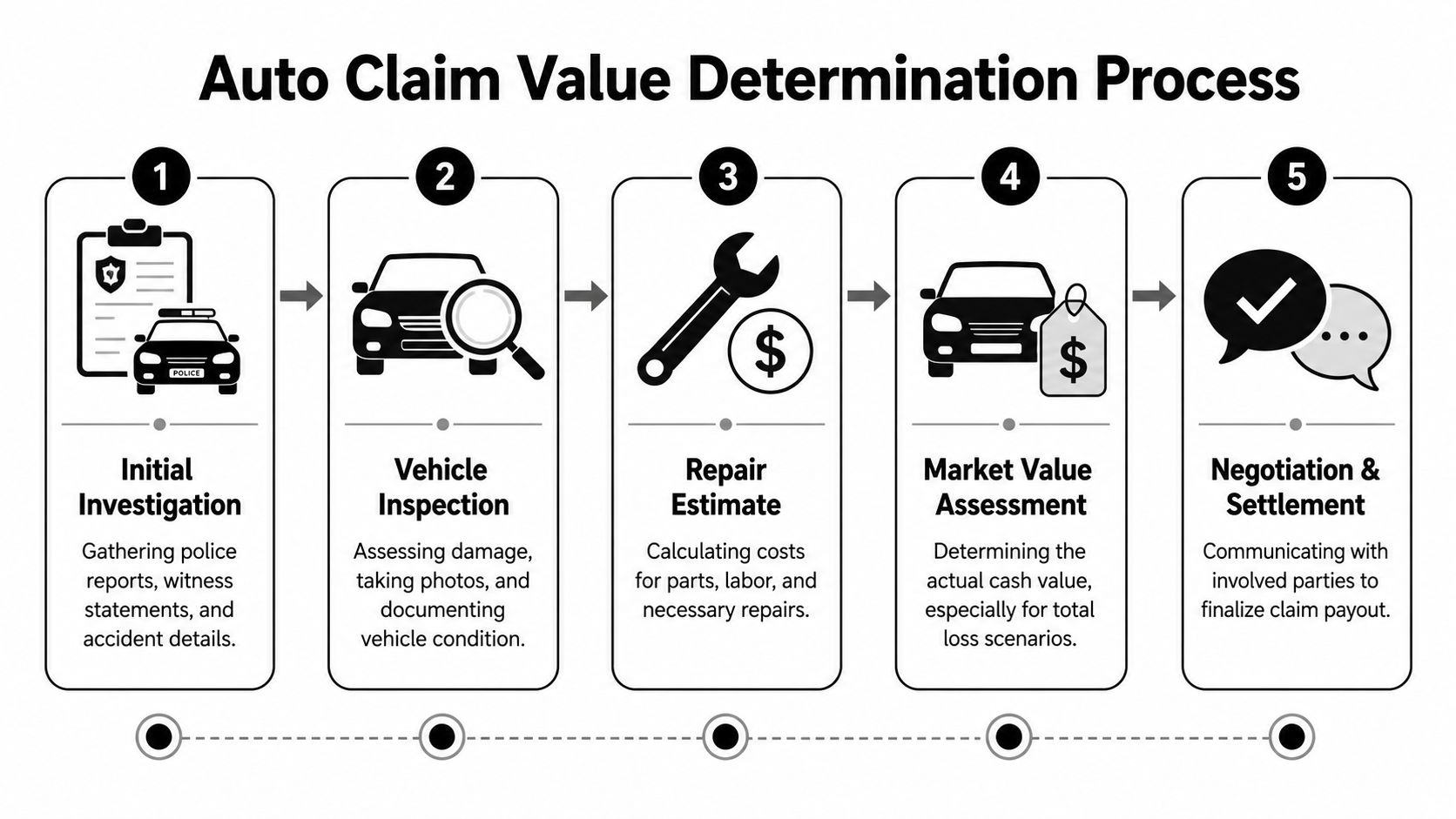
Step one starts with investigation
Before a number is discussed, the adjuster has to build the factual record. The investigation and documentation phase is the backbone of the file. Adjusters inspect physical damage, review police reports, interview witnesses, and fact-check the claim details. When a loss is complicated, they may coordinate with specialists such as engineers or forensic analysts. The same source also notes that adjusters must log 20 to 30 claims during onboarding and learn liability analysis and photo-based appraisals to produce early gains in accuracy and cycle time (Independent Agent claims handling perspective).
That matters because valuation depends on verified facts. If the adjuster gets the facts wrong, the number built on top of those facts can also be wrong.
Then comes damage assessment
For repairable vehicles, the adjuster reviews the damage, checks photos, and often works from shop estimates or inspection tools. For total losses, the process shifts from repair cost to vehicle value.
Here's the key concept: Actual Cash Value, often shortened to ACV.
Auto claim adjusters use specialized damage estimation software such as CCC One and Solera to calculate ACV for total losses. These tools pull from repair shop databases and local market data so the settlement aligns with policy limits ().
What affects the final number
The software doesn't work in a vacuum. The valuation process depends on inputs, and those inputs matter a lot.
Common factors include:
- Pre-accident condition of the vehicle
- Mileage at the time of loss
- Local market data used in the valuation model
- Repair cost data from estimating systems and shops
- Deductible application where required under the policy
If the vehicle is totaled, the adjuster generally works from ACV and then applies the deductible to determine the settlement payout.
The number you receive isn't just “what the car is worth.” It's the insurer's documented conclusion based on the facts and data entered into its system.
Where drivers should pay close attention
The process sounds mechanical, but it still leaves room for dispute. A valuation can be off if the vehicle trim is wrong, options were missed, condition was graded harshly, mileage was entered incorrectly, or the comparison set doesn't reflect the local market well.
A smart response is not “That seems unfair.” A smarter response is: show me the inputs.
Use this checklist when reviewing a valuation:
- Vehicle identity. Confirm year, make, model, trim, drivetrain, and major options.
- Condition assessment. Ask how pre-loss condition was evaluated.
- Comparable market support. Request the market basis used for ACV.
- Repair assumptions. If the vehicle was borderline repairable, ask how repair-versus-total-loss judgment was reached.
- Deduction review. Identify any reductions tied to prior damage, wear, or condition adjustments.
That approach keeps the conversation on verifiable facts. It also makes it much harder for a weak valuation to hide behind a simple lump-sum offer.
Navigating California's Specific Claim Regulations
California drivers pay enough for coverage that they should expect disciplined claim handling in return. The financial backdrop alone explains why the claims process matters so much. In California, the average annual cost for full-coverage auto insurance is $2,569, or $214 monthly, while minimum liability coverage averages $751 annually, or $63 monthly (California car insurance cost overview).
When premiums are that meaningful to a household budget, it's reasonable to expect the insurer to communicate clearly, investigate promptly, and explain decisions.
What California drivers should focus on
The legal framework in California matters, but most drivers don't need to memorize regulatory language. They need to know what good claim handling looks like in practice.
Watch for these basics:
- Timely acknowledgment of the claim and your communications
- A real investigation, not a rushed request for a statement followed by silence
- Clear explanation of what information the insurer still needs
- Consistent communication when the carrier can't yet make a final decision
- A reasoned basis for payment, denial, or partial payment
If any of those are missing, don't just vent. Create a record.
How to protect yourself during delays
Keep a written claim log. Note the date of every call, every voicemail, every email, every request for documents, and every promise to call back. A clean timeline changes the conversation. It turns “I feel ignored” into “Here is the communication history.”
That's especially important in California because many claim disputes are not really about one dramatic denial. They're about drift. Calls go unanswered. Documents get requested twice. The claim stalls without anyone clearly saying why.
A strong personal file should include:
- Claim number
- Adjuster names and departments
- Dates of contact
- Copies of estimates and photos
- Any written explanation of valuation or liability position
For broader California insurance guides, it helps to review policy and claim topics before a dispute gets serious.
If an insurer is taking time, ask one direct question in writing: “What specific information is still needed to make a decision on my claim?”
That question is effective because it pushes the file toward specifics. Either the insurer identifies what is missing, or it becomes harder to justify continued delay.
How to Communicate Effectively with Your Adjuster
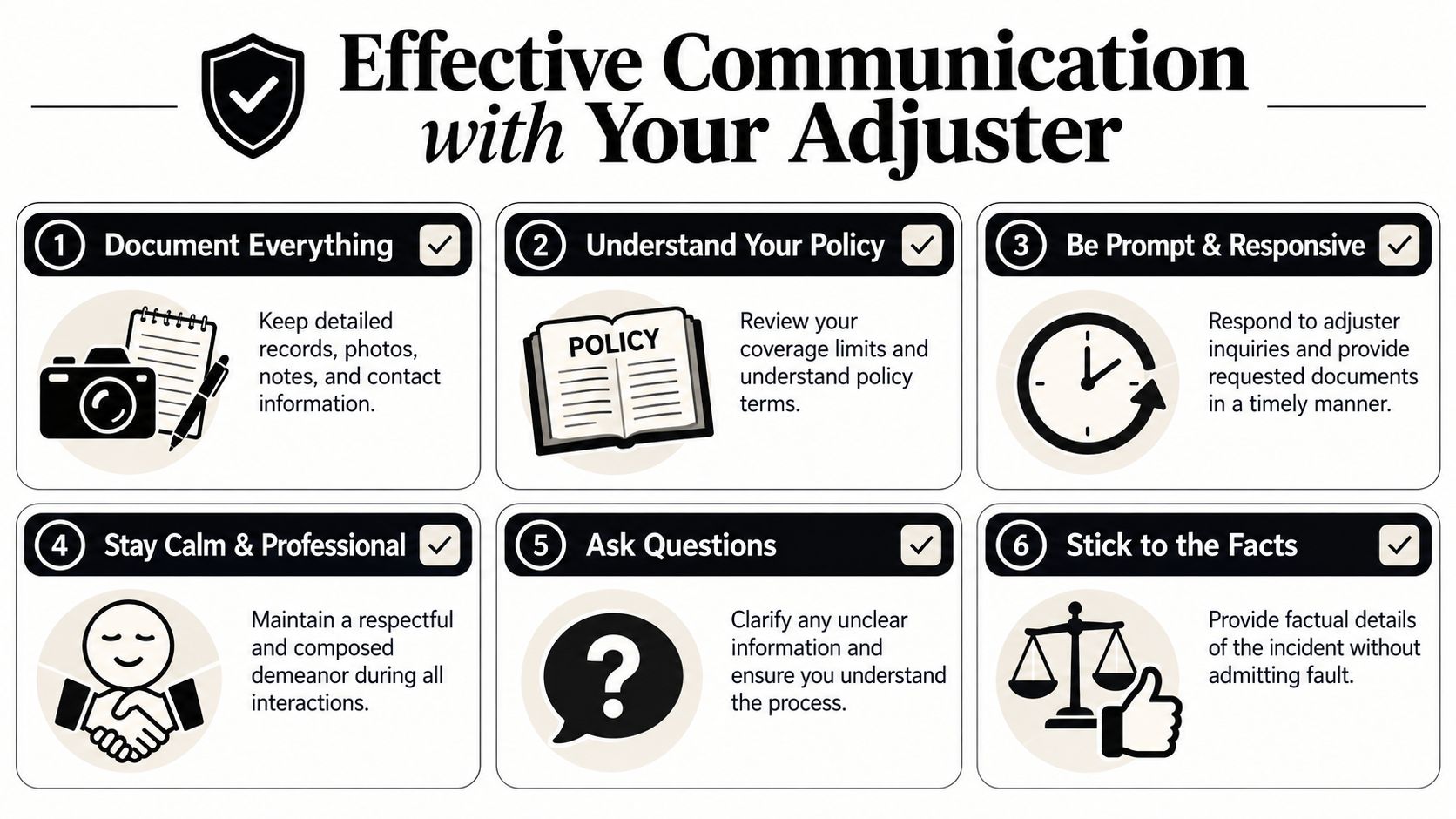
Drivers often weaken their position by treating claims calls like ordinary customer service calls. They aren't. Every conversation shapes liability, valuation, or both. The right communication style is calm, factual, and deliberate.
Politeness helps. Precision helps more.
Start with preparation, not improvisation
Before you return a call or speak with an adjuster in detail, gather your file. You don't need a legal brief. You need clean facts.
Have these ready:
- Accident basics including date, location, vehicles involved, and claim number
- Photos and documents such as scene photos, vehicle photos, police report information, and repair estimates
- Policy copy or declarations page so you know your deductibles and coverages
- A short timeline of what happened before, during, and after the crash
Adjusters are trained to move quickly through facts. Consequently, if you answer from memory while upset, your wording can become sloppy. Sloppy wording creates room for later disagreement.
Ask the liability question early
One of the strongest questions a driver can ask is simple: “Are you accepting liability for this accident?”
Expert strategists advise drivers to get adjusters to explicitly state whether liability is being accepted before discussing settlement numbers, because adjusters often delay liability admission to limit the scope of payout ().
That's not a technicality. It affects the whole posture of the claim.
If liability is still undecided, don't act as if the only issue is the amount of money. If liability is accepted, the conversation changes. You're no longer negotiating in a fog about whether the insurer is taking responsibility at all.
A useful version is:
“Before we discuss numbers, please tell me whether your company is accepting liability, and if not, what facts are still under review.”
That wording keeps the focus where it belongs.
Ask for the settlement math, not just the settlement number
The second question is just as powerful: “Can you provide a specific, line-item breakdown of my settlement calculation?”
The structure of an offer often reveals its weaknesses. A lump sum is hard to challenge. A breakdown can be tested.
Ask for:
- Repair cost components if the claim is being handled as repairable
- Depreciation or condition adjustments if any were applied
- Pre-existing damage deductions if the insurer claims prior damage affected value
- The formula and data sources used in a total loss valuation
- Any comparable vehicle information used to support ACV
Most drivers never ask for this level of detail, which is exactly why they should.
Stick to facts and avoid volunteer statements
A lot of claim damage happens through unnecessary talking. Don't guess about speed. Don't speculate about what the other driver saw. Don't fill silence with opinions about fault.
Use this communication framework instead:
- Answer the question asked
- Keep the answer factual
- Stop when the factual answer is complete
- Ask for the next step in writing when possible
That approach protects you without making you sound evasive.
If you want a consumer-focused legal perspective on handling these conversations, the LA Law Group adjuster insights article is a useful supplementary read.
“I'm happy to cooperate. I want to keep the discussion factual, and I'd like your position on liability and valuation in writing.”
That sentence does a lot of work. It signals cooperation, discipline, and documentation all at once.
What to Do When You Disagree with the Adjuster
A low offer isn't the end of the claim. It's the start of a more structured phase. The mistake many drivers make is responding emotionally instead of methodically.
Start with the record.
Most drivers don't know they can demand a specific, line-item breakdown of a settlement calculation, including the mathematical formulas and data sources used, and that's often the first step in exposing and challenging a lowball offer ().
Build the rebuttal around specifics
If you disagree, write a short rebuttal letter or email. Keep it professional. Identify the exact points you dispute.
A solid dispute usually includes:
- Valuation errors such as wrong trim, mileage, options, or condition assumptions
- Unsupported deductions for wear or prior damage
- Missing documentation that you already provided
- A request for revised review based on corrected facts
Don't write “Your offer is unfair.” Write “The valuation appears to omit identified features and applies deductions that need support.”
Escalate in steps
If the adjuster won't move, ask whether a supervisor review is available. If the disagreement is really about vehicle value, check your auto policy for an appraisal clause. Many drivers overlook this. It can be an effective path when the dispute is about amount, not basic coverage.
If the file is still stuck, consider whether outside help makes sense. A public adjuster may be useful in some claim situations, and an attorney may be appropriate if liability, injuries, bad faith concerns, or significant payment issues are in play.
Keep your leverage by staying organized
Disputes are won with documents, not frustration. Save every estimate, email, photo, and valuation report. Confirm important phone conversations in writing afterward.
Put every disagreement into a sentence the insurer has to answer. That's how vague frustration becomes a real claim dispute.
Secure Your Best Outcome with Mai & Associates
The best claim outcomes usually start before the accident happens. Good coverage, clear deductibles, and policy language that matches your real risk make the claims process easier when life gets messy. That applies across auto insurance, home insurance, renters insurance, and life insurance in California.
If you want to review your protection before the next claim tests it, start with a California insurance quote. Mai & Associates helps Californians compare options for car insurance, homeowners coverage, renters policies, life insurance, and specialized needs such as Fair Plan reviews and higher-risk property protection. Their multilingual team gives drivers and families a clearer understanding of what they're buying before they ever need to call an adjuster.
If you want a California agency that can help you compare auto, home, renters, and life insurance with practical guidance and responsive service, contact Mai & Associates. A strong policy won't prevent an accident, but it can make the claim that follows far easier to manage.