Auto and Home Insurance Bundle: Save on California Coverage in 2026
Think of bundling your auto and home insurance like getting a value meal at a fast-food joint. You get the burger and the fries together, usually for a better price than buying them separately. For many Californians, it's a popular and smart way to get a discount on protecting both their car and their house. Getting the right California insurance is crucial, and bundling can be a key strategy.
What an Insurance Bundle Actually Means in California
At its core, a bundle is just a package deal. You buy two or more policies—in this case, your car insurance and home insurance—from the same company. To reward you for giving them more business, insurers offer a multi-policy discount, which can knock a nice chunk off your total bill.
This approach offers two big wins: convenience and savings. Suddenly you have one company to call, one bill to pay, and one renewal date to track. It just makes life a little bit easier.
But while the idea is simple, choosing the right path takes some thought. It's crucial to know what you're buying. Before you even think about bundling, make sure you understand what goes into a standard homeowner's policy. For a deep dive, this complete guide to a homeowners insurance policy is an excellent resource.
Bundling at a Glance: Pros vs. Cons
Bundling has some obvious upsides, but it isn't the perfect fit for every single person. The trade-offs really come down to your specific situation, from your driving history to where your home is located. To make the best decision for your California insurance needs, you need to see both sides of the coin.
| Pros of Bundling | Cons of Bundling |
|---|---|
| Real Savings: The biggest motivator, with discounts that can add up to 23% or more. | Less Specialized Coverage: A great deal on price might mean you're missing key protections. |
| Simpler Management: One company, one bill, one renewal date. It's just easier to keep track of everything. | Tougher to Shop: Comparing bundled quotes is more complex than comparing individual policies. |
| Loyalty Perks: Building a relationship with one carrier can sometimes lead to better service or extra benefits. | The "Bundle Fumble" Risk: A huge rate hike on one policy can wipe out the savings on the other. |
| Single Deductible Option: Some insurers let you pay just one deductible if one event damages both your car and home. | Higher Cost Sometimes: Believe it or not, two separate policies can sometimes be the cheaper option. |
Ultimately, weighing these pros and cons will help you figure out if bundling is your best move. For more information on different types of insurance, feel free to explore our other guides.
Watch Out for the "Bundle Fumble" in California
Lately, the classic appeal of bundling has hit a few bumps in the road here in California. Soaring car insurance rates are causing what some are calling a "bundle fumble," where homeowners are starting to second-guess their all-in-one packages.
It makes sense. If your auto premium suddenly spikes, the discount on your home insurance might not be enough to make the bundle worthwhile anymore.
A 2022 study from J.D. Power really put a number on this trend. It found that 31% of bundled customers were ready to jump ship and find a new home insurer if their car insurance costs got too high. The data showed a 10-point drop in price satisfaction among people who bundle, proving that while discounts are great, they don't mean much when one half of the deal becomes too expensive.
Calculating Your Potential Savings from Bundling
The biggest reason anyone considers an auto and home insurance bundle is, of course, the savings. But how much can you actually save? It's a lot like buying in bulk at Costco—the more business you give a single company, the better the price they'll give you. Insurers reward this loyalty with a multi-policy discount that can seriously lower your annual premiums.
These aren't just a few dollars here and there. Insurers often offer discounts ranging anywhere from 5% to over 20%. State Farm, for instance, leads the pack with an average discount of around 23% for combined policies. Other big names like American Family and Farmers offer about 18%, while Allstate and Nationwide are closer to 15%.
Considering that California auto insurance costs shot up by a staggering 63.8% between 2014 and 2023, every bit of savings helps. These bundling discounts provide some much-needed relief for family budgets across the state.
How Discounts Translate to Real Dollars
So what do those percentages look like in your bank account? A 5% discount might not sound like a game-changer, but if your combined auto and home premiums are $4,000 a year, that’s $200 back in your wallet. A 20% discount on that same premium? That’s a hefty $800 annual savings.
At its core, the principle is simple: insurers want to keep your business. When you trust them with both your home insurance and auto insurance policies, they reward that loyalty with a significant discount. This is one of the most effective strategies for battling the high cost of California car insurance.
This is a two-way street. Insurers know that when rates go up, customers start shopping around. The chart below shows just how much risk they face when policyholders get unhappy with their premiums.
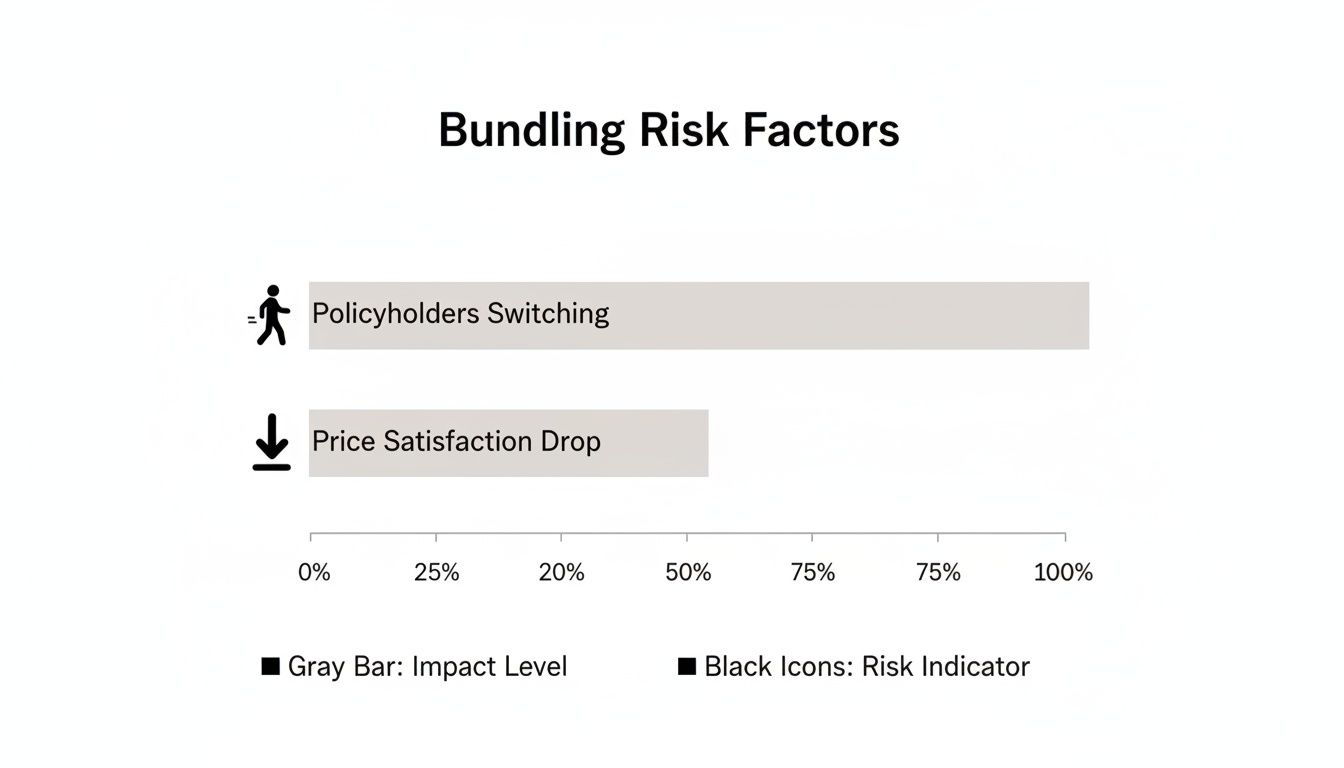
The data is clear: as soon as price satisfaction drops, customers are very likely to jump ship. This gives insurers a powerful incentive to keep their bundle prices attractive.
Sample Savings Scenarios in California
Let's put this into practice with a few real-world examples for California residents. Keep in mind these are just illustrations to show how savings can play out.
Scenario 1: The Suburban Family in Escondido A family with two cars and a house might pay $2,200/year for auto insurance and $1,500/year for home insurance if bought separately, for a total of $3,700. A 15% bundling discount would cut $555 off their bill, dropping their new total to $3,145 a year.
Scenario 2: The Single Professional in Glendale Someone with a condo, a clean driving record, and a single car could have a renters insurance policy for $250 and car insurance for $1,800. Their separate total would be $2,050. Bundling with a 10% discount would save them $205, making their annual premium $1,845.
Scenario 3: The High-Risk Wildfire Zone Homeowner For a homeowner in a higher-risk area like Westlake Village, home insurance can be incredibly expensive. Here, even a smaller 8% bundling discount can mean hundreds of dollars in savings, making their overall California insurance costs much more manageable.
Unlocking Deeper Discounts
The savings don't necessarily stop with just your car and home. Many insurance carriers will give you even deeper "multi-line" discounts if you add more policies into the mix.
You can often boost your savings by bundling these policies, too:
- Renters Insurance: A great option for tenants who want to take advantage of bundling with their auto insurance.
- Life Insurance: Adding a term or whole life insurance policy can sometimes unlock the biggest discounts an insurer offers.
- Umbrella Policy: This provides an extra layer of liability protection over your existing policies and is often discounted when bundled.
Essentially, the more policies you stack, the more valuable you become to the insurer—and the more they're willing to cut your rates. The only way to know for sure what you could be saving is to get a personalized quote. Our team can help you find your potential savings with a same-day quote and see exactly what's possible for you.
Navigating California's Unique Insurance Landscape
Getting the right California insurance is a different ball game compared to other states. We're dealing with a tough combination: some of the nation's highest auto insurance premiums and ever-present risks from natural disasters. This unique environment completely changes how an auto and home insurance bundle works and what you should really expect from it.
For a lot of homeowners, especially if you live in places like Westlake Village or other high-risk zones, bundling isn't just about saving a few bucks. It's often about finding a carrier that’s willing to cover you at all. This is exactly why knowing California’s specific rules and options for home insurance and car insurance is so important.
Why Is California Car Insurance So Expensive?
One of the biggest squeezes on a California family's budget is the sky-high cost of car insurance. It’s not your imagination; several factors are driving these rates up.
Think about our packed urban areas like Los Angeles and the Bay Area. All that traffic congestion leads to a lot more accidents. On top of that, California has a huge number of uninsured or underinsured drivers, which means responsible drivers have to get more coverage just to protect themselves.
When you add in high vehicle repair costs and a tendency for more lawsuits, you've got a perfect storm for expensive auto policies. An auto and home insurance bundle can be a great way to push back against these costs, using the discount to make your total insurance bill more manageable. You can dive deeper into what drives up your rates in our full article on California auto insurance.
The FAIR Plan and Your Insurance Bundle
If you're a homeowner in a high wildfire risk area, you've probably heard of the California FAIR Plan. For many, it's the last resort for fire insurance when traditional companies say no. The FAIR Plan provides basic fire coverage, which is a lifesaver, but it's crucial to know what it isn't. A FAIR Plan policy only covers damage from fire, lightning, and internal explosions—that's it.
A critical mistake we see people make is assuming a FAIR Plan policy can be bundled like a regular homeowners policy. Because it's not a comprehensive HO-3 policy, you can't directly bundle it with your auto insurance for that multi-policy discount.
This leads to a common puzzle. You'll need a separate "Difference in Conditions" (DIC) policy to cover everything else—theft, liability, water damage, you name it. It's sometimes possible to bundle your auto insurance with this DIC policy, but the discount might be smaller, and the whole setup is definitely more complicated.
This is where having an experienced independent agent on your side makes a huge difference. They can look at your FAIR Plan coverage and shop around to find the best fit for your DIC and auto policies, structuring everything to get you solid protection without overpaying.
Strategies for Wildfire and Earthquake Protection
Beyond the FAIR Plan, bundling can also be part of a smart strategy for adding other essential coverages for California's unique threats. For example, a lot of homeowners are shocked to learn that standard home insurance policies do not cover earthquake damage.
Here are a few ways to build a stronger shield for your home:
- Bundling and Endorsements: The simplest route is when an insurer offering an auto and home insurance bundle also lets you add a wildfire or earthquake coverage endorsement right onto your homeowners policy. This is the most seamless way to close those dangerous gaps.
- Standalone Policies: If you can't add an endorsement, you'll need a separate policy, often from a specialized provider like the California Earthquake Authority (CEA). While you can't "bundle" this in the classic sense, a good agent can help you find an auto/home carrier whose savings are big enough to help offset the cost of that separate earthquake policy.
- Proactive Mitigation: Many insurers are now offering real, substantial discounts to homeowners who take steps to reduce wildfire risk. This means clearing brush, installing a fire-resistant roof, and creating "defensible space" around your house.
In a state with so many moving parts, an auto and home insurance bundle is much more than a simple discount. It’s the core of a broader strategy to lock in affordable, complete California insurance protection against the real risks Californians face every single day.
When Does Bundling Make the Most Sense?
Figuring out if an auto and home insurance bundle is right for you isn't about finding a single "best" answer. It’s about what makes sense for your life, right now. While the discounts are certainly appealing, bundling isn’t a one-size-fits-all strategy. In some cases, it's a clear financial win. In others, keeping your policies separate is actually the smarter move.
Let's walk through who tends to benefit the most from bundling and when it might be better to shop for your policies individually. This will help you see where you fit in.
Ideal Candidates for Bundling
For many Californians, bundling is a home run. The savings and sheer convenience are tough to beat, especially if your insurance needs are pretty standard. If you see yourself in any of the descriptions below, you should definitely be looking into a bundle.
You're a strong candidate for an auto and home insurance bundle if you are a:
- First-Time Homeowner: You're already juggling a new mortgage and property taxes—it's a lot. Bundling your new home insurance with your car insurance policy simplifies everything. It gives you one less thing to worry about and can offer some immediate savings when every dollar counts.
- Family with Multiple Cars: The more you have to insure with one company, the more valuable you are to them. A household with a home and a couple of cars is a dream customer for an insurer, which is why they often roll out the red carpet with their best multi-policy and multi-car discounts.
- Person Prioritizing Convenience: Do you love the idea of one bill, one renewal date, and one phone number to call for everything? If so, bundling is your best friend. It cuts down on the administrative hassle and saves you a ton of mental energy.
Bundling typically pays off the most for people with a clean claims history. If you have a good driving record and your home is considered low-risk, insurers will be competing for your business with their most attractive bundled rates.
When to Consider Keeping Policies Separate
On the flip side, bundling isn’t always the cheapest or most effective path. Sometimes, trying to force a bundle means you end up compromising on either price or the quality of your coverage. This is especially true when your risk profile is a bit more complicated.
It often makes more sense to keep your policies separate in these situations:
- High-Risk Driver, Low-Risk Home: If your driving record has a few blemishes like tickets or an at-fault accident, your car insurance premium is going to be high. Bundling could drag your home insurance rate up with it, effectively canceling out any discount. You'll likely get a much better overall price by finding a carrier that specializes in high-risk auto insurance and placing your home insurance with a different company.
- Needing Specialized Home Coverage: Do you own a historic home, a house with unique architecture, or have valuable collections to protect? You might need a policy from a niche insurer that specializes in these types of properties. These specialty carriers rarely offer auto insurance, so keeping policies separate is your only option.
- High-Risk Property Location: If you live in a high-risk wildfire area and your fire coverage comes from the California FAIR Plan, a traditional bundle simply isn't an option. You’ll need to piece together separate policies for fire (the FAIR Plan), a Difference in Conditions policy for liability, and your auto insurance. This requires a completely different strategy.
The global home insurance market, a critical piece of any bundle, is expected to reach $417.66 billion by 2030—a testament to how essential this protection is. For Californians trying to make sense of this massive market, particularly with added complexities like FAIR Plan requirements, working with an agency like Mai & Associates can make all the difference. Our licensed experts serve over 50 cities and can provide the specific guidance you need. To dive deeper into these trends, you can review the full home insurance market analysis.
How to Find the Best Insurance Bundle Deal

Shopping for an auto and home insurance bundle isn't just about chasing the lowest number. It’s about finding the sweet spot where great savings meet solid protection. You wouldn't buy a car just because it's cheap; you'd check the safety ratings, pop the hood, and make sure it’s reliable. Your California insurance deserves that same thoughtful approach.
The key to a successful search is starting with a little prep work. Before you dive into getting quotes, you need to know exactly what you’re looking for and what your current coverage looks like. This simple step is crucial for making a true apples-to-apples comparison later.
Gather Your Essential Information
To get quotes that are actually accurate, you’ll need to have some key details ready to go. Having this info handy from the start ensures the rates you see are a realistic preview of your final premium, not just a ballpark guess.
Here’s what to pull together before you start shopping:
- Current Insurance Policies: Your best friend here is the declarations page from your existing auto insurance and home insurance (or renters insurance). It’s a cheat sheet listing all your coverage limits, deductibles, and what you’re currently paying.
- Vehicle Information: For every car you want to insure, you'll need the Vehicle Identification Number (VIN), make, model, and year.
- Driver Details: Make sure you have the driver's license numbers for everyone in your household who will be insured, along with a rundown of any accidents or tickets they've had in the last 3-5 years.
- Home Details: Be ready with specifics about your property, like its square footage, the year it was built, the age of the roof, and any security features (think alarms or smoke detectors) or recent upgrades you’ve made.
Once you’ve got this information organized, you’re ready for the most important part of the process.
Compare Carriers the Smart Way
When it comes to getting quotes, you really have two options. You can go directly to each insurance company, one by one, or you can partner with an independent agency. Going direct works, but it can be a real time-drain, forcing you to enter the same information over and over again on different websites.
It turns out most people are already on board with this strategy. A recent survey found that 61% of homeowners bundle their policies. The main drivers? Cheaper prices (70%) and pure convenience (69%). This is exactly where an independent agency shines—we do the shopping for you, hitting both of those goals at once.
Working with an independent agency like Mai & Associates completely streamlines this process. We take your information just once and then do the legwork, gathering competitive quotes from a range of top-rated insurance carriers. This lets you see a clear, side-by-side comparison without all the hassle, making it easy to spot who truly offers the best value for your situation.
Look Beyond the Price Tag
The lowest price isn't always the best deal. A cheap policy might look good on paper, but if it's riddled with coverage gaps, it could cost you a fortune when you actually need to file a claim. As the quotes come in, you need to dig into the details.
Make sure you’re comparing these key elements:
- Coverage Limits: Does the new bundle offer the same level of liability protection you have now? This is not the place to cut corners.
- Deductibles: A lower premium sometimes comes at the cost of a much higher deductible. Be honest with yourself—can you comfortably pay that amount out-of-pocket on a moment's notice?
- Exclusions: Pay close attention to what the policy doesn't cover. For California homeowners, this is especially critical when it comes to risks like wildfires and earthquakes.
At Mai & Associates, our licensed agents are here to walk you through these comparisons, offering multilingual support in English, Spanish, Armenian, Russian, and Vietnamese. We'll help you make sense of the fine print so you can feel completely confident in the auto and home insurance bundle you choose.
Common Questions About California Insurance Bundles
Even after you've weighed the pros and cons, the idea of an auto and home insurance bundle can still bring up a lot of "what-if" scenarios. Getting straight answers is the key to feeling confident that you’re making the right move for both your wallet and your peace of mind. We hear these questions all the time from Californians, so let's walk through some of the most practical ones.
If you have more questions after reading this, we've compiled even more answers on our full insurance FAQ page for you to explore.
Can I Bundle Renters Insurance with My Car Insurance?
Absolutely. In fact, this is one of the smartest and most common ways for renters to save a good chunk of money. Most insurance companies that offer the traditional auto and home insurance bundle will give you a very similar discount for combining your renters insurance with your car insurance.
The logic is the same: you’re bringing more business to one company, and they reward you for that loyalty.
For renters in places like Glendale or Costa Mesa, where car insurance can be surprisingly expensive, this is a fantastic strategy. A renters insurance policy itself is usually very affordable—often just a few hundred dollars a year. But the multi-policy discount it unlocks on your much pricier auto policy can be substantial. You get simplified billing, plus crucial liability and personal property protection, all at a great price.
What Happens to My Bundle If I Sell My Home?
This is a really common question, and thankfully, the answer is simple. When you sell your home, your homeowners policy is canceled because you no longer have an "insurable interest" in that property. Think of it this way: you can't insure something you don't own.
Since the home policy was one half of your bundle, the bundle itself dissolves, and you'll lose the discount that came with it. Your auto insurance policy will almost always stay active with the same company, but the price will go up to reflect the loss of that discount. This is actually a perfect time to take a fresh look at your options and shop for car insurance again to ensure you're still getting the best rate.
Is It Difficult to Switch Insurers If I Have a Bundle?
Switching companies when you have a bundle sounds a lot more intimidating than it is. The whole secret is coordination. The last thing you want is a gap in coverage, so the goal is to have your new bundled policies start on the exact same day your old ones are canceled.
Trying to line this up yourself can get tricky, often involving multiple phone calls and precise timing. This is one of the biggest reasons to work with an independent agent. We can manage the entire switch for you, ensuring a seamless transition with zero lapse in protection for either your home insurance or your car insurance.
Does My Driving Record Affect My Home Insurance in a Bundle?
Yes, it often can, and this is a critical detail many people miss. A poor driving record, with accidents or tickets, is obviously going to drive up your auto insurance premium. But when you bundle, insurers look at your overall risk profile to price the entire package. A history of claims or high-risk driving can make the whole bundle more expensive, and in some cases, might even make it less competitive than just buying two separate policies.
On the flip side, a great driving record doesn't just lower your car insurance cost; it makes you a more attractive customer all around. This can help you lock in a better rate on your entire auto and home insurance bundle. When it comes to your home, it's also wise to understand common issues—for example, knowing how to handle roof insurance claims gives you insight into one of the most frequent types of homeowner problems.
Can I Bundle with a California FAIR Plan Policy?
No, you can't directly bundle your auto insurance with a California FAIR Plan policy to get that traditional multi-policy discount. The FAIR Plan isn't a standard homeowners (HO-3) policy; it’s a last-resort plan providing only basic fire coverage. To get full protection for things like liability, theft, and water damage, you have to buy a separate "Difference in Conditions" (DIC) policy.
While you can’t bundle with the FAIR Plan itself, some insurance carriers will let you bundle your auto insurance with that separate DIC policy. The discount might be a bit smaller, but in a high-risk fire area, it's still a valuable way to find some savings.
Can I Add Life Insurance to My Bundle?
Yes, and doing so can lead to some of the biggest discounts available. Many carriers offer a "multi-line" discount when you add a life insurance policy to your existing auto and home insurance bundle. From their perspective, you become a very stable, long-term customer, and they're willing to offer serious savings to keep all of your business.
Adding a term life insurance policy can be a surprisingly affordable way to both secure your family’s financial future and lower your current insurance bills. It's a powerful strategy to explore if you’re looking to maximize every possible discount.
Finding the right mix of coverage and savings with California insurance can be a challenge, but you don't have to do it alone. The licensed experts at Mai & Associates are here to help you compare options from top carriers and build the perfect insurance plan for your needs. Contact us today for a free, no-obligation quote and discover how easy it can be to protect what matters most.