Are Life Insurance Proceeds Taxable? Your California Guide
Let's cut right to the chase: for most California families, the life insurance payout they receive will be completely income-tax-free. That’s the good news and, frankly, one of the biggest reasons people buy life insurance as part of a comprehensive financial plan that often includes home and auto insurance.
When a policy pays out, the death benefit typically goes directly to the named beneficiaries as a lump sum, without the IRS taking a cut. This is a core feature designed to deliver the full, intended financial support to loved ones when they need it most.
The Simple Answer to a Complex Question
The question "Are life insurance proceeds taxable?" gets to the heart of what makes this tool so powerful. The goal is to create a tax-free financial safety net. This principle ensures that the entire face value of the policy can be used for immediate needs—covering a mortgage, paying for final expenses, or simply managing daily bills—without the shock of a hefty tax bill.
This isn't some loophole; it's by design. The IRS deliberately excludes life insurance death benefits from a beneficiary's gross income. This special treatment cements life insurance as a key pillar of sound financial and estate planning in California, alongside other protections like home, renters, and auto insurance. But as with most things involving taxes, the simple answer isn't always the complete answer. There are a few important exceptions where taxes can come into play.
Understanding the Basics First
Before we get into the weeds, it's helpful to have a solid grasp of the foundational life insurance tax rules. Getting these fundamentals right is the first step toward building an effective plan for your family's future.
Here are the key takeaways for the general rule:
- Direct Payouts: If the money is paid directly to a person, a group of people, or a trust you've named as the beneficiary, it's almost always received income-tax-free.
- No Reporting Necessary: In these straightforward cases, the beneficiary doesn't even need to report the death benefit as income on their tax return.
- Works for All Policy Types: This tax-free advantage applies across the board, whether it's a simple term life policy or a more complex whole life or universal life plan.
This concept is crucial for anyone thinking about their financial security. If you ever run into unfamiliar terms, our glossary can help clear things up. Now, let’s dive into the specific situations where this tax-free status might not apply.
When Life Insurance Proceeds Become Taxable
While the tax-free death benefit is one of the most powerful features of life insurance, it’s not always a straight line. Think of it as a general rule, not an unbreakable law. In certain specific situations, the IRS can and will tax a portion—or even all—of the payout.
For both policyholders and their beneficiaries, understanding these exceptions is the key to avoiding a nasty surprise down the road. Most people will never run into these issues, but it's crucial to know where the potential tax traps are hidden.
This simple chart lays out the basic path: most payouts are tax-free, but a few key decisions can change that.
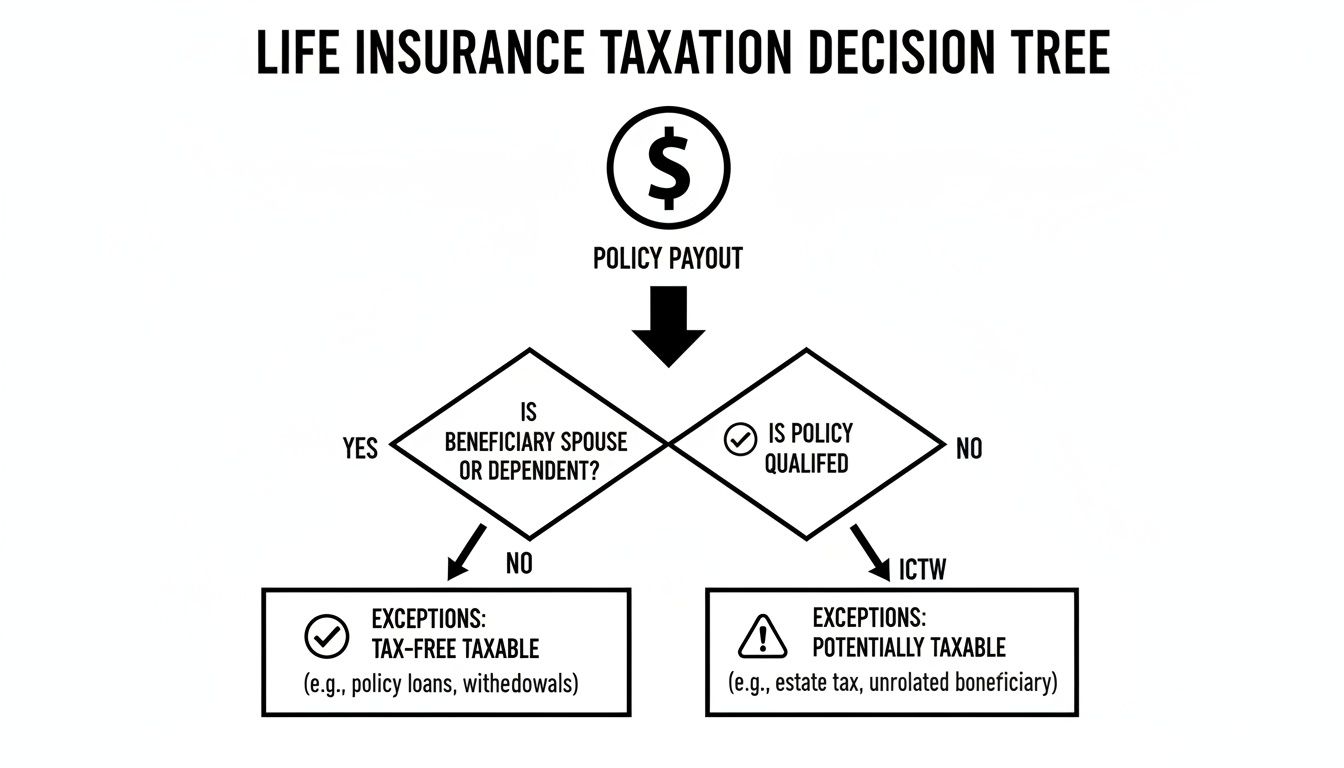
As you can see, the default is tax-free. But once you introduce things like interest payments or selling the policy, the rules get more complex.
Interest Earned on Payouts
This is the most common reason a beneficiary sees a tax bill. The core death benefit itself remains completely tax-free, but any interest that accrues on that money is taxable income.
So, how does this happen? It often comes up when a beneficiary doesn't receive the payout as a single, immediate check. If the insurance company holds the money for a period while processing the claim, or if the beneficiary chooses to receive the payout in installments over several years, the balance will earn interest. That interest has to be reported to the IRS.
Key Takeaway: Think of the death benefit as a tax-free gift. But any money that gift earns is considered income. It’s like being gifted a rental property—you don't pay tax on the property's value, but you absolutely pay tax on the rental income it generates.
The Transfer-for-Value Rule
This is a tricky one that catches many people by surprise. The transfer-for-value rule kicks in when a life insurance policy is sold or transferred to someone else for any kind of valuable consideration (like cash). Once that happens, the death benefit generally loses its income-tax-free status.
Let’s look at an example. Imagine two California business partners, Alex and Ben, who own policies on each other to fund a buyout agreement. If Alex retires and sells his policy on Ben to a third-party investor for cash, the rule is triggered. When Ben passes away years later, the investor who bought the policy will have to pay income tax on the death benefit, minus what they paid for the policy and any premiums they covered.
There are a few key exceptions to this rule (like transfers between business partners or to the insured themselves), but it underscores why you can't just treat a life insurance policy like any other asset you can buy and sell freely.
Surrendering a Cash-Value Policy
Permanent policies like whole life and universal life have a savings component called cash value that grows over time. The policy owner can access this money while they're alive by surrendering the policy. If you do this, you might face a tax bill.
The taxable amount is the difference between the cash you walk away with and your cost basis (the total amount you've paid in premiums).
- No Taxable Gain: You paid $40,000 in premiums over the years and surrender your policy for a $35,000 cash value. Since you got back less than you paid in, there’s no gain and no tax.
- Taxable Gain: You paid $40,000 in premiums, but the policy’s cash value has grown to $50,000. If you surrender it, that $10,000 gain is considered taxable income for the year you receive it.
This tax event only impacts the policy owner during their lifetime and has nothing to do with the death benefit paid to a beneficiary. But it's a critical detail for anyone who might tap into their policy’s cash value.
How Life Insurance Can Affect Estate Taxes

Here’s a twist that catches many families by surprise: even when life insurance payouts are 100% income-tax-free for your beneficiaries, they can still trigger an entirely different tax—the federal estate tax. For those with significant assets, especially here in California, this is a huge planning blind spot.
The confusion comes down to a simple IRS distinction. The death benefit isn't treated as income to the person who receives it, but it can be counted as part of your taxable estate when you die. Your estate is essentially the total value of everything you own—your house protected by home insurance, car insurance for your vehicles, investments, retirement accounts, and yes, your life insurance policy.
This becomes a major issue when your estate’s total value gets close to the federal estate tax exemption. In 2024, that exemption is a generous $13.61 million per person. While that number sounds huge, a large life insurance policy, when added to a lifetime of assets like a California home, can push an estate over that line.
If that happens, every dollar over the exemption gets hit with a federal estate tax that can reach as high as 40%. All of a sudden, a policy meant to provide your family with security could end up creating a significant tax bill instead.
It All Comes Down to Who Owns the Policy
So, what determines if your life insurance proceeds are part of your estate? The IRS looks at one crucial factor: incidents of ownership.
If you, the person insured, held any control over the policy at the time of your death, the IRS considers it part of your estate. That’s the rule. "Control" includes having the right to:
- Change the policy's beneficiaries
- Borrow against the cash value
- Surrender or cancel the policy
- Transfer ownership (assign the policy) to someone else
Basically, if you have the power to make any meaningful decisions about the policy, it's yours in the eyes of the IRS. This is the single biggest reason families get hit with an unexpected estate tax bill. Fortunately, with the right planning, you can structure things to keep the policy out of your estate entirely.
A Smart Solution: The Irrevocable Life Insurance Trust (ILIT)
For anyone worried about crossing that estate tax threshold, one of the most powerful tools available is the Irrevocable Life Insurance Trust (ILIT). An ILIT is a specialized trust created for one main purpose: to own your life insurance policy.
Here's how it works. You create the trust, and the trust then becomes both the owner and the beneficiary of the policy. By doing this, you give up all your incidents of ownership. Since you no longer own or control the policy, the death benefit is not included in your estate when you pass away.
By transferring ownership to a trust, the proceeds can pass to your heirs completely outside of your taxable estate. This move helps you sidestep federal estate taxes on the death benefit, while the payout remains income-tax-free for your beneficiaries. It's a cornerstone of sophisticated wealth preservation.
For anyone looking to use life insurance as a strategic part of their estate plan, understanding what is a life insurance trust is a critical first step. It's a strategy that allows California families to protect their legacy and ensure their loved ones receive the maximum benefit possible.
Special Considerations for California Residents
While federal tax law sets the foundation for life insurance, where you live can change the game entirely. For Californians, state law adds a critical layer to your planning, especially around marriage, divorce, and making sure your policy's proceeds end up exactly where you intend them to. This local expertise is vital for all California insurance matters, from life and home insurance to car and renters insurance.
The good news first: California is one of the states that does not have a state inheritance tax. This is a huge relief for beneficiaries. It means that when you receive a life insurance payout, you don't have to worry about another round of taxes at the state level. The benefit passes to you just as it does federally—generally income-tax-free.
But the real twist for Californians comes from our community property laws. This is where things can get complicated if you aren't paying attention.
Community Property and Its Impact on Your Policy
California is a community property state. In simple terms, this means that most assets acquired during a marriage using joint funds—like the income either spouse earns—are considered owned 50/50 by both partners.
This principle extends directly to life insurance. If you pay your policy premiums using money from a shared bank account, that policy can be legally viewed as community property. This has some serious real-world consequences you need to know about.
Who Gets the Money? Even if you are the sole owner of the policy on paper, your spouse may have a legal claim to half of the death benefit if community funds were used to pay for it. This can create major conflicts if you name someone other than your spouse—say, a child from a prior marriage—as the 100% beneficiary.
What Happens in a Divorce? During a divorce, any life insurance policy with cash value is treated like any other financial asset—it has to be divided. Your divorce decree absolutely must spell out who gets ownership of the policy and who is entitled to the death benefit to prevent bitter disputes down the road.
Think about this common scenario: A husband buys a policy and names his mother as the beneficiary, paying the premiums from the joint checking account he shares with his wife. If he passes away, his wife could legally challenge that designation and claim 50% of the payout, arguing that her community property funds kept the policy active.
Getting the ownership and beneficiary details right from the start is non-negotiable. To make sure your policy is structured correctly for your family's unique situation, it's wise to learn more about choosing the right life insurance in California. A little planning now ensures your wishes are followed and your loved ones are protected from legal headaches later.
How US Tax Rules Compare Globally
It’s easy to get lost in the weeds of U.S. tax law, but it's helpful to pull back and see the bigger picture. How does America's approach to taxing life insurance stack up against what other countries are doing?
When you look around the world, a clear pattern emerges. The fundamental idea that a life insurance death benefit should be a protected, tax-free resource for a family isn't just an American concept. It's a widely shared philosophy.
A Common Global Standard
Most developed nations treat life insurance payouts the same way: the money is meant to reach beneficiaries without the government taking a slice. This near-universal agreement highlights just how crucial this tool is for families everywhere, no matter the currency or language.
This international consensus isn't an accident. It shows that governments globally view life insurance as a vital safety net, and they build their tax laws to protect its core purpose. For California residents, this global standard reinforces why life insurance is such a powerful part of a smart financial and estate plan. You can read more about global life insurance payout rules on CapitalForLife.com.
The consistent tax-free treatment of death benefits across different countries reinforces a key idea: life insurance is fundamentally about protection, not investment gains. Governments worldwide recognize this and have structured their tax codes to support that mission.
Let's look at a few quick examples to see this in action:
- Canada: Just like in the U.S., death benefits paid from a life insurance policy to a named beneficiary are received completely tax-free.
- United Kingdom: Payouts are generally free from income and capital gains taxes. However, they can sometimes get tangled up in inheritance tax, depending on how the policy was set up.
- Australia: Life insurance proceeds paid as a lump sum to a dependent are typically tax-free, staying true to the goal of providing for loved ones after a loss.
This quick world tour shows that the tax-free nature of life insurance in the United States isn't some strange loophole. It's a proven, internationally accepted way to make sure families get the full financial support they were promised, when they need it most.
Protecting Your Legacy with Proactive Planning

Knowing the tax rules for life insurance is one thing, but making sure your policy actually does what you want it to—that’s where the real work begins. Getting proactive with your planning is the only way to shield your loved ones from frustrating delays, legal headaches, and unexpected tax bills down the road. This is true for all your California insurance policies, whether it's for your car, home, or life.
For anyone who owns a policy, this means getting into the habit of regular check-ups. Life never stays still. A marriage, a new baby, or a divorce can instantly make your beneficiary choices outdated, setting the stage for confusion or even conflict.
The same goes for policy ownership. As we’ve seen, the person or entity who owns the policy can trigger major estate tax consequences. A quick review can tell you if your current setup still makes sense for your financial picture.
A Checklist for Policyholders
Think of it like an annual physical for your financial plan. At least once a year, and especially after a big life change, pull out your policy and run through this list:
- Beneficiary Designations: Are your primary and contingent beneficiaries correct? Double-check that names are spelled right and that these are still the people you intend to receive the funds.
- Policy Ownership: Look at who legally owns the policy. If your net worth is climbing, now might be the time to talk to a professional about more advanced strategies, like an ILIT.
- Contact Information: Is your address and phone number up to date with the insurance company? This simple check prevents crucial mail from getting lost.
Guidance for Beneficiaries
If you're named as a beneficiary, you have a few big decisions ahead of you. It's not just about waiting for a check; you have choices in how you receive the money.
The most straightforward option is a tax-free lump-sum payment. It gives you immediate control over the full death benefit. However, insurers often provide other settlement options, like an annuity that pays out over time. While this creates a predictable income, any interest earned on those installment payments could be taxable.
Before you decide, it’s a smart move to sit down with a financial advisor. They can help you map out your financial needs and figure out which option gives you the most security for the long haul. This ensures the legacy you've received is put to its best possible use.
To learn more about related financial topics, feel free to explore our other guides.
Frequently Asked Questions About Life Insurance Taxes
When it comes to life insurance and taxes, a few key questions come up time and time again. Let's walk through some of the most common ones we hear from our clients here in California, with clear, straightforward answers.
Do I Have to Report the Payout on My Taxes?
This is probably the number one question beneficiaries ask. For the main death benefit itself, the answer is almost always no. The IRS doesn't see that lump sum as taxable income, so you don’t need to report it.
The exception? Any interest the insurance company pays you. If there’s a delay in paying out the claim, the insurer might add interest to the final amount. That extra interest income is taxable and absolutely must be reported on your tax return for that year.
What's the Difference Between an Estate Tax and an Inheritance Tax?
It's easy to get these two mixed up, but they work very differently.
- An estate tax is a tax on the deceased person's total estate before anything is passed down to their heirs. The federal government imposes this, but only on extremely large estates.
- An inheritance tax is paid by the person receiving the inheritance after the assets have been distributed.
Here's some good news for those in the Golden State: California has neither an estate tax nor an inheritance tax. This really simplifies things for beneficiaries here. If you're curious about similar topics, feel free to explore our detailed FAQ page.
Can Life Insurance Be Used to Pay Estate Taxes?
Absolutely. In fact, it's one of the most effective and widely used strategies in estate planning. Think of it as a tool to protect the rest of the family's assets from being sold off.
By using a special vehicle like an Irrevocable Life Insurance Trust (ILIT), the policy's death benefit can provide instant, tax-free cash. This gives the estate the liquidity it needs to settle any federal estate taxes without forcing heirs into a tough spot, like having to sell the family business or the primary home just to pay the tax bill.
Navigating the complexities of auto insurance, home insurance, renters insurance, and life insurance is simpler with an expert on your side. For a no-obligation review of your current California insurance coverage, contact Mai & Associates at https://cahomeauto.com to see how we can help you protect what matters most.