Your Guide To Apartment Renters Insurance In California For 2026

Think of apartment renters insurance as your personal financial safety net. It's an affordable policy designed to protect your belongings from theft or damage and, just as importantly, shield you from liability if someone gets hurt in your apartment. For California renters, this coverage is often the only thing standing between an unexpected mishap and a devastating financial hit, making it a key part of a smart California insurance plan.
Why Renters Insurance Is Your Financial Safety Net

Here's a scenario I see all the time: a renter comes home to find a burst pipe has soaked their apartment, ruining their laptop, couch, and clothes. Or worse, a friend slips during a get-together, gets injured, and decides to sue. Many people assume their landlord's insurance will cover them in these situations. It won't.
Your landlord's policy only covers the physical building—the walls, the roof, the pipes. It does absolutely nothing for your personal property or your financial liability. That’s the critical gap that apartment renters insurance is built to fill.
It’s best to think of it not as just another monthly bill, but as a small investment in your own peace of mind. For what often amounts to less than the cost of a few coffees a month, you're protecting everything you’ve worked so hard to acquire. It’s an essential tool for financial stability, whether you're living in a Glendale high-rise or a Costa Mesa townhouse.
A Surprising Affordability Gap
For something so valuable, it's shocking how many renters go without it. National data shows that only 37% of U.S. renters have coverage, despite the average policy costing just $19 per month. This is a huge risk, especially when you consider that 63% of claims come from common disasters like theft and water damage—events that leave uninsured tenants paying for thousands in losses right out of their own pockets. You can dig deeper into these numbers by exploring the latest renters insurance statistics.
This is where a trusted local agency like Mai & Associates can be a real ally. We specialize in finding affordable California renters, auto, and life insurance policies that provide solid protection without breaking the bank.
A common misconception is that renters insurance is expensive or unnecessary. The reality is that for a minimal monthly cost, you're transferring the risk of a catastrophic financial loss from your shoulders to an insurance company. It’s one of the smartest financial decisions a renter can make.
The Three Pillars of Protection
So, what are you actually buying? A standard renters policy is built on three core pillars of protection. Getting a handle on these is the first step to seeing just how much ground a simple policy can cover.
The table below breaks down these three key components to give you a quick snapshot of what’s protected.
Core Components Of A Renters Insurance Policy
| Coverage Type | What It Protects You From | A Real-World Scenario |
|---|---|---|
| Personal Property | Loss or damage to your belongings (furniture, electronics, clothes) from events like fire, theft, or water damage. | A kitchen fire destroys your cabinets, cookware, and microwave. This coverage helps you replace them. |
| Personal Liability | Lawsuits and legal costs if you're found responsible for injuring someone or damaging their property. | Your dog bites a visitor, leading to medical bills and a potential lawsuit. This helps cover those expenses. |
| Additional Living Expenses (ALE) | The cost of temporary housing and meals if a covered event makes your apartment unlivable. | A burst pipe floods your unit, and you need to stay in a hotel for two weeks. ALE reimburses you for that hotel bill. |
Each of these coverages works together to create a comprehensive shield. Personal Property helps you rebuild your life, Liability protects your savings and future income, and ALE ensures you have a place to stay while things get sorted out.
What Your Policy Actually Covers (And What It Doesn't)

Trying to figure out what's inside a renters insurance policy can feel a bit like deciphering a legal document. Let's cut through the jargon. Think of your policy as a financial safety net with a few different layers, each designed to catch you if something goes wrong.
Let's break down exactly what that safety net covers.
Personal Property Coverage: Your Stuff
This is the heart of renters insurance. It’s all about protecting your belongings—your furniture, laptop, clothes, bike, and kitchen gadgets. This coverage kicks in when your stuff is damaged or destroyed by specific events, which the insurance world calls "named perils."
Most policies cover you for common disasters like:
- Fire and lightning
- Theft and vandalism
- Smoke damage
- Water damage from inside (think a burst pipe or an overflowing washing machine)
- Windstorms and hail
- Explosions
So, if a kitchen fire in your building leaves your apartment filled with smoke, ruining your couch and TV, your personal property coverage helps pay to repair or replace them, up to your policy limit. It’s the coverage that helps you get back on your feet after a disaster.
Actual Cash Value vs. Replacement Cost
This is a crucial detail that determines how you get paid after a claim. You’ll choose between two options when you buy your policy: Actual Cash Value (ACV) or Replacement Cost Value (RCV).
Actual Cash Value (ACV): This pays you for what your items were worth the moment they were destroyed. It’s essentially the "eBay price," factoring in wear and tear (depreciation). A five-year-old laptop isn't worth what you originally paid, and ACV reflects that.
Replacement Cost Value (RCV): This is the superior option for most people. It pays you what it costs to go out and buy a brand new, similar item today, with no deduction for depreciation. RCV policies cost a little more, but the payout is significantly better.
For most California renters, choosing Replacement Cost Value (RCV) is a no-brainer. While the premium is slightly higher, it means you can actually afford to buy new things to replace what you lost, instead of getting a check that only covers a fraction of the cost.
Personal Liability Coverage: Your Financial Defense
This might be the most important part of your policy you don't think about. Liability coverage protects you if you're ever held responsible for injuring someone or damaging their property. It's a financial firewall that covers legal fees, settlements, and judgments, keeping your savings and future income safe from a lawsuit.
Here are a few real-world California scenarios where this coverage is a lifesaver:
- Your dog bites a visitor at your San Diego apartment, and they sue you for their medical bills.
- You leave a candle burning, and it causes a fire that damages the unit next door.
- A guest slips on a wet floor in your kitchen in Irvine, breaks their wrist, and holds you responsible.
Without this protection, you'd be on the hook for those expenses personally. Most standard policies start with $100,000 in liability coverage, but I almost always recommend bumping that up to $300,000 or even $500,000. The extra cost is minimal for the huge increase in peace of mind.
What Your Policy Does Not Cover
Knowing what isn't covered is just as important as knowing what is. A standard renters policy has very specific exclusions. It’s also important to remember your policy is different from other property insurance; for example, understanding the difference between landlord insurance vs homeowners insurance helps clarify that your policy doesn't cover the building itself—that's the landlord's job.
Here are the big things a typical renters policy leaves out:
- Earthquakes: This is a massive gap for anyone in California. Coverage for earthquakes must be added on separately as an endorsement.
- Floods: Damage from outside water sources, like a flash flood or overflowing river, is never included. This requires a completely separate flood insurance policy.
- Your Car: Your renters policy might cover personal items stolen from your car, but it won’t cover theft of or damage to the car itself. That’s what your comprehensive auto insurance in California is for.
- Roommates: Your policy covers you and any family members living with you. Your roommate is not covered; they need to get their own separate policy for their belongings and liability.
Decoding Your Policy Limits And Deductibles
When it comes to your renters insurance, two terms matter more than almost any others: coverage limits and your deductible. Getting these two figures right is the key to making sure your policy actually comes through for you when you need it most, without any nasty financial surprises.
Let’s break them down. Your coverage limit is simply the maximum amount your insurance company will pay for a claim. Think of it as the ceiling on your protection. You'll have separate limits for different things, mainly for your personal belongings and for personal liability.
On the flip side, your deductible is the amount you have to pay out of your own pocket before your insurance coverage kicks in to cover the rest. It's your share of the cost. Picking a higher deductible usually means a lower monthly premium, but you'll have to cover more of the initial expense if something goes wrong.
Finding The Right Balance For Your Coverage Limits
Setting your coverage limits is all about striking a smart balance. For personal property coverage, most California renters land somewhere between $20,000 and $50,000. But the right number for you is completely personal—it all comes down to what your stuff is worth. One of the most common and costly mistakes I see is people underinsuring their belongings.
The best way to get a real number is to do a quick home inventory. Just walk through your apartment room by room, making a list of your major items—your couch, TV, laptop, clothes, kitchen gear—and estimate what it would cost to buy them all brand new today. This simple exercise will give you a solid, realistic target for your personal property limit.
When it comes to personal liability coverage, standard policies often start at $100,000. Frankly, that's almost never enough, especially here in California where legal and medical bills can skyrocket. I strongly advise clients to choose a limit of at least $300,000, and ideally $500,000. The cost to bump up this protection is typically very small, but the peace of mind it provides is massive.
The Role Of Your Deductible
Think of your deductible as the first hurdle in a claim. Let’s say a thief breaks in and steals your $2,500 bicycle, and your policy has a $500 deductible. Here’s how it works:
- You pay the first $500 of the loss yourself.
- Your insurance company then steps in and pays the remaining $2,000.
If that stolen bike was only worth $400, you wouldn't even file a claim, because the total loss is less than your deductible. The most common deductible amounts are $250, $500, or $1,000. For most renters, a $500 deductible is the sweet spot, offering a good balance between an affordable premium and a manageable out-of-pocket cost if you have to make a claim.
Important Note on Special 'Sub-Limits': Your standard policy isn't a blank check. It will have specific, lower limits—called "sub-limits"—for certain categories of high-value items. For instance, your policy might cover $30,000 in property overall, but only pay out a maximum of $1,500 for all your jewelry combined. If you own expensive jewelry, art, or collectibles that are worth more than these sub-limits, you'll need to add extra coverage (often called a "floater" or "rider") to insure them for their full value.
These terms can feel a little technical at first, but understanding them is crucial. To get more comfortable with the language of insurance, you can learn more about insurance terminology in our glossary. This knowledge will empower you to build a California apartment renters insurance policy that truly protects your life.
How Much Does Apartment Renters Insurance Cost In California?
Let's get right to the question on every renter’s mind: what’s this actually going to cost me? Most people overestimate the price of renters insurance, lumping it in with major expenses like rent or car payments. The truth is, this kind of financial safety net is incredibly affordable—we’re often talking about less than the cost of a couple of streaming subscriptions.
Of course, there isn't one flat price. Think of it less like a fixed utility bill and more like customizing a policy that fits your life perfectly. The final premium comes down to a handful of specific details about you, your apartment, and the amount of protection you need.
Key Factors That Shape Your Premium
A few key variables come together to determine your final monthly or annual rate. Once you understand them, it's easy to see why a policy for a new high-rise in Downtown LA would cost a bit more than one for a quiet complex in Escondido.
Here’s what insurers look at:
- Your Location: Where you live in California plays a big role. Insurance companies analyze zip code-level data on things like local crime rates, wildfire risk, and how close you are to a fire station.
- Your Coverage Amounts: This is the biggest piece of the puzzle. How much you choose for your personal property and liability limits directly impacts your premium. More coverage means a slightly higher cost.
- Your Deductible: The deductible is the amount you pay out of pocket on a claim before your insurance coverage kicks in. If you choose a higher deductible, you’ll have a lower monthly premium, and vice-versa.
- Your Claims History: Just like with California car insurance, a history of filing multiple claims can signal higher risk and lead to higher rates. A clean record usually gets you a better price.
The good news? For the vast majority of California renters, the cost is very manageable. On average, you can expect to pay somewhere between $15 and $30 per month. It's a small price for protection against financial disasters that could otherwise set you back thousands.
This image shows the typical ranges you might see for the core parts of a standard renters policy.
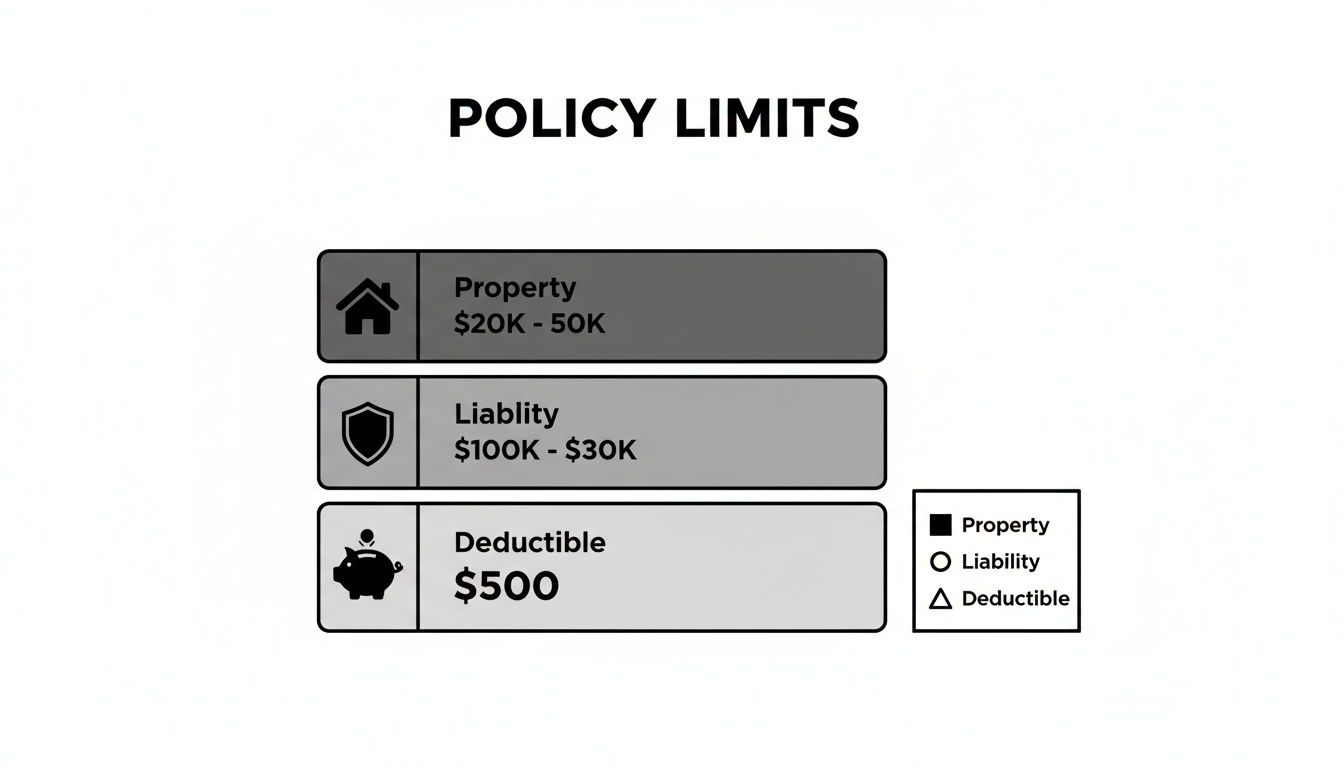
Finding the right balance between these three elements—your property coverage, liability limit, and deductible—is the secret to building a policy that’s both affordable and effective.
To give you a clearer picture, this table shows some real-world examples of what different renters might pay across the state.
Sample Monthly Renters Insurance Costs Across California
| Renter Profile | Example Location | Personal Property | Liability Coverage | Estimated Monthly Cost |
|---|---|---|---|---|
| The Student | Irvine, CA | $15,000 | $100,000 | $12 - $18 |
| The Young Professional | Glendale, CA | $30,000 | $300,000 | $18 - $25 |
| The Couple | Costa Mesa, CA | $50,000 | $500,000 | $25 - $35 |
Keep in mind that these are just estimates. Your actual quote will depend on your personal claims history, the deductible you select, and any discounts you qualify for.
Unlocking The Power Of Bundling
One of the best ways to make renters insurance even more affordable is by bundling. This is where you combine your renters policy with another policy from the same insurance company, like your auto insurance or life insurance.
Insurers love rewarding customer loyalty. When you trust them with more of your business, they give you a multi-policy discount that can be surprisingly deep. In many cases, the discount on your car insurance is so significant that it makes your renters policy feel like it’s practically free.
This is a fantastic strategy, especially since most California renters already have car insurance. Instead of paying two separate, full-price premiums, you can consolidate them for a lower total cost. An independent agent can take your needs and shop them across multiple carriers at once to find the absolute best bundled deal out there.
At the end of the day, the takeaway is simple: the peace of mind that a solid renters insurance policy provides is well within reach for the average Californian. For a small monthly investment, you're protecting your belongings, your savings, and your future from life's unexpected curveballs.
Navigating California-Specific Risks Like Wildfires And Earthquakes
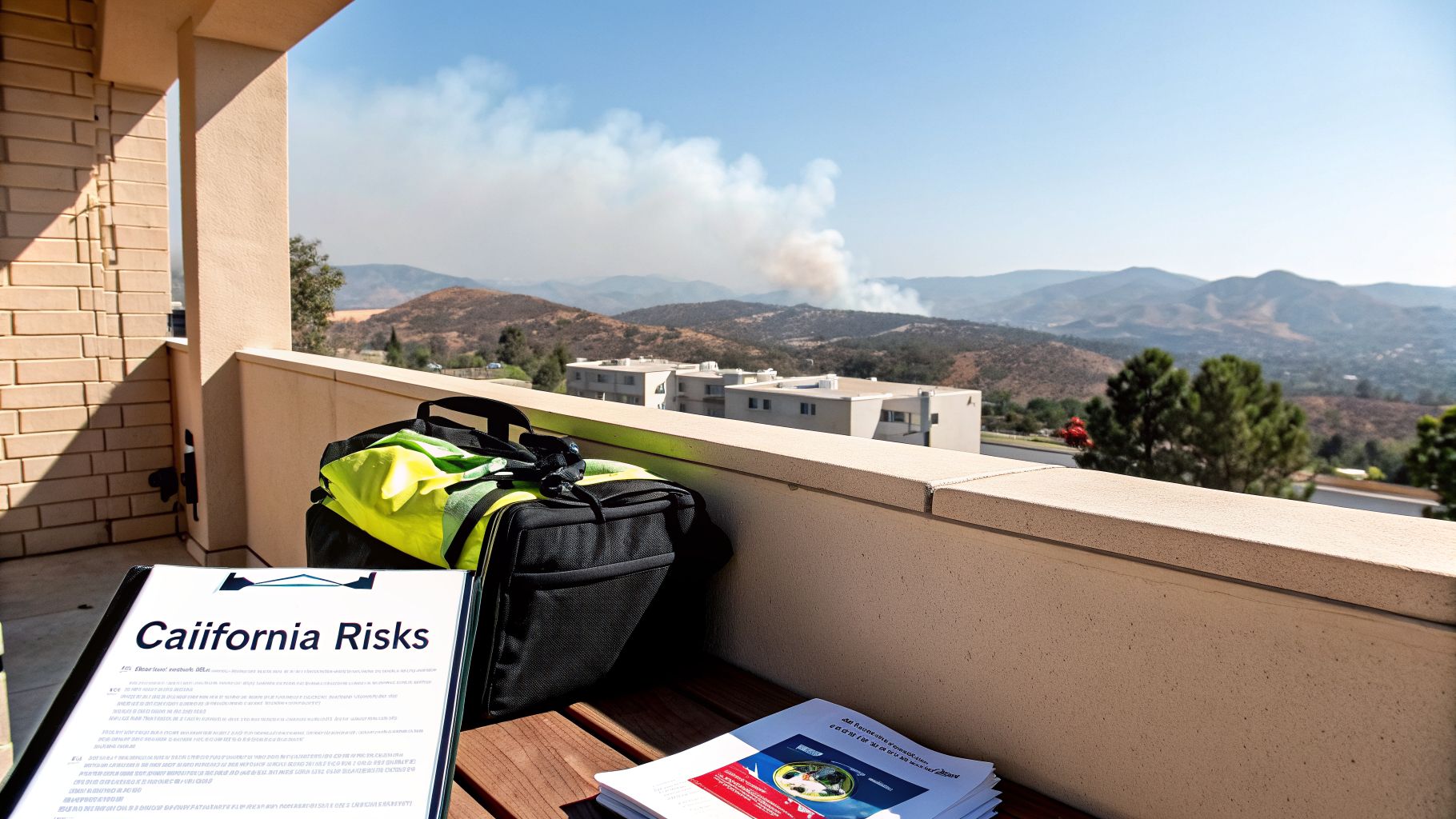
Living in the Golden State is incredible, but it means dealing with a few major risks that a typical insurance policy just wasn't designed to handle. Your standard apartment renters insurance is fantastic for things like theft or a burst pipe, but it falls short when it comes to California's most infamous natural disasters.
Getting a handle on these built-in exclusions is the key to creating a financial safety net that won’t fail you. It’s so important to remember that your landlord’s policy covers the building, not your stuff. Protecting your personal belongings and your finances is entirely up to you.
The Earthquake Exemption
Here’s the unfiltered truth: your standard renters policy provides zero coverage for earthquake damage. This is a detail that every California renter needs to have circled and highlighted. If a quake hits and your TV, furniture, and computer are destroyed, your regular policy won't pay a dime to replace them.
To get that protection, you have to buy a separate earthquake insurance policy or add it as an endorsement to your existing renters plan. This is the only coverage that will step in to help you replace your belongings after a seismic event.
The real kicker here is the deductible. Earthquake coverage has its own, separate deductible that works differently. Instead of a flat amount, it's a percentage of your total personal property limit—usually between 5% and 25%. So, if you have $50,000 in coverage with a 10% earthquake deductible, you’d be responsible for the first $5,000 of damage yourself before the insurance kicks in.
Wildfire Worries And Your Policy
Now for some good news. Unlike earthquakes, fire damage—and that includes from wildfires—is a standard covered event in every renters insurance policy. That said, if you live anywhere near a high-risk wildfire zone, having the right amount of coverage is non-negotiable. A fire can wipe out everything you own in a matter of minutes.
For renters in these areas, two parts of your policy become incredibly important:
- Personal Property Coverage: You have to be realistic about how much stuff you have. Do a quick home inventory and make sure your limit is high enough to replace everything at today’s prices, not what you paid for them years ago.
- Additional Living Expenses (ALE): This is your lifeline. If a wildfire forces an evacuation or makes your apartment uninhabitable, ALE is what pays for your hotel, meals, and other essentials while you're displaced.
The growing threat of natural disasters is a major reason why more landlords require renters insurance. In fact, the global market is expected to jump from $100.99 billion in 2025 to $107.53 billion in 2026, partly driven by these trends. You can dig deeper by checking out the latest renters insurance market research.
Other California Considerations
Beyond the big two, there are other regional issues to think about. Mudslides, for instance, often follow wildfires when heavy rains hit the unstable, burned soil. Coverage for mudslides is tricky; it’s typically excluded along with floods, which require their own separate policy from the National Flood Insurance Program (NFIP).
This is where talking to an expert can save you a massive headache. An independent agency like Mai & Associates can help you navigate complicated scenarios, like getting coverage through the California FAIR Plan if you’re in a high-risk zone, and make sure you’re not left with any dangerous gaps in your policy.
Building a solid protection plan in California isn’t about just buying a standard policy. It’s about taking a hard look at your specific location, identifying its unique risks, and strategically adding the right coverage to fill in the gaps.
Of course, financial protection is only one piece of the puzzle. Knowing how to prepare for an earthquake with a physical safety plan is just as crucial. When you combine smart preparation with the right insurance, you give yourself the best possible defense against whatever comes your way.
Here’s a step-by-step breakdown of how to buy a renters insurance policy. Don't worry, it's a lot simpler than it sounds. We'll walk through it together, from figuring out what you need to locking in your coverage.
Think of this as your personal roadmap. Following these steps will make sure you get a policy that actually fits your life here in California, without any gaps you'll regret later.
Step 1: Take a Home Inventory
Before you can insure your stuff, you have to know what it’s worth. The best way to do this is with a home inventory. This sounds like a huge project, but it doesn't have to be.
Just walk through your apartment, room by room, and make a quick list of your major possessions.
- Living Room: Your TV, soundbar, couch, coffee table, and any artwork.
- Bedroom: The bed and mattress, dressers, and a rough estimate for your clothes and shoes.
- Kitchen: Think about smaller appliances like your air fryer or stand mixer, plus your pots, pans, and dishes.
- Electronics: This is a big one. Add up your laptop, tablets, phone, and any gaming consoles.
A great tip is to just pull out your phone and take a video as you walk through your place, narrating what you see. This visual proof is absolute gold if you ever have to make a claim. Add it all up, and you’ll have a solid number for your personal property coverage goal.
Step 2: Decide on Your Liability Needs
Next up is personal liability. This is the part of your policy that steps in if you're found responsible for injuring someone or damaging their property. Standard policies often start with $100,000 in liability coverage, but frankly, that’s almost never enough—especially in a place like California.
Think about it: do you ever have friends over? Own a dog? These things increase your risk. For most renters, bumping that coverage up to at least $300,000 is a smart, conservative move. The best part? The cost to triple your liability protection is usually just a few extra dollars a month. It’s one of the best bargains in insurance.
Step 3: Shop for Quotes and Discounts
Now for the fun part: finding the best deal. You could go directly to different insurance company websites one by one, but the fastest and easiest way is to work with an independent agent. We can pull quotes from a bunch of different A-rated carriers all at once, which saves you a ton of time and hassle.
This is also where you can really stack up the savings. Always ask about bundling your renters policy with your auto insurance. The multi-policy discount on your car insurance is often so large that it can make your renters policy feel practically free.
Step 4: Fill Out the Application
Once you’ve landed on the right company and quote, the application is usually quick and painless. You’ll need to provide your name and the apartment address, along with the coverage limits and deductible you decided on. They'll also ask a few simple questions, like whether you have any pets or if you run a business out of your home.
Step 5: Review Your New Policy
After you've paid your first premium, you'll get your official policy documents. Take five minutes to look at the "declarations page"—it’s the summary of your entire policy. Make sure your name is spelled right and that the address, coverage amounts, and deductible are all exactly what you asked for.
By following these five steps, you can turn what seems like a chore into a simple, confident decision. Ready to see just how affordable real peace of mind can be? You can get a personalized insurance quote from our experts, and we'll help you find the perfect coverage for your needs.
Frequently Asked Questions About California Renters Insurance
Even after you get the basics down, a few specific questions always seem to pop up. Let's walk through some of the most common ones we hear from California renters every day.
Is My Roommate Covered By My Policy?
Nope, they aren't. Your renters insurance policy only covers you and any family members who live with you, like your spouse or kids. Your roommate is considered a separate individual and needs their own policy to protect their stuff and cover their own liability.
Trying to share a single policy between unrelated roommates is a surefire way to run into problems. If a kitchen fire ruins everything, your policy will only pay out for your lost belongings, leaving your roommate completely out of luck. To make sure everyone is protected, each person in the apartment should have their own renters insurance.
Think of it like this: you and your roommate wouldn't share a single car insurance policy for two different cars. The same logic applies here—separate people with separate property need separate policies.
Does Renters Insurance Cover My Car If It's Broken Into?
This is a classic point of confusion, and the answer is a bit of a "yes and no." Your renters policy will not cover damage to the car itself. A broken window or a busted door lock falls under the comprehensive coverage of your auto insurance policy.
However, your renters insurance will cover the personal items that were stolen from your car. It doesn't matter if the car was parked in your apartment's garage or across the country. So, if a thief smashes your window and grabs your laptop, your auto policy handles the window repair, and your renters policy helps you replace the laptop (minus your deductible).
For a deeper dive into other common scenarios, you can always explore our detailed FAQ page.
Why Do I Need Insurance If My Landlord Has It?
This is a big one. Your landlord's insurance is there to protect their investment—the building. It covers the physical structure: the roof, the walls, the foundation, and the shared plumbing and electrical systems. It provides absolutely zero coverage for your personal belongings.
If that same fire destroys the building, the landlord's policy will help them rebuild, but it won't give you a dime to replace your couch, TV, clothes, or computer. That responsibility falls entirely on you, which is exactly why having your own home insurance or renters policy is so essential.
Ready to get the right answers and the right coverage for your California insurance needs? The licensed agents at Mai & Associates can provide a same-day quote, compare options from top carriers, and find you the perfect policy that bundles with your auto, home, or life insurance for maximum savings. Get protected today by visiting us at cahomeauto.com.