Alternatives to California Fair Plan That Save Coverage

You've received a non-renewal notice, your mortgage company still wants proof of insurance, and the California FAIR Plan looks like the only door left open. You're not alone, but accepting that first option without reviewing the gaps can leave your home, belongings, liability, and family finances exposed.
The right alternatives to the California FAIR Plan depend on the property, not just the ZIP code. A wildfire-exposed home with a fire-resistant roof may qualify for an admitted specialty carrier. A hard-to-place property may fit surplus lines coverage. Another home may need a deliberate FAIR Plan and Difference-in-Conditions structure while the owner works toward private-market eligibility.
Why So Many Homeowners Are Looking Beyond the California FAIR Plan
A homeowner in a foothill community may have a well-maintained property, updated roofing, and documented vegetation management, yet still find the voluntary insurance market difficult to access. After a non-renewal, the FAIR Plan can provide a fast answer for fire coverage. The problem begins when that basic policy is treated as a complete homeowners policy.
The FAIR Plan was created as an insurer of last resort, not as a full replacement for ordinary private home insurance. Its growth shows how much the California insurance market has changed. By December 2025, the Plan had about 668,609 policies in force and roughly $724 billion in total exposure, according to the California FAIR Plan oversight hearing materials. Its exposure was up 4% from September 2025 and about 230% from September 2022, showing that the residual market now carries a much larger role in California property insurance.
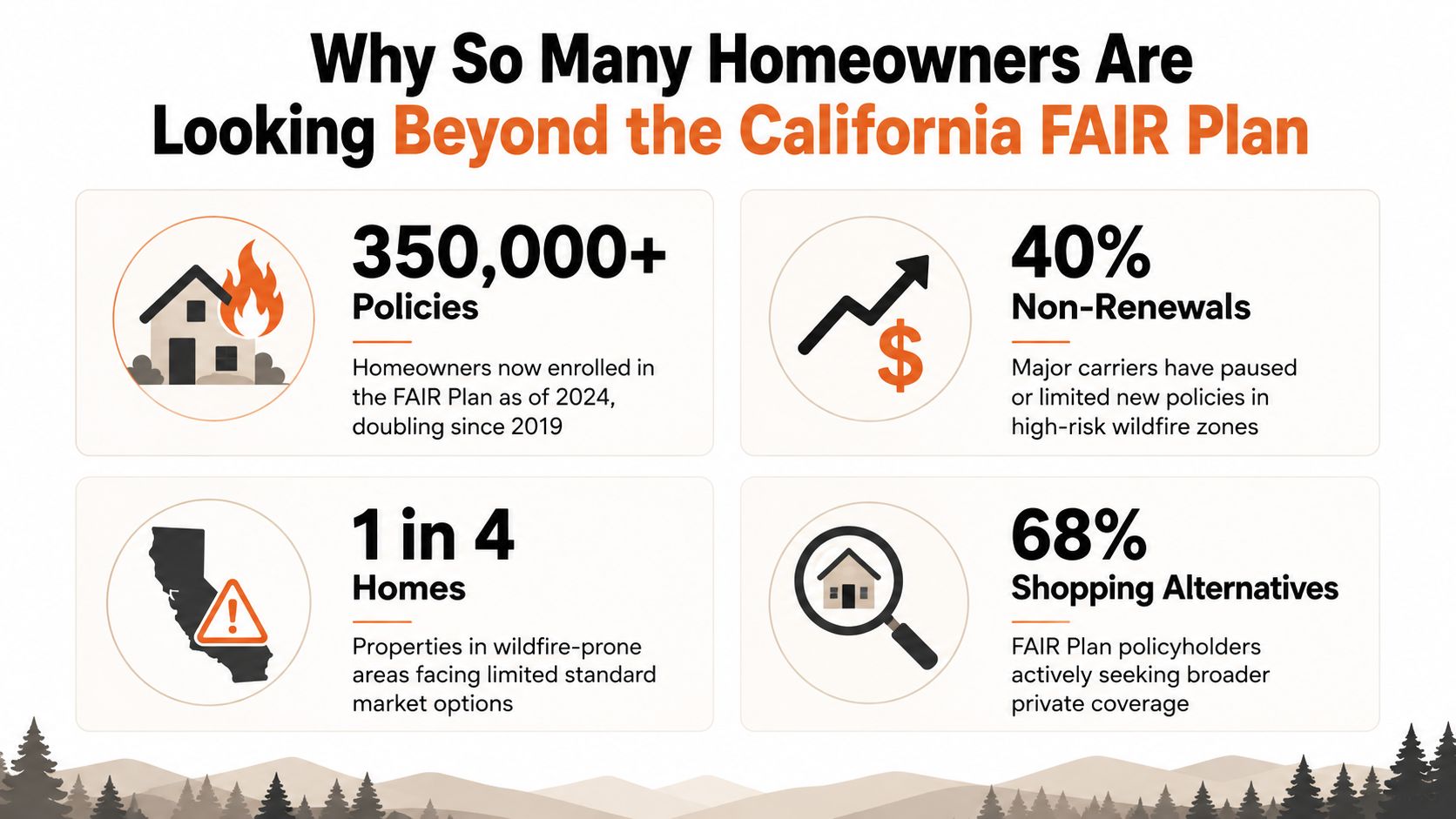
Berkeley Haas estimated that the FAIR Plan reached about 6.2% of California's residential property-and-casualty market by September 2025, as reported in those same California insurance market materials. That figure matters because the Plan is no longer a small fallback used by a handful of unusual properties. It has become a significant part of the homeowners insurance system.
The real reason to shop beyond the Plan
The FAIR Plan's growth doesn't mean every policyholder should cancel it immediately. It means homeowners should stop assuming that FAIR Plan placement proves a property is permanently uninsurable. Private admitted carriers, specialty programs, surplus lines markets, and hybrid structures each assess risk differently.
The search should focus on total protection, not just fire coverage. A policy that appears affordable may still leave you without personal liability, theft protection, water damage coverage, or additional living expenses. Those gaps can be more financially damaging than the premium difference between two quotes.
For a broader California insurance review covering home, auto, renters, and life insurance needs, homeowners can also review California insurance guidance from Mai & Associates. The practical question is simple: can another structure protect more of your home and finances without creating an unacceptable cost or underwriting burden?
What the California FAIR Plan Covers and Where It Falls Short
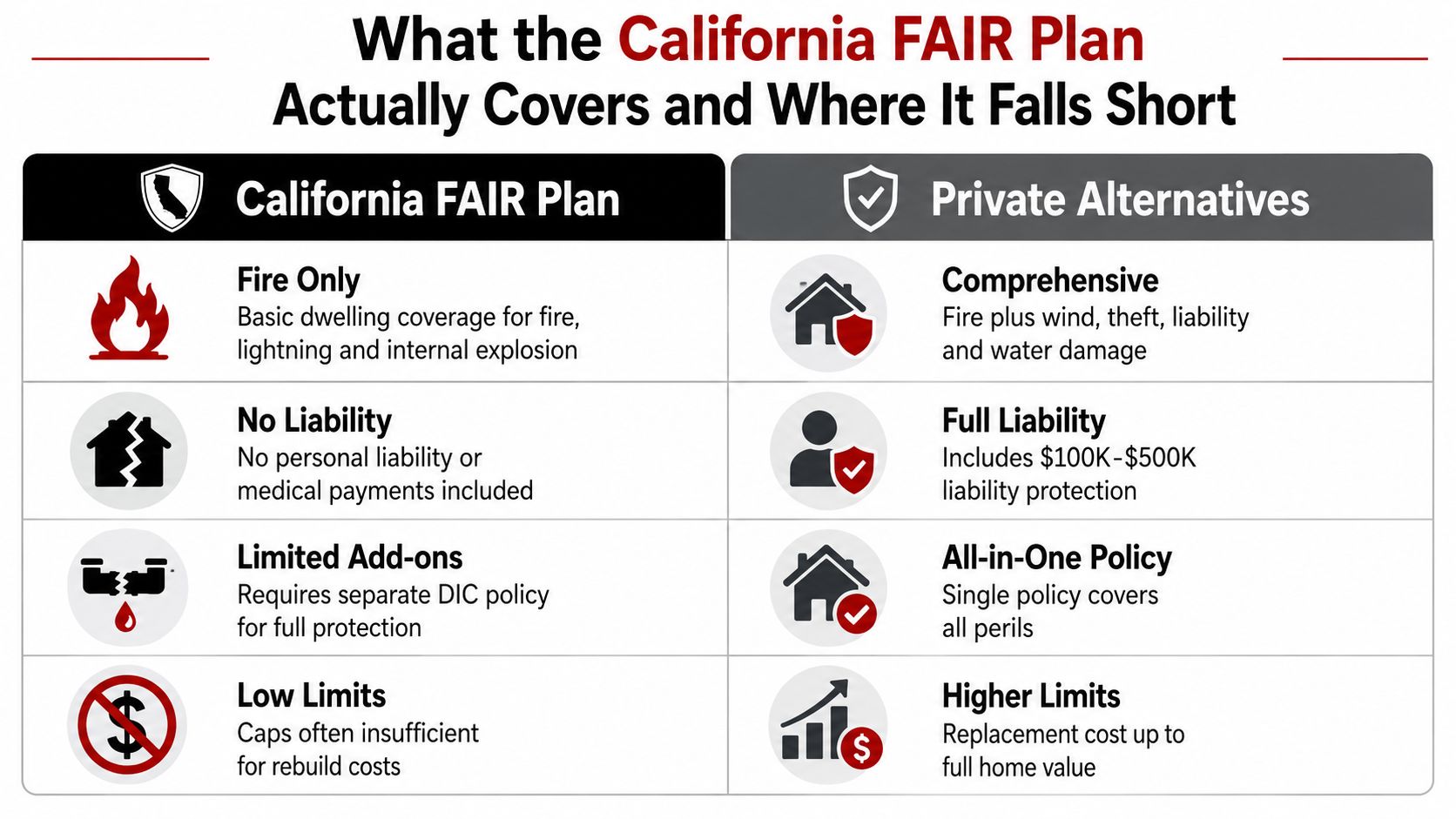
A FAIR Plan policy can keep a wildfire-exposed home insured for named perils, but it should not be mistaken for a complete homeowners policy. It generally covers fire, lightning, smoke, and internal explosions, rather than the wider group of covered causes of loss found in standard homeowners insurance. The Plan's limited design is described in the Little Hoover Commission coverage discussion.
Evaluate quotes by comparing total protection, not the FAIR Plan premium alone. A homeowner with a well-maintained, defensible property should keep testing admitted or specialty markets. A property with severe wildfire exposure, unusual construction, or limited private-market options may need a FAIR Plan paired with DIC coverage until a broader private policy becomes available.
The missing protections that create financial exposure
A FAIR Plan policy by itself generally leaves several household risks outside its basic protection:
- Personal liability: If a visitor is injured or you are accused of causing damage, the FAIR Plan does not operate as a complete liability policy.
- Theft protection: Stolen furniture, electronics, clothing, and other belongings require separate coverage.
- Water damage: Burst pipes and other common water losses may remain outside the Plan's scope.
- Loss of use: If a covered event makes the home unlivable, separate coverage may be needed for temporary housing and related expenses.
- Broad personal property coverage: Fire protection for the structure does not automatically replace everything your household owns.
A Difference-in-Conditions policy, or DIC wraparound, can address many of these gaps. Depending on its terms, it may add personal liability, theft, water damage, personal property, and loss-of-use coverage. The trade-off is administrative: you will manage two policies, with separate limits, exclusions, deductibles, and claim procedures. For a home that cannot yet qualify for a full private policy, that combination often closes more gaps than a FAIR Plan alone.
The Plan's scale also supports regular coverage reviews. By June 2025, exposure had reached $649.4 billion, while policies in force had risen 31% to 610,179, according to this California FAIR Plan alternatives analysis. The Plan had paid $2.7 billion in claims by March 2025, showing its role as a catastrophe backstop.
Your next step should match the property. Homes with strong mitigation and acceptable construction should pursue admitted or specialty coverage. Hard-to-place homes may need surplus lines or a specialty program. If no private policy fills the full risk, use a FAIR Plan plus DIC structure and check policy coordination before binding coverage. For related California coverage questions, consult this California homeowners insurance FAQ.
Comparing Your Main Alternatives to the California FAIR Plan
There are four practical paths for most high-risk homeowners. The first is re-entry into the admitted market. The second uses a surplus lines or excess-and-surplus carrier. The third relies on a specialty program designed for difficult properties. The fourth combines the FAIR Plan with a DIC wraparound policy.
| Alternative Type | Best For | Coverage Scope | Key Trade Off |
|---|---|---|---|
| Admitted standard or specialty carrier | Homes with strong mitigation, manageable claims history, and acceptable construction | Broad homeowners protection, often including dwelling, personal property, liability, and additional living expenses | Underwriting can be strict, and eligibility may be limited |
| Surplus lines or E&S carrier | Hard-to-place homes, unusual construction, or severe wildfire exposure | Customizable property and liability protection, subject to policy wording | No California guaranty fund protection, plus added tax and fees |
| Specialty high-risk program | Properties that don't fit ordinary carrier rules but have a defensible risk profile | Broader protection than a basic FAIR Plan, depending on the program | Availability and underwriting appetite can change |
| FAIR Plan plus DIC wraparound | Homes that cannot yet secure a complete private policy | FAIR Plan fire protection plus supplemental liability, theft, water, property, and loss-of-use coverage | Two policies, separate terms, coordinated renewals, and potentially higher total complexity |
Admitted carriers are the preferred long-term target
If your home qualifies, an admitted carrier is usually the cleanest solution. You receive one regulated policy rather than a fire policy plus separate supplements. The policy can also make it easier to coordinate dwelling limits, personal property, liability, and additional living expenses.
Strong mitigation documentation can help. Keep records of roof work, ember-resistant features, vegetation management, access improvements, and other property upgrades. The carrier still decides whether the home fits its guidelines, but a complete submission gives underwriting more to evaluate than a bare address.
Surplus lines provide flexibility, not a free pass
E&S coverage exists for properties the admitted market may decline. These carriers can customize terms for wildfire-exposed homes, high-value dwellings, and unusual risks. The trade-off is material. Surplus lines policies aren't backed by the California insurance guaranty fund, and California generally applies an additional surplus-lines tax of about 3% to 4% plus a stamping fee, as explained in the admitted and non-admitted market comparison.
The right E&S policy is not the one with the shortest quote. It's the one whose exclusions and limits you understand before a loss.
DIC works when the FAIR Plan is unavoidable
A FAIR Plan plus DIC structure makes sense when fire coverage is available but private coverage isn't. The DIC policy should be reviewed alongside the FAIR Plan, not purchased as an afterthought. Check how the policies coordinate on deductibles, limits, claims handling, personal property, liability, water damage, and additional living expenses.
For a property with serious unresolved risk, this hybrid can reduce gaps more effectively than a FAIR Plan alone. It doesn't automatically make the package inexpensive or simple.
Homeowners comparing these structures can use California home insurance options from Mai & Associates as one place to request a policy review and compare available markets.
How Much Alternatives Cost and What Affects Your Price
Don't compare the FAIR Plan premium with the price of a private policy and stop there. Compare the complete insurance program. A FAIR Plan may require a DIC policy to add liability, theft, water damage, personal property, and loss of use. An E&S policy may add a surplus-lines tax and stamping fee. An admitted policy may cost more upfront but include broader protection in one contract.
The price depends on the dwelling limit, construction, wildfire exposure, claims history, deductible, carrier appetite, and the scope of exclusions. You can influence some of those factors through mitigation and documentation, but you can't negotiate away the property's underlying exposure.

Price the package, not the first policy
A two-policy structure requires more than adding premiums. Confirm whether the DIC policy has separate deductibles, how it handles losses that involve multiple perils, and whether its liability limit matches your assets and household responsibilities.
Surplus lines pricing also includes the additional California tax of about 3% to 4% plus a stamping fee, according to the California non-admitted market comparison. The final amount depends on the placement and transaction details, so ask for a complete premium and fee breakdown.
Budget for the rest of your California insurance program
Homeowners often review home insurance while ignoring auto, renters, or life insurance. That's a mistake when the goal is household financial protection.
California's minimum auto liability requirement changed from 15/30/5 to 30/60/15, meaning at least $30,000 per person for bodily injury, $60,000 per accident, and $15,000 for property damage. The change took effect January 1, 2025, and applies at renewal rather than instantly to every existing policy, as described in this California auto insurance liability update.
Renters also need a realistic baseline. A California renters-insurance benchmark based on NAIC 2023 data places the average annual premium at about $171, or roughly $14 per month, according to the California renters insurance calculator. That coverage can protect personal belongings, liability, and additional living expenses without insuring the building itself.
Life insurance belongs in the same household conversation. If a wildfire loss, mortgage obligation, or loss of income would place dependents under pressure, life coverage addresses a different financial risk that home and auto policies cannot solve.
How to Transition From the FAIR Plan Without Losing Coverage
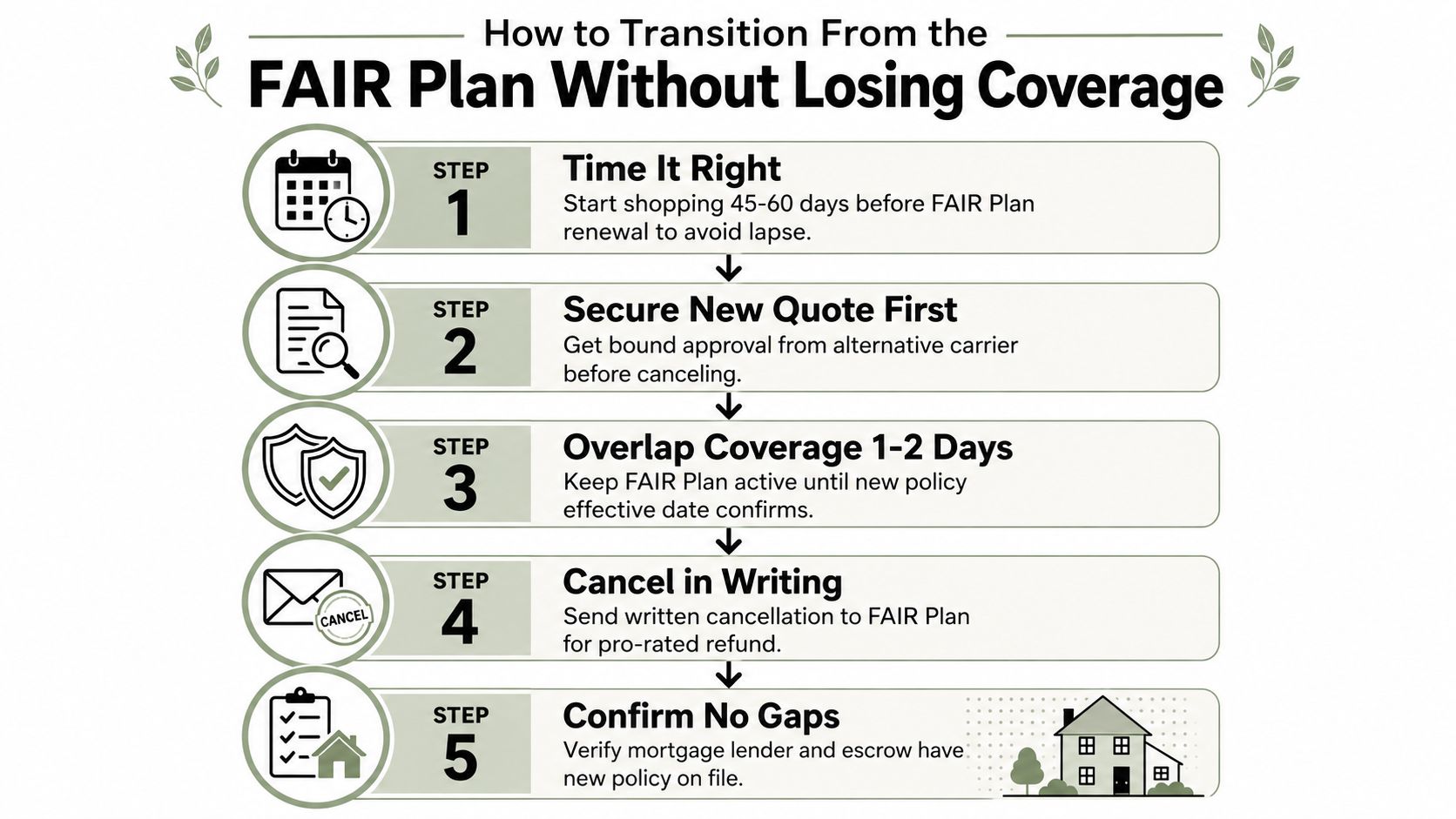
The most dangerous switching error is canceling the FAIR Plan before the replacement policy is active. A quote isn't coverage. An application isn't coverage. You need written confirmation that the new carrier has bound the policy, the effective date is correct, and the mortgage lender will accept the policy.
Start the process before renewal, while you still have time to correct documentation problems or consider a temporary hybrid structure.
Use a controlled transition sequence
- Review the current policy. Identify the FAIR Plan dwelling limit, deductible, renewal date, exclusions, and lender requirements.
- Prepare underwriting records. Gather roof invoices, inspection documents, mitigation photos, permits, claims information, and a property description.
- Shop multiple paths. Ask for admitted, specialty, E&S, and FAIR Plan plus DIC options when appropriate.
- Bind replacement coverage first. Obtain the declarations page or other binding confirmation before requesting cancellation.
- Align the effective dates. Keep the FAIR Plan active until the replacement policy is confirmed effective.
- Notify the lender and escrow team. Send the new policy documents and confirm that the lender has updated its records.
- Cancel in writing. Request cancellation from the FAIR Plan only after the new coverage is active, then retain confirmation and any refund information.
Treat mitigation as underwriting evidence
A new roof or cleared vegetation only helps if the carrier knows about it and can verify it. Photograph completed work, keep contractor receipts, preserve permits, and document ongoing maintenance. If the first carrier still declines, submit the same organized file to another market rather than assuming the property has no options.
California's Sustainable Insurance Strategy is intended to help policyholders transition out of the FAIR Plan and restore voluntary-market choices. That policy direction may improve availability, but you still need to manage your own renewal dates and documentation.
Requesting a California insurance quote and policy review can help you compare the replacement and hybrid paths before making a cancellation decision.
Never create a coverage gap to save a few days of premium. The new policy must be active before the old one ends.
Real World Scenarios That Show Which Alternative Fits Best
The best option changes with the property and the household. Use these profiles to identify the coverage structure that deserves attention first.
A mitigated wildfire-zone home
The owner has a newer fire-resistant roof, documented vegetation management, and clear emergency access. The FAIR Plan may still be active because a prior carrier withdrew from the area, but the property has evidence that can support a fresh admitted-market submission.
Recommendation: Test admitted specialty carriers first. If they decline, move to E&S rather than assuming the FAIR Plan and DIC package is the permanent answer. The mitigation file is the homeowner's strongest underwriting asset.
A high-value property
The home needs a dwelling limit beyond what ordinary FAIR Plan placement can comfortably address. California's FAIR Plan allows up to $3 million in residential dwelling coverage, according to the FAIR Plan background materials. A larger or more complex property may need specialty or surplus lines underwriting, particularly when reconstruction details, valuable contents, and liability needs require customized terms.
Recommendation: Prioritize a high-value specialty or E&S policy. Use FAIR Plan coverage only as a carefully coordinated bridge if a complete private placement isn't available.
A first-time buyer who needs home and auto insurance
A buyer may focus on satisfying the mortgage lender and overlook liability limits, deductibles, personal property, and auto exposure. The home policy and car insurance should be reviewed together, especially after California's auto liability minimum changed to 30/60/15 at renewal.
Recommendation: Ask an independent agency to compare the complete household program. A single carrier may offer bundling, but don't sacrifice home coverage just to obtain an auto discount.
A renter in a wildfire-exposed building
The landlord's policy generally protects the building, not the renter's furniture, clothing, electronics, liability, or temporary living costs. A renters policy is usually the appropriate product, not a homeowners policy or FAIR Plan placement.
Recommendation: Buy renters insurance that matches the value of your belongings and liability concerns. The statewide benchmark of about $171 annually provides a useful budget reference, but your actual premium depends on location, limits, deductible, and underwriting.
A family reviewing home and life protection
A FAIR Plan review can expose more than property gaps. A family may also discover that the person whose income supports the mortgage has little or no life insurance. Home insurance protects the structure and certain liabilities. Life insurance supports dependents after a death.
Recommendation: Review both policies as separate tools within one financial plan. Don't expect a property policy to replace income or protect a surviving family's long-term stability.
Choosing the Right Protection With Help From Mai and Associates
Use the admitted market when your property qualifies and you want one coordinated homeowners policy with standard consumer protections. Choose surplus lines when the property is difficult to place and the policy terms, carrier strength, exclusions, and additional fees have been reviewed carefully. Choose FAIR Plan plus DIC when fire coverage is available but a complete private policy isn't yet realistic, and attach a written plan for re-marketing the property.
The deciding factors are straightforward:
- Property condition: Roof, construction, access, vegetation, and documented mitigation can affect eligibility.
- Coverage priorities: Liability, theft, water damage, personal property, and loss of use determine whether a fire-only policy is acceptable.
- Complexity tolerance: One policy is simpler. Two policies may be necessary but require coordination.
- Long-term objective: A temporary FAIR Plan placement should have renewal reviews and a path toward broader protection.
Mai & Associates evaluates homeowners policies, including FAIR Plan placements, and compares traditional carrier options. The agency also works across auto insurance, renters insurance, life insurance, earthquake coverage, and wildfire protection strategies, with offices in Glendale, Westlake Village, Escondido, and Costa Mesa. Its licensed agents provide multilingual support in English, Spanish, Armenian, Russian, and Vietnamese.
A useful review should produce more than a premium. It should show what each option covers, what it excludes, how the policies coordinate, and which choice best protects your property and household finances.
Ask Mai & Associates to review your current FAIR Plan, compare admitted, specialty, surplus lines, and DIC options, and identify gaps across your home, auto, renters, and life insurance. Visit Mai & Associates for a no-obligation comparison and a practical path toward stronger California insurance protection.