Agreed Value Insurance: Protect Your California Assets
You might be looking at something you've spent years building or preserving. A classic car that only comes out on clear weekends. A custom home in the hills. A collection you'd hate to replace with a check that feels too small. In California, that concern is common because standard insurance often values property the way a spreadsheet does, not the way an owner experiences it.
That gap matters across car insurance, auto insurance, home insurance, and even some renters insurance situations. It can also affect broader financial planning, because people who care enough to protect special assets usually care about the rest of their protection too, including life insurance and liability limits. If you want fewer surprises after a major loss, agreed value insurance is worth understanding before you need it.
Why Standard Insurance Might Fall Short
A lot of Californians assume “full coverage” means full value. It usually doesn't.
Standard policies often rely on Actual Cash Value, which is a claims method that factors in depreciation. That works reasonably well for ordinary property. It works far less well for property that is unusual, customized, scarce, or emotionally important. A restored Mustang in Los Angeles isn't just an old car. A custom-built home in a canyon community isn't the same as a tract home down the street.
Where the gap shows up
Here's where people get caught off guard:
- Classic or collector cars: The insurer may treat age as a reason to reduce value, even when the market treats age as a reason to increase it.
- Custom homes: Standard valuation may not reflect specialty materials, craftsmanship, or the extra difficulty of rebuilding in a wildfire-sensitive area.
- High-value contents: Art, collectibles, and one-of-a-kind items can be hard to value after a loss if no value was set in advance.
- Unique California risks: Wildfire, smoke damage, and regional rebuilding challenges can expose weak policy assumptions.
If you own a distinctive property, the question isn't whether you have insurance. It's whether the policy values the asset the right way.
Practical rule: If replacing or rebuilding your property would require a debate after a loss, you should pay close attention to how the policy defines value before the loss.
Homeowners in particular should review how their dwelling and contents are valued, especially in higher-risk areas. A good starting point is this overview of California home insurance options, because the valuation method can matter as much as the premium.
Why agreed value gets attention
Agreed value insurance is built for certainty. Instead of waiting until claim time to argue over what something was worth, you and the insurer establish that value upfront for covered property that qualifies.
That doesn't make it the right fit for every car or every home. It does make it easier to protect assets that don't fit neatly into ordinary depreciation models. If you've ever thought, “I know what this is worth, but I'm not sure my policy would,” you're already asking the right question.
What Is Agreed Value Insurance
Think of a valuable painting. Before a sale, the owner and buyer don't wait until the painting is damaged to decide what it was worth. They agree on the price beforehand, supported by appraisals, records, and condition. Agreed value insurance works in a similar way.
The basic promise
With agreed value insurance, you and the insurer decide the asset's value at the start of the policy. If there's a covered total loss, the payout is based on that agreed amount, minus any deductible, rather than a depreciated figure created after the loss.
The cleanest summary comes from this explanation of agreed value versus stated value: agreed value insurance guarantees a 100% payout of the predetermined amount for a total loss, eliminating depreciation deductions that reduce Actual Cash Value coverage; unlike standard policies that pay the lesser of stated amount or ACV at loss time, agreed value policies fix the vehicle's worth at policy inception, typically 12 months, based on mutual agreement supported by appraisals, receipts, or documentation.
That sentence is dense, so let's make it practical.
How it works in real life
The concept of car depreciation is well-known. You buy a normal vehicle, time passes, value drops, and a standard claim reflects that decline. Agreed value changes that structure for qualifying property.
A simple version looks like this:
- You document value. That may include appraisals, receipts, restoration records, photos, or other proof.
- The insurer reviews it. Both sides agree on a number for the policy period.
- The value is written into the policy. That number becomes the reference point for a covered total loss.
- A total loss claim is simpler. You're not starting from zero and arguing about depreciation.
People often mix this up with “stated value.” That's a different setup, and the difference matters.
If your asset is hard to price with a generic market database, agreeing on value before a loss is usually safer than hoping a claims adjustment will sort it out later.
Why readers get confused
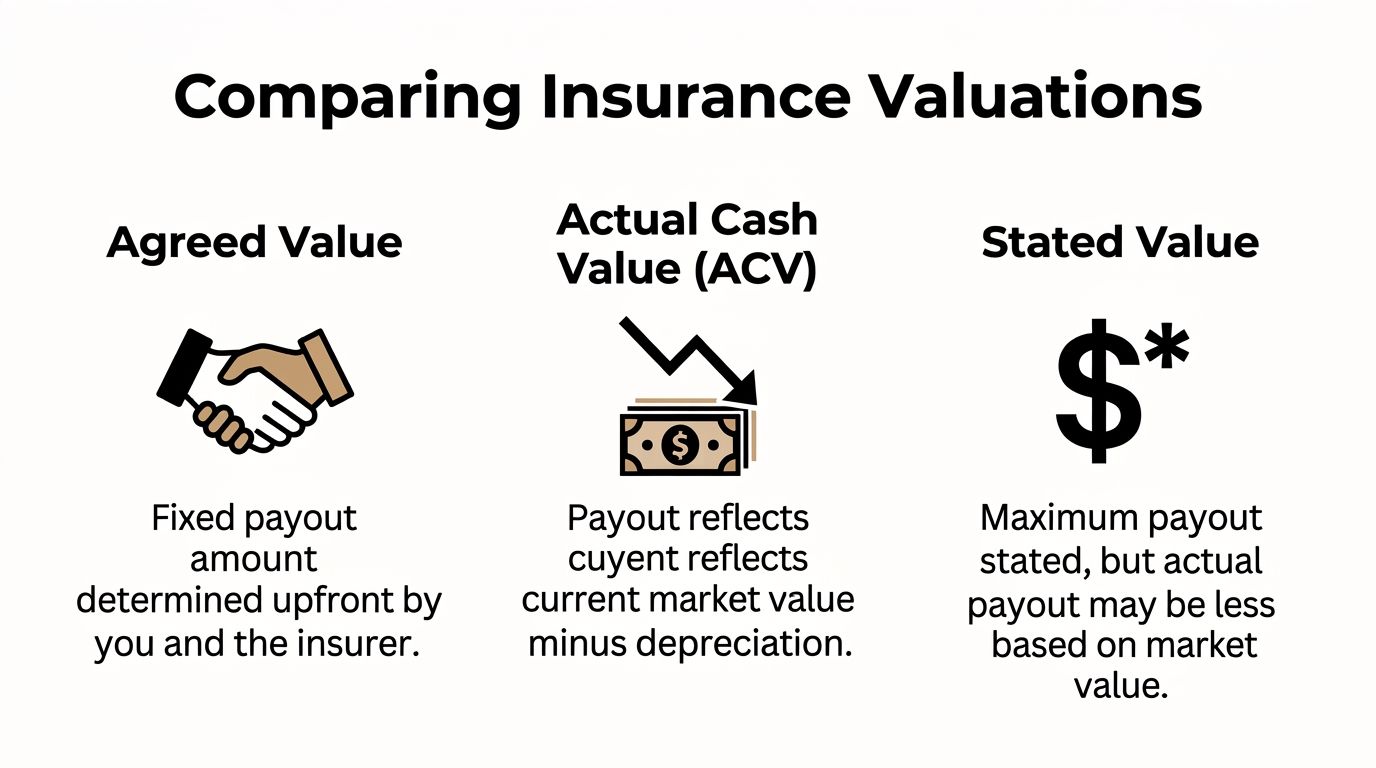
Three terms sound similar but mean different things: agreed value, actual cash value, and stated value. The wording seems technical, but the practical question is simple. Do you know your claim payment method before the loss, or are you leaving room for a lower payout later?
If policy language makes your eyes glaze over, a plain-English glossary helps. This insurance glossary for California consumers is useful for translating policy terms into everyday language.
Agreed Value vs Other Insurance Valuations
The biggest mistake I see is assuming all “value-based” coverage means the same thing. It doesn't. Two policies can list a high number on the declarations page and still produce very different claim payments.
Side by side comparison
| Valuation type | How payout is determined | Depreciation | Best fit |
|---|---|---|---|
| Agreed Value | Value is set upfront by you and the insurer | Not used to reduce a covered total loss payout in the same way as ACV | Classic cars, collectibles, specialty assets |
| Actual Cash Value | Claim is based on value at time of loss | Yes | Standard vehicles and ordinary property |
| Stated Value | Often pays the stated amount or ACV, whichever is less | Can still affect payout | Some specialty situations, but easy to misunderstand |
ACV is common because it's simple
Actual Cash Value, or ACV, is common in standard auto insurance and other property coverage. It's the easiest model for mainstream underwriting because insurers can point to age, condition, and market comparisons.
For a daily driver, that can be fine. For a collectible Porsche, heavily restored Bronco, or a one-of-a-kind item, ACV can feel like asking a pawn shop to value a family heirloom.
If you want a broader consumer-friendly explainer on how valuation methods affect settlements, NW Claims Management has a helpful guide for insurance claim payouts.
Stated value is where people get burned
This is the trap. “Stated value” sounds like a promise. In many cases, it isn't.
A stated value policy commonly sets a ceiling, not a guaranteed payout. That means the number you stated may be the most the insurer will pay, while the actual settlement can still come in lower if the policy applies a lesser-of calculation. If you bought the policy believing the stated amount was locked in, you may only discover the difference during a stressful claim.
Many policyholders don't have a coverage problem. They have a vocabulary problem. One misunderstood term can change a total loss settlement.
A quick decision test
Use this checklist if you're reviewing your policy:
- If the asset is ordinary: ACV may be enough.
- If the asset is collectible or difficult to price: Agreed value deserves a serious look.
- If the policy says stated value: Read the loss settlement language carefully, not just the declarations page.
- If you're unsure how your California car insurance handles valuation: Review options for California auto insurance with attention to claim wording, not just premium.
The point isn't that one method is always best. The point is that you should know which method you bought.
Who Needs Agreed Value Coverage in California
California has more than one kind of insurance customer. The right policy for a commuter in Sacramento isn't automatically the right one for a collector in Orange County or a renter in San Francisco with a serious art collection.
The classic car owner
A Los Angeles driver with a garage-kept classic usually learns fast that standard car insurance treats an older vehicle very differently than an enthusiast would. That's why agreed value coverage comes up so often in the collector market.
According to Policygenius on agreed value car insurance, agreed value car insurance guarantees that the insured receives 100% of the pre-agreed amount in the event of a total loss, unlike standard policies that pay actual cash value, which depreciates as the vehicle ages. The same source notes that this coverage is particularly valuable for classic, collector, or antique vehicles, and that insurers such as GEICO, State Farm, and Progressive via Hagerty offer agreed value policies, along with specialty companies.
That setup fits the California owner who drives the car occasionally, stores it carefully, and wants the policy to reflect the car's real collectible status rather than just its age.
The homeowner with a unique property
Now think about a hillside home with custom finishes, nonstandard materials, or a location exposed to wildfire concerns. Standard home insurance may do a decent job for ordinary replacement assumptions, but unique homes can raise valuation questions quickly.
The same is true for homes where rebuilding isn't straightforward. Access challenges, specialty design, or a property that doesn't resemble nearby homes can make “market value” or generic replacement assumptions feel incomplete. Agreed value concepts become more attractive when the owner wants more certainty around what the policy is protecting.
The renter with special belongings
A renter can need this too, especially when the apartment itself is ordinary but the contents aren't. Think framed artwork, collectibles, rare instruments, or inherited pieces that can't be valued by guessing after smoke or water damage.
If you rent and own items that would be difficult to price under a basic policy, it's worth reviewing your broader California renters insurance options and asking whether scheduled or specially valued coverage makes more sense than relying on standard contents treatment.
Other California profiles
Agreed value ideas also make sense for:
- Collectors with mixed assets: Cars, memorabilia, and specialty contents often need coordinated documentation.
- Owners of heavily customized vehicles: Modifications can be expensive and easy for generic valuation systems to miss.
- Small business owners with unusual property: Specialty equipment or distinctive contents may not fit a standard assumption.
Not everyone needs agreed value insurance. People with ordinary daily-use property often don't. But Californians with assets that are scarce, custom, collectible, or hard to replace should at least ask the question.
Pros Cons and Cost of Agreed Value Policies
Agreed value coverage solves a specific problem. It gives you more certainty about what happens after a covered total loss. That strength comes with tradeoffs.
The upside
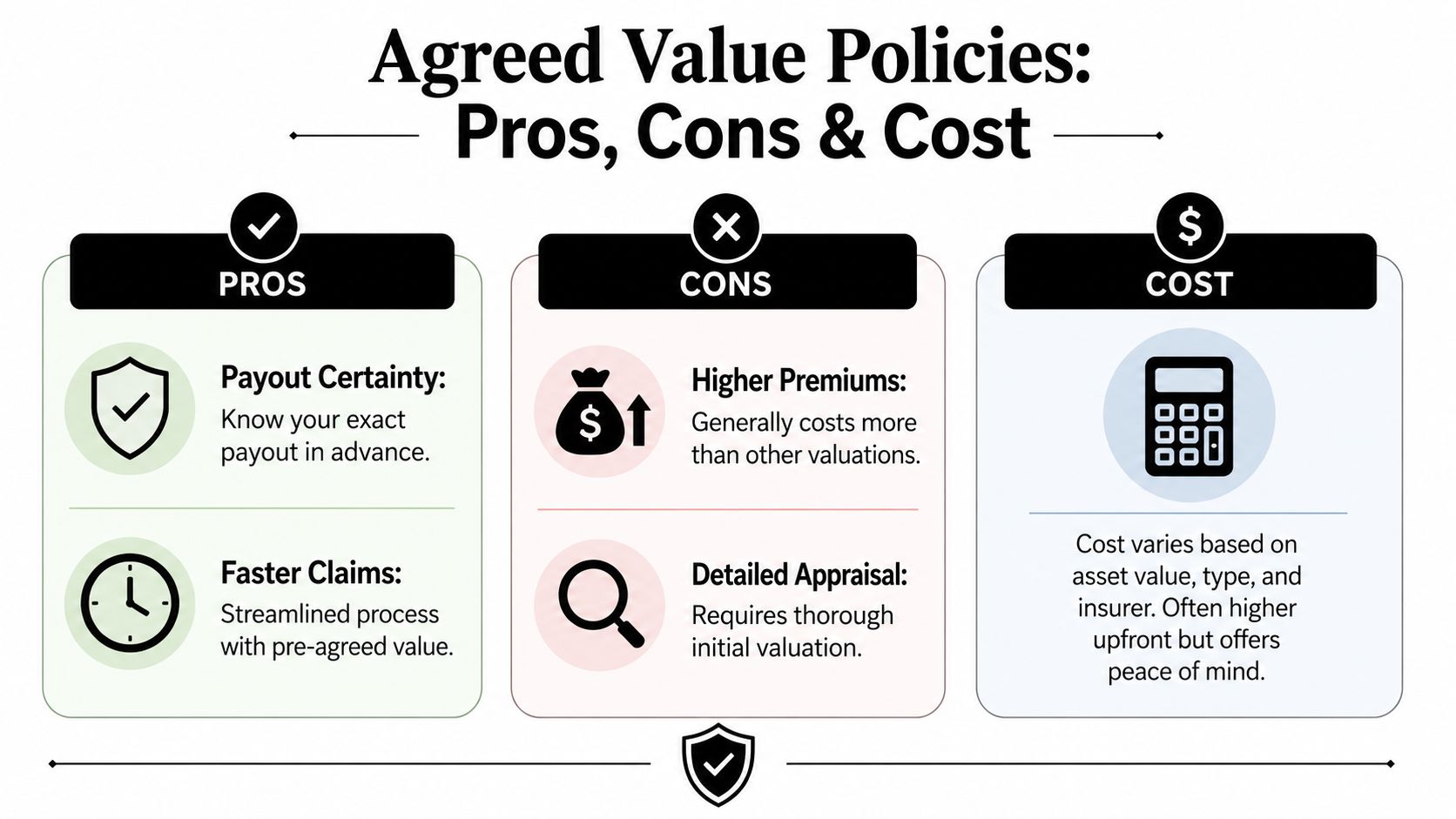
The biggest benefit is predictability. You don't buy this type of policy because it sounds impressive. You buy it because you don't want a fight over depreciation after a serious loss.
Other advantages often include:
- Payout clarity: You know the value basis ahead of time.
- Better fit for special assets: Useful when ordinary market valuation doesn't capture the property's real worth.
- Cleaner expectations: The policyholder and insurer start from the same valuation framework.
The downside
The main drawback is cost, plus the work required upfront.
For commercial property, agreed value insurance typically increases premiums by 5 to 15 percent compared to Actual Cash Value coverage, while also eliminating the coinsurance provision and helping avoid significant underinsurance penalties, according to this explanation of agreed value in commercial property insurance. That commercial property data shouldn't be copied directly onto every personal policy, but it gives you a realistic sense of the tradeoff. More certainty usually costs more.
You may also need:
- Documentation: Appraisals, receipts, and photos
- Periodic review: Values can change, especially for collectibles
- A narrower fit: Not every insurer offers this structure for every asset
Paying more for the right valuation isn't overinsuring. Paying less for the wrong valuation can be underinsuring.
When the extra premium makes sense
This isn't just a math issue. It's a mismatch issue.
If the property is ordinary, standard valuation may be perfectly fine. If the property is rare or hard to price, a lower premium can become expensive in the wrong moment. That's why owners of collector cars, custom assets, and unusual property often accept the higher cost. They're paying for fewer surprises, not just a different line item on the declarations page.
How to Get a Policy in California with Mai & Associates
Getting an agreed value policy usually goes more smoothly when you prepare before you start requesting quotes. California insurance already has enough moving parts with carrier rules, underwriting questions, wildfire concerns, and specialty eligibility. Bringing organized documentation to the process saves time.
Start with your proof of value
For most agreed value situations, you'll want to gather the records that support the number you want insured.
That often includes:
- Photos of the asset from multiple angles
- Receipts and invoices for purchase, restoration, upgrades, or custom work
- Appraisals if the item is collectible or difficult to price
- Storage or condition details when they matter to underwriting
If it's a vehicle, include maintenance records and restoration paperwork when available. If it's high-value home-related property, keep records that show material quality, customization, or specialty features.
Expect questions specific to California
Insurers writing in California may ask about risks that go beyond the asset itself. A home can trigger questions about brush exposure, prior claims, or whether other coverage layers are in place. A specialty vehicle can trigger questions about use, garaging, and how often it's driven.
That's one reason people appreciate a local agency that already works within the California market. Mai & Associates serves clients across the state and helps compare options from multiple carriers for auto insurance, car insurance, home insurance, renters insurance, and life insurance. The agency also helps clients think through related issues such as Fair Plan reviews, earthquake options, and wildfire protection concerns.
Use an agent who can compare, not just quote
With a specialized policy, the cheapest quote isn't always the best one. The details matter. You want someone to review how the value is established, what documentation is required, how renewals are handled, and whether the policy language lines up with your expectations.
A practical approach looks like this:
- Ask how the value is set
- Ask what happens at renewal
- Ask whether the asset's use affects eligibility
- Ask how the policy handles total loss versus repairs
- Ask about related coverage gaps on your other California policies
That consultative review is where a specialist can be useful. A strong agency doesn't just place the policy. It helps you avoid buying the wrong version of the policy.
Frequently Asked Questions About Agreed Value
Can I get agreed value coverage on my daily driver
Usually, this coverage is most associated with classic, collector, antique, or otherwise special-use vehicles. Standard daily-use cars more often stay on regular valuation methods. Eligibility depends on the insurer and the type of vehicle.
Do I need an appraisal every year
Not always, but insurers often want updated documentation when values change or at renewal for specialty property. If you've restored a car further, added expensive modifications, or your collectible has materially changed in value, an update is wise even if the insurer doesn't require a full new appraisal every year.
Does agreed value apply to partial losses too
The headline benefit is clearest in a total loss. Partial losses and repairs are usually handled under the policy's repair and claims terms, not directly by handing over the full agreed amount. That's why you should read the loss settlement language, not just the valuation label.
Is agreed value the same as replacement cost
No. Replacement cost focuses on what it costs to replace damaged property with like kind and quality, depending on the policy. Agreed value is based on a number set in advance between you and the insurer.
Can renters use this idea for valuables
Yes, in the sense that valuable personal property may need scheduled or specially documented coverage rather than broad default contents treatment. The exact format depends on the insurer and the item.
Should I review other policies too
Yes. People protecting valuable property should also review liability limits and the rest of their insurance package. A smart coverage review often includes car insurance, home insurance, renters insurance, and life insurance because gaps tend to show up across policies, not just in one.
If you want help reviewing agreed value options or comparing your current California coverage, Mai & Associates offers no-obligation guidance for auto insurance, home insurance, renters insurance, car insurance, and life insurance. Their team understands California-specific issues like wildfire exposure, earthquake options, Fair Plan questions, and specialty asset protection, so you can get clear answers before you commit to a policy.