Finding Affordable Home Insurance in California

Finding affordable home insurance in California feels less like shopping and more like navigating a minefield these days. If you’ve been hit with a shocking premium increase or a non-renewal notice, you’re not alone. The market is in a tough spot, squeezed by skyrocketing wildfire risks, ballooning construction costs, and a web of state regulations. The same pressures are affecting other types of California insurance, from auto insurance to renters insurance.
To find the best possible coverage without breaking the bank, it helps to first understand why things have gotten so difficult.
Why Finding Affordable California Home Insurance Is So Hard Now
If you've shopped for a policy lately, you’ve felt the sticker shock. What used to be a predictable expense has become a real source of anxiety for countless California homeowners. Trust me, it’s not just you—the entire insurance market is under immense pressure.
A perfect storm of factors has made it incredibly challenging for insurers to operate profitably, which in turn means fewer and more expensive options for you, whether you need home insurance, car insurance, or life insurance. Let’s break down the real issues driving up your costs.
The New Reality of Wildfire Risk
The biggest force reshaping the insurance landscape is the catastrophic wildfire risk we now face. The sheer scale and frequency of these disasters have completely changed how insurers calculate risk in California.
Just look at the numbers. Between 2017 and 2018, wildfires caused over $30 billion in insured losses. That kind of financial hit forces a company to rethink everything. As a result, since 2022, seven of the state's top 12 insurance providers have either stopped writing new policies entirely or dramatically scaled back their coverage areas.
There's a massive financial hole. California is facing a coverage shortfall somewhere between $1.35 trillion and $2.00 trillion. That’s the gap between the state's total wildfire risk and the money available to cover it. Closing that gap would require an extra $8 billion to $10 billion in premiums every single year.
This staggering imbalance shows a system that’s struggling to adapt to our new climate reality.
Regulatory Roadblocks and Rate Problems
California’s insurance market operates under a unique law called Proposition 103, passed way back in 1988. It mandates that insurers get state approval for any rate increase and, crucially, bases those rates on historical loss data, not future risk projections.
For decades, this law helped keep California home insurance rates among the lowest in the country. But today, it’s a major part of the problem. Insurers argue they’re not allowed to charge rates that accurately reflect the very real, very high risk of future wildfires.
This has led to a situation experts call "rate suppression." For the period between 2017 and 2022, California had the largest gap in the U.S. between the rates insurers were charging and the rates they actually needed to stay solvent.
When carriers can't charge enough to cover their potential losses, they have two options: absorb massive financial hits or stop offering coverage. Many have chosen to pull back, which is why your options are shrinking.
The Double Whammy: Construction and Reinsurance Costs
On top of all that, two other powerful forces are driving your premiums higher.
First, the cost to rebuild a home in California has exploded. Lumber, materials, and labor prices are through the roof. This means your policy's dwelling coverage—the part that pays to rebuild your house—has to be much higher, and that directly increases your premium.
Second is the cost of reinsurance. Think of it as insurance for insurance companies. It protects them from devastatingly large claims. As reinsurers face more climate-related disasters globally, their prices go up. They pass those costs down to the companies that sell you your home and auto policies.
It’s a lot to take in, but understanding these pressures is the first step toward finding a solution. We break down the whole process in our comprehensive guide on California home insurance.
The table below summarizes the key factors we see impacting homeowners' premiums every day.
Key Factors Driving Your Home Insurance Costs
This table breaks down the primary pressures affecting your home insurance premiums today, from market-wide issues to property-specific risks.
| Factor | Impact on Your Premiums | What You Can Do About It |
|---|---|---|
| Increased Wildfire Risk | This is the #1 driver of higher rates and non-renewals, especially in high-risk zones. Carriers are limiting their exposure. | Harden your home against fire (e.g., clear brush, install fire-resistant roofing) to improve your risk profile. |
| Prop 103 Regulations | Prevents insurers from using forward-looking risk models, causing many to pull back from the market and reducing competition. | While you can't change the law, working with an independent agent gives you access to more carriers, including those still writing policies. |
| Soaring Rebuild Costs | Higher construction and labor costs mean you need more Dwelling Coverage (Coverage A), which directly increases your premium. | Review your dwelling coverage annually to ensure it’s accurate—not too high or too low. Over-insuring costs you money. |
| Expensive Reinsurance | The "insurance for insurers" is more expensive globally, and carriers pass this cost down to you in the form of higher base rates. | Focus on maximizing discounts. Bundling home and auto insurance, installing security systems, and maintaining good credit can help offset these costs. |
Navigating this complex environment is tough, but it's not impossible. By understanding what's driving the costs, you can take strategic steps to find the best possible coverage for your home.
Getting Real About Your Home's Risks and Coverage Needs

Before diving into quotes for affordable home insurance in California, we need to take a step back. It’s tempting to just shop for the lowest price, but a cheap policy is worthless if it leaves you exposed after a fire, theft, or other disaster. The real secret to finding great, affordable coverage is to first understand exactly what you need to protect.
Think of it like a California insurance underwriter would. You have to look at your home with a critical eye to spot its vulnerabilities. This isn't just about the building itself, but also its location and everything you own inside. Once you have this clear picture, you can find a policy that fits your budget and gives you peace of mind.
Calculating Your Home's True Replacement Cost
The single most important number on your policy is your dwelling coverage (often called Coverage A). This isn't your home's Zillow estimate; it's the cold, hard cash it would take to rebuild your home from scratch after a total loss.
Getting this figure right is non-negotiable. If you insure for too little, you could be left with a massive, unpayable bill to rebuild. On the flip side, over-insuring means you're throwing money away on your premium every month. Remember, market value includes land, which doesn't burn down. Replacement cost is all about materials and labor—both of which have seen staggering price increases in California recently.
To nail down an accurate number, you (or your agent) need to look at:
- Total Square Footage: This is the baseline for any construction estimate.
- Building Materials: Is your home a standard wood-frame build, or does it have more expensive brick or stone?
- Age and Style: An older Victorian or a mid-century modern with unique features will cost far more to replicate than a standard tract home.
- Custom Features: Think about your high-end kitchen appliances, custom-built cabinetry, or that beautiful tile roof. These all drive up the cost.
We see it all the time: homeowners who are dangerously underinsured because they confused their home's market value with its replacement cost. An independent agent can run a professional replacement cost estimate for you. It’s far more reliable than a simple online calculator and is the best way to ensure you're not caught with a huge coverage gap.
Pinpointing Your California-Specific Risks
Here in California, where you live can matter even more than what you live in. Your home’s exact address determines its exposure to the state's biggest threats, which are the primary drivers of insurance availability and cost.
Wildfire Risk: Carriers use incredibly detailed maps to score your property’s fire risk. They analyze everything from your proximity to wildlands and the type of surrounding vegetation to the steepness of your lot. Even if you're not in a "high-risk" zone, your rates can be impacted. For instance, the insurance burden in far northern California has jumped by 2.2 percentage points since 2012, a much steeper rise than in other parts of the state.
Earthquake & Flood Zones: It’s a hard truth many homeowners learn too late: your standard policy covers fire and theft, but not earthquakes or floods. Those require separate, specialized policies. You need to check the official FEMA flood maps and California earthquake fault zone maps to see where you stand. Living near an active fault line changes your risk profile completely.
And don't forget the more common perils. It's wise to have some familiarity with understanding the financial implications and insurance aspects of roof hail damage repair before you ever need it. For a closer look at these topics, feel free to browse our other insurance resources and guides for California residents.
Taking a Full Inventory of Your Belongings
Now for what's inside your home. Your personal property coverage (Coverage C) is designed to replace your furniture, clothes, electronics, and everything else. Most policies automatically set this coverage between 50% and 70% of your dwelling coverage. For many people, that's simply not enough.
The only way to know for sure is to create a home inventory. This might sound tedious, but it will be your most valuable tool if you ever have to file a major claim.
- Walk and Record: The easiest way is to just walk through every room, opening closets and drawers, while recording a video on your phone. Narrate what you're seeing.
- Flag the Valuables: Do you have jewelry, art, firearms, or other collectibles? Get them appraised. Most policies have frustratingly low limits—like $1,500 for all your jewelry—unless you specifically add extra coverage (called a "floater" or "rider").
- Store It in the Cloud: Save your inventory video, photos, and any digital receipts to a service like Google Drive or Dropbox. You'll need access to it even if your computer is destroyed.
With this complete picture of your home, your belongings, and your risks, you're no longer just a passive shopper. You're an informed buyer, ready to compare policies and find the right protection at the best possible price.
Proven Strategies to Lower Your Insurance Premiums
When I talk to California homeowners, the first question is always about the sticker shock from their latest insurance renewal. It can feel like you’re powerless against rising rates, but that’s not the whole story. You can absolutely take control and make your home a more attractive, less risky property in the eyes of an insurer.
This isn't just about tweaking your deductible. It's about taking real-world, practical actions that prove you're a responsible homeowner. Let’s walk through the exact steps you can take to earn yourself a lower premium, year after year.
Fortify Your Home Against California’s Biggest Threats
The most direct way to get an insurer’s attention is to make your home a less risky bet. In California, that boils down to two things: fire and earthquakes. Proactively "hardening" your home against these specific dangers is hands-down one of the most effective strategies for lowering your costs.
For wildfire risk, it all starts with defensible space. This is a non-negotiable for insurance carriers. You need a clean, 100-foot perimeter around your home, clear of dead brush, overgrown plants, and any other flammable junk. Other upgrades that underwriters love to see include:
- A Class A fire-rated roof (think asphalt shingles or metal).
- Fine metal mesh (1/8-inch) covering attic and crawl space vents to block embers.
- Dual-pane windows, which are far more resistant to heat than older single-pane glass.
Taking these steps systematically shows you're serious. If you need guidance, professional fire mitigation services can help you create a comprehensive plan to improve your property's resilience.
On the earthquake front, seismic retrofitting can unlock significant discounts, particularly if you have a separate earthquake policy. This usually involves bolting your house to its foundation and bracing the cripple walls—the short walls between the foundation and the first floor. It’s a major upgrade, but it directly addresses an insurer's biggest fear in a quake: the home sliding off its foundation.
Put Smart Tech and Security to Work for You
Beyond physical upgrades, you can also use technology to prove your home is well-protected. Insurance companies are all about data, and smart home devices give them the data they need to justify a discount.
A professionally monitored security system that covers both fire and burglary is an easy win. But you can go further. Smart water leak detectors and automatic water shut-off valves are fantastic because they help prevent water damage—one of the most frequent and expensive types of claims.
A lot of people think they need to spend a fortune on a fully automated smart home. The truth is, a few key devices can make a real impact. If you're starting out, a monitored alarm and smart smoke detectors often give you the best bang for your buck on insurance discounts.
Here's a quick look at some of the most effective ways you can lower your home insurance costs.
Top Ways to Reduce Your California Home Insurance Premiums
| Strategy | Potential Premium Reduction | Upfront Cost and Effort |
|---|---|---|
| Increase Your Deductible | 5% - 25% | Low. No cost, but you pay more out-of-pocket for a claim. |
| Bundle Home & Auto Policies | 10% - 25% | Low. Simple administrative change. |
| Install a Monitored Security System | 5% - 20% | Medium. Involves installation and a monthly monitoring fee. |
| Home Hardening (Fire) | 5% - 15% | High. Can involve significant costs for roofing or landscaping. |
| Seismic Retrofitting | 5% - 25% (on EQ policy) | High. A major construction project with substantial costs. |
| Improve Your Credit Score | Varies Significantly | Medium. A long-term effort with no direct cost. |
| Annual Policy Review | Varies | Low. Requires an hour or two of your time each year. |
As you can see, bundling policies is often the simplest and most effective starting point for immediate savings.
The Underrated Power of Bundling
One of the easiest wins for finding affordable home insurance in California is bundling your policies. This just means you're buying your home, auto insurance, and maybe an umbrella or life insurance policy from the same company.
Carriers love this. It’s more efficient for them and creates a stickier customer relationship, so they reward you for it. For homeowners, the savings are often significant, typically ranging from 10% to 25% off each policy. It really adds up.
This is where working with an independent agency like Mai & Associates gives you a serious leg up. We can run the numbers across dozens of carriers to see who offers the best overall package. Sometimes one company has a cheap home policy but a pricey auto rate. Another might have a killer bundle discount that makes their combined price the clear winner. We do that homework for you.
Surprisingly, California has historically had some of the most affordable home insurance in the country. A 2023 analysis showed the average homeowner here paid about $1,200 a year. Even with recent hikes pushing the estimated average toward $1,700, we're still below the national average of $1,800 and worlds away from Florida’s staggering $3,600 average. This is largely thanks to Proposition 103, a 1988 law that forces insurers to set rates based on past data, not future predictions. The Terner Center at UC Berkeley offers some great research on these long-term trends.
Make an Annual Policy Review Your New Habit
Your insurance needs are not set in stone; they change as your life does. Letting your policy auto-renew without a second thought is a surefire way to overpay.
Get in the habit of scheduling an annual review with your agent. It’s the perfect time to:
- Update Your Coverage: Did you finish a big renovation or sell a valuable piece of art? Make sure your coverage limits still make sense. You don’t want to be over-insured or under-insured.
- Hunt for New Discounts: Insurers are always adding new discounts. You might now qualify for a loyalty discount, a claim-free discount, or one based on your profession.
- Re-evaluate Your Deductible: If you’ve built up your emergency fund, you might be comfortable with a higher deductible now, which provides an immediate premium reduction.
By actively managing your risk profile and staying on top of your policy details, you can push back against rising rates. These strategies—from home upgrades to smart policy management—are your best defense.
Navigating High-Risk Areas With the FAIR Plan and Earthquake Options
For a growing number of California homeowners, especially if you live in an area flagged for high wildfire risk, finding insurance on the standard market has become nearly impossible. If you’ve received a non-renewal notice or been flat-out denied coverage, it’s easy to feel stranded.
This is where the California FAIR Plan and other specialized policies come into play. Let's be clear: these aren't perfect solutions. Think of them as essential tools to piece together the protection you need when traditional carriers have pulled back. It’s a completely different way to approach home insurance, but it’s the new reality for many of us in the state.
Understanding the California FAIR Plan
The California Fair Access to Insurance Requirements (FAIR) Plan is our state's "insurer of last resort." It’s a state-mandated association of all licensed property insurers, created to offer basic fire insurance to property owners who can't get it anywhere else.
To get on the FAIR Plan, you typically have to show proof that you’ve been turned down by a few standard insurance companies. What was once a niche option has now become a reluctant necessity for thousands.
The numbers are staggering. Between September 2020 and September 2024, the number of FAIR Plan dwelling policies skyrocketed by 123%, jumping from 202,897 to 451,799. In that same period, its written premium exploded by 199% to $1.267 billion, making it the third-largest insurer in California. This is a direct result of the wider crisis, with major carriers dropping coverage for over 100,000 homeowners.
This chart gives you a sense of the proactive steps you can take to make your property more attractive to insurers and potentially lower costs—which is even more vital when dealing with these specialized policies.
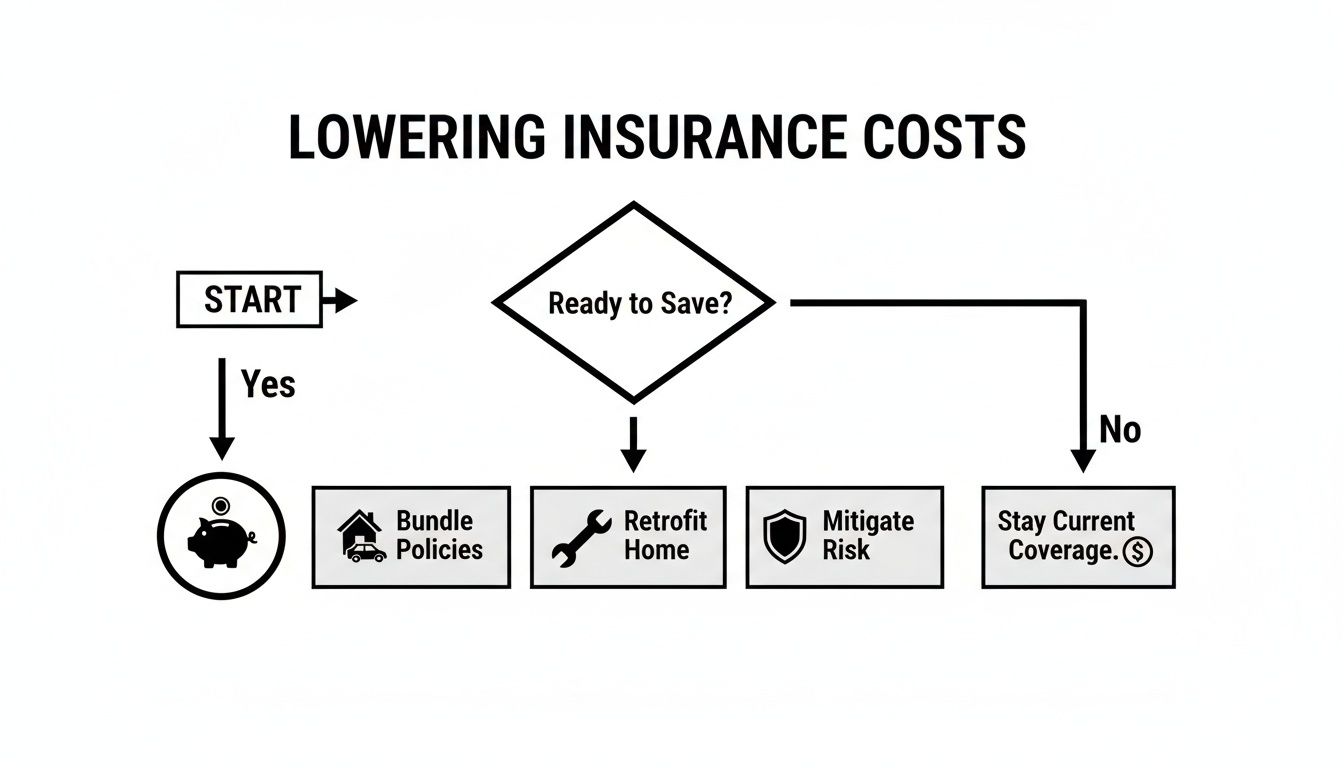
As you can see, things like retrofitting your home and actively mitigating risks aren't just good ideas; they're key strategies for managing your insurance situation in this tough market.
What the FAIR Plan Does and Doesn't Cover
This is the most critical part to understand: a FAIR Plan policy is not a standard homeowner's policy. It’s an incredibly basic, "named-peril" policy that only covers losses from a few specific events:
- Fire and lightning
- Internal explosion
- Smoke
That’s it. You'll notice some huge things missing. It does not cover theft, personal liability if someone gets hurt on your property, or water damage from a burst pipe. Relying only on a FAIR Plan policy leaves massive, dangerous gaps in your coverage.
A FAIR Plan policy alone is dangerously incomplete. It’s only one piece of the puzzle. To get comprehensive protection, you must pair it with a second policy called a Difference in Conditions (DIC) policy.
A DIC policy is designed to "wrap around" the basic FAIR Plan fire policy. It fills in those crucial gaps by adding back coverage for things like liability, theft, and certain types of water damage. For many homeowners in high-risk areas, this two-policy approach is the only way to build a complete safety net. Even in dense urban areas, unique risks can require layered coverage, a topic we touch on in our guide to home insurance in San Francisco.
Decoding Earthquake Insurance
Just as the FAIR Plan was created to address fire risk, earthquake insurance is another essential piece of the puzzle for Californians. Your standard home policy, and even the FAIR Plan, explicitly excludes damage from earthquakes. If you want this protection—and you probably should—you have to buy it as a separate policy.
Earthquake insurance also works very differently, particularly with the deductible. Instead of a fixed dollar amount, the deductible is a percentage of your home's insured value, usually between 5% and 25%.
Let’s look at a real-world example. Imagine your home is insured for $700,000 and you choose an earthquake policy with a 15% deductible. Your out-of-pocket cost would be a shocking $105,000 ($700,000 x 0.15) before your insurance pays a single dollar.
Because the deductibles are so high, this insurance isn't meant to fix a few cracks after a minor tremor. It's catastrophe coverage. It's there to save you from financial ruin if a major quake levels your home. In a state with over 15,000 known faults, going without it is a significant gamble. An independent agent can help you weigh the cost against your personal risk tolerance and find a balance that makes sense for you.
How to Compare Quotes and Choose the Right Carrier
You’ve done the legwork and now you have a few insurance quotes sitting in front of you. It's so tempting to just look at the premium, pick the lowest number, and call it a day. I’ve seen it a thousand times, and it's one of the biggest mistakes a homeowner can make.
That cheap policy is almost always cheap for a reason. You don’t want to find out why when your roof is leaking and you’re trying to file a claim. Finding truly affordable home insurance in California isn't about the lowest price—it's about finding the best value. To do that, you have to compare apples to apples, and that means digging into the details.
Your Quote Comparison Checklist
To make sense of it all, I always tell my clients to line up the quotes side-by-side. A simple spreadsheet works great, but even a sheet of paper with columns for each carrier will do the trick. It forces you to look at the same critical details for every single option.
Make sure these items are on your checklist. They’re non-negotiable.
- Dwelling Coverage (Coverage A): Is this number the same on every quote? If one carrier comes in with a suspiciously low replacement cost estimate, that's a huge red flag.
- Personal Property (Coverage C): Look at how this is calculated. Is it a percentage of your dwelling coverage or a set dollar amount? Make sure it’s actually enough to replace your belongings.
- Liability Coverage: Whatever you do, don't skimp here. I consider $300,000 the absolute bare minimum, but $500,000 is a much safer bet. Carriers often drop this limit to make a quote look artificially cheap.
- Deductibles: This is a big one. Note the deductible for a standard claim, but also look for separate, often higher, deductibles for things like wind, hail, or wildfires. A low premium can easily hide a painfully high deductible you can't afford to pay out-of-pocket.
- Key Exclusions: Read the fine print. What isn't covered? Pay close attention to exclusions for things like certain types of water damage, cosmetic roof damage, or mold. This is where you find the policy's weak spots.
When you standardize your comparison like this, you’ll quickly see where one policy offers real protection and another is just a piece of paper. The focus shifts from price to true value.
Look Past the Premium and Vet the Carrier
A fantastic quote from a shaky company isn't worth much. Your insurance premium is you buying a promise that the company will be there when disaster strikes. You need to be confident they'll keep that promise, whether it's for your home insurance or your car insurance.
Before you sign anything, take a few minutes to do some quick research on the insurance carrier itself.
- Financial Strength: Look up the carrier’s A.M. Best rating. Think of it as a credit score for insurance companies. You really want to see an "A" rating, which signals they have an excellent ability to pay out claims.
- Customer Service Reputation: The California Department of Insurance website has a complaint ratio tool—use it. Beyond that, a quick search for online reviews can tell you a lot about what real customers think of the claims process.
- Claims Handling: Do they have a 24/7 claims hotline? Are their adjusters local? A clunky and difficult claims process can turn a stressful situation into an absolute nightmare.
An independent agent is your best asset here. We work with these carriers every day and have firsthand knowledge of which companies are easy to work with and which ones create headaches for their clients during the claims process. That insider perspective is invaluable.
How an Independent Agent Makes This Easy
Honestly, trying to gather and compare all these quotes yourself is a frustrating, time-sucking process. You spend hours punching the same information into different websites, only to get back quotes with wildly different coverage levels that are almost impossible to compare fairly. It’s a common headache for anyone shopping for home insurance, auto insurance, or even renters insurance.
This is where working with an independent agency like Mai & Associates really makes a difference.
We do all that heavy lifting for you. Instead of you shopping around, we shop the entire market on your behalf, getting rates from dozens of top-rated carriers at once. You get a complete, organized view of your options in one place, saving you a ton of time. More importantly, we can look at the whole picture—bundling your home, auto, and life insurance—to unlock discounts and find the most competitive package available.
Ready to see what your options really look like? You can get a clear, straightforward comparison by requesting a same-day, no-obligation insurance quote from our team. Our goal isn’t just to find you a cheap rate, but to make sure you have the right protection for your family’s future.
Common Questions We Hear from California Homeowners
The California insurance market is a tough nut to crack right now, and we get it. Homeowners are calling us with more questions than ever. Here are straight answers to some of the most common ones we're tackling every day.
"Why Did My Insurance Company Drop Me?"
Getting a non-renewal notice in the mail is jarring, but it's happening all over the state. The short answer is wildfire risk. Insurers are frantically trying to reduce their financial exposure in areas they now consider too risky.
It’s not personal. You could be a perfect customer who’s never filed a claim, but if an algorithm puts your neighborhood on a new high-risk map, that might be all it takes. Other triggers can be an older roof, deferred maintenance, or even a couple of small claims over the last few years.
If a non-renewal letter shows up, your first call should be to an independent agent. Don't wait. We can immediately start searching for a new policy and get you set up with the FAIR Plan if needed. The goal is to make sure you have zero gaps in your coverage.
"Can I Still Find Affordable Insurance in a High-Risk Wildfire Area?"
"Affordable" has definitely taken on a new meaning lately, but yes, you can still get insured. For many homeowners, the starting point is the California FAIR Plan, which covers the basic threat of fire damage. As we mentioned earlier, you'll need to pair this with a separate Difference in Conditions (DIC) policy to get the liability, theft, and water damage coverage you’d find in a standard plan.
This two-policy approach is almost always more expensive, there's no sugarcoating it. But you're not powerless. Taking proactive steps to "harden" your home with fire-resistant siding or creating a robust defensible space can sometimes open up more options or at least keep your premiums from skyrocketing. This is where an independent agent is indispensable—we know how to package these policies correctly to get you the best possible outcome.
"How Much Liability Coverage Is Enough?"
This is a big one. Most off-the-shelf policies default to $100,000 in liability protection, which is simply not enough for a California homeowner. We tell our clients to start at a bare minimum of $300,000, but frankly, $500,000 is a much safer number.
Think about what could happen. A guest slips and falls, a tree in your yard falls on a neighbor's car, or your dog bites someone at the park. The resulting medical bills and legal fees can blow past $100,000 in a heartbeat. If your coverage runs out, your personal assets—your savings, your investments, even your home itself—are on the line. Increasing your liability limit is usually inexpensive and is one of the smartest things you can do to protect your financial future.
This is also a great time to look at bundling your home insurance with your auto insurance. As independent agents, we can review all your policies, from car insurance and renters insurance to life insurance, to make sure everything works together without any dangerous gaps.
At Mai & Associates, our licensed agents live and breathe California insurance. We know this challenging market inside and out. Let us do the shopping for you to find a policy that secures your home and fits your budget. Protect what matters most by visiting us at https://cahomeauto.com to get your no-obligation quote today.