Adjustable Life Policy: Ultimate Guide to Flexible Coverage
A lot of Californians are trying to protect a life that doesn’t stay still.
One month, your freelance income is strong. The next, a client pauses work. You buy a home in a hillside neighborhood and suddenly your budget includes a mortgage, home insurance, and a real conversation about wildfire risk. Or maybe you’re renting now, carrying auto insurance and renters insurance, and planning for a family in a year or two. Life changes quickly in California. Your insurance often doesn’t.
That’s where an adjustable life policy gets interesting. It’s a form of permanent life insurance built for change. Instead of locking you into one rigid setup and hoping your life cooperates, it gives you room to adjust key parts of the policy as your needs evolve. For the right person, it can feel less like a fixed contract and more like a long-term tool you can re-tune.
This matters more in California than in many places. People here often juggle several kinds of protection at once. Car insurance for the daily commute. Home insurance or renters insurance for the place you live. Life insurance for the people who depend on you. If your income or risk profile shifts often, flexibility can be more than a convenience. It can be the difference between keeping coverage workable and dropping it at the worst time.
Your Life Changes Shouldn't Outgrow Your Life Insurance
A couple in Escondido buys their first home. They’re excited, but the math has changed. The down payment drained savings. The mortgage is new. They’re reviewing home insurance because wildfire exposure is part of the conversation. They still need life insurance, but they don’t want a policy that assumes their budget and family needs will look exactly the same in ten or twenty years.
At the same time, a driver in Glendale is thinking about protection from another angle. She already compares auto insurance carefully because she knows one wrong fit can leave painful gaps. She rents now, but plans to buy later. Her work is steady overall, yet income moves up and down. A fixed financial commitment can feel easy in a good month and awkward in a slow one.
Traditional insurance products can be a lot like fixed furniture. They do their job, but they don’t adapt well when you move the room around. An adjustable life policy was built for people whose financial life isn’t a straight line.
A good life insurance policy shouldn’t force you to choose between long-term protection and real-world flexibility.
That doesn’t mean flexible is always better. Flexibility comes with moving parts, and moving parts require attention. But for California households managing housing costs, wildfire concerns, self-employment, or shifting family obligations, flexibility can solve a problem that rigid coverage doesn’t.
Think about how you already insure the rest of your life. You might update car insurance when you change vehicles. You might revisit homeowners insurance after renovations or a move. Life insurance can need the same ability to adapt. The difference is that life insurance also has to support people who depend on your income long after one bill or one season passes.
What Is an Adjustable Life Insurance Policy
An adjustable life insurance policy is a form of permanent life insurance that lets you change key parts of the policy over time, within limits set by the insurer. Those parts can include your premium, your death benefit, and how the policy’s cash value is used to support the coverage.
For a California resident, that flexibility can matter more than a generic life insurance guide suggests. Income can swing for freelancers, commission-based workers, and small business owners. Expenses can jump after a move, a home purchase, or wildfire-related disruption. An adjustable policy is built for those changing conditions, but it only works well if you keep up with it.

A permanent policy with settings you can revise
A simple way to understand adjustable life is to compare it with fixed products. Term life usually stays straightforward for a set number of years. Whole life usually stays more predictable from year to year. Adjustable life gives you more room to revise the policy as your life changes.
That can be useful if your budget does not move in a straight line.
Three features usually define the policy:
- Premium flexibility. You may be able to pay more in strong income years and reduce payments in tighter periods, as long as the policy has enough value to stay in force.
- Adjustable death benefit. You may be able to raise or lower the amount your beneficiaries would receive, though increases often require new underwriting.
- Cash value growth. Part of your payment can build cash value inside the policy on a tax-deferred basis, depending on how the policy is funded and performing.
Cash value is where many people get confused. It helps to treat it like a reserve inside the policy, not like a checking account. It can support the policy, and in some cases you can borrow against it or use it in other ways, but every move has tradeoffs.
Why adjustable life appeals to some California households
This policy often fits people whose insurance needs change along with their income and property risks. A self-employed graphic designer in Oakland might want stronger coverage after having a child, then lower premiums during a slow business stretch. A couple buying a home in a wildfire-prone area may need to rebalance their monthly insurance budget across life, auto, and homeowners coverage instead of locking themselves into a payment structure that never changes.
That is a key appeal. Adjustable life can be used as one part of a broader protection plan, alongside car insurance, home insurance, or renters insurance, so your total insurance costs stay workable as life shifts.
It also comes with more responsibility. If you lower premiums too much, raise the death benefit without understanding the cost, or ignore policy reviews for years, the flexibility can work against you.
Practical rule: Adjustable life fits best when you plan to review it regularly, especially after income changes, marriage, a home purchase, or a major shift in your California insurance costs.
Adjustable life is also different from investment-oriented products such as Variable Universal Life Insurance. The names can sound similar, but the way risk, cash value, and policy management work is not the same.
If insurance terms start to blur together, a plain-language insurance glossary for life, home, auto, and renters coverage can help clarify phrases like cash value, face amount, underwriting, and in-force policy before you compare options.
Adjustable Life Insurance vs Other Common Policies
Shopping for life insurance is a lot like shopping for protection in other parts of your life. You don’t buy car insurance the same way you buy home insurance, because the job is different. Life insurance is similar. Each policy type solves a different problem.
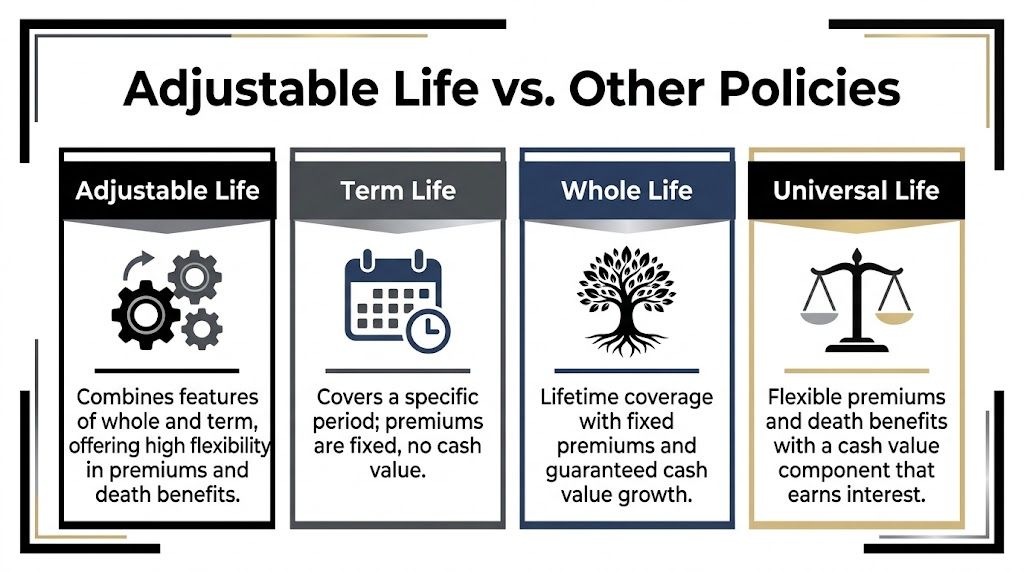
A simple analogy helps. Term life is like a lease. Whole life is like buying a reliable sedan you plan to keep forever. Adjustable life is closer to a vehicle with configurable settings. Universal life is another flexible option, but it works with a different structure.
The quick comparison
| Feature | Term Life | Whole Life | Adjustable Life | Universal Life |
|---|---|---|---|---|
| Coverage length | Set term | Permanent | Permanent | Permanent |
| Premium style | Typically fixed | Fixed | Adjustable within policy rules | Flexible within policy rules |
| Death benefit | Fixed during term | Generally fixed | Can be adjusted | Can often be adjusted |
| Cash value | No | Yes | Yes | Yes |
| Complexity | Lower | Moderate | Higher | Higher |
| Best fit | Temporary income protection | Predictability and permanence | People expecting changes over time | People who want flexibility with a different policy design |
Where adjustable life stands out
Adjustable life sits in an unusual middle ground. It’s permanent coverage, so it isn’t designed to expire after a limited term. But it also isn’t as rigid as classic whole life.
That combination can be attractive if your financial life keeps changing. A California household might need to redirect money temporarily after buying a car, replacing a roof, or dealing with a jump in property-related insurance costs. A rigid premium can become stressful. An adjustable life policy gives you more ways to respond.
Here’s the trade-off. More flexibility usually means more responsibility. With term life, the main question is often whether the term and death benefit are enough. With adjustable life, you also need to understand what your premium choices do to the policy over time.
How it compares to universal life
Many people confuse adjustable life and universal life because both offer flexibility. They’re related in spirit, but not identical in structure. If you want a deeper look at one of the more investment-sensitive branches of flexible permanent coverage, this overview of Variable Universal Life Insurance gives helpful context on how another policy design handles growth potential and risk.
For most buyers, the practical difference is this: adjustable life can work well when you want flexibility inside a permanent policy but still want to approach changes more deliberately. Universal life often gets discussed by people who want flexibility too, but the mechanics and disclosures can feel different.
When each type tends to fit
- Term life fits best when you need the most death benefit for the lowest cost and your main goal is temporary protection.
- Whole life fits best when you value predictability and don’t expect to make many changes.
- Adjustable life fits best when your income, obligations, or family needs are likely to shift over time.
- Universal life fits best when you’re comfortable comparing flexible permanent designs in more detail.
Choosing life insurance is like choosing the right protection mix for your car, home, and income. The best policy isn’t the one with the most features. It’s the one that matches the risk you actually live with.
How to Modify Your Adjustable Life Policy
The phrase “adjustable” sounds easy, but the process works best when you know which changes are simple and which ones trigger more review. An adjustable life policy usually lets you request changes to premium payments or the death benefit, but those changes follow policy rules and insurer procedures.
Changing the death benefit
Many people find this surprising: You may be able to reduce the death benefit more easily than increase it. Significant increases often require new medical underwriting, and your health at the time of the request, not when you first bought the policy, can affect the new rate, as explained by Guardian’s adjustable life insurance guide.
That practical reality matters. If you think you’ll need more coverage after a future home purchase, a growing family, or a business expansion, waiting too long can make the increase more expensive or harder to qualify for.
Adjusting your premium
Premium flexibility is one of the main reasons people choose this policy type. But “I can pay less” doesn’t mean “nothing happens if I pay less.”
An insurer sets minimum amounts needed to support policy costs. If you reduce payments for too long, the policy may rely on cash value to make up the difference. That can help in a temporary squeeze, but it also weakens the cushion inside the policy.
A practical way to handle premium changes is to think in seasons:
- Growth season. Income is strong, so you pay more and build policy value.
- Tight season. You reduce payments carefully and monitor the policy.
- Reset season. You review whether the lower payment is still sustainable or whether it’s time to increase funding again.
What to ask before making a change
A short review call with your insurer or agent should answer these questions:
- What happens to the policy if I lower payments now
- Will this change affect how long the policy stays healthy
- Does this death benefit increase require underwriting
- Are there fees or processing requirements
- Will a withdrawal create tax consequences
Some of those answers can be technical, which is why it helps to prepare before the call. A plain-language set of California insurance guides can make that review easier.
Don’t ask only, “Can I change it?” Ask, “What does this change do to the policy next year and ten years from now?”
Withdrawals and taxes
Cash value can be useful, but it isn’t free money. The verified guidance for this article notes that withdrawals are taxed as ordinary income in the context of adjustment decisions. That means using policy value without understanding tax treatment can create an unpleasant surprise.
The broad lesson is simple. Before you pull money from the policy, check how that move affects three things at once: your taxes, your death benefit, and the policy’s long-term stability.
Key Pros and Cons for California Residents
A California household can have three insurance problems at once. Income can swing from month to month. Housing costs can leave little room for mistakes. A wildfire, evacuation, or business interruption can suddenly force every bill into a new order of priority.

That is why adjustable life can appeal to Californians. It works a bit like a financial Swiss Army knife. You can change parts of the policy as life changes, instead of replacing the whole plan every time your budget or family needs shift.
Why Californians may like it
This policy can make sense for people whose pay is uneven. Freelancers, commission-based workers, seasonal business owners, and gig workers often have strong months and lean months. A fixed-premium policy asks for the same payment rhythm every time. Adjustable life gives you more room to respond when real life does not follow a steady schedule.
That flexibility can also help in a state where major expenses tend to arrive in clusters. A family might be juggling a higher mortgage payment, rising auto premiums, and the cost of updating home coverage in a wildfire-prone area. In that setting, adjustable life can give you another budgeting tool, especially if you want permanent coverage but need some room to adapt over time.
It also fits better into a whole-household insurance strategy than many people realize. Life insurance protects your income for the people who rely on it. Auto coverage protects against liability and accident costs. Homeowners or renters insurance protects your living situation and belongings. If you live in a wildfire zone, these choices affect each other because pressure on one part of the budget can spill into the others. A review of California life insurance options can help you compare whether flexible permanent coverage belongs alongside your home, renters, auto, and wildfire-related planning.
Where the risks get sharper
The same flexibility that helps in a rough month can cause trouble if you use it too casually.
Lowering premiums is not the same as making the policy cheaper. In many cases, you are using cash value to cover the gap. That can work for a while, but it is more like drawing down a reserve tank than finding a discount. If the tank keeps getting used and does not get refilled, the policy can weaken or lapse.
California adds a practical wrinkle here. Wildfire risk can create sudden financial stress that lasts longer than people expect. Temporary housing, missed work, repairs, higher property insurance costs, or the loss of a small business location can all squeeze cash flow. Under that pressure, it is easy to reduce life insurance funding and assume you will catch up later. Sometimes later comes too slowly.
This is the core tradeoff. Adjustable life gives you options, but it also asks for attention.
A balanced California view
Here is the plain-language version:
- A strong fit for uneven income. It can suit households whose earnings rise and fall during the year.
- Useful when family needs change. Marriage, children, a new mortgage, or a growing business can all change how much coverage makes sense.
- More hands-on than fixed policies. You need periodic reviews so a short-term adjustment does not create a long-term problem.
- More exposed to budget stress in high-risk areas. If wildfire-related costs or relocation expenses hit, the policy can become one more account competing for limited dollars.
For some Californians, that tradeoff is worth it. For others, the extra flexibility creates too much room for drift. The best test is simple. If you want a policy you can mostly leave alone, a more fixed design may fit better. If your income changes often and you are willing to review the policy regularly, adjustable life can be a useful part of a broader insurance plan.
Adjustable Life Insurance in Action Real Scenarios
The easiest way to understand an adjustable life policy is to see how it behaves in ordinary California lives.
A starter home in Escondido
Nina and Rafael buy a starter home near an area where wildfire risk is part of every insurance conversation. Their budget is tighter than it was when they were renting. They want permanent life insurance, but they also know they may need more coverage later if they have children.
They choose an adjustable life policy because it gives them a way to start with one setup and revisit it later. For now, they keep the policy aligned with today’s budget. Their key discipline is review. They don’t assume flexibility means “set it and forget it.” They check whether the policy is still being funded in a way that supports long-term coverage.
A freelancer in Westlake Village
Jordan is a graphic designer. Some months are packed. Some are slow. He likes the idea of using stronger months to put more into the policy and easing back during uneven stretches.
Adjustable life can feel useful. The policy’s cash value acts as a buffer when premium payments don’t fully cover ongoing costs. But that buffer isn’t endless. As described by Finance Strategists’ explanation of adjustable life mechanics, if payments fall short, the policy draws from cash value, and once that value is depleted, the policy will lapse.
The mistake isn’t using flexibility. The mistake is assuming the safety cushion refills itself.
Jordan treats the policy like a reserve system that needs maintenance. In high-income periods, he restores the cushion. In slow periods, he watches it.
A family in Glendale planning ahead
Leila and Sam have a child and begin thinking beyond basic bills. They want life insurance that stays in place for the long haul, and they like that policy value may be accessible later if needed.
Their mindset is conservative. They don’t treat cash value as spending money. They view it as part of a broader planning tool that might help absorb future financial pressure if used carefully. Before touching it, they check how a withdrawal could affect the policy’s health and the benefit their child would rely on.
These scenarios show the same lesson in three different ways. Adjustable life can adapt to homeownership, freelance income, and long-term family planning. But each scenario works only because the policy owner stays engaged.
Get Expert Guidance for Your California Insurance Needs
An adjustable life policy can be smart. It can also become expensive, confusing, or fragile if it’s handled casually.
That’s the core issue. The product’s biggest strength is flexibility. Its biggest weakness is also flexibility. If you make changes without understanding the cost, tax effect, or long-term impact on the policy, you can solve one short-term problem and create another one later.
Why guidance matters with this policy
The verified guidance for this article notes three points that deserve real attention. First, adjustable life can cost 6 to 10 times more than term life. Second, strategic adjustments can lead to 15% long-term savings compared to static whole life. Third, adjustment fees can be up to 5% per change. Those details come from Scarlet Oak Financial Services’ explanation of adjustable life insurance.
That combination tells you exactly why expert review matters. This isn’t just about whether the policy is “good” or “bad.” It’s about whether your specific version of the policy still fits your life, your tax picture, and your other insurance obligations.
A California review should be broader than life insurance alone
For many Californians, life insurance decisions are tied to property and liability choices.
A homeowner in a wildfire-prone area may need to review life insurance alongside home insurance and Fair Plan arrangements. A renter may need to think about how life insurance works with lower overhead today and a future home purchase tomorrow. A driver carrying a large car loan may need to make sure life coverage reflects real family obligations, not just abstract planning goals.
A strong review usually includes:
- Current obligations. Mortgage, rent, family support, debt, and business responsibilities.
- Coverage mix. How life insurance fits with auto insurance, home insurance, and renters insurance.
- Adjustment strategy. Which changes make sense now, and which changes should wait.
- Tax awareness. Whether withdrawals or other moves could create taxable consequences.
Estate planning can matter too
Some readers are using life insurance as part of a larger protection plan for family wealth or legacy goals. In those cases, it may help to understand how legal tools fit around the policy. For example, this guide to an irrevocable trust for asset protection and estate planning in California offers useful context for people thinking beyond the policy itself and into how assets may be structured.
That doesn’t mean everyone needs a trust. It means life insurance decisions often reach further than the policy page.
What good next steps look like
If you already own an adjustable life policy, ask for an in-force review before making changes. If you’re considering buying one, compare it against term, whole, and other permanent options with your actual California budget in front of you.
It also helps to bring your full protection picture into one conversation. A clear California insurance quote review can make it easier to compare life insurance decisions alongside auto, home, and renters coverage instead of treating each policy in a vacuum.
Frequently Asked Questions About Adjustable Life Policies
Is an adjustable life policy the same as universal life
No. They’re related, and both are flexible permanent life insurance products, but they aren’t identical. Adjustable life lets you modify key features under the policy’s rules. Universal life also offers flexibility, but it uses a different policy structure and often gets discussed with a different style of cost disclosure.
If you’re deciding between them, don’t stop at the word “flexible.” Ask how each policy handles premiums, death benefit changes, and cash value growth in practice.
What happens if I miss premium payments
The answer depends on the policy’s condition when you miss them. If there’s enough cash value, the policy may use that value to help cover ongoing insurance costs for a time. If that cushion runs out, the policy can lapse and coverage can end.
That’s why missed payments in an adjustable life policy aren’t always immediately visible as a crisis. The policy may keep going for a while, which can give a false sense of security. A review is important whenever payments change.
Can I increase coverage later without a medical exam
Sometimes small or routine changes may be simpler, but significant increases often require underwriting. That means your current health, not your health when you first bought the policy, can affect approval and cost.
If you already expect your need for coverage to grow, it’s worth discussing timing before you delay. The ability to adjust later is valuable, but it isn’t a guarantee that future increases will be cheap or easy.
Are policy loans and withdrawals harmless
No. Even when they’re allowed, they can affect the policy’s cash value and the amount ultimately paid to beneficiaries. Withdrawals can also have tax implications, which means a move that feels helpful now can reduce protection later or create an unexpected tax issue.
The safest habit is to treat cash value access as a planning decision, not a convenience feature.
Who is usually a good fit for adjustable life
People who tend to fit this policy well often share one trait: their financial life changes in ways they can reasonably anticipate. That can include self-employed workers, households expecting income swings, people planning for growing family responsibilities, or buyers who want permanent life insurance but don’t want a rigid setup.
It’s usually a weaker fit for someone who wants the simplest possible policy and doesn’t want to monitor it over time.
How often should I review an adjustable life policy
Review it whenever your life changes in a meaningful way. A marriage, divorce, new child, home purchase, major debt change, business launch, or relocation can all justify a fresh look. For California residents, wildfire exposure, property coverage changes, and shifts in household income can matter too.
Even without a major event, regular check-ins are wise. Adjustable life works best when you notice problems early, not after the policy has already been weakened.
What should I bring to a policy review
Bring the current policy statement, your premium history, any recent notices from the insurer, and a list of major changes in your finances or family obligations. It also helps to bring your other insurance information. Auto insurance, homeowners insurance, renters insurance, and life insurance don’t exist in separate universes. They all compete for the same household budget.
A solid review should answer three questions clearly:
- Is the policy still sustainable
- Does the death benefit still match the people and debts I need to protect
- Would another policy design fit better now
If you want help comparing an adjustable life policy with term, whole, auto, home, or renters coverage in California, Mai & Associates can help you review the full picture. Their licensed team works with Californians across the state, including homeowners in wildfire-prone areas, renters, drivers, and families looking for practical life insurance guidance in English, Spanish, Armenian, Russian, and Vietnamese.