Accidental Death and Dismemberment Insurance Quote Guide
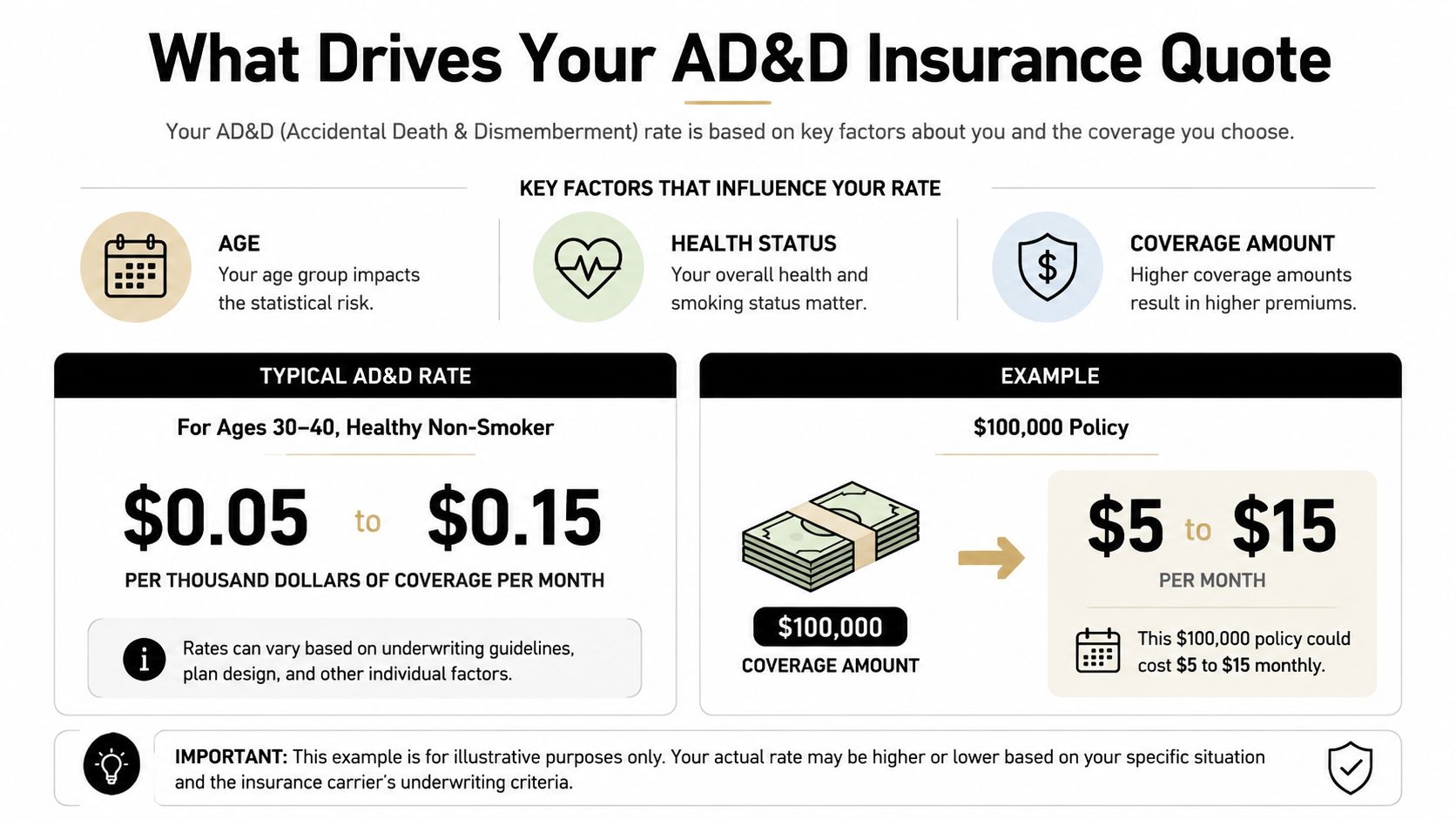
Most AD&D policies for healthy adults in their 30s and 40s land between roughly $5 and $25 per month for $100,000 to $250,000 of coverage, depending on the benefit amount, riders, and carrier. That low premium can look appealing, especially when you're comparing auto insurance, home insurance, renters insurance, car insurance, and life insurance bills, but AD&D only pays after a qualifying accident.
You may be looking at an accidental death and dismemberment insurance quote after seeing a workplace benefit, receiving a credit union offer, or wondering whether your existing life insurance would protect your family after a serious crash. A Northern California household might ask the question after a spouse begins commuting on a motorcycle along I-80. The family already has term life insurance, but they want to know whether an accident creates a separate financial risk.
The answer depends less on the headline price than on what triggers payment, how much the policy pays for a specific injury, and which exclusions apply. AD&D can supplement life insurance, but it rarely replaces the broader protection offered by a life policy.
What AD&D Insurance Actually Covers
A family in Northern California may already have term life insurance on the primary wage earner. When the husband starts commuting by motorcycle on I-80, his spouse may wonder whether the existing policy covers a fatal crash. A standard life policy generally addresses death from many causes, subject to its contract terms. AD&D is narrower. It pays only when a covered accident causes death or a listed severe injury.
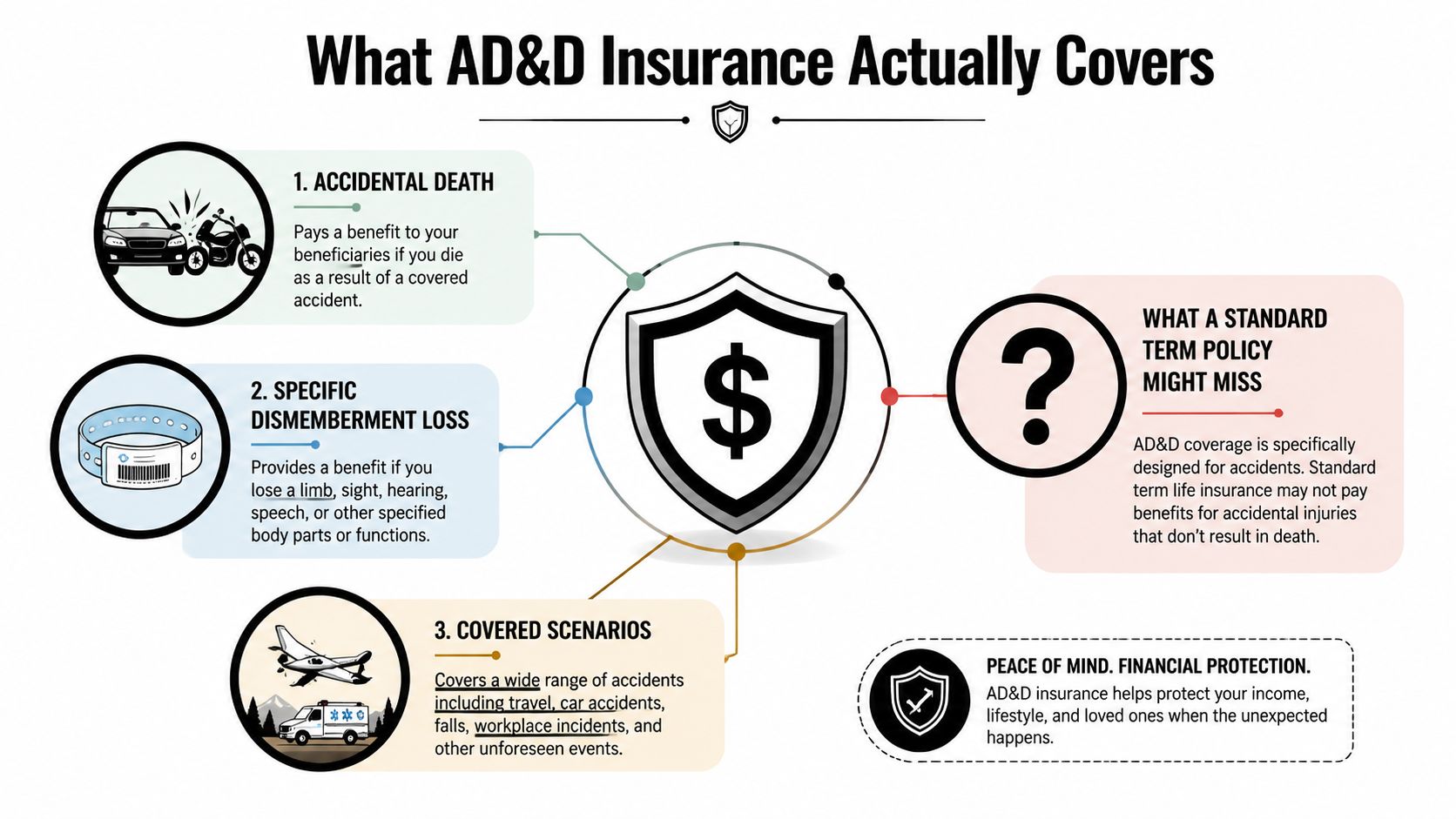
Accidental death and dismemberment insurance has two distinct benefit pathways:
- Accidental death: The insurer pays the principal sum, usually the policy's stated face amount, when a covered accident causes death.
- Dismemberment: The insurer pays a percentage of that principal sum after a qualifying loss, such as a limb, sight, hearing, speech, or mobility, according to the policy schedule.
That distinction matters. A person can survive an accident and still receive an AD&D benefit, but only if the injury fits the contract's definition and benefit table. A broken bone, medical bill, or temporary inability to work may not qualify for a dismemberment payment.
Standalone coverage and policy riders
You can encounter AD&D in several forms. A standalone policy exists separately from life insurance. An accidental death rider may attach to a term or permanent life policy and provide an additional payment after a covered accidental death. An employer may offer AD&D through a group benefits plan, sometimes as an employee-paid election and sometimes as a workplace benefit.
These arrangements aren't interchangeable. An employer plan may end or change when you leave the job, while individually owned coverage may remain in force as long as you pay the premium. A rider may also have its own limits, exclusions, and conversion rules.
Practical rule: Treat AD&D as supplemental accident protection unless the policy language clearly proves otherwise.
Before comparing a quote, review your existing life insurance, employer benefits, and household obligations. The California insurance glossary can help with terms such as principal sum, rider, beneficiary, exclusion, and dismemberment schedule. The central question is simple: would this policy fill an accidental-loss gap, or would it duplicate coverage you already have?
Covered Losses and the Benefit Schedule
The benefit schedule is the part of an AD&D policy that turns an injury into a dollar calculation. The accidental death benefit commonly pays 100% of the principal sum when the insured dies from a covered accident. Dismemberment payments are different. The insurer applies a listed percentage to the principal sum, and the schedule may distinguish between one loss and multiple losses.
For example, a policy with a $100,000 principal sum might pay the full amount for loss of both hands, both feet, or sight in both eyes. A single qualifying loss may produce a partial payment instead. The exact percentage varies by carrier, so the table below is a shopping framework, not a substitute for the issued contract.
Typical AD&D Benefit Schedule
| Type of Loss | Benefit Payout (% of Principal Sum) |
|---|---|
| Accidental death | 100% |
| Loss of both hands, both feet, or sight in both eyes | 100% |
| Loss of one hand and one foot | 50% |
| Loss of sight in one eye | 50% |
| Quadriplegia or comparable total paralysis | Policy-specific, often a high-tier benefit |
| Paraplegia or other listed paralysis | Policy-specific, based on the schedule |
| Loss of speech or hearing | Policy-specific, with separate tiers possible |
| Loss of one hand or one foot | Policy-specific partial benefit |
| Loss of a finger or toe | Policy-specific smaller fraction |
An accident that causes loss of one hand might therefore produce a materially smaller payment than an accident causing loss of both hands. Loss of speech, hearing, or sight can also qualify, but the contract may require complete and permanent loss of the function rather than a temporary impairment.
Independent incidence material used for AD&D pricing illustrates why carriers account for several types of covered loss. Annual incidence per 100,000 people has been estimated at 0.558 for loss of one hand or one foot, 0.336 for loss of two or more fingers or toes, 0.137 for loss of sight in both eyes, 0.833 for quadriplegia or triplegia, and 11.25 for loss of hearing in one ear in the listed categories, according to independent AD&D incidence tables.
Don't assume percentages stack automatically. Many contracts pay once per loss, with special rules for simultaneous injuries. The schedule is the contract. Claims professionals follow its definitions, percentages, permanence requirements, and proof standards precisely.
What Drives Your AD&D Insurance Quote
AD&D pricing often follows a relatively direct relationship between the selected benefit and the monthly premium. A published Standard employer-sponsored voluntary plan shows monthly premiums of $0.42 for $30,000, $3.36 for $240,000, $4.90 for $350,000, and other face-amount tiers, demonstrating how quote systems can scale cost with the elected benefit amount. See the published Standard premium schedule for the carrier's listed examples.
That structure makes face amount the first variable to test. If the insurer's unit rate stays consistent, increasing the benefit generally increases the premium in a near-linear way. A shopper should compare the monthly cost per $100,000 of coverage, then check whether family coverage, child benefits, seat-belt benefits, repatriation, or other riders change the price more than the base amount.
Questions that shape the quote
Even when an AD&D application doesn't require a medical exam, the carrier still needs information about the applicant and the risk being insured. Expect questions about:
- Age and gender: These details can affect the carrier's pricing model.
- Tobacco use: The application may ask whether you use cigarettes, vaping products, cigars, or other tobacco products.
- Occupation: A desk-based role presents a different exposure profile from commercial aviation, roofing, construction, or field work.
- Hobbies: Motorcycling, skydiving, rock climbing, racing, and private aviation may trigger exclusions, surcharges, or rider requirements.
- Travel and commute: Frequent travel, remote worksites, and a motorcycle commute can affect underwriting questions.
- Current health information: Some applications ask about diagnoses, prescriptions, or conditions that could complicate an accident claim.
The insurer may not medically underwrite AD&D the way it underwrites life insurance, but that doesn't mean every applicant receives the same price. The application, occupation class, activities, selected benefit, and contract exclusions all matter.
U.S. claim costs also help explain why insurers price conservatively. AD&D-related incurred claims reached USD 2.830 billion in 2023, up from USD 2.423 billion in 2022, according to the CEIC accident and accidental death and dismemberment claims dataset. The series shows 2023 as its highest level, compared with USD 1.915 billion in 2010, while the available-period average was USD 2.389 billion.
AD&D Compared to Life Insurance and Employer Riders
AD&D and life insurance answer different financial questions. Term life insurance asks whether the insured died during the policy term, subject to the policy's conditions. AD&D asks whether a covered accident caused the listed death or injury. That narrower trigger usually explains the lower AD&D premium, but it also means the chance of payment is more restricted.
A healthy 38-year-old in Los Angeles might compare a hypothetical $22 monthly premium for a 20-year, $500,000 term policy with an illustrative $9 monthly premium for a $250,000 standalone AD&D policy. Those figures are the specified comparison example, not a personal quote. Actual pricing depends on the carrier, application, policy form, and underwriting details.
| Feature | Standalone AD&D | Term Life Insurance | Employer AD&D Rider |
|---|---|---|---|
| Primary trigger | Covered accidental death or listed injury | Death during the policy term, subject to contract terms | Covered accidental death or listed injury |
| Injury benefit | Yes, if listed in the schedule | Usually no dismemberment benefit unless a rider applies | Yes, according to the group schedule |
| Illness-related death | Generally not covered | Generally covered under the policy terms | Generally not covered |
| Ownership | Individually owned | Individually owned | Often connected to employment |
| Main use | Supplemental accident protection | Income replacement and family protection | Low-cost workplace supplement |
| Portability | Depends on the policy | Usually remains with the owner while premiums are paid | Depends on the employer plan |
Employer AD&D can be useful, but don't assume it matches your family's needs. Group coverage may be limited to a multiple of salary, such as one or two times pay, leaving a substantial shortfall for a household with a mortgage and high California living costs. Review the certificate for the benefit cap, portability, beneficiary rules, and exclusions.
For broader planning, readers comparing end-of-life expenses may also find this guide to funeral insurance coverage useful. Funeral funding is only one part of financial protection, but it can clarify why a small accidental benefit shouldn't be confused with income replacement.
A life insurance policy remains the foundation for many families because it can address death from illness and other causes. An AD&D rider or standalone policy can add accidental-death protection, particularly when the premium is affordable and the exclusions fit your activities. For California households reviewing their larger protection plan, this California life insurance resource provides a starting point for comparing broader coverage.
Exclusions and Claim Denials Worth Knowing
The most uncomfortable AD&D questions often arise after the accident, when alcohol, medication, illness, or a traffic violation complicates the facts. A policy may cover accidental death in general language while excluding a specific circumstance that contributed to the loss. The claim turns on the contract wording and evidence, not on the buyer's assumption that every crash is covered.
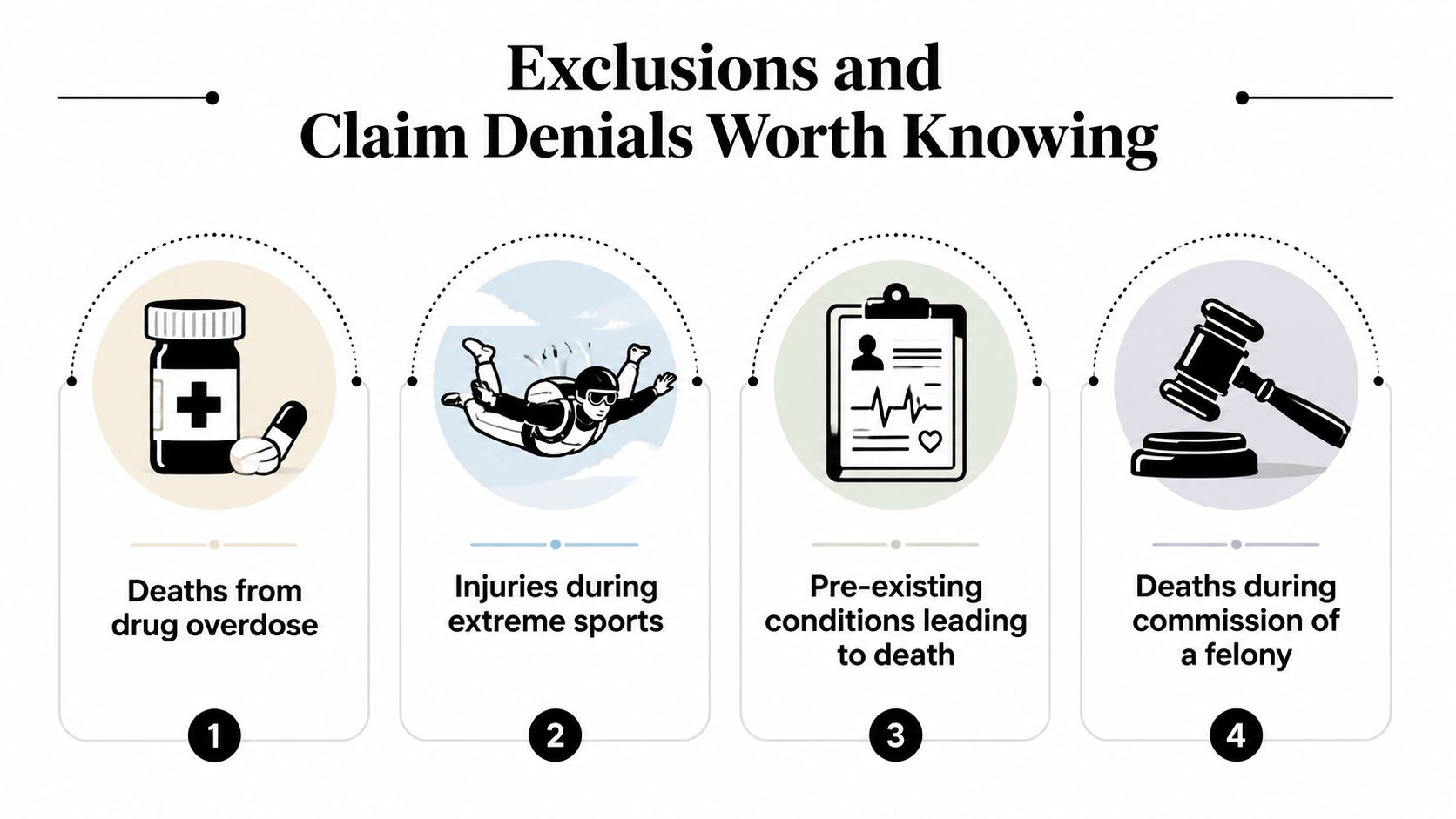
Common problem areas include:
- Alcohol or drugs: Toxicology evidence may lead to denial when intoxication or drug use contributed to the accident.
- Prescription medication: A prescribed drug isn't automatically treated the same way as an illicit substance, but the policy may still investigate impairment, misuse, dosage, and causation.
- Illness: A heart attack, stroke, seizure, or other medical event may defeat the accidental-cause requirement if illness triggered or materially contributed to the incident.
- Legal violations: A felony, assault activity, or other illegal conduct may fall within an exclusion. Even speeding or another traffic infraction can become relevant if the contract links illegal activity to the loss.
- Hazardous activities: Professional racing, certain aviation activities, extreme sports, and other listed pursuits may be excluded or require a special rider.
- Self-inflicted injury and suicide: These are commonly excluded, with the exact language and applicable time periods controlled by the policy.
The NAIC glossary of insurance terms describes the importance of policy definitions and exclusions across insurance contracts. For AD&D, read the definitions of accident, accidental means, injury, loss, and proof of loss. Those terms can shape whether a medically complicated event qualifies.
Questions to ask before you bind
Ask the carrier or agent to answer scenario questions in writing:
- Would the policy pay if the accident involved prescribed medication?
- What happens if an illness triggered the crash?
- Does a DUI conviction affect payment?
- Are motorcycles, off-roading, cycling, or rock climbing excluded?
- Does the contract exclude a seat-belt violation or another traffic citation?
- What happens if alcohol is present but isn't the direct cause?
If a claim is denied, request the denial letter, policy provisions, medical records relied on, toxicology findings, and appeal deadline. A consumer-focused discussion of AD&D claim denials and appeals highlights why causation and real-world circumstances deserve close attention. You can also review common insurance questions through this insurance FAQ.
How to Get an Accurate AD&D Quote
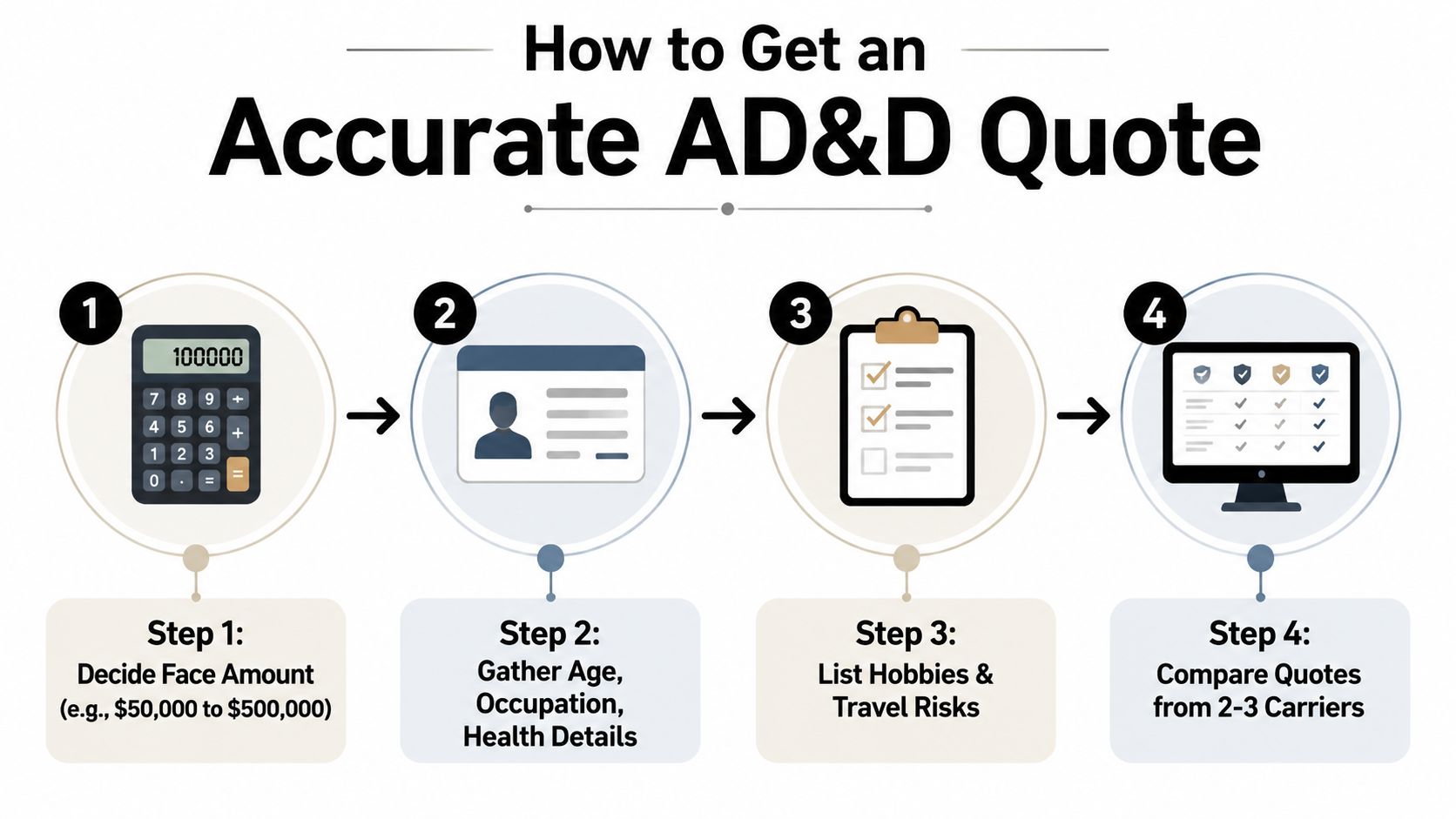
An accurate accidental death and dismemberment insurance quote starts with complete information. A quick online estimate can be useful for orientation, but a carrier or licensed agent can't evaluate the true price and exclusions if the application leaves out a motorcycle commute, private aviation, or a hazardous hobby.
Prepare the coverage decision first
Choose the face amount before requesting comparisons. A practical shopping range may run from $100,000 to $500,000, but the appropriate amount depends on income, debt, dependents, existing life insurance, and the purpose of the AD&D benefit. Decide whether you want standalone coverage or a rider attached to an existing life policy.
Then gather the details an agent will need:
- Identity: Full legal name, date of birth, California ZIP code, and current driver's license number.
- Work details: Employer, job title, and specific duties. “Manager” is less useful than explaining whether the work is office-based, field-based, or physically hazardous.
- Activity details: Motorcycling, rock climbing, skydiving, racing, off-roading, private aviation, and other high-risk hobbies.
- Health details: Tobacco use, recent diagnoses, prescriptions, and conditions that might affect accident causation.
- Existing coverage: Current life insurance, employer AD&D, accidental death riders, and any benefit limits.
Compare the contract, not only the premium
Request quotes from multiple carriers through a licensed California agent. Ask for the certificate or sample policy form, benefit schedule, exclusions, portability provisions, beneficiary rules, and any rider costs before you bind coverage.
A useful sequence looks like this:
- Set the benefit purpose. Decide whether the money would replace income, cover household obligations, support rehabilitation, or add an employer benefit.
- Disclose risk accurately. Omitting a hobby may produce a cheaper illustration but can create a claim dispute later.
- Normalize pricing. Compare monthly cost per $100,000, then examine riders and family options separately.
- Read the exclusions. Match the wording against your commute, work, travel, and recreational activities.
- Confirm ownership. Find out whether the policy stays active if you change employers or move within California.
You can begin with a California insurance quote request, but don't submit payment until you understand the final policy form. The cheapest illustration isn't necessarily the strongest value if a key activity is excluded or the dismemberment schedule pays less than expected.
Smart Ways to Lower Your AD&D Premium
Start with the benefit amount, but test the decision against a real household need. Cutting a $250,000 benefit may lower the bill, yet leave less money for lost income, funeral costs, or long-term adjustment expenses. If the contract offers guaranteed insurability, a smaller policy may make sense when it lets you increase protection later without new medical underwriting.
Compare the same coverage in two forms. For example, a standalone AD&D policy might cost $12 per month for $250,000, while the same benefit as a rider costs $9 per month. The rider saves $3 monthly, or $36 annually. Ask the carrier whether adding AD&D to an existing life policy qualifies for a multiline discount, and whether the discount applies to AD&D itself.
Review each optional feature against a likely need:
- Adjust a disability-style rider: A longer elimination period may reduce the premium, but only if you can cover the waiting gap.
- Pay annually: Annual billing may avoid monthly service charges, depending on the carrier.
- Remove unused riders: Repatriation and family coverage add cost when they do not match your situation.
- Coordinate employer benefits: Avoid duplicate coverage when a workplace rider addresses the same accidental loss. Check whether it remains portable after you leave the employer.
- Compare exclusions: A cheaper policy may leave your motorcycle commute, occupation, or regular hobbies uncovered.
Use one comparison sheet for the AD&D quote, term life policy, and employer benefits. Record the premium, face amount, dismemberment schedule, exclusions, ownership, and portability. This shows whether the new policy fills a gap or merely repeats protection you already have.
Mai & Associates offers no-obligation comparisons for California auto, home, renters, and life insurance, along with guidance on accidental death and dismemberment coverage and policy gaps. Visit Mai & Associates to request a personalized quote review and speak with a licensed agent about coverage that fits your household and budget.